

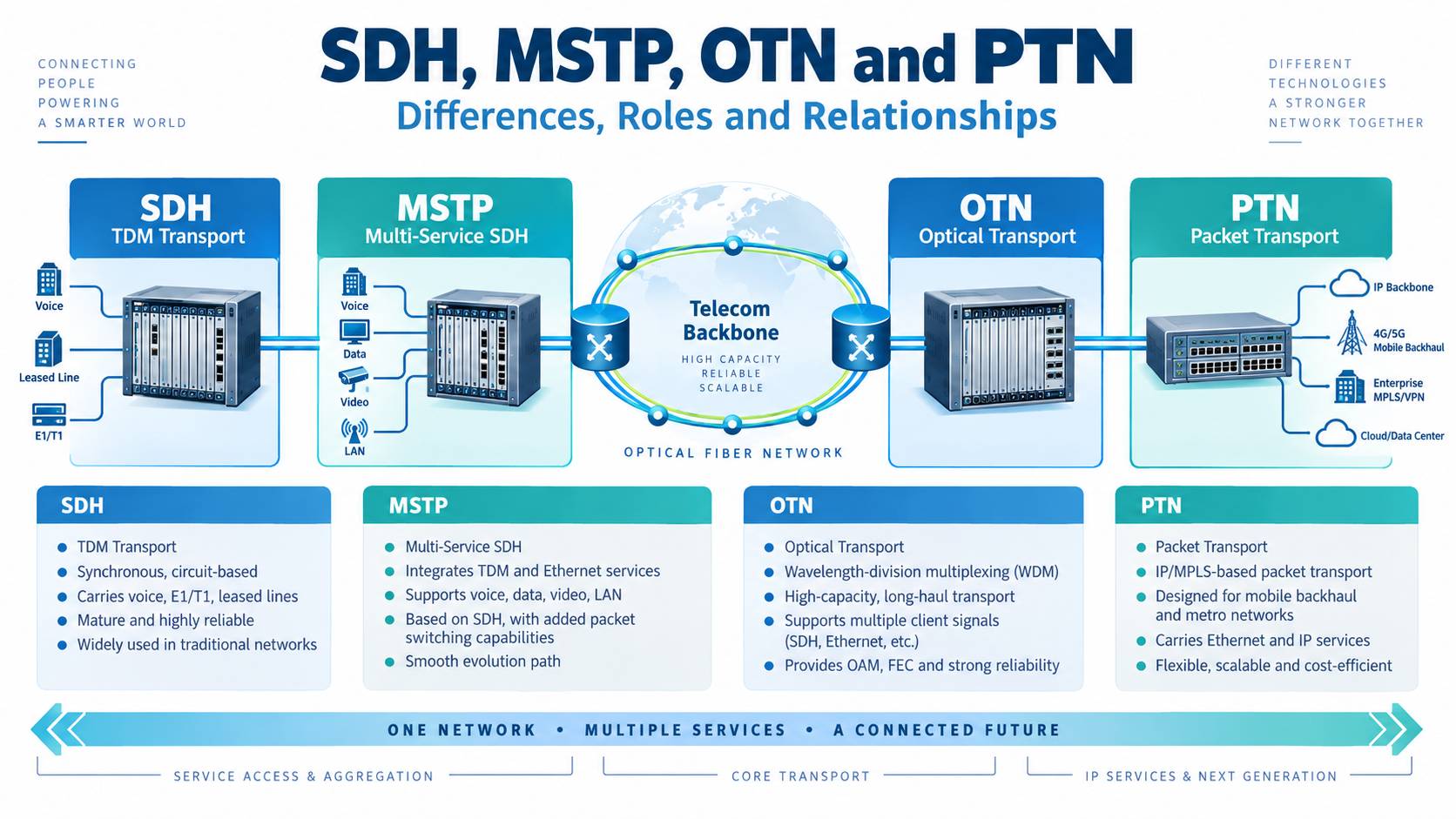
The circuit scheduling of SDH systems is based on TDM, so I see many people saying that SDH business is TDM business, which is traditional circuit scheduling, which has a theoretical basis;
But when SDH was very popular, in another war between Ethernet and ATM (not cash machines), Ethernet achieved a comprehensive victory, and Ethernet became popular, among which IP was the most powerful. As a result, many business sides today have become IP-based. It cannot be said that Ethernet is too XXXXX.
Question: SDH is a popular person, and Ethernet is another popular person. Can we cooperate? We hit it off immediately, and MSTP was born!
The shares in the joint venture MSTP are not evenly distributed: SDH holds 70%, Ethernet holds 20%, and others including ATM hold 10%. SDH is still in charge, and the core is still TDM. All the disadvantages of TDM are still retained, such as rigid pipes; Ethernet and ATM have not come up with anything decent due to equity issues, but they must have their own appearance (providing corresponding interfaces)
With the popularization of the Internet, computers, mobile phones, TVs and other terminals can access the Internet. The demand for bandwidth has increased sharply. Opportunities for telecom operators to make money have come, but challenges have also come. In the past, 1*155M could support thousands of people making calls. Now people have to go online when making calls. There is a conflict between the increase in bandwidth demand and the existing network resources.
To resolve this contradiction, let’s take a look at how SDH, a celebrity, usually gets along with others:
SDH, a popular man, has always had his own way of doing things, and he has never shared public resources with others. For example, if I am allowed to run on the Second Ring Road, no other vehicles are allowed to pass by on the Second Ring Road. I have only one car on it. At the beginning, my car can pull 1 guest (STM-1), so what about the Second Ring Road? The efficiency is to transport one person (155M–STM-1). Later, the tonnage of the truck was upgraded. I can transport 64 guests (64*STM-1). Then the efficiency of the second ring is (10G-STM-64). This is the ring rate; the current maximum is 40G
If there is a period of time when no one needs to be transported, then I will run empty-handed and look at the scenery, beautiful women, etc. along the way. At this time, the efficiency is 0. Even if other roads are blocked, it has nothing to do with me. Because I am stubborn, I also have a lot of helplessness. For example, your car can carry 64 guests, but now there are 65 guests. Sorry, I can only transport 64 people. We call this inefficient operation mode rigid pipeline.
Now there are more and more passengers to transport, and we are overwhelmed. There are three solutions:
The first type: build more roads (new optical cables) and divert people; Disadvantages: The cost and cycle are too long——–PASS
The second type: Upgrade the car tonnage (increase the speed); Disadvantage: The car factory has not yet developed a vehicle with a larger load (electronic components are limited)-PASS
The third type: Divide the Second Ring Road into multiple lanes (wave lanes), and multiple vehicles share the road
After seeing it, the leader immediately gave instructions: Plan 3 is feasible and should be implemented immediately! Wave division occurs.
Wavelength division WDM is to put vehicles (signals) in multiple lanes (channels) on the same road (optical fiber) for transmission. It is divided into two categories according to the size of the lane spacing:
The lane spacing is 20nm, which is sparse wavelength division, also called coarse wavelength division;
If the lane spacing is less than or equal to 0.8nm, it is dense wavelength division.
In this way, the bandwidth is doubled, which temporarily solves the problem of insufficient bandwidth! You can take a rest…
After WDM was reused, various places followed suit. Nowadays, WDM is not only used on urban main roads (urban wavelength division), but also on inter-city and inter-provincial roads (long-distance wavelength division);
Its specific working method is that various types of goods or passengers (business signals) are loaded into cars, and the cars drive according to pre-assigned lanes (channels). The cars in the middle need to be refueled. We also set up gas stations (optical amplifier stations OLA). Drivers and passengers need to eat and rest to replenish their physical strength. We set up temporary rest areas (relay stations) for them. Of course, we still cannot do without the support of the traffic police system (optical monitoring OSC or electrical monitoring ESC)
As people’s needs continue to increase, the number of lanes has expanded from 16 or 32 at the beginning to 40, 80, and 160. The current construction level (manufacturing technology) has exceeded 200 lanes (wave channels), but our management level is still very low, which is mainly reflected in the following aspects:
1. Poor traffic management message delivery (lack of OAM): The original intention of WDM was to solve the problem of insufficient bandwidth. It did not take into account that after the bandwidth increases, management must also keep up. The biggest problem now is that there are more vehicles. How to know the status of each vehicle well, the traffic police (OSC) feels unable to do what it does. ; At this time, several SDH drivers and passengers were talking in a low voice: Our SDH bus system has a unified management organization. Each bus has a driver and a conductor. The division of labor is clear. Real-time video monitoring (online monitoring) is also used. The company can always understand the operating status of each bus. WDM, you are too far behind.
2. Scheduling is not flexible enough: WDM has a serious flaw at the beginning of its design: for example, if a cargo is to be transported from Xi’an to Beijing, the pre-allocated lane is 10 lanes (10th wave), then the entire journey from Xi’an to Beijing will be the 10th lane, and cannot be changed unless you pass through several high-speed sections (optical regeneration sections) , such as Xi’an-Zhengzhou, Zhengzhou-Beijing, then you can have an opportunity to change lanes in Zhengzhou, and the cost of changing lanes is to build a small road (laying optical fiber) for your behavior this time; when SDH encountered similar situations in the past, it built a large dispatch center in Zhengzhou, and all problems were solved
3. Easy to get blocked (imperfect protection): On urban main roads or inter-provincial express roads, in order to improve efficiency, the differences from ordinary roads are taken into consideration when designing the roads. Only a few exits are set up, and the others are all closed. The consequence of this is that once congestion or traffic accidents occur, passengers will make a fuss ( Business interruption); think about our city bus SDH. As soon as the driver sees the traffic jam ahead, he immediately takes a small route. There may be a few passengers who cannot get off at the destination (a small amount of business interruption), but the vast majority of passengers can arrive smoothly. The reason is that there are a large number of available roundabout routes, coupled with flexible scheduling (the driver can decide)
The Bureau of Transportation (ITU-T) saw the problem and carried out reforms in the following aspects:
1. Add monitoring equipment and necessary security administrators to all vehicles on the road – increase OAM overhead
2. Add a dispatching hub at the transportation hub node – add business dispatching (inter-lane dispatching [optical layer dispatching] and cargo or passenger dispatching [electrical layer dispatching])
3. Relying on the dispatching hub and reserving part of the lanes or vehicles on the road to provide complete protection for all vehicles – improve the protection mechanism
SDH smiled and said: What kind of reform is this? We have always done this, but the capacity is not as big as yours;
WDM responded: My capacity is indeed much larger than yours, but I am not as good as you in these aspects;
They shook hands and chatted happily, complementing each other’s advantages, and a brand new system was born——OTN
An overview of OTN:
OTN is based on WDM and integrates some advantages of SDH, such as rich OAM overhead, flexible service scheduling, complete protection methods, etc.
OTN’s business scheduling is divided into: optical layer scheduling and electrical layer scheduling
Optical layer scheduling can be understood as the category of WDM; electrical layer scheduling can be understood as the category of SDH
So simply put: OTN=WDM+SDH
However, the electrical layer scheduling working method of OTN is still somewhat different from that of SDH:
Let’s review the characteristics of SDH:
1. The departure frequency is unified, 8,000 times per second, the system stipulates that it cannot be changed (following the PDH system);
2. Increase capacity by developing vehicles with larger tonnage. High-capacity vehicles are generally made up of four vehicles with a lower capacity level, so the structures of vehicles with different capacities are different;
The working characteristics of OTN electrical layer scheduling:
1. The size, specification and capacity of all vehicles are uniform, and the overall dimensions are: 4*4080;
2. Increase departure frequency according to demand
advantage:
1. There is no need to continuously develop larger-capacity vehicles and reduce development costs;
2. Unified structure for easy management;
3. Convenient cross-regional transportation (easy to communicate with different manufacturers);
4. In theory, the capacity can be infinitely increased by increasing the departure frequency, and the implementation method is simpler and clearer;
Two flowers bloom, one for each. We have made a detailed description of the development of the former celebrity SDH in the world. Now SDH is only equivalent to a hall leader under the head of OTN. So how is the development of another celebrity now?
Back then, Ethernet and ATM were like the Huashan sect, which was unique in the martial arts world with its exquisite swordsmanship and had a high reputation in the martial arts world. However, the Huashan sect was divided into the Sword Sect, which was mainly based on swords and supplemented by Qi, and the Qi Sect, which was based on Qi and supplemented by swords.
Ethernet is like swordsman, ATM is like airbender
Ethernet is famous for its simplicity, and it is easy to use and attracts many disciples; ATM has very advanced internal skills and mental methods, and only a few people practice it. In the final battle, Ethernet won a great victory, which is inconsistent with the plot in the novel and is puzzling…
Until one day, Ethernet was worried about how to carry forward his sect. At the same time, ATM was also depressed that no one appreciated his profound martial arts. After the two former rivals met and talked by chance, ATM wanted to use Ethernet to increase its influence, and Ethernet wanted to use the essence of ATM’s internal skills to strengthen its momentum. They hit it off immediately.
After months of secret discussions, and a year later, the two jointly released a new martial arts manual – MPLS (Multi-Protocol Label Switching)
This martial arts secret book was later adapted into multiple versions and is an important foundation for other martial arts. This is a story later!
Core comparison:
ATM VPI VCI
MPLS TUNNEL VC
Ethernet is becoming more and more popular, and with the help of MPLS, it gradually has the strength to compete with SDH, so there is the initial integration of SDH and Ethernet, and MSTP is born. However, MSTP is still dominated by SDH due to equity issues, and Ethernet and ATM can only be supporting roles. Ethernet is not happy and vows to change…
In order to fight against the SDH camp, Ethernet vigorously develops its own sphere of influence, adopting the strategy of surrounding rural areas and cities, and first IP-ing the terminals (IP-ing the business side). IP can be used as SDH cargo, through SDH
The transfer proceeds, but a problem arises:
When SDH was first developed, it had strict appearance requirements for the cargo. It must be a “block structure” and the size is also standard. Each seat is also made according to this requirement, so that the transportation efficiency is the highest. Later, there were more and more strange-looking cargo (different formats) like IP. Even if MSTP was specially developed, to put it bluntly, MSTP reserved several special seats for IP and ATM on SDH vehicles. That’s it, IP still can’t be transported very well! The reason is that IP is the right disciple of Ethernet. Ethernet is based on the characteristics of simplicity, unrestraint, and best effort. Therefore, IP also has this characteristic. Some are small and some are fat (IP frame length is variable). If there are fewer IPs in SDH/MSTP, it is not a big problem. If IP accounts for more than half, the cost of vehicle modification may be too high.
[MSTP: If the packet service is less than 50%, there is still a cost advantage];
But the problem now is that there are more and more IP cargoes. I want to set up my own transportation company, and I have the final say. I can no longer be controlled by SDH. At the same time, SDH is also thinking about whether it can be divided into two floors, with one floor reserved for the original business and one reserved exclusively for IP, so that it can take care of both.
Now is a time when a hundred schools of thought are contending, with all kinds of new companies and new technologies emerging. Let’s talk about the SDH camp first. Due to the uneven distribution of equity when MSTP was established, there are many legacy issues, which has led to serious dissatisfaction with Ethernet now. Now SDH Group has launched MSTP+ (also called HybridMSTP) after research, with a 50/50 equity allocation. The vehicle becomes a second tier, and the second tier is managed and dispatched separately. Two sets of scheduling systems (dual-core crossover) are not a good compensation measure.
Let’s talk about the Ethernet camp, which is used to being free and loose. Now there are two major differences:
One way of thinking is that our self-established transportation company does not allow SDH customers (TDM business) to get on the bus. If they must come in, they must change their appearance – disguise (simulation). At the same time, we have no time guarantee (no time synchronization). We purely serve our Ethernet. Our company is called IP-RAN;
One person thinks that we should absorb some SDH customers. SDH has been operating for so many years, and it still has many customers (and there are many TDM business needs). After entering, we still have to change our appearance – disguise (simulation), and then work in our gang. After leaving the gang, we will remove the disguise and return to our original appearance. This company is named PTN
No matter which way, camouflage-disguise is always indispensable, and then the PWE3 disguise technique was developed.
There are two major factions in PTN:
One faction is the product of integrating MPLS, Disguise PWE3 and MSTP—-MPLS-TP faction;
One faction is the product of the fusion of QinQ and MSTP ——————PBT faction;
For the MPLS-TP faction, there are many supporters, including heavyweight stars such as Huawei, ZTE, FiberHome, Alcatel-Lucent, Ericsson, and China Mobile;
For the PBT faction, the only supporter is Nortel Networks, and they are alone;
So most of the PTNs we see now are of the MPLS-TP faction;
As they learn from each other, the difference between IP-RAN and PTN is getting smaller and smaller. The advantage of IP-RAN is the three-layer connectionless service, but PTN can now also implement it. In the past, PTN specially developed a time and clock synchronization system called the 1588 system in order to transmit SDH customer TDM services. It is now using the V2 version, and the V3 version is being tested. Now IP-RAN has also learned it and supports this system.
It really lives up to the saying: If we are separated for a long time, we will be reunited and if we are together for a long time, we will be separated!
MSTP+ (Hybrid MSTP) can be seen as a compromise between SDH and Ethernet, and it is a last resort;
IP-RAN and PTN have now converged and there is not much difference. They can be seen as a comprehensive challenge to SDH, and now it seems that they have won!
