


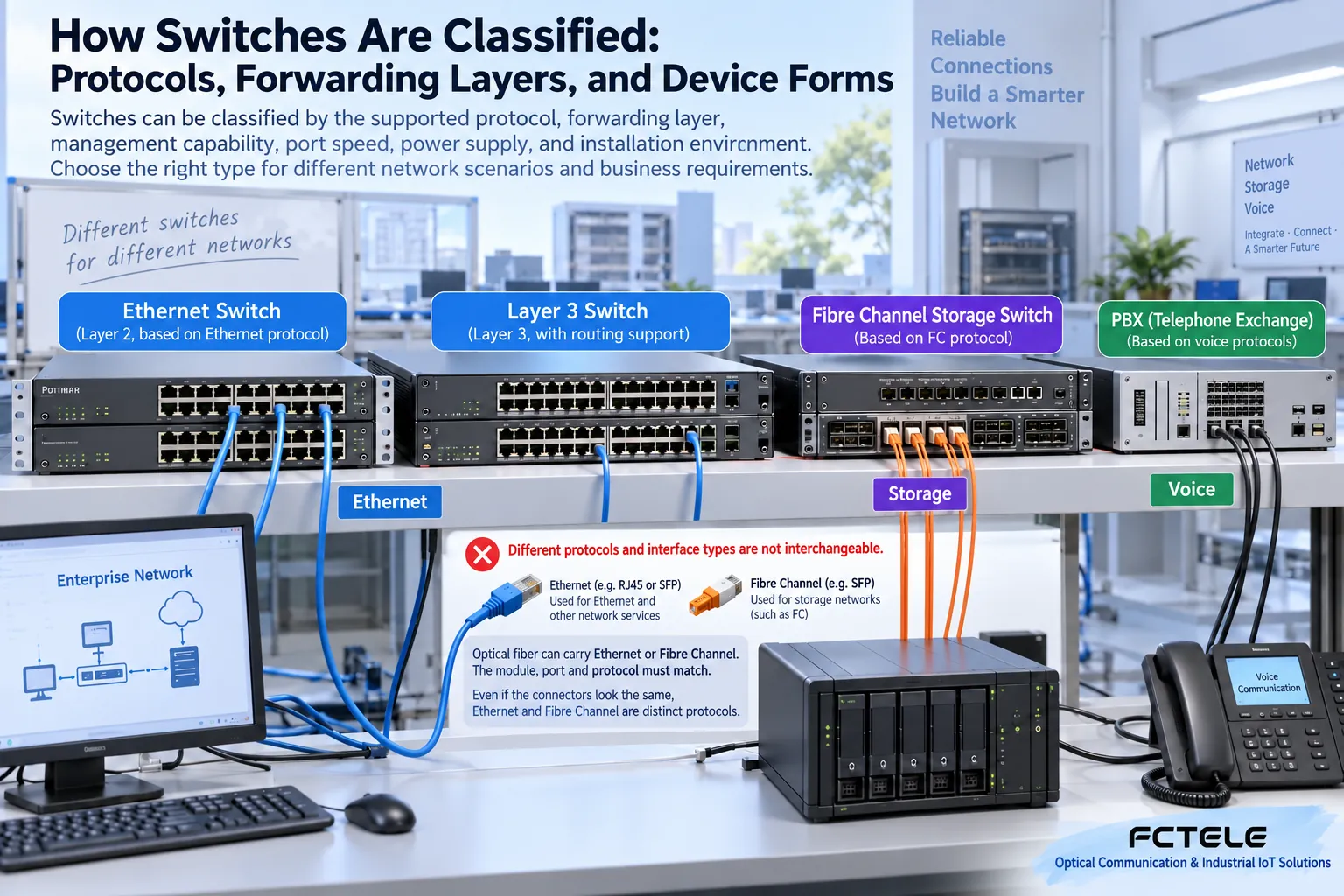
Switches can be classified by the protocol they carry, forwarding layer, management capability, port speed, power supply, and installation environment. These dimensions can overlap: one device can be industrial, managed, Layer 2, gigabit, and PoE at the same time. Ethernet switches, storage switches, and telephone exchange systems also cannot be arbitrarily interconnected just because they share similar names.
Step one: first define which kind of network is being discussed
What is usually called a network switch mostly refers to Ethernet equipment, connecting terminals according to the corresponding link rules. Fibre Channel storage switches serve the corresponding storage network, and telephone exchange systems serve voice services. Their interfaces, protocols, and functions are different, and they should not be considered replaceable just because of the word “fiber.”
Even if optical connectors or module shapes are the same, that does not prove the service standards are the same. A procurement requirement should first state the protocol and purpose clearly, then discuss speed, distance, and port count. Otherwise, later model screening may deviate from the target from the very beginning.
Layer 2 and Layer 3: the difference lies in forwarding decisions
Layer 2 Ethernet switches mainly forward frames based on MAC addresses and broadcast domains. Layer 3 switches can also have IP routing capabilities. When accessing different network segments across VLANs, corresponding Layer 3 interfaces, routing, and permissions are usually required. Simply creating two VLANs will not automatically complete this.
Layer 3 devices do not necessarily support all routing protocols or security functions, and Layer 2 devices may have fairly rich management and filtering capabilities. They should be compared according to a function checklist, not by understanding “number of layers” as an absolute performance ranking.
Managed and unmanaged: the difference lies in configurability and observability
Unmanaged devices are usually used for basic access and have fewer management entry points; managed devices can provide ports, VLANs, logs, and other settings. Which specific functions are available is determined by the model. When remote troubleshooting is needed, status, counters, and backup capabilities may be more important than the number of ports.
Management capability also increases configuration responsibility. Incorrect VLAN, redundancy, or permission settings may affect services. A more complex device should not be assumed to be automatically more stable. Maintenance personnel should be able to save configurations and explain recovery methods.

Port speed does not equal overall application speed
Fast Ethernet, gigabit, 10-gigabit, and similar terms describe the corresponding interface capabilities, and a device may mix multiple speeds. Uplinks, switching capacity, and forwarding conditions must also be checked. A 10-gigabit uplink port cannot be taken to mean that all terminals support 10-gigabit.
File transfer or video performance will be affected by servers, storage, terminals, and service traffic. Speed selection should be based on actual requirements and the complete path, not just buying the highest number.
PoE, form factor, and environment each have independent conditions
PoE means that compatible ports can supply power over copper cabling, and the power supply standard, per-port budget, and total budget need to be checked. It is not a default capability of all switches, and a fiber uplink will not carry PoE power to a remote end.
Box-type, DIN-rail, rack-mounted, and chassis-type mainly relate to installation, expansion, and maintenance. Industrial types focus on specific environments and power supply requirements, but suitability cannot be judged only by a metal shell or DIN rail. The host, modules, cabinet, and site conditions all need to be verified.
How to write an unambiguous selection description
For example, first state the Ethernet service, then list ports, uplinks, whether routing is needed, VLANs, PoE, and environmental conditions, and finally give management and acceptance requirements. To Product Center When comparing models, confirm each dimension separately.
Names can help establish a candidate range, but they cannot replace evidence. If a supplier only answers “industrial gigabit switch,” then protocol, port combination, power supply, configuration, and test conditions still need to be added before judging whether it truly solves the current problem.
Translated from the Chinese technical article. Source first published: 2019-11-08. Source last revised: 2026-10-13T22:35:50+08:00. Read the Chinese source
