


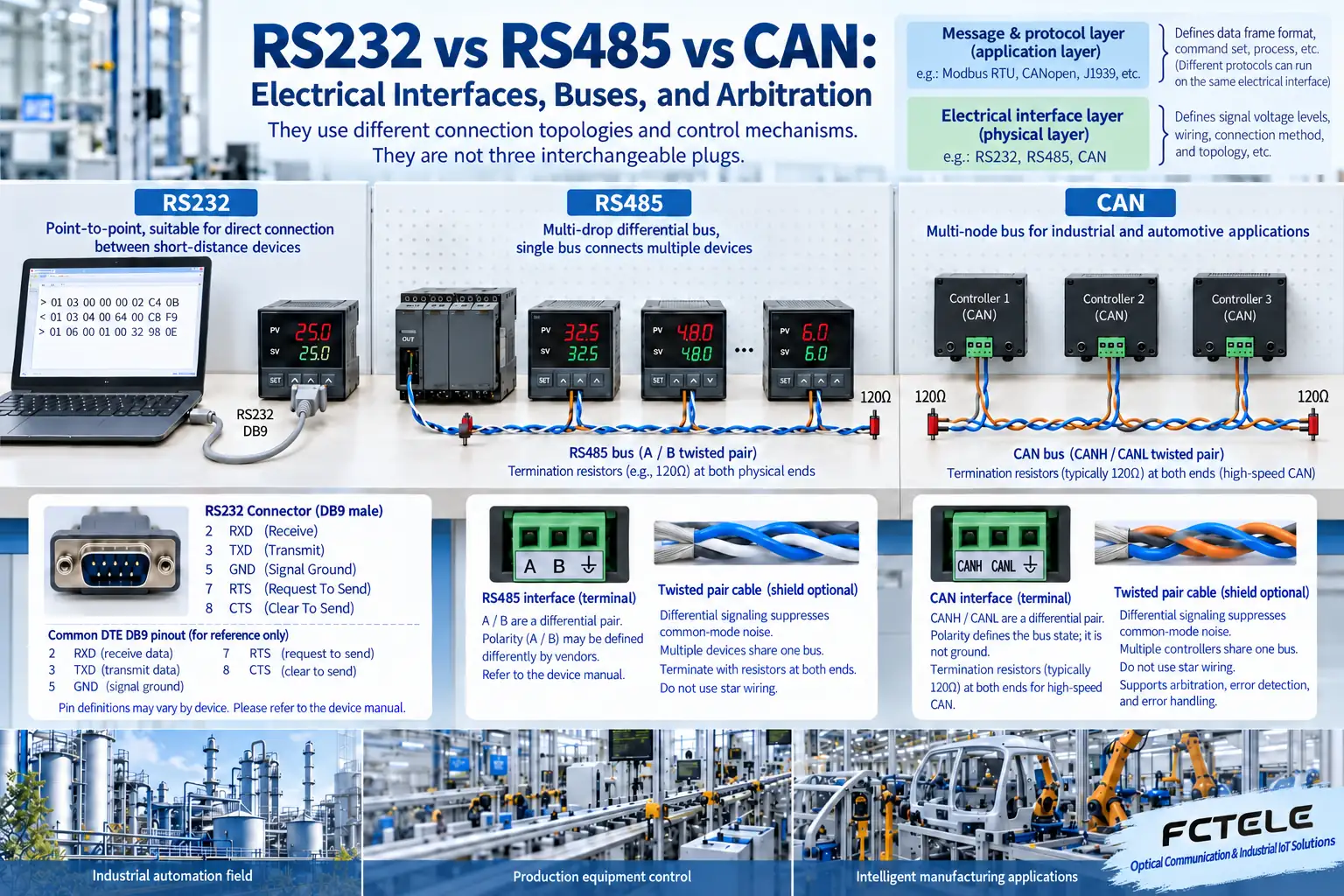
RS232 and RS485 mainly define the electrical interface for serial communication; CAN also has message, arbitration, and error handling mechanisms. RS232 is often used point-to-point, RS485 suits differential multi-drop buses, and CAN suits control systems that need message priority and multi-node coordination. The three cannot interoperate just by changing connectors; when choosing, you must check the electrical layer, data format, and application protocol at the same time.
Why it is called a “serial port” but cannot be directly interconnected
Serial communication sends data in order, but “how to represent the electrical signal” and “what these data mean” are different questions. When a computer and an instrument are connected through RS232, both ends still need to agree on baud rate, data bits, parity bit, and stop bits, and use the same command format. The same port shape only shows that the mechanical connection may fit; it cannot prove that voltage and protocol are compatible.
RS232 usually uses single-ended voltage relative to signal ground, and transmit and receive can use separate wires. DTE and DCE roles affect wire order; DB9 is only a common connector, and you cannot mechanically assume that every DB9 uses the same pin definition. Industrial equipment may also put other interfaces into a similar shell, so the manual should be the basis.
RS485: two differential wires do not mean you can all talk at once
A differential receiver focuses on the voltage difference between the two wires, making interference that is commonly added to both wires easier to suppress, but there are still common-mode range, grounding, and protection requirements. Two-wire RS485 is commonly half-duplex, and at the same moment usually only one driver should transmit; the application protocol decides who sends when, for example a master polling slaves. RS485 itself does not automatically provide addresses, polling, or data retransmission.
The trunk should be organized as a bus, branches should be as short as possible, and terminating resistors should be set at the two physical ends according to cable characteristic impedance, length, and edge speed, not casually added at every node. The number of nodes depends on device load, wiring, and rate, and a traditional number cannot be applied to all products. Distance and rate also constrain each other, and you should not promise that any rate can run the same distance.
CAN: arbitration is an important difference from an ordinary 485 bus
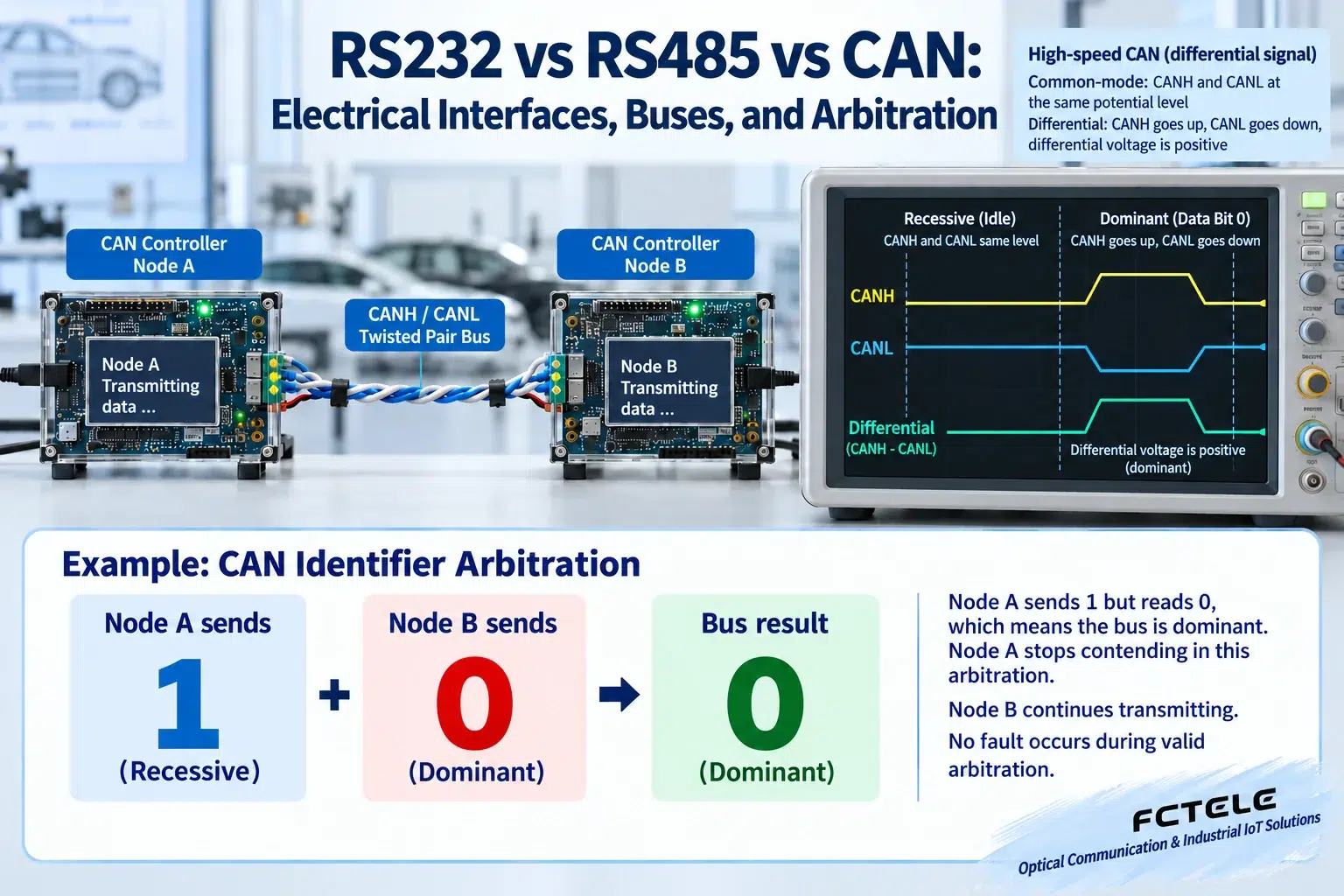
A CAN controller participates in bus arbitration according to the message identifier. A dominant bit can override a recessive bit, and a node reads while it sends; a node that sends a recessive bit but reads a dominant bit stops the current competition, letting the message that gained priority continue. It is not a simple way of grabbing the line by first colliding and damaging data and then waiting randomly. If high-priority identifiers are arranged improperly, low-priority messages may also wait too long.
A CAN transceiver handles differential electrical signals, and the controller handles frames and errors. Upper-layer protocols such as CANopen further specify device objects and communication behavior. Classic CAN and CAN FD also differ in frame length, rate phases, and compatibility conditions, and you cannot assume full interoperability just because both are labeled CAN.
Choose by project requirements, not by ranking names as high or low
When debugging a single device over a short distance, RS232 may be simple and direct; when multiple meters are connected in series and polled by a master, RS485 with a corresponding protocol is more common; when multiple control nodes need to cooperate according to message priority, CAN and a suitable upper-layer protocol should be considered. In the end you still need to check the environment, cycle, error recovery, and software support.
Interface converters also have layers. A 232-to-485 converter may only convert the electrical interface and cannot automatically turn vendor commands into Modbus; if 485-to-CAN is to achieve semantic interoperability, clear gateway mapping and scheduling are needed. Acceptance should use real messages to check bidirectional data, latency under load, and exception recovery, not just observe that there is a waveform at the wire end.
When the oscilloscope shows a waveform but the software still reports errors, how to think about it
First separate physical problems from data problems. Port polarity, reference ground, common-mode range, or unsuitable termination may make the receiver read the wrong bits; inconsistent serial format may make normal voltage levels be interpreted according to the wrong character boundaries; different application commands may make correctly formatted data get no valid response. The three layers of problems should be verified layer by layer, and you should not cover the cause with a single “serial port not working” label.
When checking CAN, you also need to read the controller error counters and status. A broken bus, missing acknowledgment, or configuration error may trigger error handling, and in severe cases a node enters bus-off state. How to recover after the cable is fixed depends on the controller and software strategy, so you should confirm the application’s recovery behavior, not just wait for the port light to come back on.
When purchasing replacement instruments, list the interface electrical standard, connector pins, communication rate, data format, and application protocol, and attach actual message samples. For CAN devices, you should also clarify Classic CAN or CAN FD, identifier, and upper-layer protocol requirements. Writing these conditions completely is more likely to avoid buying the wrong thing than vaguely asking for “a serial port”.
Extending an interface over fiber also cannot cross protocol boundaries. Transparent 232 fiber optic modems, 485 fiber optic modems, and CAN optical transmission devices each adapt to different mechanisms; CAN in particular also needs to consider arbitration timing and propagation delay constraints. Long-distance solutions should be designed according to complete system compatibility instructions, and ordinary serial fiber devices cannot be treated as CAN extenders.
References:TI: RS422/RS485 system configuration;TI: RS485 differential transmission basics.
Translated from the Chinese technical article. Source first published: 2020-05-18. Source last revised: 2026-10-13T23:18:15+08:00. Read the Chinese source
