


Conclusion first: The four technologies are at different stages of evolution and different bearer layers, so you cannot simply judge by new versus old which one absolutely replaces which. Network design should start from service type, granularity, distance, protection and existing equipment.
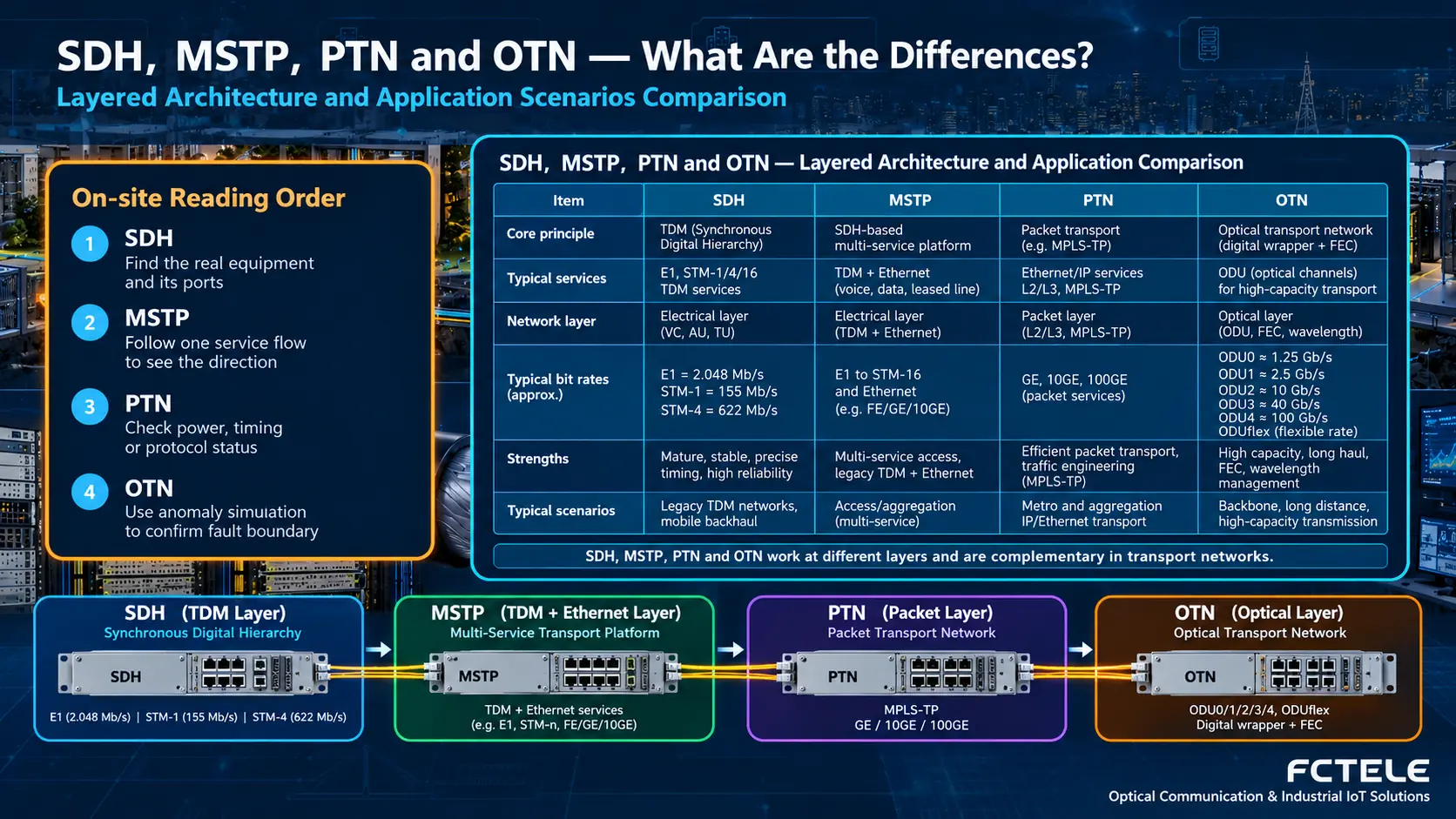
How to read the diagrams: This article centers on “SDH vs MSTP vs PTN vs OTN: Bearer Layers and Application Scenarios Compared” and uses SDH, MSTP, PTN and OTN respectively: first determine which layer the service is at, and how SDH encapsulates, maps or terminates it, to organize the diagrams. When reading, first confirm SDH along the signal or state direction, then use MSTP to check the boundary, and finally trace abnormal phenomena back to the specific interface, medium or protocol layer.
1. SDH, MSTP, PTN and OTN: first determine which layer the service is at
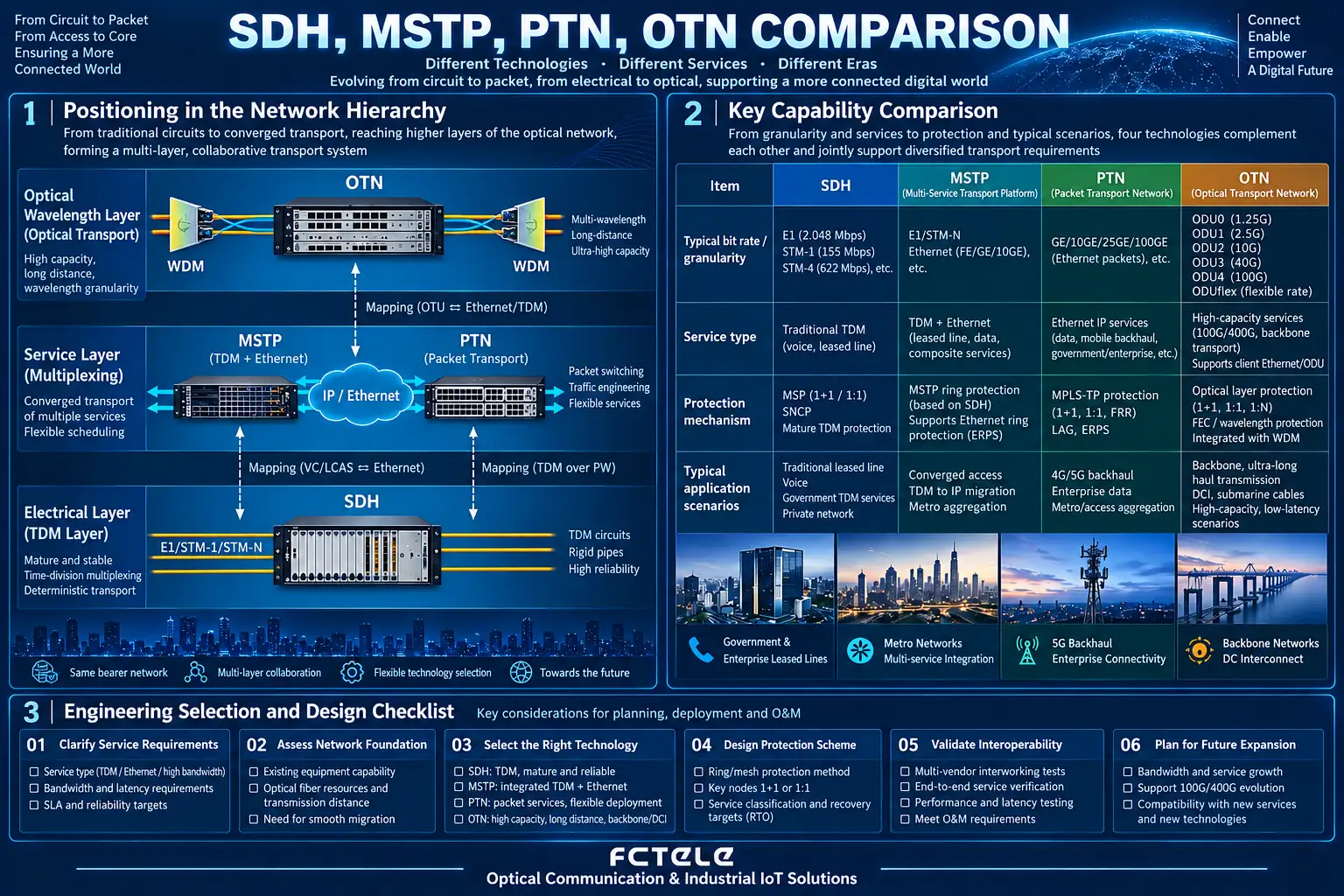
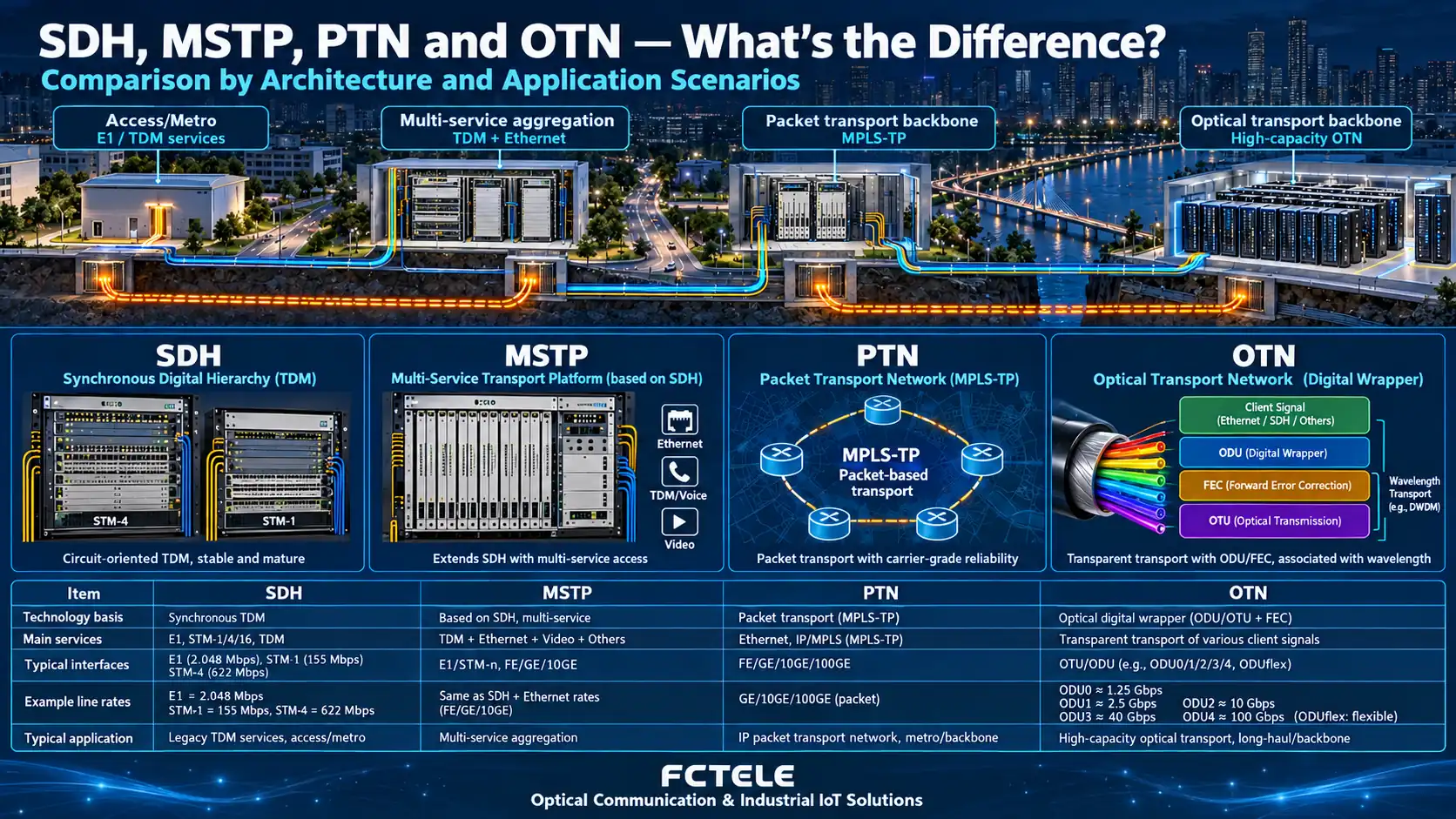
SDH is good at deterministic TDM circuits; MSTP merges Ethernet on the SDH platform; PTN is oriented to packet services and provides carrier-class protection; OTN provides large-granularity multiplexing, long-distance transmission and wavelength-level scheduling at the optical layer.
Protocol functions work as expected only when the role, instance, control messages and protected object are consistent. Compare SDH, MSTP, PTN and OTN by circuit layer, packet layer and wavelength layer in terms of service granularity, protection mechanisms and typical applications. This article centers on “SDH, MSTP, PTN, OTN”. During implementation, mark the role of each interface and path in the drawings, record the differences between normal and fault states, and confirm the solution boundary with measured results.
2. SDH, MSTP, PTN and OTN: how SDH encapsulates, maps or terminates
Sort out existing TDM, Ethernet and high-bandwidth services, confirm SLA, latency, protection and capacity expansion goals, then decide on a single technology or layered coordination. Migration also needs to consider network management, clocking, interworking and cutover of existing services.
Acceptance suggestion: Execute in the order of “specification check—single-link test—fault simulation—recovery confirmation—record archiving”, changing only one variable at a time to avoid mixing configuration, medium and equipment problems together.
3. SDH, MSTP, PTN and OTN: why cross-layer configuration is prone to errors
First, the concept of TDM: TDM is time-division multiplexing, which divides a standard duration (1 second) into several small time slots (8000), and each small time slot (1/8000 = 125us) carries one signal; circuit scheduling in SDH systems is all based on TDM, so when many people say SDH services are TDM services, that is, traditional circuit scheduling, there is a theoretical basis; but when SDH was at its peak, in another war, the battle between Ethernet and ATM (not the cash machine), Ethernet won a comprehensive victory, so Ethernet became widespread, and among it IP was the strongest, causing many service sides today to become IP-based; you have to say Ethernet is too XXXXX. Question: SDH is one big star, Ethernet is another big star, can they cooperate? They hit it off immediately, and MSTP was born! The share allocation in the joint venture MSTP is not very
even: SDH holds 70%, Ethernet holds 20%, and others including ATM hold 10%. The one in power is still SDH, the core is still TDM, and all the disadvantages of TDM remain, such as rigid pipes; because of the equity problem, Ethernet and ATM did not bring out anything decent, only appearances (providing corresponding interfaces only). With the massive spread of the Internet, terminals such as computers, mobile phones and TVs can all access the Internet, and bandwidth demand has increased sharply. Telecom operators’ opportunity to make money has come, but the challenge has also come. Previously 1*155M could support thousands of people making phone calls, but now people also want to access the Internet while making calls, and the growth in bandwidth demand conflicts with existing network resources. To solve this conflict, let us look at how SDH, this big star, usually gets along with others: SDH, this big star, has always gone its own way, considering itself supreme, and never sharing public resources with others. For example, if the Second Ring Road is approved for me to run on, then the Second Ring Road is not allowed
to have other vehicles pass; on it there is only my car. At first, my car could carry 1 passenger (STM-1), so the efficiency of the Second Ring Road was transporting one person (155M–STM-1). Later, the car’s tonnage was upgraded, and I could carry 64 passengers (64*STM-1), so the efficiency of the Second Ring Road was (10G-STM-64). This is the ring rate; currently the maximum is 40G. If there is a time period when no one needs to be transported, then I run empty, looking at the scenery, beautiful women and so on along the way. At this time the efficiency is 0, and even if other roads are completely jammed it has nothing to do with me. Because it is rather stubborn, it also has many helpless situations. For example, your car can hold 64 passengers, but now there are 65 passengers. Sorry, I can only transport 64 people. We call this low-efficiency operation mode a rigid pipe. Now more and more passengers need to be transported, and it is too busy. There are three ways to solve it: First:
Build more roads (new optical cables) to divert people; disadvantage: cost and cycle are too long——–PASS. Second: upgrade the car’s tonnage (increase rate); disadvantage: the car factory has not yet developed a vehicle with a larger load capacity (limited by electronic components)-PASS. Third: divide the Second Ring Road into multiple lanes (wavelength channels), with multiple vehicles sharing the road. After reading this, the leader immediately instructed: Plan three is feasible, execute immediately! Wavelength division was born. WDM wavelength division multiplexing is putting the vehicles (signals) of multiple lanes (wavelength channels) onto the same road (optical fiber) for transmission. Here it is divided into two categories according to the lane spacing: lane spacing of 20nm is sparse wavelength division, also called coarse wavelength division; lane spacing less than or equal to 0.8nm is dense wavelength division. In this way bandwidth increases many times, temporarily solving the problem of insufficient bandwidth! Can rest and rest………… After WDM was reused, various places imitated it one after another, now
4. SDH, MSTP, PTN and OTN: cross-verify with packets, counters and alarms
Protocol functions work as expected only when the role, instance, control messages and protected object are consistent. Compare SDH, MSTP, PTN and OTN by circuit layer, packet layer and wavelength layer in terms of service granularity, protection mechanisms and typical applications. This article centers on “SDH, MSTP, PTN, OTN”. During implementation, mark the role of each interface and path in the drawings, record the differences between normal and fault states, and confirm the solution boundary with measured results.
5. Protocol Q&A: SDH, MSTP, PTN and OTN
Will OTN completely replace PTN?
It will not simply replace it; the two often cooperate at different layers.
Why is SDH still used?
Some private lines and existing TDM services value determinism and mature protection.
What should be looked at first when selecting?
First look at service granularity, distance, bandwidth, protection goals and existing network foundation.
Translated from the Chinese technical article. Source first published: 2019-07-22. Source last revised: 2026-10-13T23:45:12+08:00. Read the Chinese source
