


A hub mainly copies physical signals, a Layer 2 switch forwards Ethernet frames based on MAC addresses, and a router connects different networks based on IP and routing tables. They process data at different layers; a Layer 3 switch may provide both switching and routing at the same time. A device name cannot replace confirmation of its actual functions and configuration.
First, separate signals, frames and packets
The cable first carries physical signals, the link layer organizes information into frames, and the network layer carries IP packets inside them. You can understand different layers as different scopes of encapsulation, but not every device reinterprets all services. Browser content belongs to a higher-level application task.
To judge what a device does, look at what information it uses to decide forwarding. Only copying signals, looking up the destination MAC, and looking up the destination IP are three different kinds of processing. The fact that device enclosures all have network ports does not prove their functions are the same.
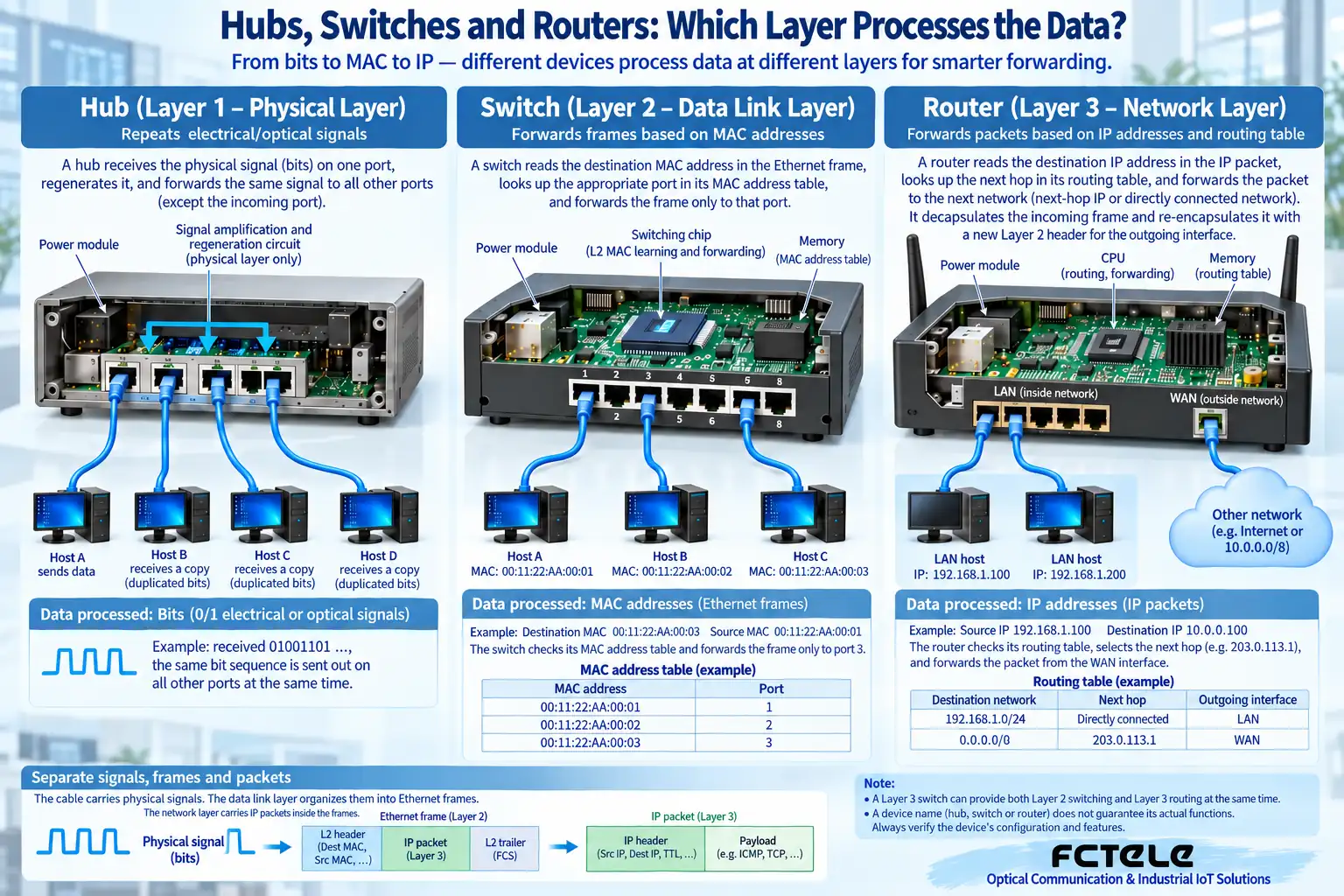
Why a hub is not today’s multi-port switch
After a traditional Ethernet hub receives a signal, it repeats and sends it to the other ports, and does not pick only one outlet based on the destination MAC. It forms a shared-medium environment, and the related collision and access mechanisms limit how communication works. This operating principle cannot be described as a modern full-duplex switch.
A hub is not a manageable traffic distributor in the usual sense, and it does not provide routing. If an old system really uses one, when upgrading you should confirm the end devices, speed and service requirements, and not treat “the plug is the same” as a complete compatibility judgment.
How a switch knows where a device is connected
A Layer 2 switch learns the source MAC and ingress port of received frames, then looks up the destination MAC to choose an egress port. Unknown destinations, broadcasts or certain multicast handling will involve flooding within the corresponding scope, so you cannot say all frames go to only one port, nor that it always copies to all ports.
VLANs let one chassis be divided into multiple broadcast domains. It is a logical partition, not equal to physical hardware isolation; communication across VLANs also needs appropriate Layer 3 routing and policies. Port configurations such as Access and Trunk affect how tags are handled when frames enter and leave.
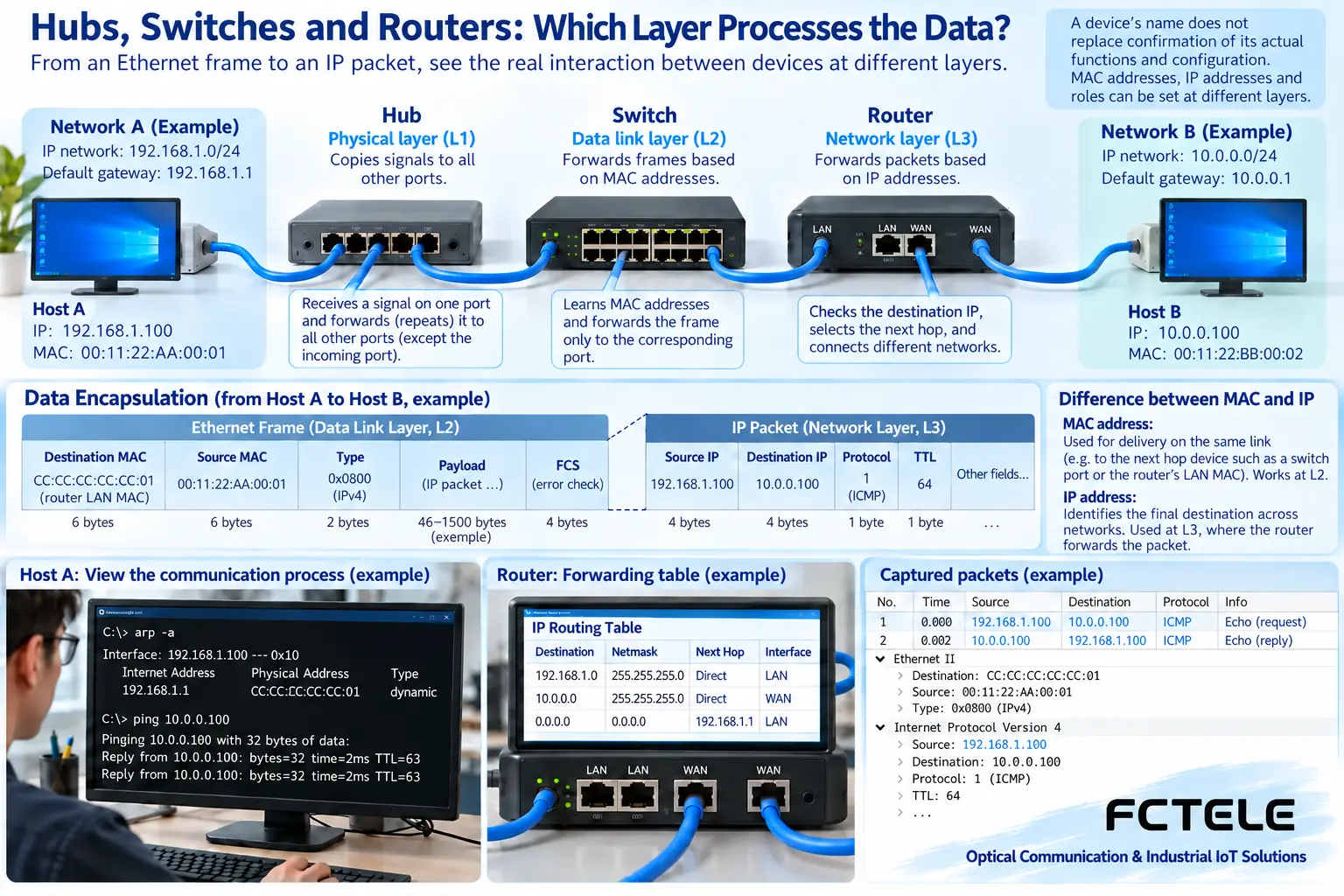
A router handles the next hop and does not necessarily rewrite the service
A router looks at the destination IP and chooses the next hop and egress according to the route. When forwarding to the next link segment, the corresponding link encapsulation is needed; the destination application can still be at the original remote end. Routing, NAT and firewalls are different functions, and they cannot be mixed into one concept.
A computer’s default gateway usually points to a reachable router interface, helping it access other networks. The same subnet usually communicates directly, while crossing subnets depends on the gateway and routing. A configuration error may cause local communication to work but remote communication to fail, but this is not necessarily a switch hardware fault.
Why one device may take on multiple roles
A home wireless router often includes wireless access, switching, routing and other functions; a Layer 3 switch may implement routing through hardware. OSI layers are used to understand processing logic, not to require every function to have a separate chassis. Judgment should be based on the model’s functions and the current configuration.
Likewise, an industrial switch does not necessarily have Layer 3 capability, and having a management interface does not mean it can route. Before selecting a model, clarify whether same-subnet switching or cross-subnet connection is needed, and avoid guessing capability from the name or price.
How to use this distinction for troubleshooting
First confirm the physical link, then check MAC learning and VLANs, then verify the IP, gateway and routing, and finally verify the application port. Ping only covers part of network reachability and does not mean application authorization, data format and service are normal. Checking layer by layer is more effective than changing multiple settings at the same time.
When purchasing Feichang Technology equipment, you can check Layer 2, Layer 3 and management capabilities from Product Center. Test records should include topology, addresses, VLANs and service results, and port count cannot be the only basis for judging a device’s layer.
Loops also need special attention. A Layer 2 loop may cause broadcasts to be copied continuously, and routers and switches have different loop-handling mechanisms; you cannot expect all topology risks to disappear automatically by adding an ordinary switch.
The illustrations are principle and application-scenario diagrams; the interfaces, structures and measured values in them do not represent specific product parameters. Actual specifications must be based on model documentation and on-site measurements.
Translated from the Chinese technical article. Source first published: 2019-09-09. Source last revised: 2026-10-13T22:35:50+08:00. Read the Chinese source
