


When choosing a fiber optic transmission equipment brand, you should first clarify the business needs, then compare interface compatibility, performance verification, documentation completeness, and service capability. Video, telephone, E1, and Ethernet equipment have different requirements, and there is no single “best brand” that applies regardless of specific needs. Rankings without reliable sources cannot replace project selection and trial acceptance.
First Break “Fiber Optic Transmission Equipment” into Specific Requirements
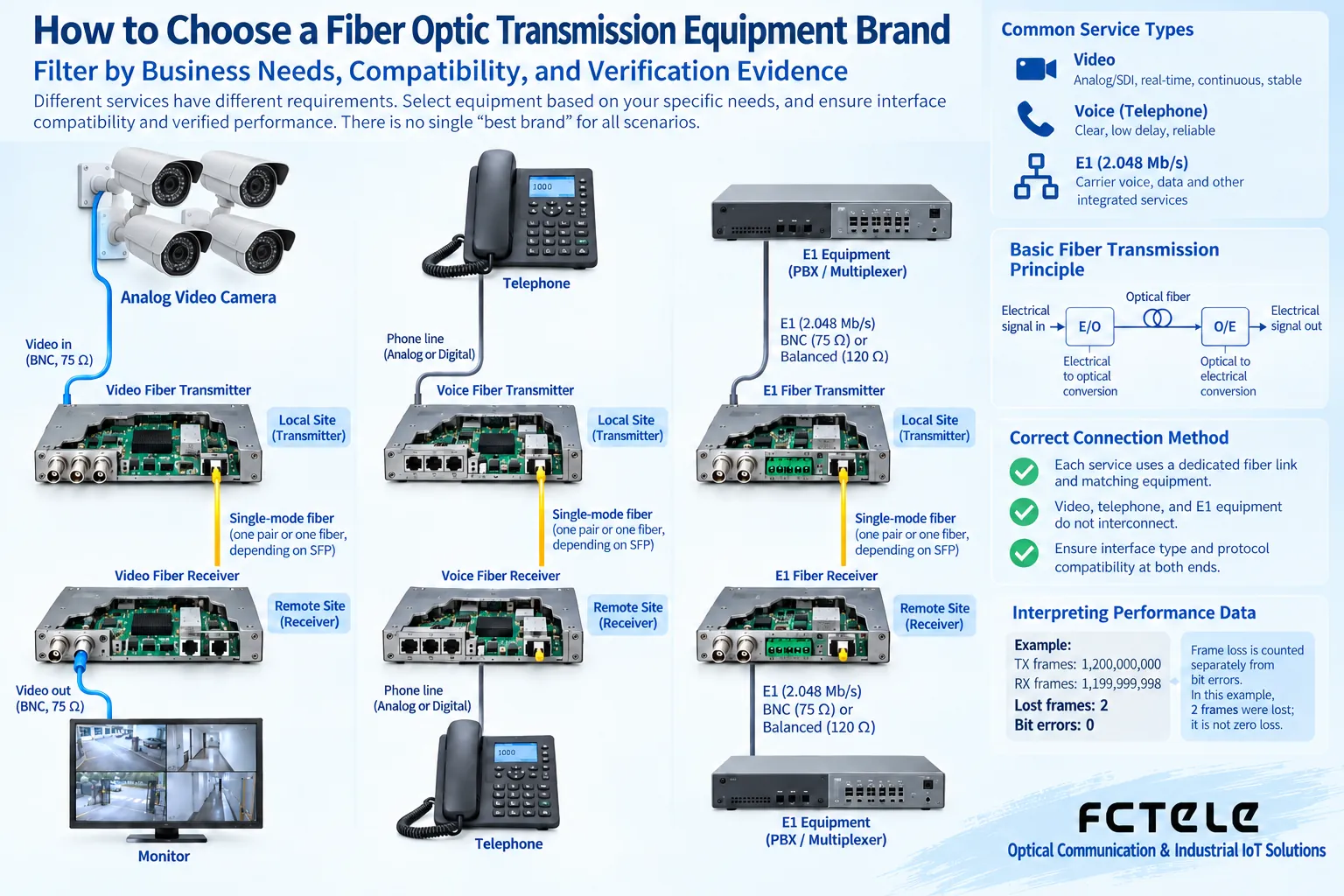
This name covers many kinds of equipment. Analog video, SDI video, analog telephone, serial port, and Ethernet signals have different formats. Before purchasing, write down clearly the input devices, output devices, number of channels, interface roles, and transmission distance. If you only say “I want a high-definition fiber optic transmission device,” you may receive products based on different technical approaches, and you will not be able to compare them fairly afterward.
You also need to determine single-mode or multimode, single-fiber or dual-fiber, and the fiber cores actually available on site. If the optical cable is already installed, the equipment needs to adapt to the actual line, not be chosen blindly based on advertised distance. Whether the central equipment room needs a rack and whether the remote end is installed in an outdoor cabinet will also affect power supply and environmental conditions.
Compare the Same Set of Conditions, Not Adjectives
Turn the requirements into a parameter table: business format, channel capacity, port direction, optical interface parameters, power supply specifications, allowed environment, and necessary management capabilities. Each item should correspond to the manual and documentation of a specific model. When a manufacturer says “stable,” “compatible,” or “industrial-grade,” you should ask about the applicable conditions and the verification evidence they can provide, rather than just noting down the promotional words.
If transmitting telephone signals, check FXS/FXO and services such as dialing and ringing; if transmitting SDI, check the supported signal formats; if carrying E1, check the interface, framing, and clock; if transmitting Ethernet, check the rate and actual forwarding capability. These are different comparison dimensions and cannot be mixed into a single so-called overall score.
Why Compatibility with the Other End Matters More Than Appearance
The same optical connector does not mean the same protocol, and dedicated equipment from different manufacturers should not be assumed to pair directly by default. You need to confirm conditions such as the rate, wavelength, and encoding on both sides. For independent optical modules, you also need to check the supported range of the equipment. When replacing an existing system, you should obtain clear compatibility information and arrange joint testing.
Multi-service equipment also involves channel mapping, software versions, and interface board compatibility. When replacing equipment, you cannot just look at whether the chassis size is the same; the configuration, alarm meanings, and maintenance methods also need to be recorded. Purchasing a complete set of equipment and purchasing a single replacement end should be assessed separately for risk.
Test Real Services During the Trial
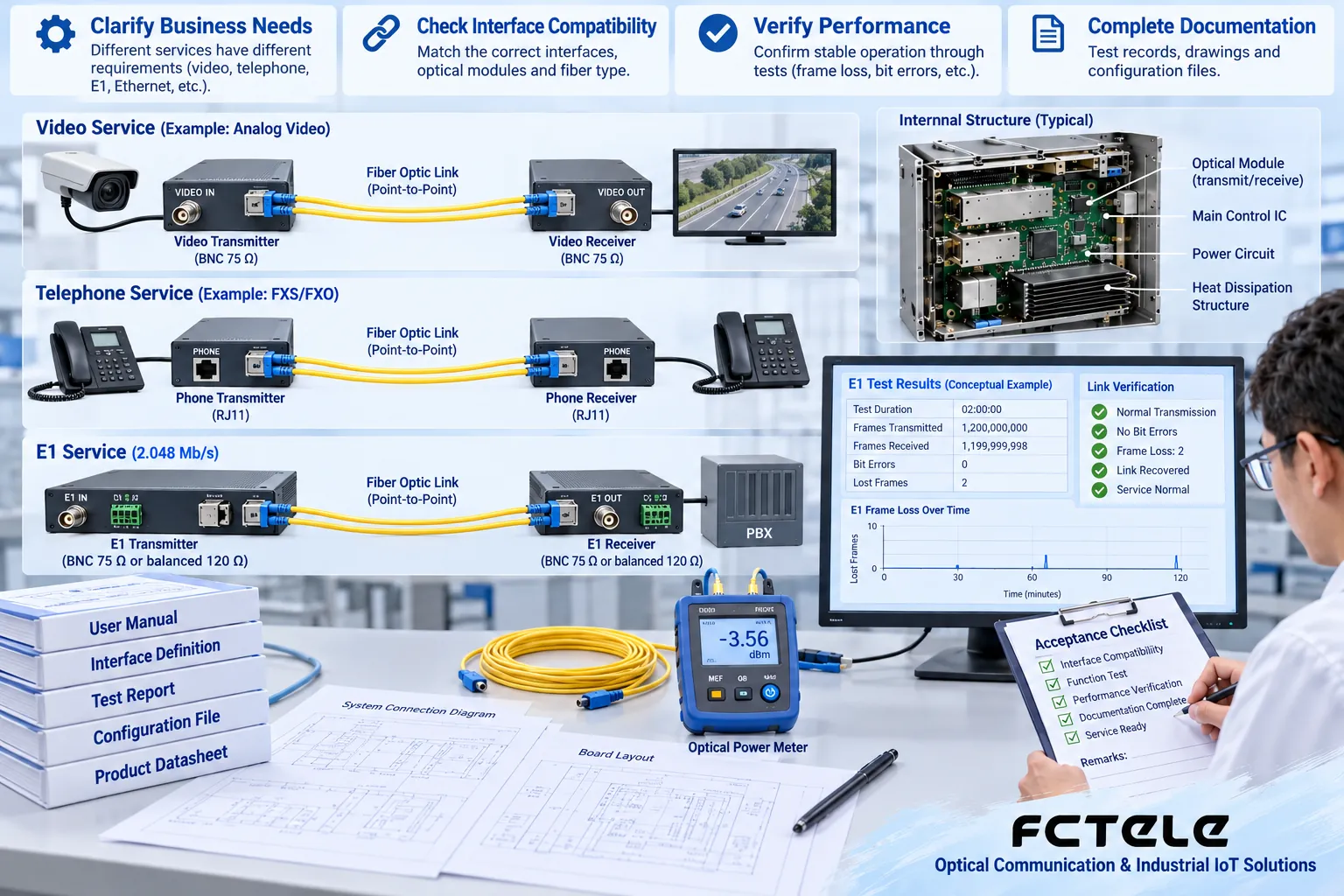
The link light being on is the beginning, not the end of acceptance. Test real video continuity, two-way calls, serial port data, or network load, and observe whether packet loss, bit errors, and reconnections occur during long-term operation. In an approved environment, test power failure, link interruption, and recovery, and record the service interruption time.
The test should use the combination of services required by the project, and there is no need to blindly pursue a single number for all ports at full load. What matters is whether the equipment can carry the actual services under the agreed conditions and whether the results can be reviewed. Environmental test or quality reports should also correspond to a specific model and should not borrow the proof of another series.
How Service Capability Translates into Delivery
Compare manuals, terminal definitions, configuration backup, fault diagnosis, warranty scope, repair, and replacement mechanisms. Whether the manufacturer can explain technical issues and whether it provides stable versions and support channels is often more valuable than a brand list. When customization is needed, write the protocol, interface, and acceptance criteria into the technical confirmation, and do not replace them with verbal descriptions.
Feichang Technology equipment can be checked from Product Center for specific specifications, and the evaluation method should also apply to other candidate manufacturers. The final choice is a solution supported by evidence under the conditions of this project, not an unverified market ranking. When the budget is limited, first ensure service compatibility and maintenance accessibility, then compare expansion functions.
Translated from the Chinese technical article. Source first published: 2019-08-12. Source last revised: 2026-10-13T19:01:44+08:00. Read the Chinese source
