


The burn-in test of an industrial switch is to let the device work continuously under specified conditions and observe whether disconnections, restarts, power abnormalities, or performance changes occur, so as to find some manufacturing and assembly problems as early as possible. It is valuable, but it is not that “the harder it is burned, the more reliable it is,” and one cannot infer from “running continuously for one day” that it will “definitely be stable for one year.” A truly useful test must state the conditions, load, monitoring items, and pass criteria.
1. Why must a newly assembled device still run continuously?
A factory functional check is like confirming that a car can start, steer, and brake; a continuous operation test is observing under controlled conditions whether it can work stably. This analogy only explains the purpose of the test and cannot convert the duration of a car road test into the life of a switch. The fact that a switch can forward data for a short time does not mean that all ports and power supply branches have no problems under temperature changes and continuous traffic.
For example, a connector with poor contact may be normal during a short test at room temperature, but after running and heating up, dimensional changes may cause intermittent faults; heat dissipation assembly problems may also appear only after the temperature rises. The goal of the test is to turn such abnormalities into recordable, reproducible evidence, then analyze the cause and correct the process. It is not to make defective parts improve by themselves, nor is it true that all abnormalities can be solved by extending the power-on time.
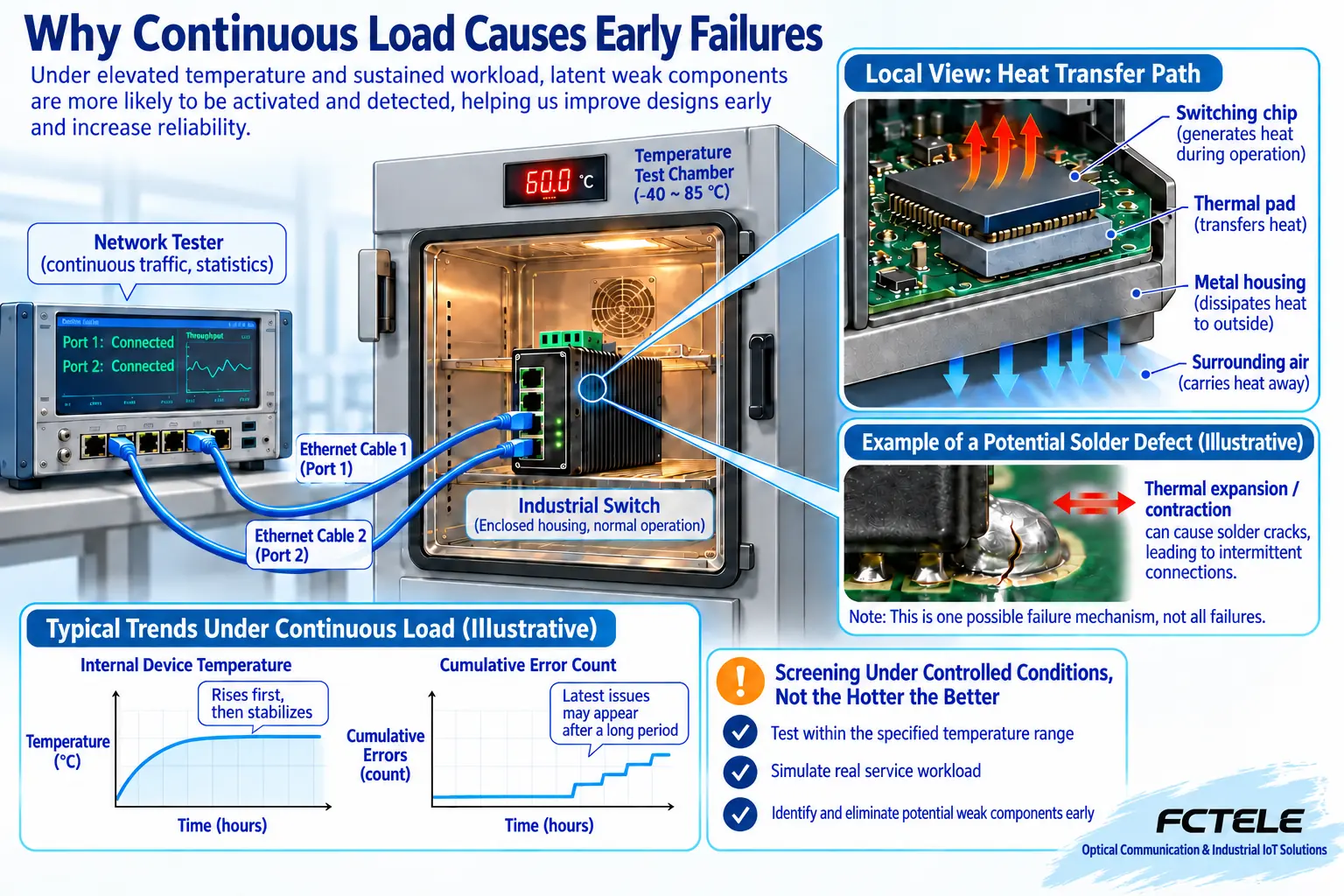
2. How Heat Travels from the Chip to the Surrounding Environment
Switch chips, physical layer transceivers, and power conversion circuits generate heat when working. Heat is conducted out through the circuit board, thermal interface materials, and metal enclosure, and then dissipated by surrounding air flow and radiation. When work begins, heat generation usually causes the temperature to rise; afterward, if the heat generated and the heat dissipated reach balance, the temperature tends to stabilize within a certain range. The specific temperature rise is affected jointly by power consumption, installation, environment, and measurement location.
Therefore, “fanless” does not mean “no heat dissipation is needed,” and a case that feels hot is not directly equal to a fault. The test should state whether it measures the ambient, case, or internal sensor temperature, and correspond to the correct allowed conditions. The temperature set in a test chamber does not represent the chip junction temperature, and touching by hand is not a reliable temperature measurement. When abnormal temperature rise occurs, first check the test setup and load, and then have professionals evaluate the device.
Thermal expansion and contraction cause dimensions of different materials to change, and some connection defects may be exposed because of this. But increasing temperature does not always find the same fault faster: excessive stress may introduce damage that would not occur in normal use. The screening plan for production equipment should be verified, and one must not arbitrarily put equipment into an uncontrolled oven in order to “test quality.”
3. Burn-in screening and life testing cannot be confused with each other
Burn-in screening cares about whether this batch of equipment shows abnormalities under given conditions; environmental testing cares about whether equipment can meet requirements under specified environmental stress; accelerated life testing attempts to infer the long-term behavior of a certain failure mechanism through samples and models. The purposes are different, and the sample arrangement, judgment method, and conclusions that can be supported are also different.
Failure rate is sometimes explained using the “bathtub curve”: some latent defects in the early stage are gradually exposed, the middle stage is relatively stable, and in the later stage some wear-out mechanisms increase risk. This is a conceptual model; not every electronic product shows exactly the same curve, and it is not a clock for the remaining life of a particular switch. Screening may reduce some early risks, but it still cannot rule out on-site surges, incorrect power supply, water ingress, or later component degradation.
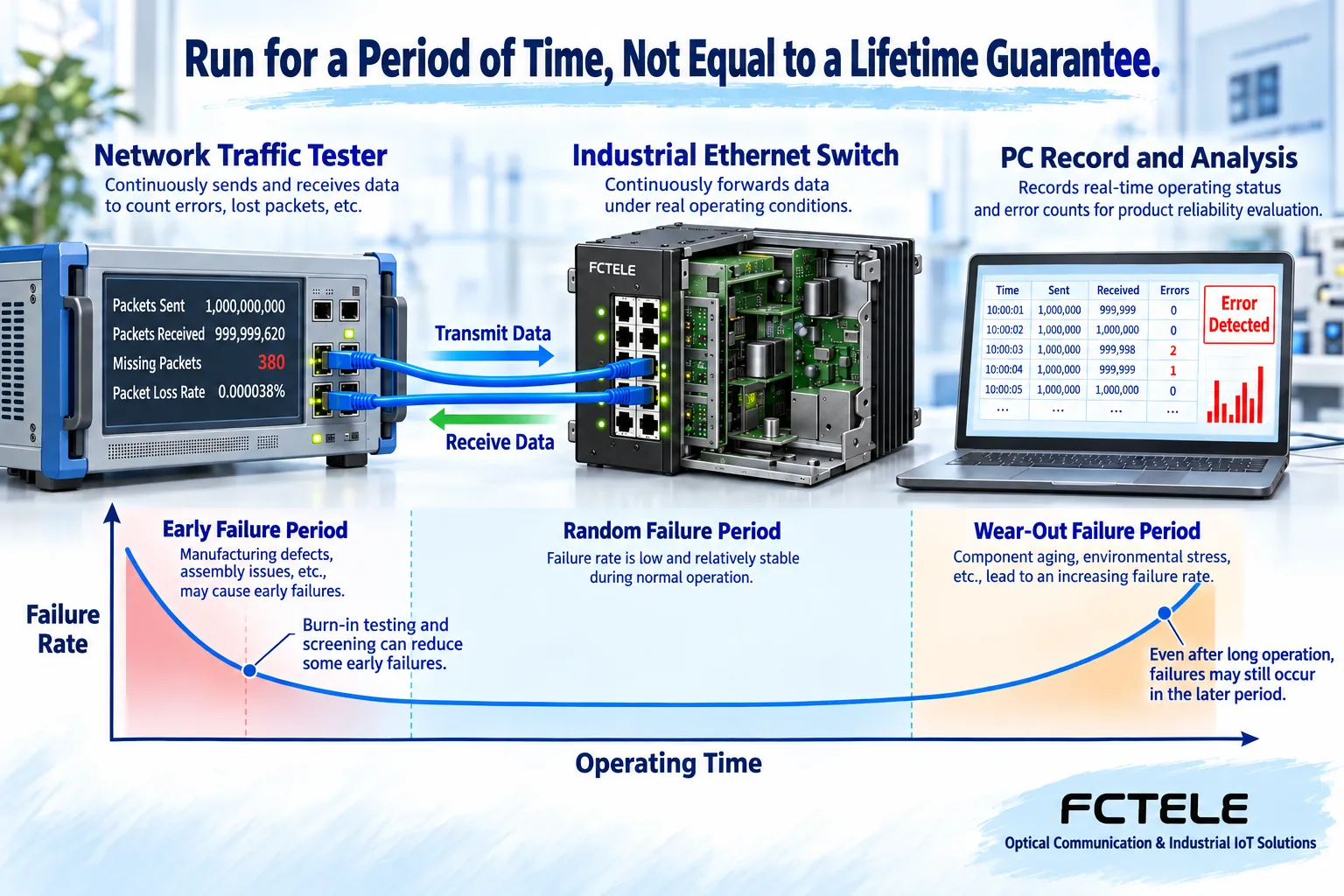
Life extrapolation in reliability research requires data for the corresponding failure mechanism as well as a suitable acceleration model and life distribution. One cannot write down how many years a device can be used just because it passed high-temperature power-on. The original statement that “one day without failure very likely means one year without failure” did not give samples, conditions, or statistical basis, so it is no longer retained here; “whether aging is done determines whether it is legitimate or counterfeit” is also not suitable as a quality criterion.
4. The Test Must Make the Device Actually Perform Work
Only connecting power and seeing the light turn on mainly proves that the device is receiving power at that moment and cannot cover all forwarding functions. The test load should include ports, frame lengths, directions, and traffic patterns related to the target, and should record sent and received data. If optical ports are needed, the modules and fiber matching should also be stated; if PoE is needed, the load, total power budget, and power supply version must be clarified, and the load plan for an ordinary switch cannot be directly copied over.
“Full load” also needs to be defined. When multiple ingress ports converge to a slower egress port, congestion itself may cause queuing or dropping, and this explainable behavior cannot be misreported as hardware failure. A baseline test can first use port pairings without oversubscription to confirm the expected result under that load, and then separately arrange functional tests such as congestion. Continuous forwarding, management functions, and power supply stress should each have records, and one total traffic number should not replace all statuses.
Monitoring items can include the number of link disconnections, error frames, abnormal restarts, logs, power status, and supported temperature data. When the device shows an abnormality, save the time point, port counters, and configuration, then check whether it is caused by the tester, cable, optical module, or power supply. It is necessary to distinguish “no service data” from “management page inaccessible” to avoid mistaking a network configuration issue for a thermal fault.
5. Time and Temperature Are Determined by the Scheme
There is no unified conclusion that applies to all industrial switches that “it must be baked for a certain number of hours.” Conditions should be determined based on the product’s rated range, known failure modes, verification results, and procurement requirements; when using a standard, the standard number, version, and test items should be clearly written, rather than generally saying “according to national standards.” Temperature holding, ramp-up and ramp-down processes, and the number of power cycles are also conditions, and one cannot write only a duration.
For safety, the test should use qualified temperature control and power supply facilities and be performed by trained personnel. Do not power on under condensation, conductive debris, or unknown ventilation conditions; do not exceed the nameplate voltage in an attempt to “accelerate aging,” and do not open the enclosure or touch internal circuits while powered. If smoke odor, abnormal sound, or dangerous temperature rise is found, stop according to laboratory procedures, isolate it, and hand it to professionals, rather than continuing to run and waiting for it to recover by itself.
6. When Purchasing, Asking for Records Is More Useful Than Only Asking How Long It Was Baked
Ask the supplier for test records related to the model and batch, and check the device number, hardware and firmware versions, date, conditions, load, pass criteria, and abnormality handling. Pass criteria are best agreed before the test, for example, under a specified load without congestion, unexpected disconnections or restarts must not occur; one cannot wait until results come out and then change the criteria, or explain all packet loss as normal.
The Feichang Technology official website’s 4-port gigabit electrical, 2-port gigabit optical managed product details state that “all models pass 100% burn-in testing.” This is the manufacturer’s statement on that page, indicating that during procurement one can further ask which versions are covered, what conditions are used, and whether batch records can be provided; the page does not give the specific burn-in duration and complete plan, and this article does not fabricate them. This statement also cannot be expanded to mean that the company’s entire series has passed the same test or an independent certification.
Suppose a project is to deploy ten devices; after arrival, a recheck can be done according to the pre-agreed interfaces and service load, keeping evidence of power supply, modules, traffic, and logs. Then confirm on site that cabinet heat dissipation, power stability, and grounding meet requirements. Factory testing and on-site acceptance complement each other: the former checks product behavior under specified conditions, and the latter confirms whether the actual installation falls within the allowed range; neither equals a guarantee that failure will never occur.
References:NIST: Extrapolating reliability under use conditions from high-stress tests,Feichang Technology industrial switch category,4-port electrical, 2-port optical managed product details. The illustrations are general teaching illustrations, not actual photos of the Feichang Technology factory, batch test records, or life measurement results.
Translated from the Chinese technical article. Source first published: 2020-11-11. Source last revised: 2026-10-13T18:44:52+08:00. Read the Chinese source
