


When selecting a fiber optic transmission device, first match the services, then match the optical path and installation conditions, and finally agree on acceptance. Video, telephone, serial ports, E1 and network equipment may all use optical fiber, but they do not automatically have the same interfaces, encryption, power supply or management functions. Writing the requirements so they can be checked item by item is more reliable than chasing a rate number that looks very high.
1. Start from the equipment at both ends, not from advertising names
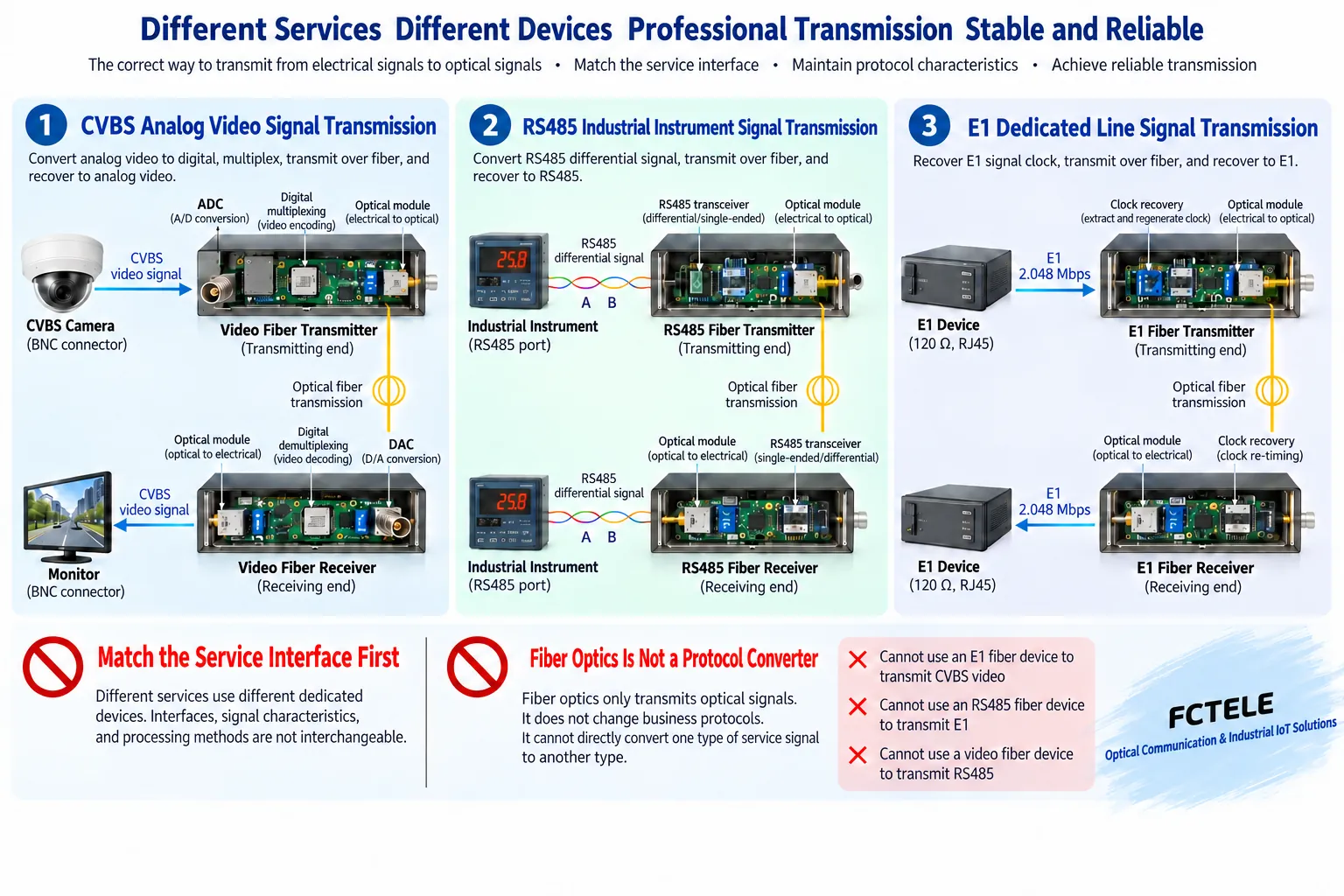
First record what is sent, what is received, how many channels, and which direction. Analog cameras need corresponding video processing; industrial instrument serial ports need electrical interface matching; E1 services also involve line coding and clocking. RJ45 and BNC are connector shapes, not all-purpose service categories; being able to plug in a connector does not prove that the internal circuit understands that signal.
The basic task of a fiber optic transmission device is to send supported electrical signals into the optical link in the corresponding way, and then restore them at the other end. The input may first be digitized, or it may already be a digital stream; the path depends on the product. Optical fiber is only a transmission medium. It cannot automatically turn analog video into a network stream, and it will not automatically translate serial port commands into another application protocol.
2. Write channel count and direction together
Four video channels may be four forward inputs, and do not necessarily mean four bidirectional video channels. If the camera has pan-tilt control, the reverse control channel, electrical interface and application protocol at both ends should also be listed. Auxiliary audio, switch contacts or telephone must also be described separately by quantity and direction. Do not assume that an unused video port can serve as any other port.
Multi-service equipment needs to arrange different signals into the corresponding transmission resources. The specific combination is affected by interface boards, firmware and the ordered version. Feichang Technology Integrated multiplexing video series provides an approach of configuring by service; during selection, a clear configuration table should be produced, and optional functions of a series should not be written as fully enabled by default on a single device. A demonstration with only one service also cannot prove that a full configuration works at the same time.
3. Distance needs to be converted into loss and power range
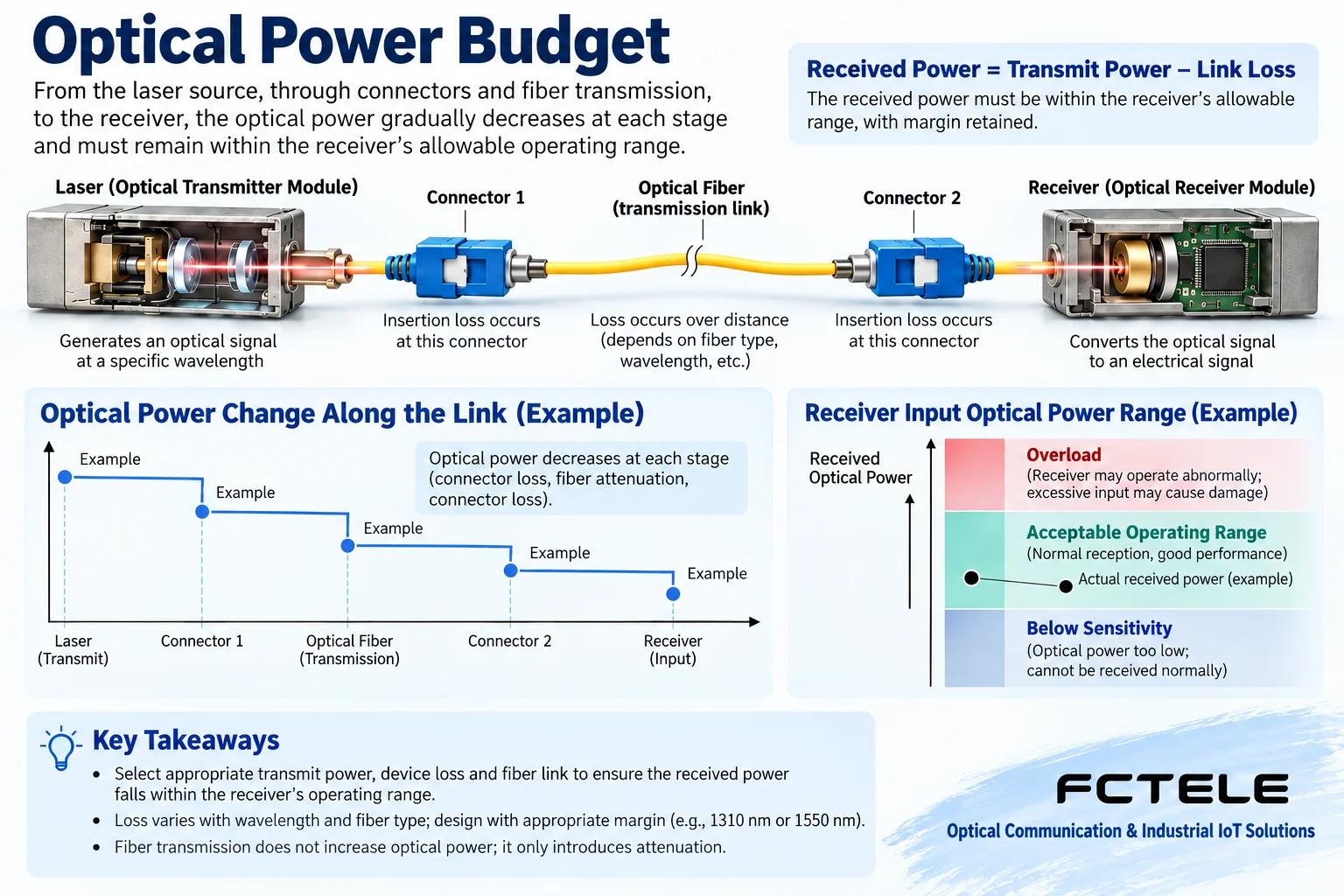
Light traveling along fiber, connectors and splice points suffers loss. Transmit power minus link loss gives the approximate power that the receiving end can receive. Actual calculation also needs to consider wavelength, device tolerance, fiber conditions and necessary margin. A certain distance written on a product is a reference range under corresponding conditions, not a guarantee that can be copied to every site.
A receiver has both a lower sensitivity limit and an overload upper limit. Too weak makes correct recovery difficult; too strong may also cause errors. A short link is not necessarily easier to match than a long link. Strong-power configurations connected over short distances especially need range confirmation. Adding attenuation can only reduce optical power; it cannot solve a problem that is already too weak, and it certainly cannot fix encoding incompatibility.
Single-mode and multimode are fiber types; single-fiber and dual-fiber are numbers of fibers used. These are two different sets of concepts. Dual-fiber usually means the local transmit connects to the remote receive; single-fiber bidirectional solutions usually require complementary optical configurations. Wavelength, optical standard and the manufacturer’s line implementation all need to be checked. Interoperability cannot be judged only because both ends are marked “single-mode”.
4. The installation environment cannot be decided by the words “industrial grade”
Write clearly the temperature inside the site cabinet, power supply, humidity and condensation risk, vibration, dust and maintenance space. A metal enclosure does not automatically mean waterproof, and wide temperature does not mean it can operate while submerged. Working conditions and test conditions are different; a certification for one product cannot be generalized to all products of the whole company.
Desktop units are convenient for distributed deployment, and rack-mounted units are convenient for centralized arrangement, but shared power or a backplane may also expand the scope of fault impact. When choosing, also check power capacity, heat dissipation airflow, grounding and surge design. Do not assume that an internal power supply is necessarily more reliable than an external one, and do not treat one AC voltage as a universal requirement for all equipment.
5. Management and security functions need evidence for confirmation
Some devices only transparently extend services; they have no web interface and do not analyze data packets. For models with management functions, confirm which items can be monitored, how alarms are uploaded, and how configurations are backed up. Optical power readings and OTDR breakpoint detection are different functions. Being able to view optical power does not mean one can claim automatic fiber break location.
VLAN is a logical division; it is not an independent physical path, and it is certainly not encryption. Changing a link to optical fiber also does not automatically provide access control or anti-eavesdropping. When encryption, authentication, auditing or isolation is needed, the security objective should be written clearly, implemented by equipment and system configurations that support the corresponding capabilities, and then verified. Do not imagine a network security menu on an ordinary video or E1 extension device.
6. How procurement and trial use form a closed loop
Prepare a requirements table and request quotations according to six items: service interfaces, channel directions, fiber conditions, installation and power supply, management and security, and acceptance methods. Different quotations should be compared under the same configuration, including equipment at both ends, supporting modules, cables, spare parts and service boundaries. A cheaper version missing key channels cannot be directly compared on total price with a complete version.
Suppose a site needs two channels of analog video and one reverse control channel. First use a real camera, recording end and control software to build a short link, then connect the formal optical cable. Check moving pictures, control response, continuous operation and the agreed power recovery. This example is only a method of organizing requirements; it does not represent the capacity or recovery performance of all models.
Archive the configuration, test results and maintenance arrangements, and check capacity and boundaries again when requirements change. The core is not to find equipment that “supports everything”, but to obtain a matching solution that can be clearly explained, reliably connected and retested.
Reference: the corresponding product details on the Feichang Technology official website and ITU digital interface materials. The illustrations are general principle diagrams, not the structure, certification or measured commitment of a specific Feichang Technology model.
Translated from the Chinese technical article. Source first published: 2025-04-24. Source last revised: 2026-10-13T17:37:33+08:00. Read the Chinese source
