


Industrial switches, fiber optic transmission devices, and serial communication devices are powered on year-round. What truly determines long-term stability is often not the most eye-catching number of ports, but the power supply hidden inside the chassis. Feichang Technology treats the power supply as the foundation of overall unit reliability, controlling everything from the PCB, capacitors, and main control components to temperature rise verification, item by item. The goal is to reduce early failure and long-term aging risks, providing a solid foundation for the overall unit’s MTBF.
The barrel theory: grasp the real weakest link in lifespan first
How much water a barrel can hold depends on its shortest stave. Applying this theory to industrial communication equipment, the key judgment can be summarized as:The lifespan weak point of general electronic equipment often falls first on the power supply, and the lifespan weak point of the power supply often falls on the electrolytic capacitor.This is not to say that all failures are caused by the power supply or capacitors, but because the power supply endures input fluctuations, ripple current, startup and shutdown surges, and temperature rise over the long term. Among these, electrolytic capacitors also experience electrolyte loss, capacitance decrease, and ESR increase over time and with temperature, making them more likely to become a sensitive link in long-term operation.
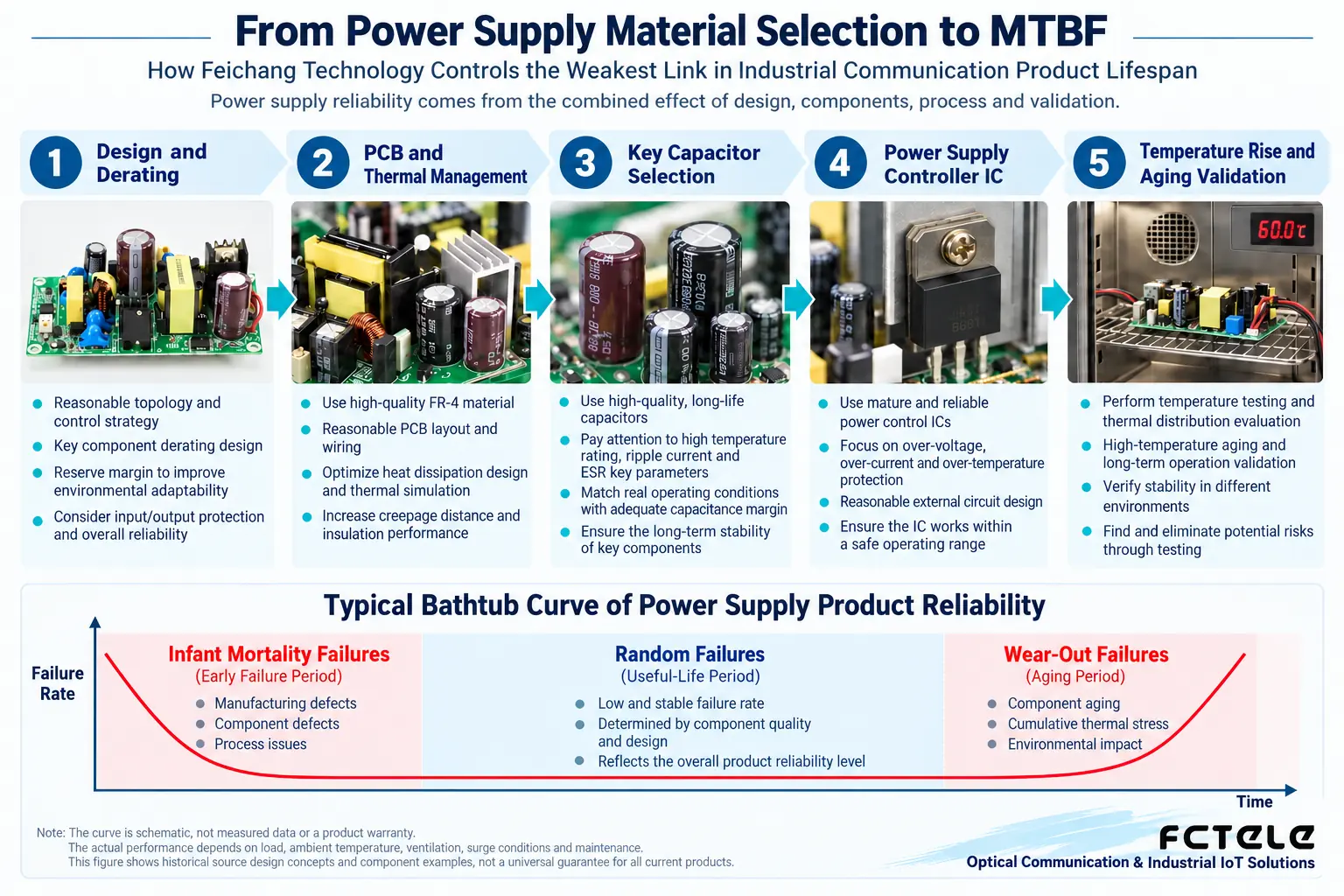
Therefore, Feichang Technology’s approach to improving MTBF is not just pursuing one impressive parameter, but first identifying weak links, then controlling layer by layer around power supply board material, capacitors, main control components, design margin, and temperature rise verification. MTBF is a statistical indicator of mean time between failures, and is not equivalent to the guaranteed lifespan of a single product; the final performance still depends on load, ambient temperature, ventilation, surges, and maintenance conditions.

First control: PCB material and layout
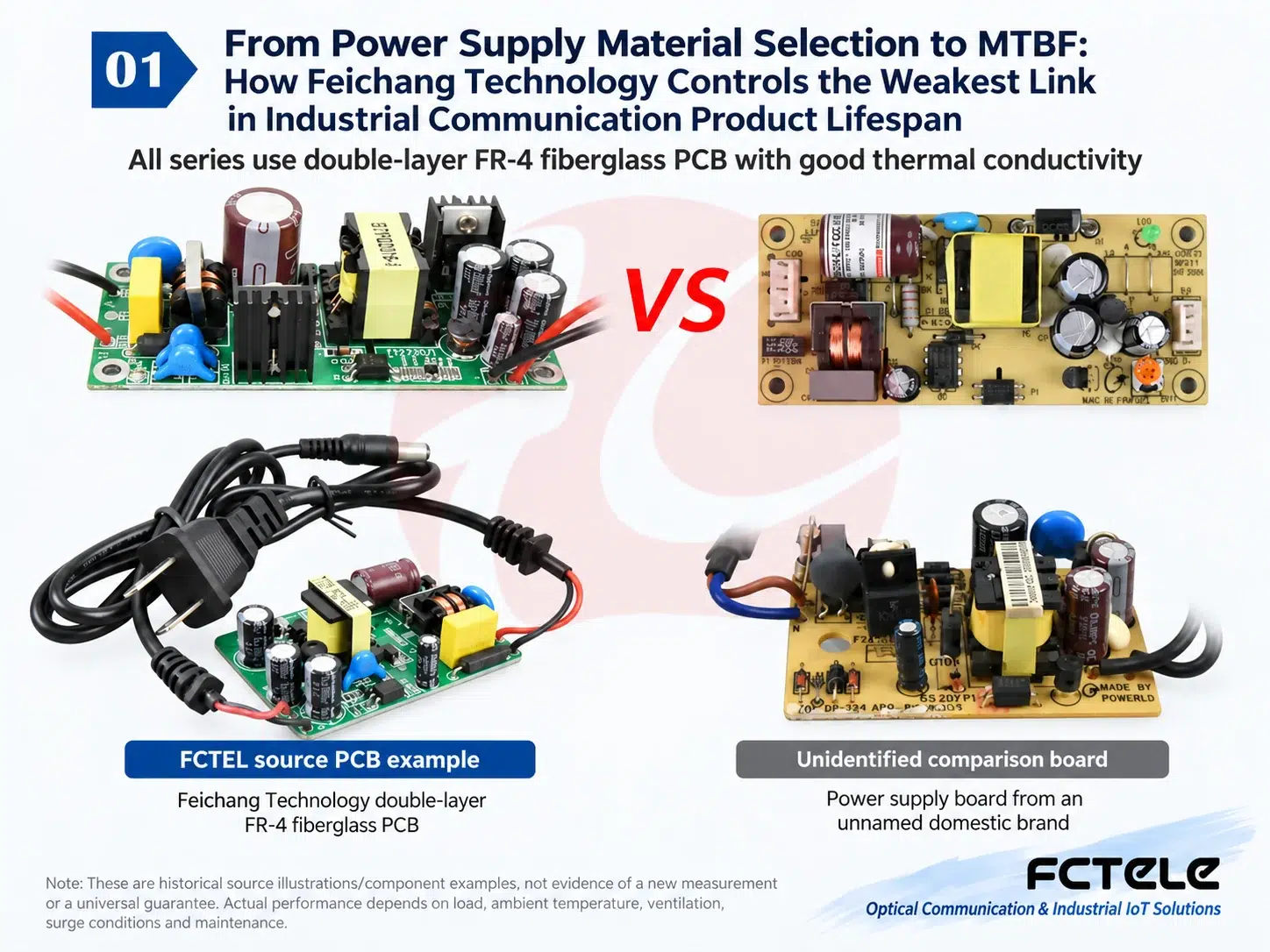
Original records show that the Feichang series power supply uses a double-sided FR-4 fiberglass board. A stable base material, reasonable copper foil, and routing provide the foundation for insulation, mechanical strength, and component placement. The double-sided board also leaves more design space for power supply circuits, grounding, and heat source distribution. True reliability must also be implemented in creepage distance, pad quality, trace current margin, and isolation between high and low voltage areas; one cannot just look at the board material name.
Second control: Key capacitors are not just about capacitance
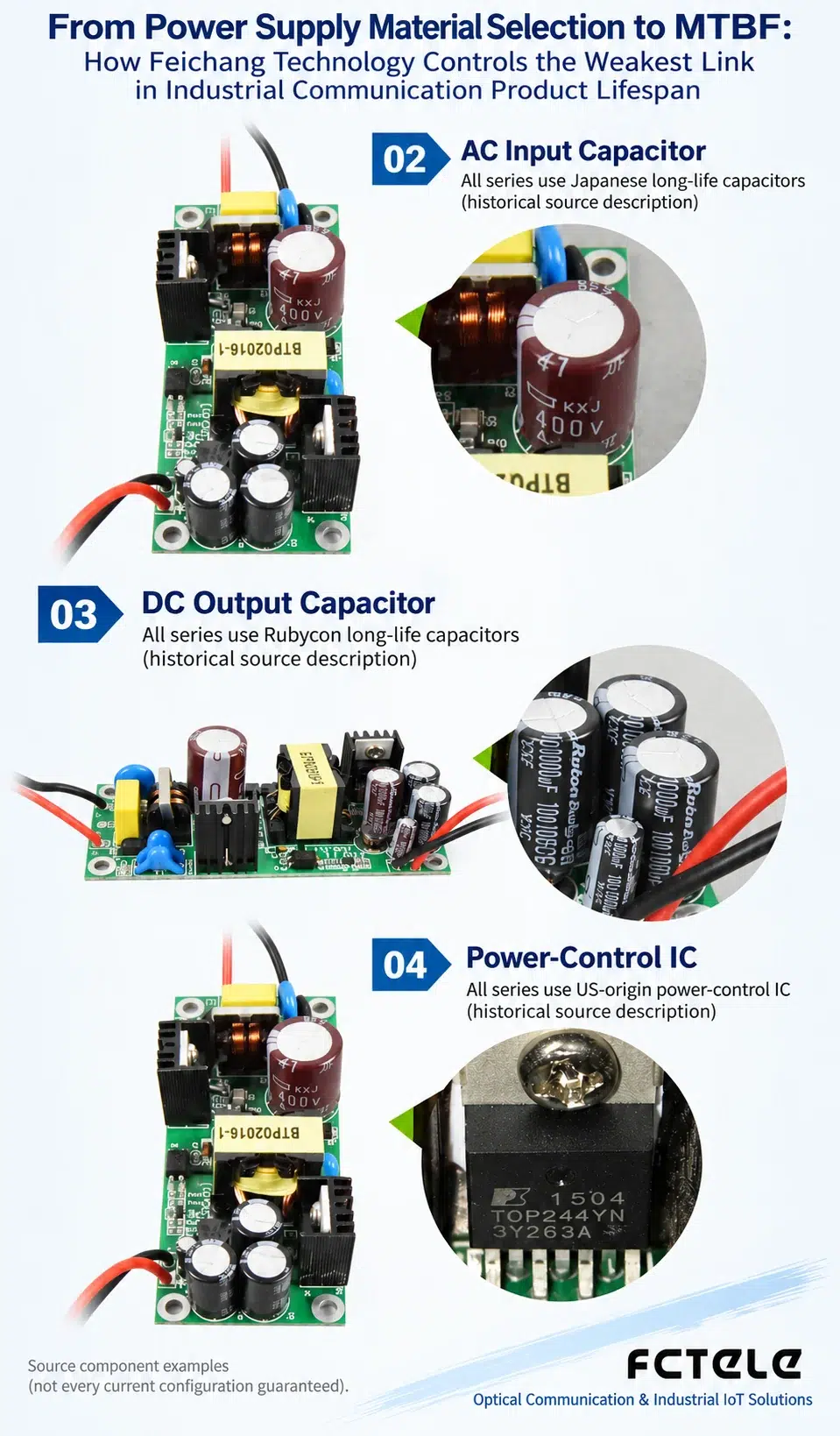
Electrolytic capacitors are components in the power supply that are more sensitive to temperature and ripple. Older materials show that long-life series capacitors were selected for the AC input side and DC output side respectively. When selecting, besides capacitance, one must also check voltage rating, allowable ripple current, temperature grade, equivalent series resistance, and expected operating life, and retain margin for the actual working voltage and temperature rise.
Input-side capacitors handle energy storage and smoothing after rectification, while output-side capacitors directly affect ripple and load transient response. If capacitors operate near the upper temperature limit for a long time, aging accelerates noticeably. Therefore, Feichang evaluates component selection together with the location of heat sources on the board, avoiding the situation where ‘parameters pass but the working environment is too hot.’
Third control: Main control components, protection, and design margin
The power supply main control chip determines switching control, voltage regulation, and part of the protection strategy. Original materials show the selection of main control components, but the chip brand itself cannot replace a complete design. In power supply design, Feichang also checks power device stress, transformer and magnetic component margin, feedback stability, input and output protection, and abnormal conditions. The further a component’s long-term operating point is from its limit rating, the more comfortably it usually handles temperature changes and grid disturbances.
Fourth control: Use temperature rise verification to find hidden risks
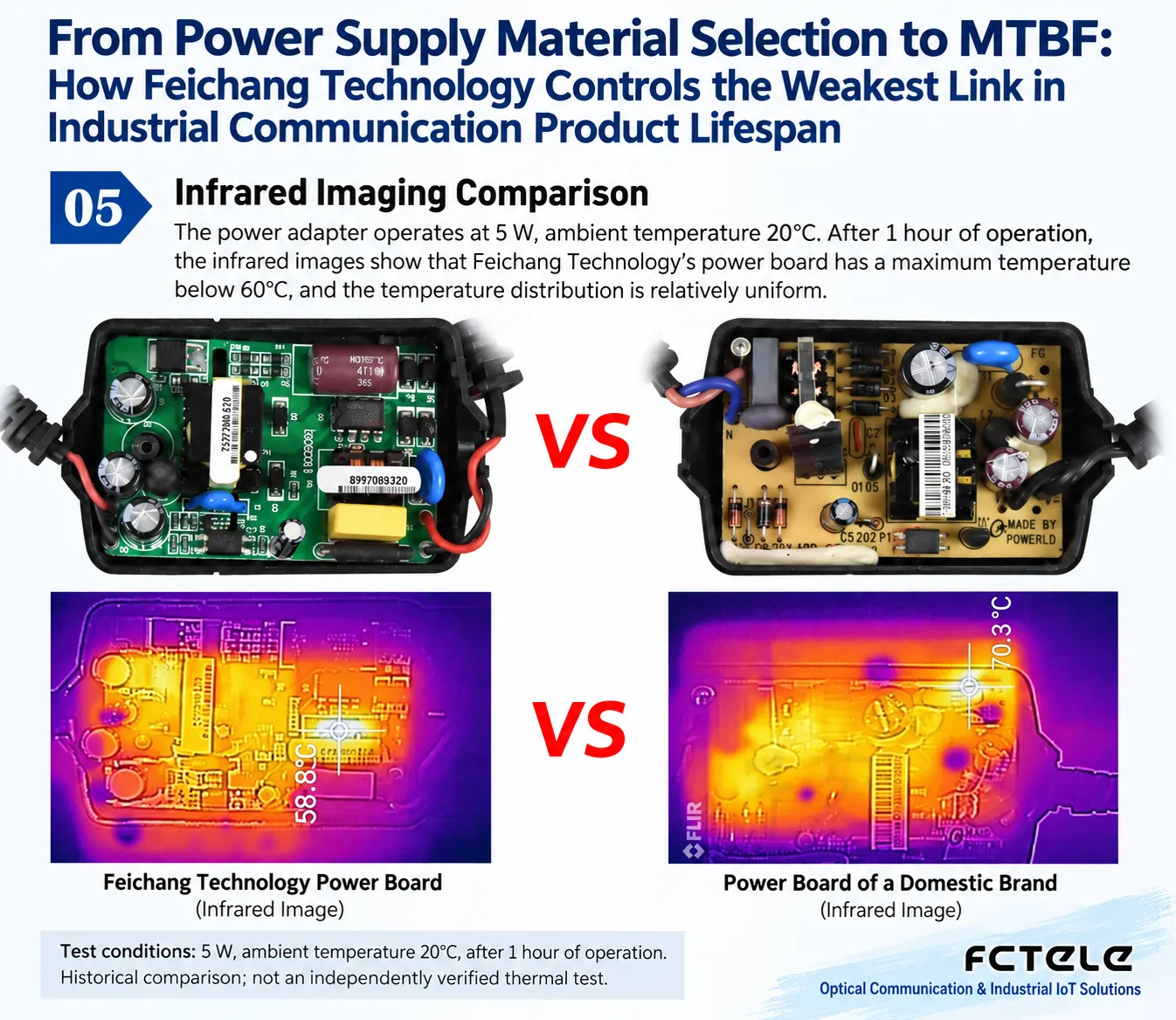
Temperature is an important variable affecting power supply lifespan. Archived images record a set of infrared thermal comparisons: 5W load, ambient temperature about 20°C, operating for 1 hour, the Feichang sample’s maximum temperature marked below 60°C, and the heat distribution relatively balanced. This set of results is used to illustrate the thermal performance of the sample and conditions at that time, and should not be extrapolated as fixed values for all models, loads, and installation environments.
The image below fully preserves two infrared thermal images: the left is the Feichang power supply board, the right is the comparison sample, and the two physical power supply boards above are also preserved, making it easy to correspond hotspot locations with specific components. Infrared thermal images can help engineers find local hotspots, insufficient component selection, or uneven layout; formal quality control should also combine input range, full load and light load, startup and shutdown cycles, ambient temperature, ripple, and protection actions for verification.
Turning strict material selection into customer value
For customers, strict power supply control is not a component list, but fewer shutdowns, fewer false resets, and more controllable maintenance costs during long-term operation. When purchasing, one can further specify input voltage, load power, cabinet temperature, installation method, and surge environment, so that the power supply solution matches the on-site conditions. Through multi-layer control of board material, key components, design margin, and thermal verification, Feichang Technology continuously improves the reliability and MTBF foundation of industrial communication products.
Note: This article is compiled based on Feichang Technology’s original production and testing materials. The brand and test data in the images correspond to sample records at that time; specific product parameters, warranty, and applicable conditions are subject to the corresponding model materials and contract.
Translated from the Chinese technical article. Source first published: 2022-04-15. Source last revised: 2026-10-13T23:36:13+08:00. Read the Chinese source
