


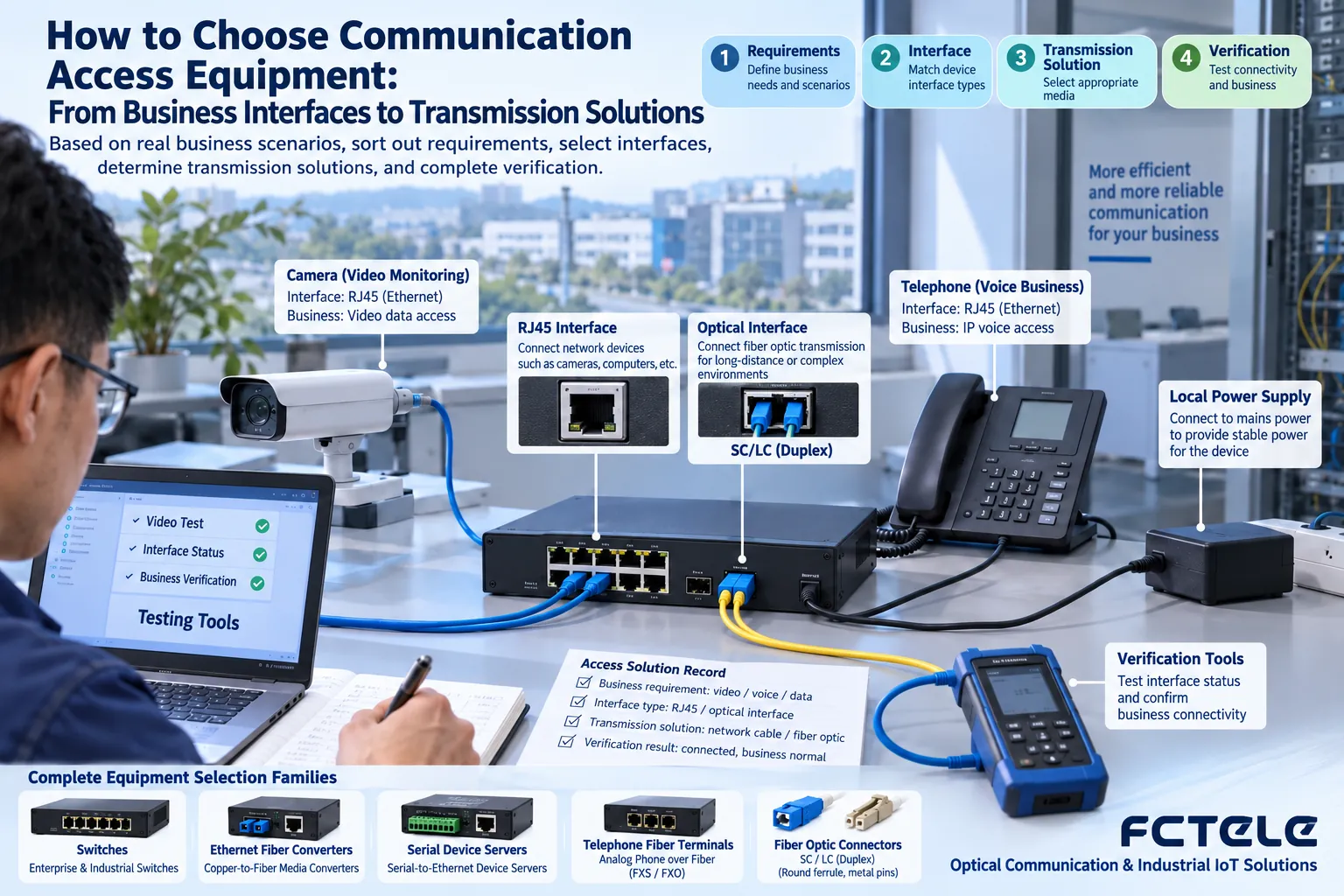
Choosing communication access equipment should start from the service interfaces and the actual lines, then determine whether you need switching, media conversion, serial networking, or dedicated optical transmission. Related FCTEL product categories can serve as an entry point for a solution, but “complete product range” cannot replace interface compatibility, performance, and environmental evidence; each project still needs to be checked against the specific model.
Turn equipment names into service questions
“I need an fiber optic transmission device” is often not clear enough. First explain whether you are transmitting network video, analog telephone, serial instruments, or other signals, then list the physical interfaces and data formats of the equipment at both ends. Products that also use optical fiber may be completely different in service handling.
For example, a network camera already outputs Ethernet data, so you can consider a switch optical port or a compatible transceiver; an analog telephone needs a telephone interface and signaling; RS485 instrument networking needs a serial server or a corresponding gateway. You cannot replace different functions with a similarly shaped port.
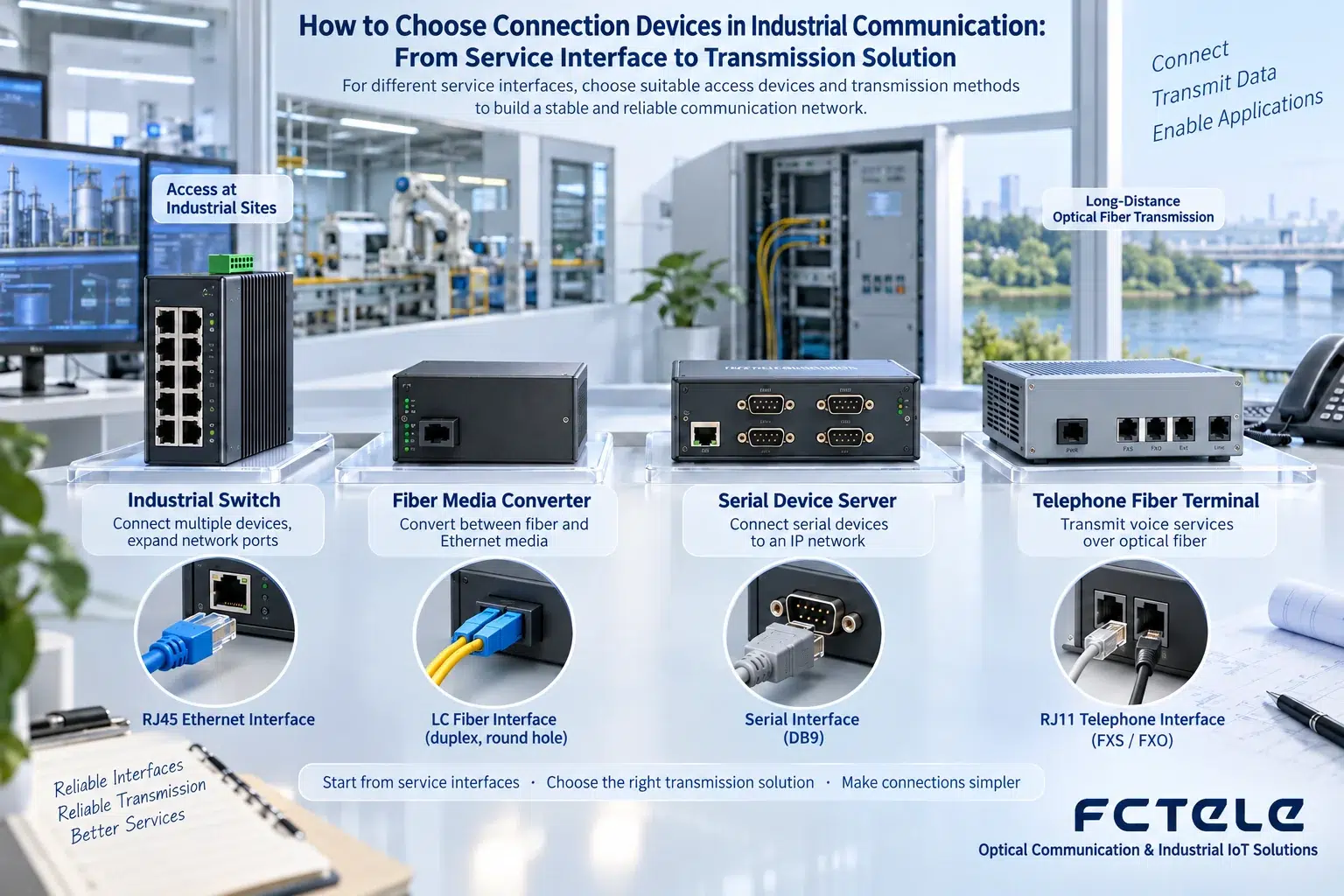
Industrial switches solve multi-terminal networking
Switches are suitable for connecting and forwarding between multiple Ethernet terminals. The number of copper ports, optical port configuration, and uplink capability determine basic connectivity, while VLAN, multicast, port diagnostics, and redundancy functions correspond to management requirements. If you need to cross different IP subnets, you must also clarify Layer 3 capability or supporting routing equipment.
Do not understand “network management” as automatic security, or “ring network” as uninterrupted. Management accounts, protocols, configuration backup, and recovery testing need to be implemented. When critical control and high-traffic video share a network, you should evaluate queues, uplinks, and fault impact, rather than only comparing the number of ports.
Transceivers solve media conversion
Ordinary Ethernet fiber media converters are suitable for conversion between electrical ports and optical ports, and usually do not automatically translate application protocols. Both ends need to match speed, fiber type, and optical conditions. Single-fiber uses complementary wavelengths, and dual-fiber crosses TX and RX. Whether special frames or fault linkage are supported must be verified by model.
If an existing switch is compatible with optical ports, you can also avoid using two separate transceivers, but you should check whether the host, optical module, and the optical standards at the other end are compatible. Whether optical ports and modules are included in the quote will affect the supporting cost and must be noted separately.
Serial networking: first confirm whether protocol translation is needed
A serial server can transmit serial bytes over a network, allowing remote applications to access the original serial equipment. Transparent transmission mainly preserves bytes and does not automatically convert all serial protocols into another network protocol. A true protocol gateway also needs rules such as registers, function codes, and exception mapping.
RS232 and RS485 are differences at the electrical interface level; baud rate, data bits, and parity are communication settings; TCP client or server is the network connection mode. Filling in requirements with these layers separated can reduce the problem of “the interface is connected correctly but the application cannot read data.”
Dedicated fiber optic transmission devices return to the corresponding service
Telephone products need to confirm FXS, FXO, and channel pairing; audio and video products need to confirm signal format, resolution, encoding, and interface version. Multi-service products also need to explain the number of channels, shared capacity, and clock item by item; you cannot infer that all services are available from the fact that one service works.
On-site power supply, cabinet temperature, installation protection, and maintenance methods also affect applicability. Test reports should correspond to specific models and conditions. Product images and experience with similar equipment can only help understanding and should not be treated as evidence that the model has passed all environmental verification.
For inquiries, you can directly submit this information
State the terminal model and interface, service format and quantity, existing cables and length, installation environment and power supply, and the reason management or redundancy is needed. Then explain the acceptance goals, such as concurrent services, allowed interruption, and fault recovery, to help form a checkable bill of materials and test list.
You can choose a category from Product Center and then let the specific manual, compatibility information, and joint debugging results confirm the solution. This article does not provide unverified rankings, market share, or “all protocols supported” conclusions; product capabilities are subject to the actual supplied configuration.
Translated from the Chinese technical article. Source first published: 2019-07-25. Source last revised: 2026-10-13T22:50:44+08:00. Read the Chinese source
