


When choosing an industrial switch supplier, you should first define the environment, interfaces, protocols and maintenance needs, and then compare specific models and verification evidence. A “top ten brands” list that lacks sources, time range and selection method cannot replace engineering selection. A suitable supplier should be able to explain product boundaries, provide verifiable materials, and assist with a trial in real business use.
Write the requirements first, so quotes can be compared
List the number of electrical ports and optical ports, speed, fiber conditions, PoE needs, installation space and power supply. Then describe the cabinet temperature, dust, vibration, interference and outdoor conditions. Saying only “industrial-grade eight-port” easily leads to products that look similar but differ greatly in actual capability.
Explain whether the business is PLC control, camera video, data acquisition or a mixed network, and provide a topology. Whether network management, VLAN, ring networking, time synchronization or Layer 3 functions are needed should be decided by the system requirements; do not treat more functions as automatically more suitable.
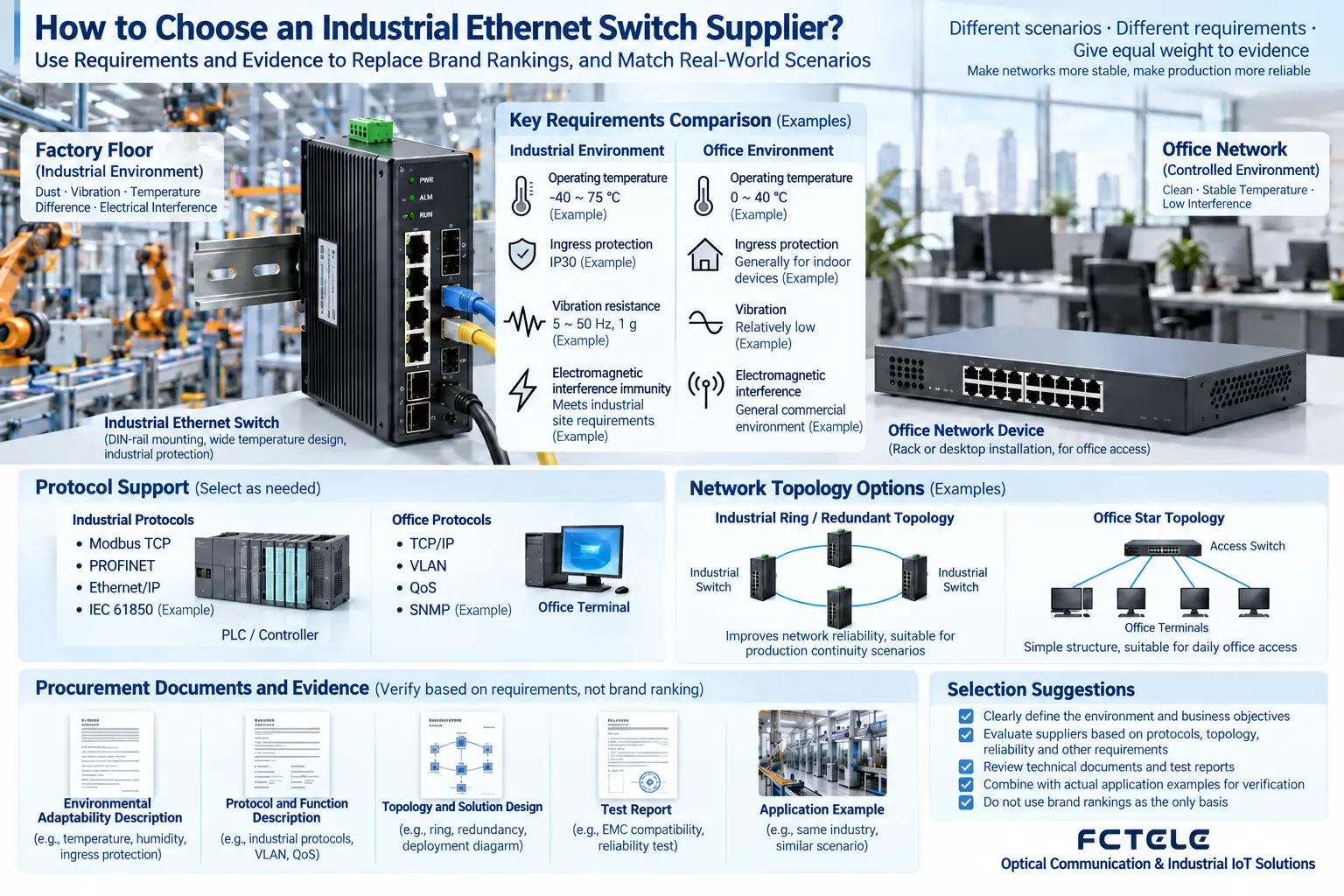
What materials can support industrial applicability
Environmental ranges should correspond to specific models and operating conditions, and test reports should state the standard, object and result. DIN rail mounting, a metal case and two power inputs are only design elements; they cannot by themselves prove water resistance, lightning resistance or operation at any temperature. Certifications should also be checked against the applicable product and scope.
Network function materials need to state the version, limits and interoperability conditions. For example, supporting a certain redundancy protocol does not mean it interoperates with every vendor’s private ring network; supporting management does not mean it is secure by default. Ask the supplier to explain the usable combinations, not just promotional keywords.
How should sample testing be designed
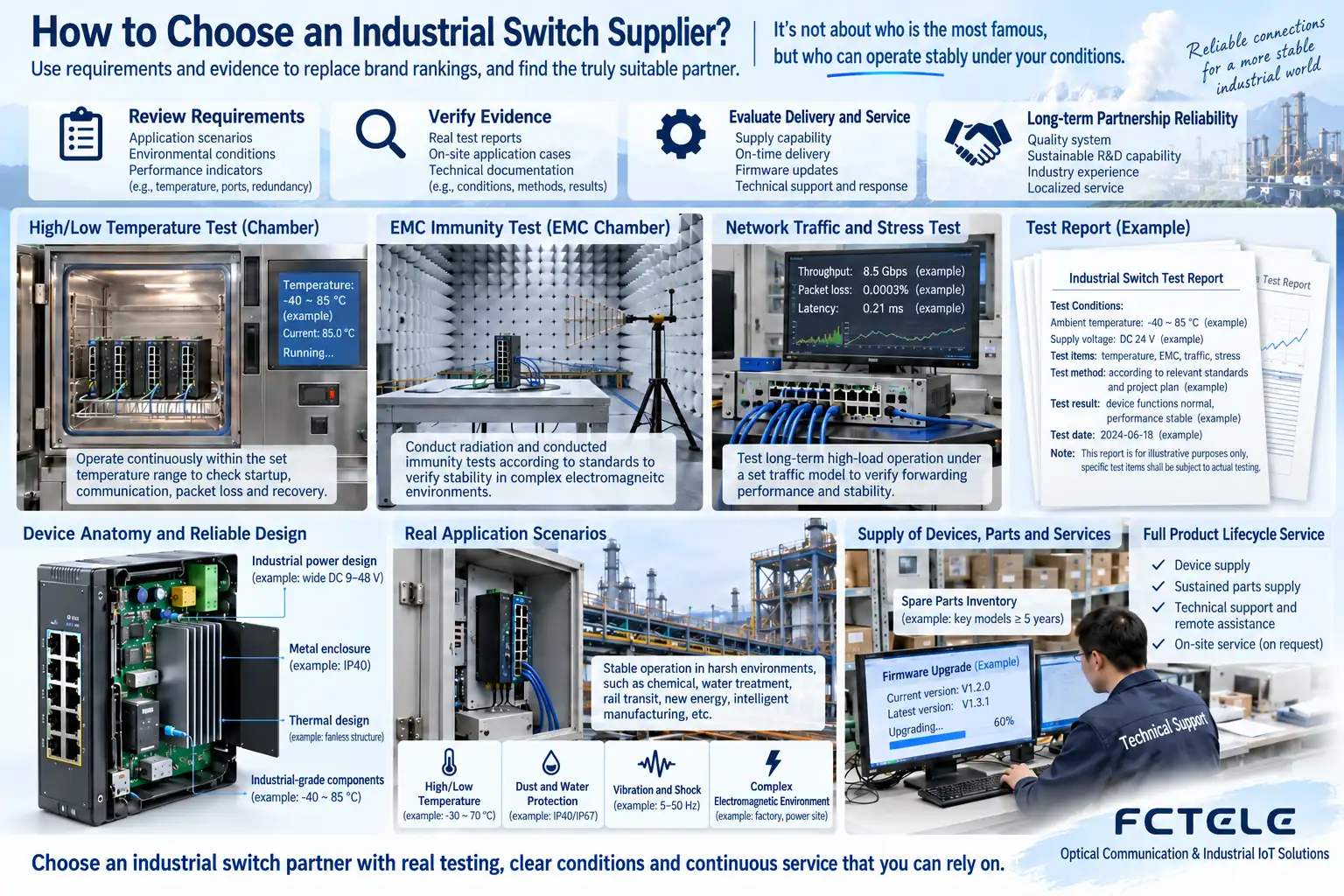
Test throughput, errors, latency and continuous operation according to the actual terminals, traffic volume and uplink combination. Video services and control services have different concerns, so a single Ping test is not enough. Record firmware, configuration, cabling and test tools so different products can be compared under the same conditions.
Fault recovery should be divided into scenarios such as link disconnection, power failure and device restart, and performed in a safely isolated environment. Link protocol recovery and application recovery may differ, so the actual business must be observed. Time values given by the supplier need conditional explanations and cannot be treated as universal guarantees for all topologies.
Besides price, what other maintenance costs are there
Check spare part availability, supply lead time, firmware updates and technical response methods. Whether there is a replacement plan after production stops, whether configurations can be migrated, and whether fault records can be retained will affect long-term maintenance. A low unit price may not reduce total cost if it leads to downtime that is hard to diagnose.
Management accounts, configuration backups, logs and upgrade methods should also be included in delivery. The supplier should be able to point out upgrade risks and recovery paths, and on-site personnel should not be required to flash firmware blindly without a backup. Remote support permissions should be controlled, so service convenience does not become an open management entry point.
How should historical brand lists be used
A list from a certain year can at most provide clues from that time; it cannot automatically become a current quality ranking. Company names, product lines and service scope may change, so check current official materials during procurement. Unverified judgments such as market share, leading or best should not become conclusions of this article.
For Feichang Technology or other candidate suppliers, specific models should be checked against the same standards. You can obtain product information from Product Center and then provide complete requirements for confirmation; do not skip interface, environment and trial checks just because the brand is familiar.
How to form a selection conclusion that can be implemented
List the items that are satisfied, not satisfied and need verification, and handle the conditions that affect business and safety first. Keep quotes, document versions and sample results, then decide based on cost, supply and maintenance. Such a conclusion can be traced and has more engineering value than a ranking without evidence.
Contracts and acceptance should target clear models and functions, and should not use a general “industrial switch” to replace commitments. When ports, optical modules or site environment are adjusted later, re-evaluate the related conditions; the initial sample passing does not mean any expansion combination automatically passes.
The figures are illustrations of scientific principles and application scenarios; the interfaces, structures and measured values in them do not represent specific product parameters. Actual specifications must be based on model documents and on-site measurements.
Translated from the Chinese technical article. Source first published: 2019-07-19. Source last revised: 2026-10-13T22:50:44+08:00. Read the Chinese source
