


To compare domestic and international industrial switch brands, you should first clarify the project’s business, environment and maintenance requirements, and then compare specific models’ protocol interoperability, on-site testing, delivery and lifecycle support. Without a credible source of evaluation and statistical scope, you should not package a list of brands as an “authoritative ranking.” Different series from the same brand also cannot be summarized with one conclusion.
First draw the project, then bring in the brands
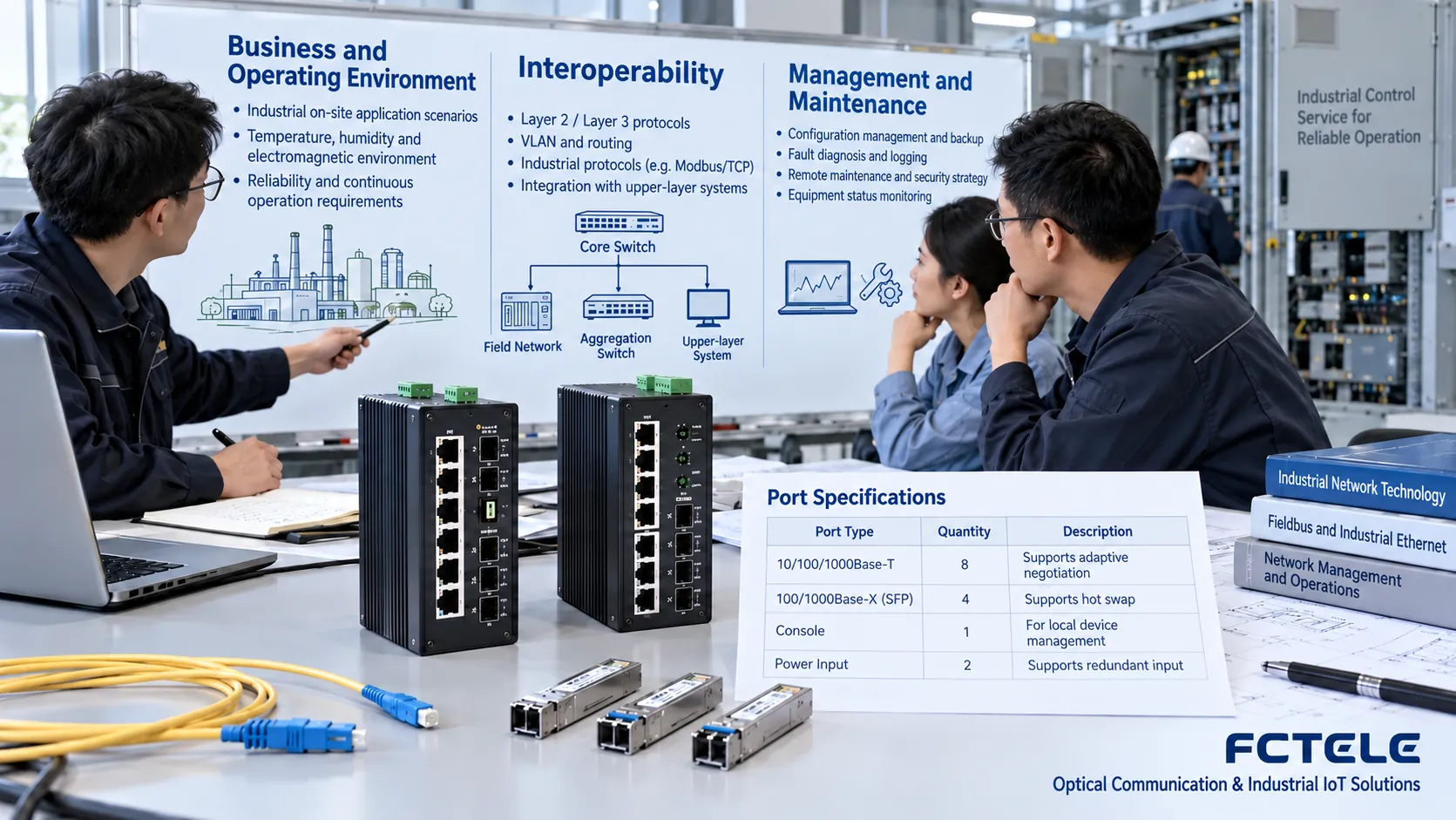
The easiest starting point for equipment selection to go wrong is to first ask “which brand is best” without explaining what needs to be connected. A PLC network inside a control cabinet and a video backhaul network across a plant have different port counts, traffic, temperatures and downtime impacts. First list the terminal types, quantities, communication directions and uplink locations, and only then do you know which capabilities are mandatory and which are merely optional.
For expanding an existing network, brand comparison must also consider the limitations of the original equipment. The existing optical modules, management platform, ring protocol and configuration habits on site may affect implementation more than the number of new ports. New equipment cannot be assumed to be fully compatible with old equipment just because it “supports standards”; versions, default configurations and specific feature scopes may all differ.
Optical port interoperability: looking the same does not mean the link will definitely come up
The same SFP slot shape only means a similar module form factor is used; it does not guarantee that speed, protocol encoding and device support scope are consistent. Both sides must match the Ethernet standard used, speed, fiber type, wavelength, distance and receive power boundaries. Single-fiber BiDi modules also require the transmit and receive wavelengths to be complementary; you cannot pair them across vendors based only on the words “A end” and “B end.”
Module compatibility limits should also be asked about clearly: some platforms check module information or restrict specific functions, and the ability to display diagnostic monitoring data may also differ. Before purchasing, test with the actual planned modules and switches at both ends, and record port status and bit errors; this is more convincing than simply putting two specification sheets side by side.
Protocol interoperability: what details lie behind the same term?
VLAN requires checking how access ports, trunks, allowed VLANs and untagged frames are classified. Interface terminology and default values may differ between vendors, but the final processing rules for service frames must be consistent. A port may appear to communicate, but it may simply be that the default VLAN happens to be the same, while other planned services are not correctly isolated.
For ring protocols, confirm whether it is a standard mechanism, the supported version and role configuration. A vendor’s proprietary fast ring should not be assumed to interoperate with another brand’s “fast ring.” For multicast services, confirm the querier, group member maintenance and router ports; for QoS, check priority marking and queue policies. A conclusion that a brand passed standalone testing cannot be directly transferred to a mixed network.
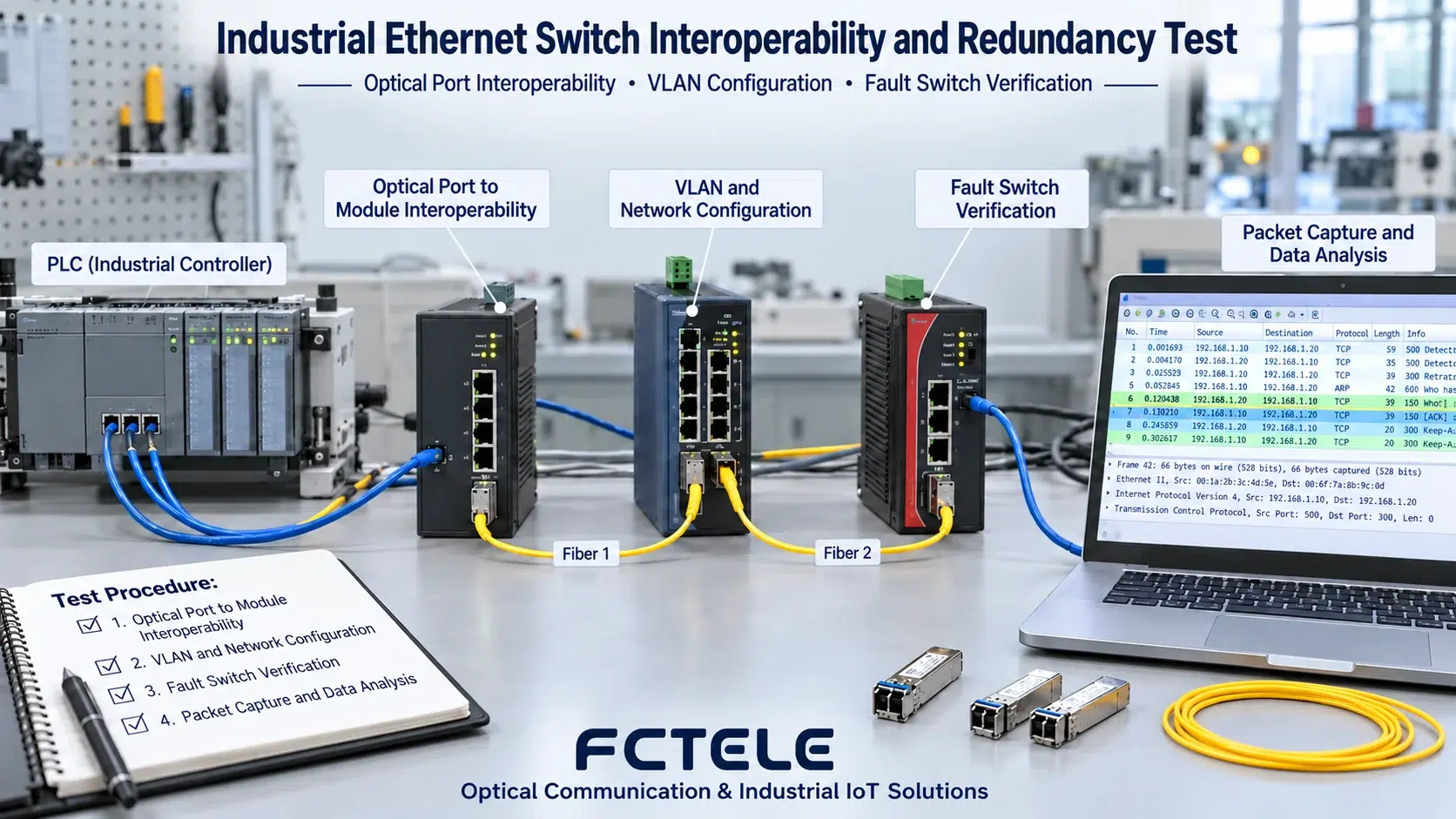
Building a test bench does not require replicating the entire factory at the start. First select a few representative nodes and real terminals, establish the key paths, and then separately test tag forwarding, concurrent load and fault recovery. Record each device’s model and firmware, each port’s role, and the test traffic and results. This way the supplier can reproduce the problem, and the project team can determine whether the issue is a missing function or a configuration inconsistency.
Management methods must suit your team
Many functions do not necessarily mean easy maintenance. You should compare whether the configuration interface is clear, whether logs can be exported, whether port status can be located, whether configurations can be backed up and restored, and whether the existing network management system can read the required information. If the team is familiar with only one management method, switching platforms should take training and configuration migration costs into account.
Security maintenance is also part of selection: whether default credentials can be changed, the management network segment can be restricted, unused services can be disabled, the management protocols required by the project can be used, and whether there is an update mechanism and version notes. Device management permissions and service forwarding are different boundaries; you cannot allow all terminals to access the management interface just because service ports can communicate.
Beyond the purchase price, what long-term costs are there?
Total cost includes equipment, modules, power supplies, installation, testing, training, spare parts, maintenance and downtime impact. A model with a low purchase price may, if it lacks replacement channels or is difficult to restore configuration, have higher operation and maintenance costs years later than the amount saved. Conversely, expensive equipment whose functions far exceed requirements does not necessarily bring actual benefits.
Compare delivery times, warranty responsibilities, spare unit or repair arrangements, and verify who bears on-site support. For long-cycle projects, ask about end-of-life notices, replacement models, firmware support and documentation availability. Without project basis, you should not directly equate a certain country or a certain brand identity with technical level or reliability.
Write the comparison results into an executable selection table
In the first column, write the requirement, for example “expand existing ERPS ring,” “high temperature inside cabinet,” “two DC inputs.” In the second column, write the specific model’s response; in the third column, write the documentation or test evidence; in the fourth column, write the risks and limitations. First eliminate those that do not meet mandatory items, then compare cost and service among candidate solutions that meet the requirements. Do not give only one total score while hiding key conditions that cannot be met.
This article updates an outdated year’s brand list into an engineering comparison method and does not publish unsourced market rankings. Feichang Technology and other candidate suppliers should accept the same testing standards. The schematic does not contain a real brand ranking; any specific performance, certification and compatibility conclusions should be supported by the purchased model documentation and project acceptance.
Translated from the Chinese technical article. Source first published: 2019-07-30. Source last revised: 2026-10-13T23:45:12+08:00. Read the Chinese source
