


The “CE certification” in industrial switch documentation needs to be broken down into specific questions: whether the product falls within the scope of applicable EU regulations, what conformity assessment the manufacturer has done, and whether the delivered model matches the documents. The CE mark is not a global passport, nor is it a performance ranking or a zero-failure guarantee. When purchasing, do not just look at the large text on a certificate image; instead, check the model, report, EU declaration of conformity, and product label together.
What the CE Mark Expresses
For products covered by applicable EU harmonization legislation, the manufacturer needs to meet the relevant requirements, complete the specified conformity assessment, and take responsibility, then issue an EU declaration of conformity and affix the CE mark as required. Whether third-party involvement is needed depends on the applicable legislation and assessment route. Buying a third-party certificate should not be understood as meaning the entire procedure has been completed. Importing, placing on the market, and specific installation may also involve other responsibilities, and all conditions cannot be inferred from a single page.
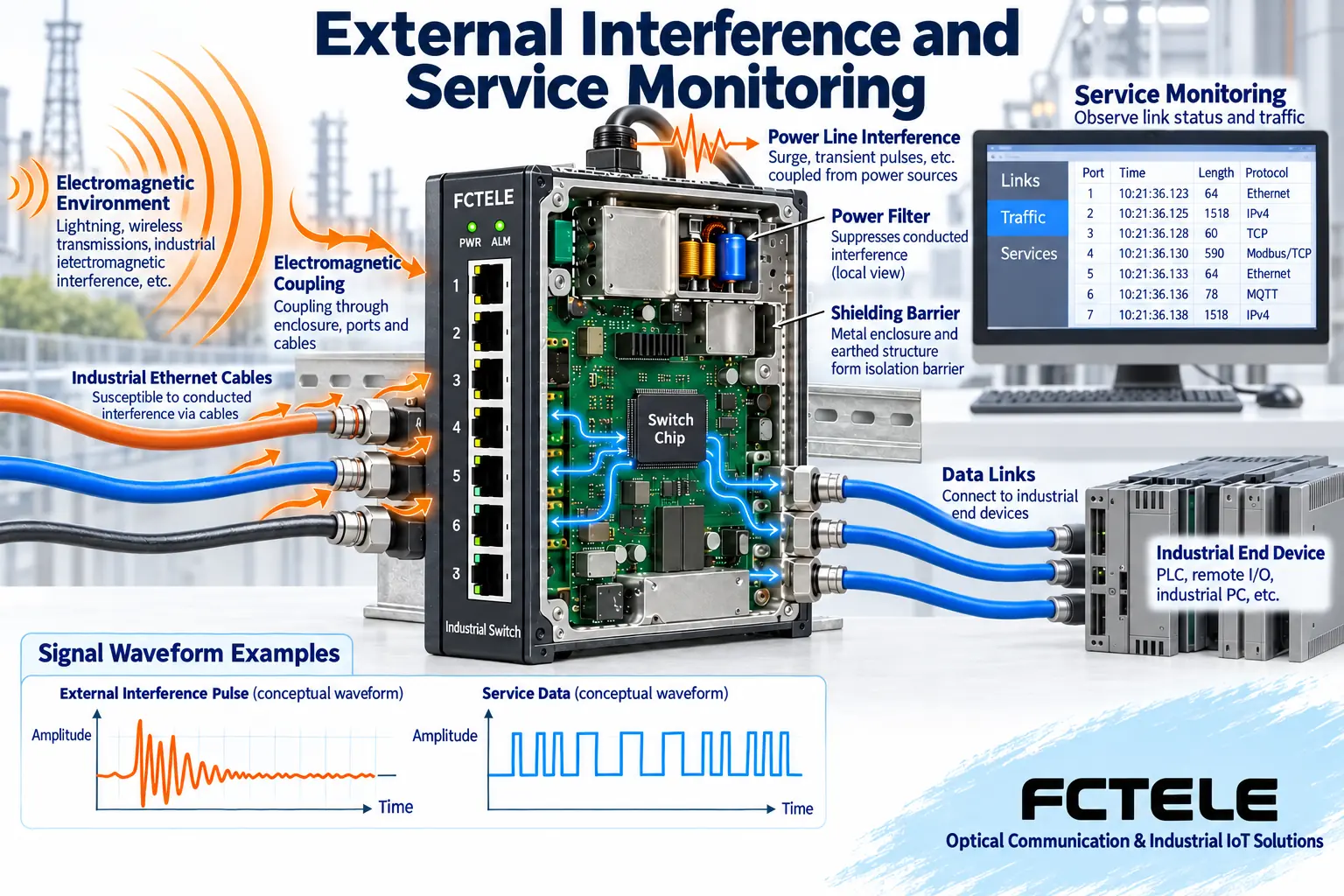
Chips, power supplies, and interfaces in industrial switches generate rapidly changing electrical signals. They need to avoid causing unacceptable electromagnetic interference to surrounding equipment and also need to maintain proper operation in the expected electromagnetic environment. This is the electromagnetic compatibility issue. Compliance documentation relates to this specific issue and cannot directly prove how far fiber can transmit, how fast a ring network recovers, or that the device is suitable for all outdoor cabinets.

Understanding the compliance material you provided
The image below is the original Certificate of Compliance provided by the user. The number and report number are both XH250802090093, and the issue date is August 19, 2025. The document states that the applicant and manufacturer is Hang Zhou Fei Chang Technology Co., Ltd, the product name is Industrial Network Switch, and it lists a group of specific models such as FCM-G8Q4 and FCM-G8Q4-PS. This article introduces the fields based on what is visible in the image and has not independently verified the issuer’s qualifications, the full report, or the authenticity of the document.
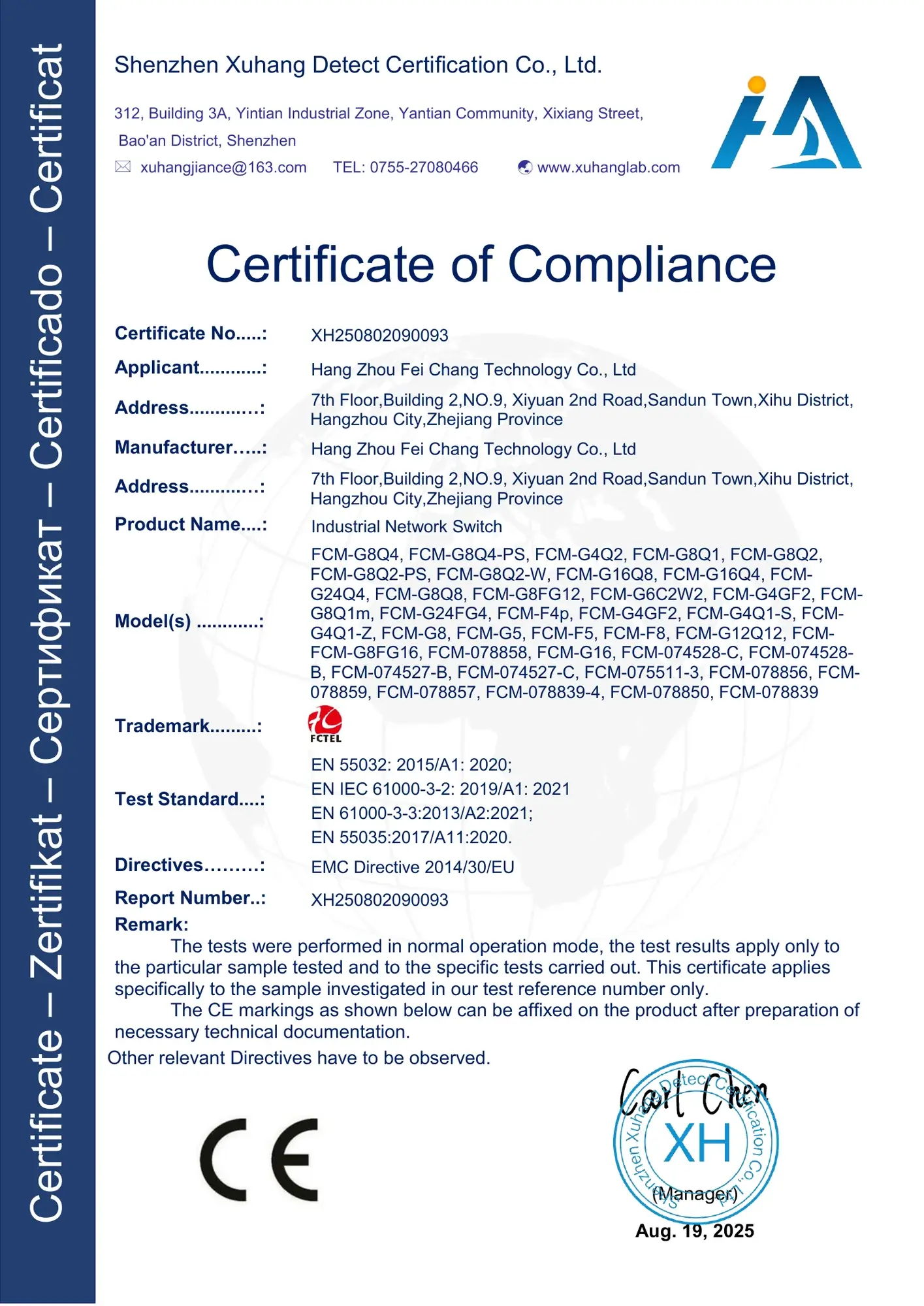
The directive listed on the certificate is EMC Directive 2014/30/EU; the test standard fields list EN55032, ENIEC61000-3-2, EN61000-3-3, and EN55035 with their corresponding versions. This prompts the buyer to continue checking electromagnetic compatibility materials; it does not mean all regulations are covered. Safety, wireless, electrical environment, or material requirements not written in the document cannot be added as passed items, and the listed standard versions cannot automatically be called all currently applicable harmonized standards.
The notes limit that the test results apply to the specific tested sample and the corresponding tests, and mention that the mark may be affixed after preparing the necessary technical documentation and that other relevant directives should still be observed. This limitation should be read together with the main body of the certificate. The CE symbol in the document does not mean that a competent authority has approved each delivered device individually, and the model list in the image cannot replace verification of the prototype identity and delivered configuration.
Emissions and immunity test two directions
Emissions focus on how much interference the device sends out, while immunity focuses on how the device behaves when external interference acts on it and whether that behavior meets requirements. These are different from everyday Ethernet data transmission: data travels along designed interfaces, while interference may also enter circuits through power supply, cables, and spatial coupling. Shielding, filtering, and structural design affect these paths, but a certain appearance or metal enclosure by itself cannot prove that testing has been passed.
Immunity tests need to specify application conditions, monitored services, and performance criteria. Seeing the word “test” in a report should not lead to the conclusion that communication will never drop or that any surge can be withstood. Short-term changes allowed under certain conditions may also differ from services required to work continuously, so formal projects should compare the report criteria with actual service requirements. Changes in device and power wiring, cables, and attached modules may also change the representativeness of the test.
Certificates, Test Reports, and Declarations of Conformity: Check Them Separately
Third-party compliance materials can indicate the associated sample, standards, and report number; a detailed test report should explain the test object, configuration, conditions, results, and limitations. An EU declaration of conformity is a document in which the manufacturer takes responsibility for applicable requirements and should identify the product and relevant legislation. The three have different uses, and a certificate cover cannot replace the content of a declaration or report. For voluntary certificates, their nature also needs to be confirmed, and they cannot be directly regarded as proof of compliance recognized by EU law.
When checking, start with the delivered device: whether the complete model, hardware version, power supply method, and attached modules can correspond to the documents. Similar models, the same series name, or the same manufacturer do not automatically prove that all configurations are covered by the same report. If the certificate lists only certain models, whether newly added models have a basis for coverage should be provided by the manufacturer through an associated explanation and technical documentation; purchasing staff should not add words by themselves in a screenshot.
Then compare the number, date, organization name, and report references. A newer date does not automatically guarantee that all legislation or standard statuses are correct; an older document also cannot be directly judged invalid just because its year is earlier. The current document version should be checked according to the actual time of placing on the market, product changes, and applicable requirements. If inconsistencies are found in the model, address, or report references, obtain a written explanation first, and do not use verbal “they are all the same” to replace traceability records.
Delivery acceptance still needs to cover specific services and environment
CE-related materials cannot replace port, bandwidth, environment, redundancy, and installation acceptance. If outdoor waterproofing is needed, check the enclosure rating and cabinet plan; if fast service recovery is needed, verify the topology and terminals; if specific power supply conditions are needed, check the power supply and wiring documentation. The absence of a certain CE image also cannot be used to claim that the device is necessarily unsafe or that the manufacturer lacks technical strength, because the applicable market and legal scope must first be determined.
Feichang Technology Managed industrial Layer 3 switch with six 10-Gigabit optical ports and 48 gigabit optical/electrical combo ports The page lists CE-related certification information, port statistics, logs, and other functions. Buyers can use this to request documents for the corresponding delivered model and use statistics and logs for service acceptance; this article does not use it to determine that the certificate provided by the user covers all configurations on that page. Product features and certificate coverage must each have evidence.
Link the document verification results with the device serial number, configuration, procurement batch, and acceptance records. When power supplies, modules, or structures are changed later, reconfirm whether this affects the basis for conformity. In this way, the certificate changes from a promotional image into traceable documentation, rather than using one mark to replace all engineering judgment.
References:Your Europe explanation of the CE mark, the original text of 2014/30/EU, European Commission EMC materials and explanation of voluntary certificates. This article explains procurement verification methods; specific legal applicability and conformity conclusions should be confirmed by the responsible parties.
Translated from the Chinese technical article. Source first published: 2020-10-15. Source last revised: 2026-10-13T18:44:52+08:00. Read the Chinese source
