


When choosing managed fiber media converters, define what must be observed, who handles alarms and how to recover after disconnection before comparing features. A login page or advertised management protocol does not prove the platform can read required fields, or guarantee remote control after an optical failure. Verify service compatibility, management reachability, information accuracy and safe operation together.
1. Turn maintenance questions into verifiable fields
List concrete questions: which site disconnected, whether the fault is copper or optical, whether a link flaps and whether an unplanned restart occurred. Identify supporting device information such as port status, uptime, event times and supported error counters. Device names must identify actual cabinets and ports; otherwise an address on screen still leaves technicians unsure where to investigate.
Port status indicates a physical-link condition, not necessarily a working camera image or application. Receive errors indicate abnormalities at their measurement point and cannot automatically identify a cable or terminal fault. Ask suppliers to explain field meanings, counter-reset conditions and history retention, then ensure the platform uses the same definitions. Attractive interface colors are not a substitute.
Optical power, module temperature and similar diagnostics require support from both module and converter. Verify the ordered version, module type, units, displayed ranges and update method. Judge power against that optical receiver range rather than another model threshold. A fixed-optics product without readings may need an external measurement arrangement; missing diagnostics do not mean the device is broken.
2. Match service interfaces before configuring management
The converter first performs electrical/optical conversion. Match copper speed, optical interface, fiber, connectors and peer. Duplex fiber connects transmit to remote receive, with both directions verified. Single fiber requires complementary wavelengths. A connector fitting establishes only mechanical compatibility. Management cannot correct a wavelength or speed mismatch.
For VLANs or longer frames, check support across the entire path. A management address on one network does not mean the device routes service traffic. Verify management-tag handling, service-tag transparency and switching separately. Otherwise the management page may work while service fails because tag conditions differ.
The FCTEL remotely managed single-optical/single-copper Gigabit page lists local and remote management, remote OAM frames and interoperation with compatible management cards. Use these as requirements for demonstrations of actual endpoint combinations, readable/writable fields and platform recognition. They do not imply remote-management support in arbitrary converters. When one page covers several ordering structures, obtain written specifications for the exact version rather than mixing their parameters.
3. Verify remote management over its actual path
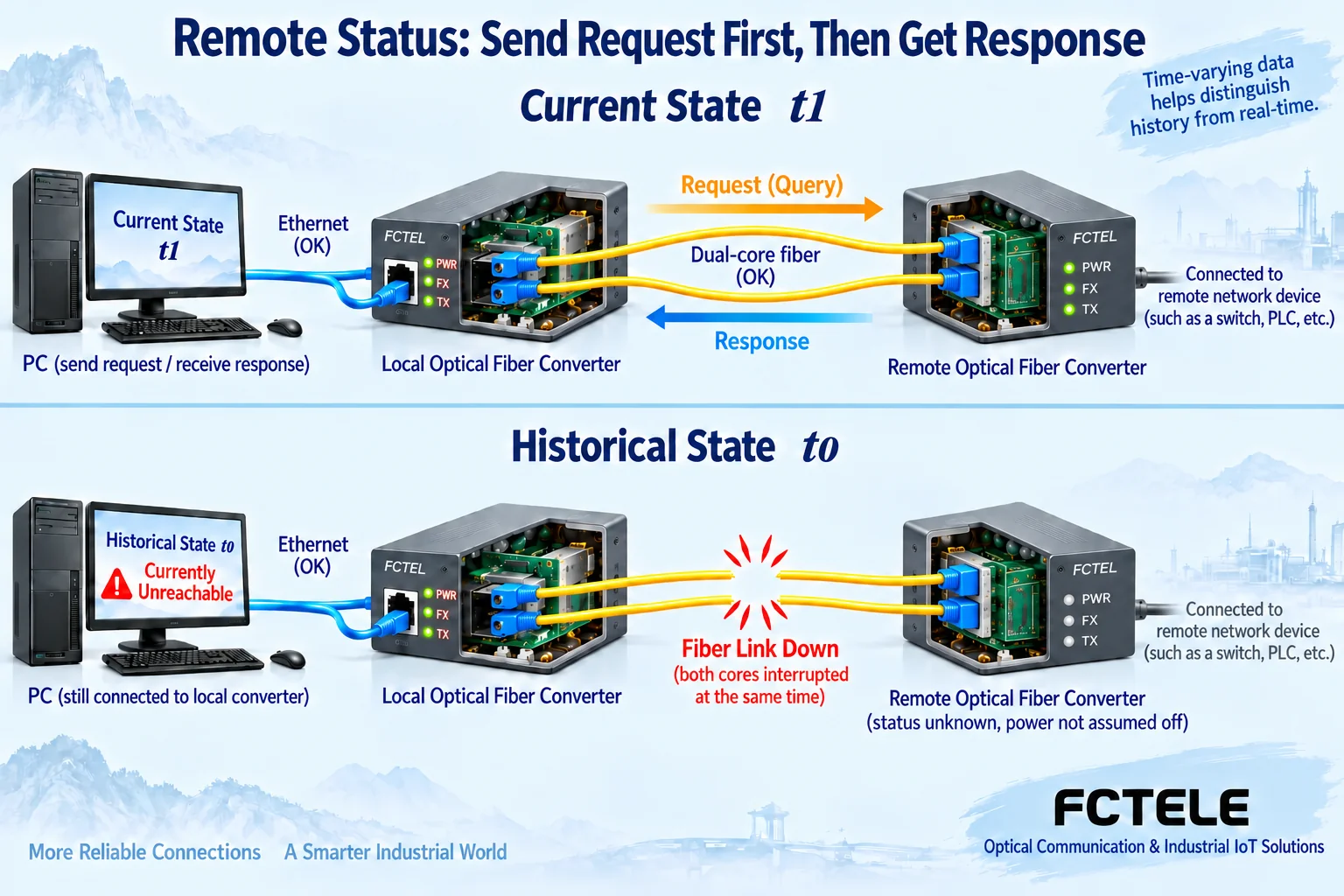
A management request travels from the computer through the management network to the local device. Reading a remote endpoint may also require the optical path and matching protocol. Only when the reply returns over an available path can the platform display current data. Opening the local web page is not remote acceptance. Change a supported remote state and observe whether the platform updates under agreed conditions.
In-band management shares transmission facilities with service. A shared fiber break can remove remote queries along with traffic. Continued local readings do not prove the remote unit powered off. Clearly distinguish current, historical and unreachable status, including the last-update time. If observation must continue during an outage, evaluate a separately designed management path rather than assuming a built-in backup channel.
4. Complete the alarm handling loop
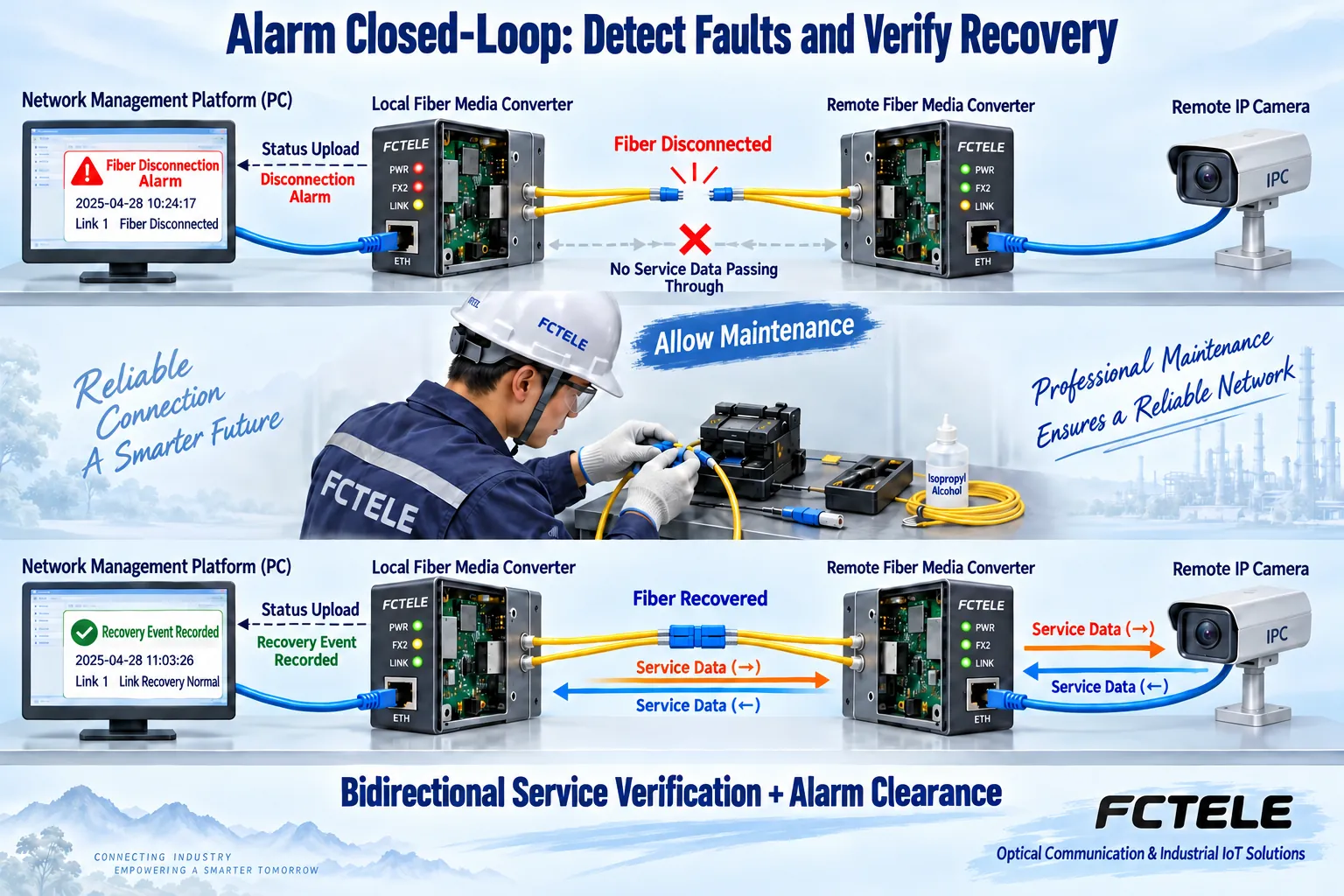
An alarm is more than a pop-up. Include location, object, event, time and current status. Maintenance personnel acknowledge and act on a procedure, then verify service and records after recovery. Link-fault propagation may cause a related port to report failure as well. Interpret this against the topology instead of declaring two independent faults. It passes failure information; it does not create a backup service link.
Periodic polling detects current state; device notifications can report changes promptly. Both depend on management reachability. No notification does not prove no fault occurred. Cross-check polling, event logs and supported notifications. Polling periods, notification capabilities and time synchronization depend on equipment and project requirements rather than a universal response time.
In isolation or an approved outage window, disconnect one registered port and retain its preceding status. Check the platform object, notification, time and history, restore the connection, then confirm alarm clearance and bidirectional service. Do not pull production fibers indiscriminately or create loops. Define the simulated action, expected effects and restoration method beforehand so testers know when to stop.
5. Remote changes require controlled permissions
Put management on a controlled network, restrict source access and avoid direct public exposure. Change default passwords. Give observers read-only access; authorize and log accounts that can disable ports or upgrade firmware. SNMP versions and security options differ. A protocol name alone cannot prove authentication or encryption; verify the actual implementation.
Disabling a port, changing an address or resetting remotely may sever the management path itself. Back up configuration, identify immediately effective settings and prepare onsite restoration within a service window. Obtain firmware from the official channel for the applicable model and check upgrade and failure-recovery conditions. Generic file-transfer instructions from an older article cannot replace a current manual.
6. Compare total cost and retain acceptance evidence
Management costs include platform integration, account maintenance, alarm handling and training, not only hardware. Avoiding unnecessary visits may benefit remote sites; complex management may be uneconomic for a few accessible links. Evaluate actual maintenance tasks rather than assuming more functions always save money or inventing a universal visit cost.
Acceptance documentation should include endpoint models and versions, topology, management addresses, field definitions, platform integration, account roles, fault tests, configuration backups and recovery steps. Each important requirement needs actual verification. Distinguish queryable, changeable, unreachable during an outage and requiring onsite recovery so procurement and maintenance share the same understanding.
Translated from the Chinese technical article. Source first published: 2024-10-23. Source last revised: 2026-10-13T16:02:51+08:00. Read the Chinese source
