


Security monitoring systems first choose optical transmission equipment based on camera output signals, then verify channels, fiber, and power. Analog video fiber optic transmission devices and Ethernet fiber media converters solve different interface problems and cannot be interchanged just because both use fiber. Transmission equipment also does not automatically provide recording, encoding, or video management functions.
Look at the interface first, don’t ask how many kilometers first
Analog cameras may output video through coaxial cable; network cameras usually send IP data through Ethernet; dedicated digital video such as SDI has its own interface standard. You must clearly list the signal type, resolution or rate, output port, and receiving-end device. A BNC connector is only a mechanical shape; the same BNC may also carry different signals, so you cannot assume that all analog or digital video can connect to one type of fiber optic transmission device.
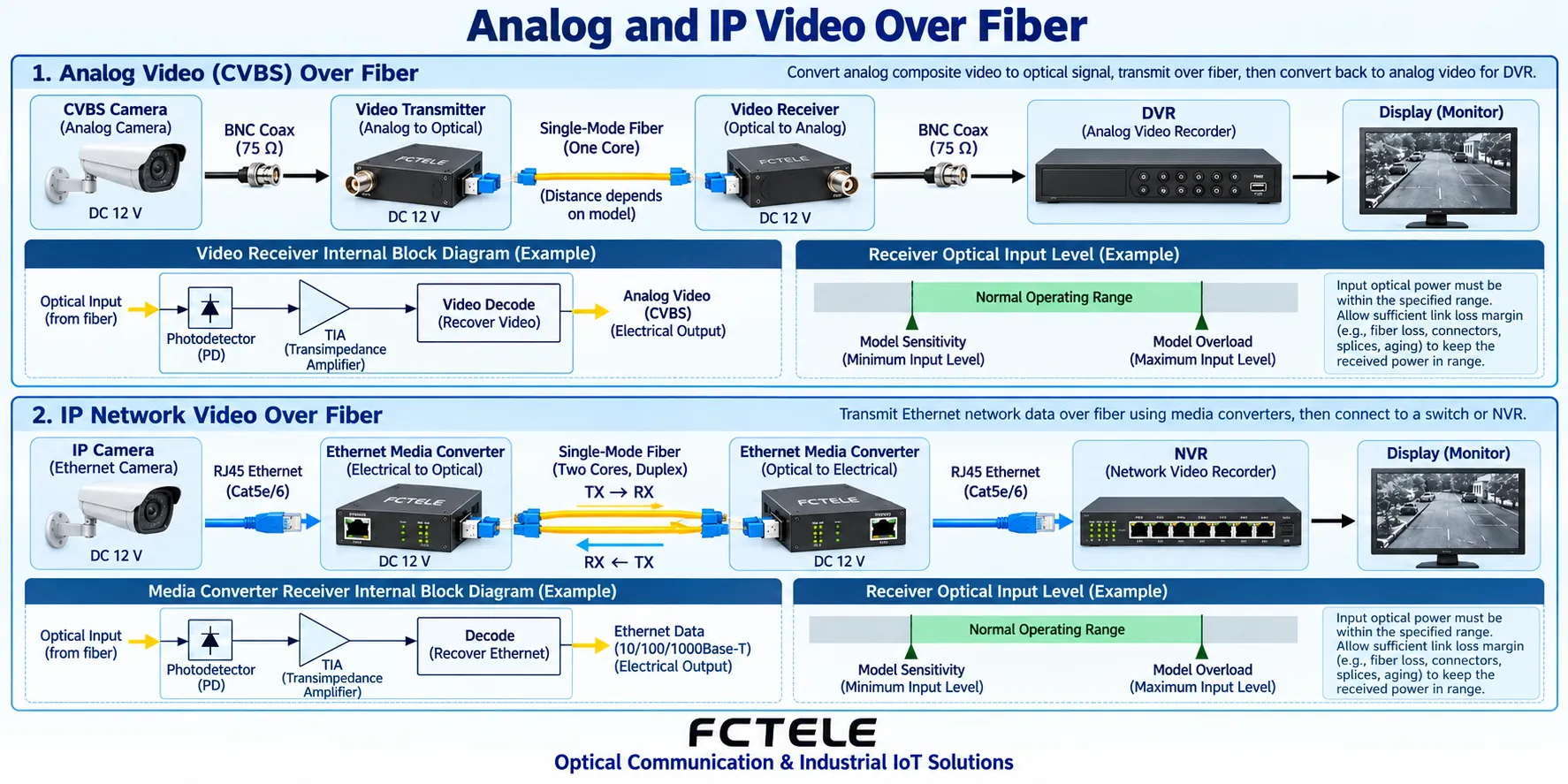
The paths for analog video and network video are different
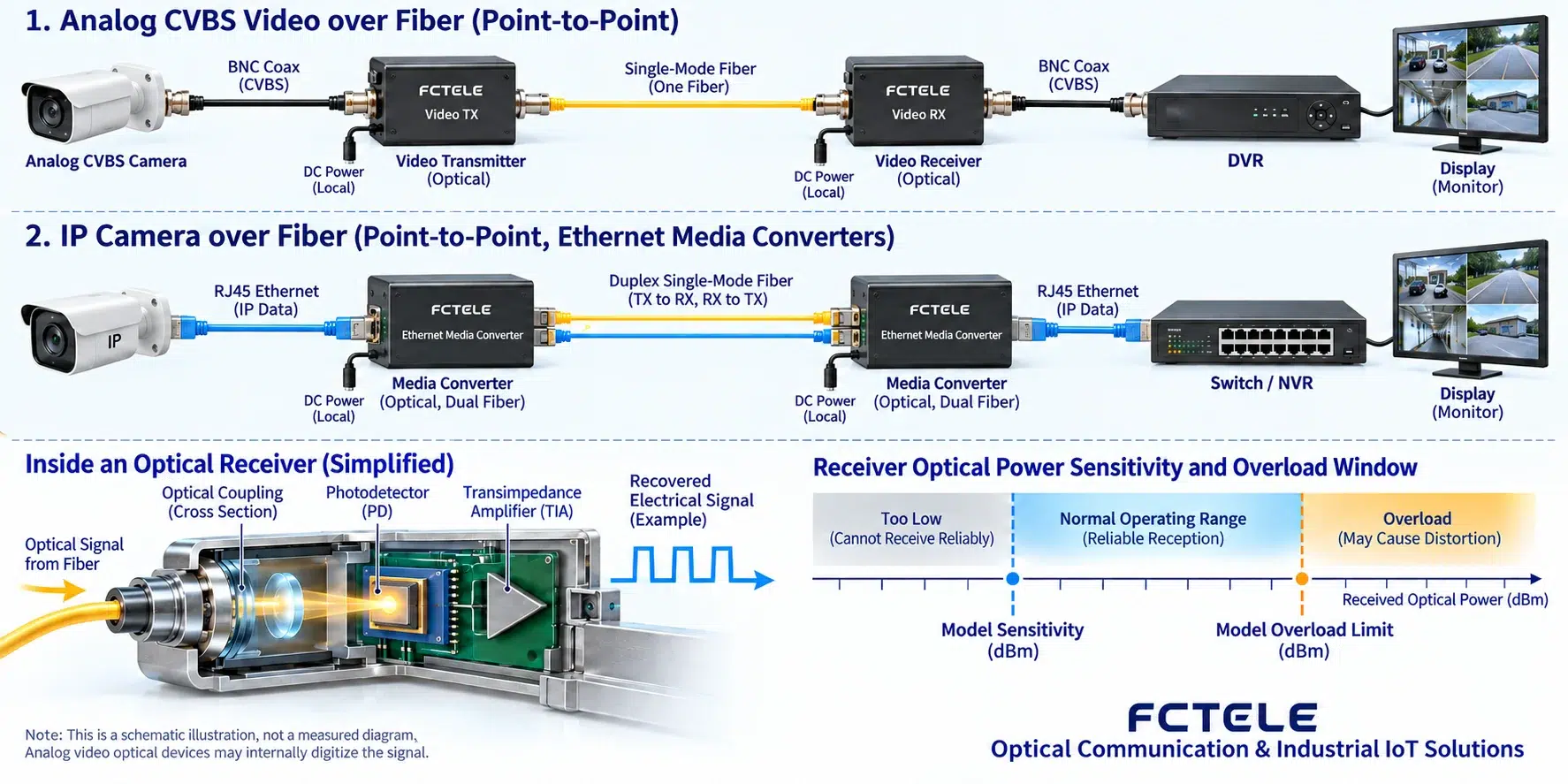
A matching analog video fiber optic transmission device sends the supported video signal to the other end of the fiber, then hands it to a compatible recording or display device. IP cameras generate network data, which can reach an NVR or platform through a switch and an Ethernet optical transmission link. An ordinary media converter does not encode analog images into network video; if this kind of conversion is needed, a compatible encoding device should be selected separately. Network bandwidth should be estimated based on concurrent video streams, other services, and margin, not by directly using the pixel count as the network port rate.
Channel count also includes control and audio
Besides video, the site may need audio, serial control, alarm input/output, or telephone. Confirm the direction, quantity, electrical specifications, and protocol of each type of interface to avoid buying multiple video channels but lacking pan-tilt control. So-called integrated services do not guarantee that all interfaces can be combined arbitrarily. Check bidirectional data, unidirectional video, and power supply requirements separately; whether the remote camera is powered by PoE also cannot be solved by the fiber itself.
The optical power window is more important than the nominal distance
Check single-mode or multimode, single-fiber or dual-fiber, wavelength, and connectors; single-fiber equipment usually needs complementary wavelength pairing. The received power must neither be lower than the sensitivity nor exceed the allowed upper limit. The nominal distance is based on certain conditions; on-site splicing, patch cords, connectors, and device losses should be added to the budget; using high-power long-distance equipment over short distances also requires evaluating overload. A lit optical port only shows that some link conditions are met; it does not prove that video quality and bidirectional services are all qualified.
Use complete services for acceptance
First test with a short fiber, then connect the formal line. For analog systems, observe the picture, synchronization, color, and control response; for network systems, check packet loss, continuous streams, concurrent access, and video playback. Record the models at both ends, optical power, fiber core number, power supply, and port status, and simulate power failure recovery. Video stuttering may also come from encoding configuration, bandwidth, or storage, and cannot always be attributed to the fiber. The selection conclusion should be based on the complete signal path.
Example: Upgrading from analog monitoring to network cameras
If the old system uses coaxial video fiber optic transmission devices, after switching to IP cameras, the original equipment may not necessarily still be usable. First confirm the new camera’s network port, power supply, stream, and platform compatibility, keep the usable fiber cable but reselect matching network optical transmission at both ends. Reusing the fiber cable does not mean the equipment can also be reused; single-fiber wavelength, connectors, and optical power need to be rechecked. Then use the recording platform to verify continuous streams, playback, and multiple concurrent channels, not just local preview. A newly added PoE switch also needs an independent power budget; fiber cannot deliver the electrical power needed by the camera.
Translated from the Chinese technical article. Source first published: 2019-04-10. Source last revised: 2026-10-13T23:07:12+08:00. Read the Chinese source
