


Serial networking efficiency is not determined by Ethernet speed alone. A transaction includes serial transmission, device processing, network waits and application parsing. Polling adds slow/faulty stations and retries. Optimize correct arrival within required time rather than maximizing every setting. A transparent server does not automatically compress, synchronize samples or correct arbitrary protocols.
Break down one response time
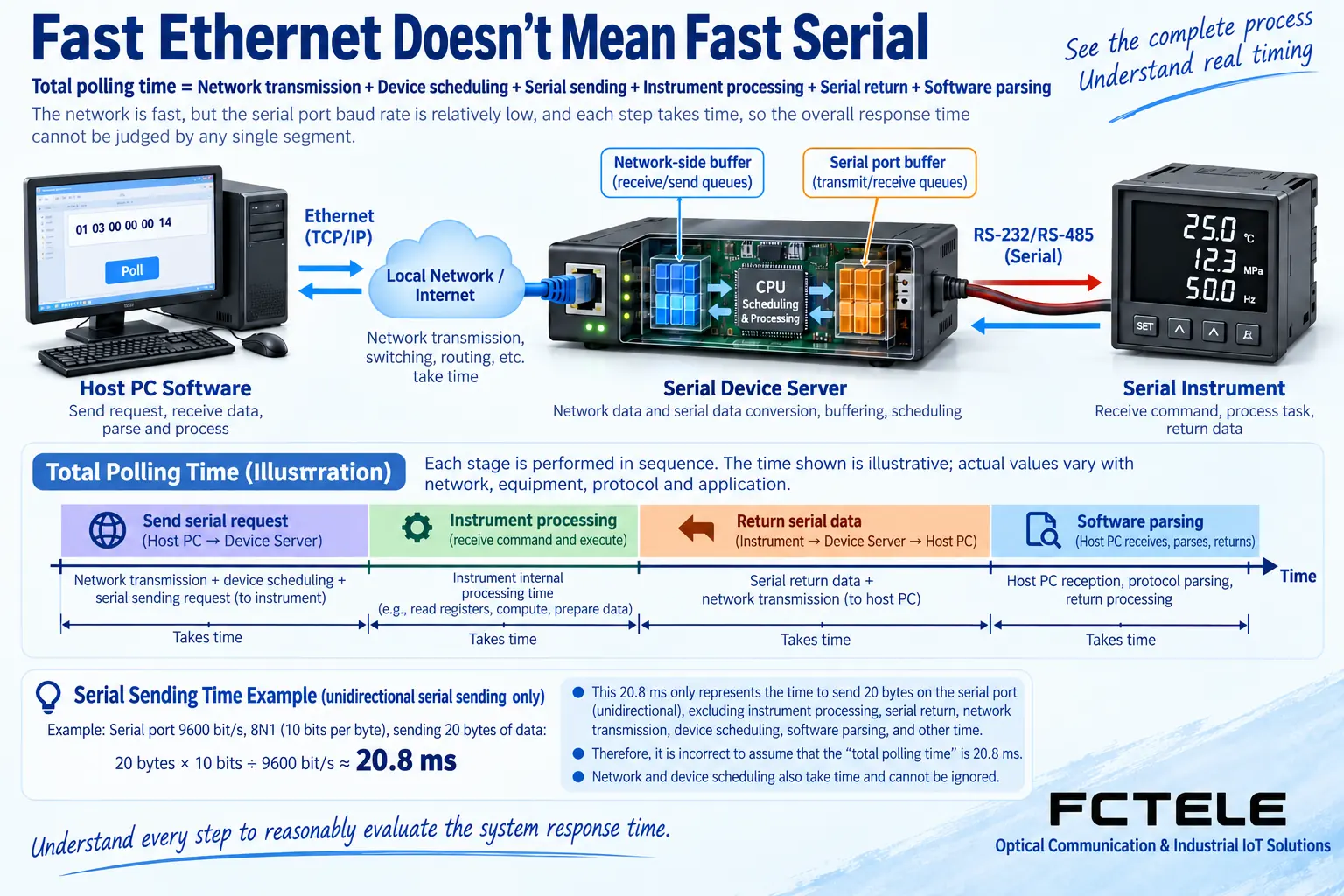
A request travels from computer over network to server, then bit by bit over serial. After receiving it completely, the instrument processes and replies along the reverse path. Each stage takes time. Fast networking cannot remove instrument processing or serial transmission by upgrading to Gigabit.
For a calculation example, 8N1 includes a start bit, eight data bits and one stop bit: ten line bits per byte. At 9600 bit/s, twenty bytes take about 20.8 ms to transmit. This is one-way serial time only, excluding request, processing, network and scheduling; it is not a guaranteed transaction response.
Give every station room in the polling cycle
Add normal transactions, silent intervals, scheduling and retry budgets for each station to estimate a cycle. Equal station counts can have different cycles because responses and processing differ. List protocols, request lengths and typical/maximum responses before judging refresh feasibility.
A disconnected station repeatedly using long timeouts/retries steals time from healthy stations. Use finite retries, alarms and controlled lower frequency, or temporary isolation under application rules. Do not hide errors by unlimited timeout extensions or discard legitimate slow replies with indiscriminately short limits.
How packetization waits affect responsiveness
A server may wait for a character count or idle interval before sending. This reduces small packets but delays the first byte. Short waits can increase overhead; long waits can trigger application timeouts. Choose against protocol and cycle needs rather than a universal millisecond value. Check configured ranges and framing behavior in the manual.
TCP is an ordered byte stream, not one message per read. Packetization optimization cannot replace protocol framing by length, terminator and valid checks. Changed packet counts do not necessarily mean lost data. Compare complete byte sequences and transactions to avoid optimizing the wrong measure.
Buffers handle temporary busy periods
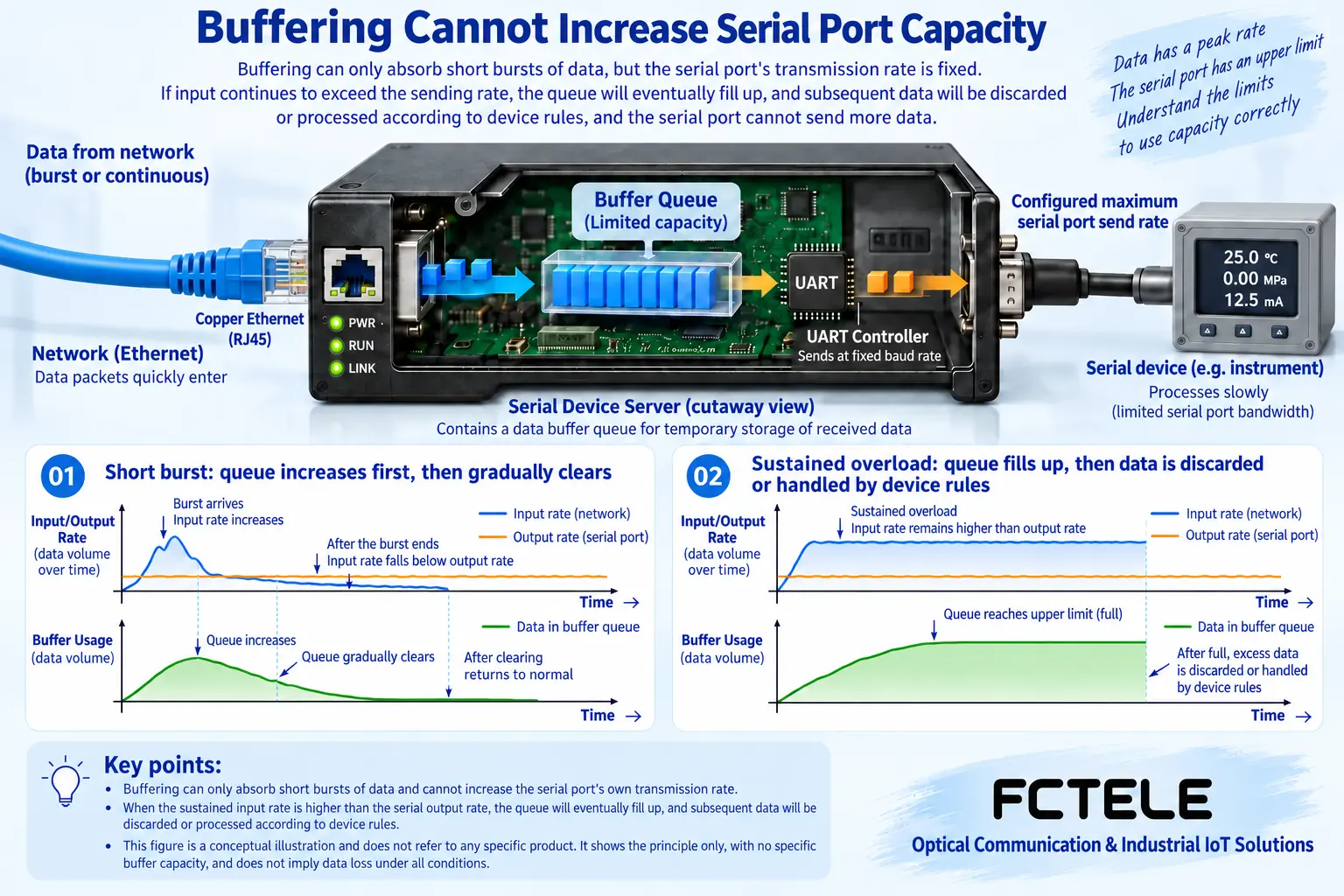
Network bursts may queue before serial bit-by-bit output. A finite buffer resembles a waiting area: temporary crowds fit, but sustained arrivals above departures eventually fill it. Check whether a full device drops, blocks or behaves otherwise. Large buffers cannot provide unlimited throughput or guarantee no loss during arbitrarily long outages.
Flow control needs compatible interface, wiring and software. RTS/CTS and XON/XOFF are not universal fixes for arbitrary two-wire RS485 devices. Match producer, queue and consumer rates. If stable capacity is exceeded, reduce requests, optimize applications or allocate independent channels rather than add retries.
Coordinate transactions across clients
Several network sessions to one serial port do not authorize several programs to query a single-master instrument simultaneously. Interleaved commands confuse response ownership, timeouts and execution. Define controlling/read-only roles, distribute data centrally or use verified scheduling instead of simply increasing connection count.
Persistent connections avoid setup overhead but require disconnection, stale-session and recovery handling. Network keepalive checks connection conditions, not application operation. Define business heartbeat meaning without sending unauthorized probes. Reconnection must not blindly replay all buffered writes; confirm uncertain execution under application rules.
Ordered arrival is not synchronized sampling
TCP preserves order within a connection, not simultaneous measurements across instruments. Computer receipt time differs from sensor sample time. For time alignment define timestamp origin, clock synchronization and error measurement. Do not claim every server timestamps every record automatically.
Transparent transport cannot compress arbitrary original messages without endpoint agreement. CRC detects certain errors; it does not automatically correct every failure. Parsing gateways have different roles from transparent servers. Separate responsibilities to identify instrument, server or application bottlenecks.
Optimize one variable at a time
Retain a known-good configuration and raw messages, record serial/network times, and assess transaction success, response distributions, timeouts and reconnects. Fast averages can hide long tails, so inspect high percentiles and worst anomalies. Do not stress production or alter protocols without authorization.
Evaluate packetization, polling frequency, timeout and retry settings one at a time under identical loads. Cover all ports, one failed station, network interruption and application restart. Select FCTEL channels/modes against actual documentation and accept measured system service, not CPU names, Ethernet speed or an unqualified promotional curve.
References:TCP byte-stream specification;FCTEL serial device server details. Figures show generic mechanisms; curves are not measurements or performance guarantees.
Translated from the Chinese technical article. Source first published: 2025-02-13. Source last revised: 2026-10-13T15:49:49+08:00. Read the Chinese source
