


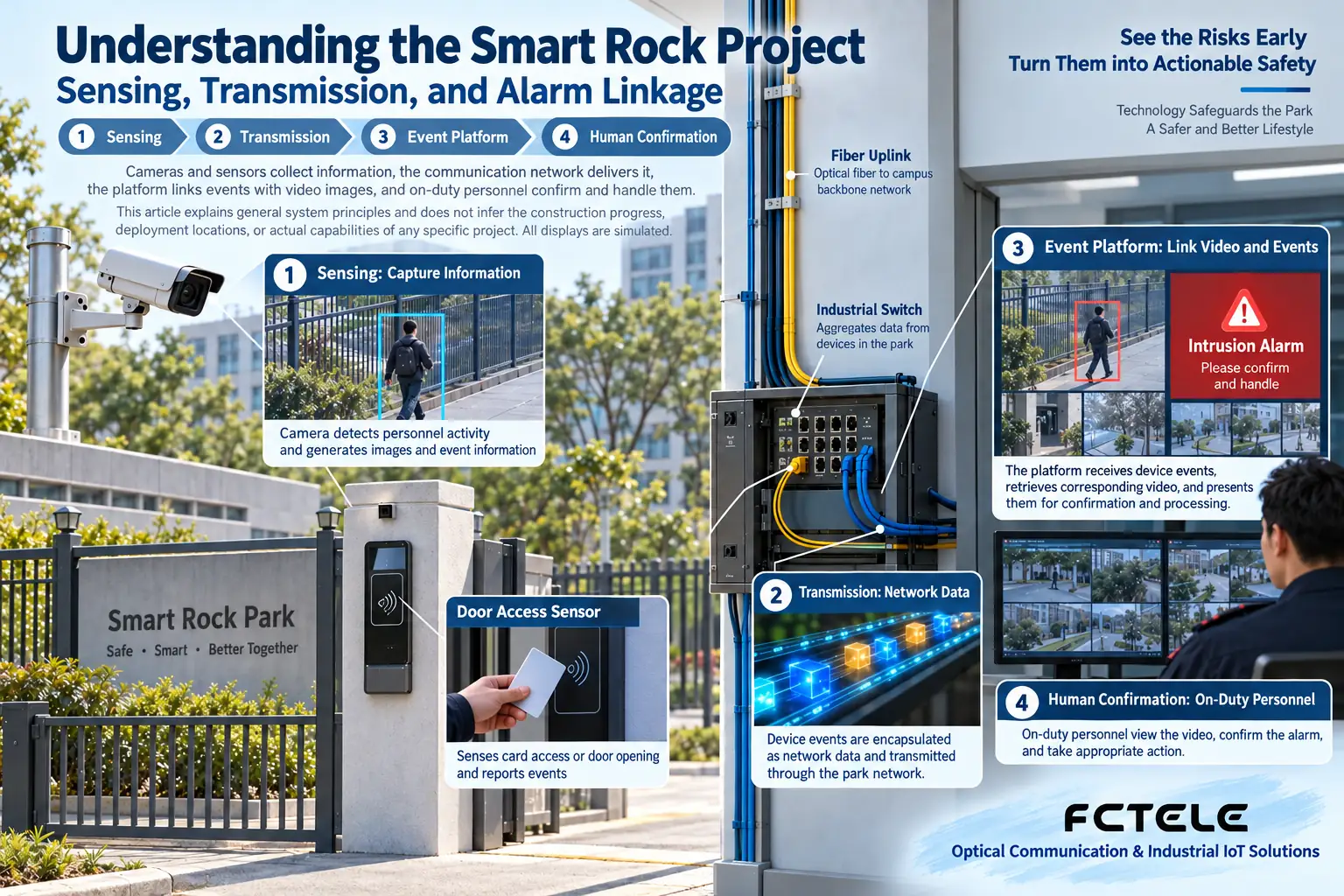
To understand information technology construction related to the “Smart Rock” project, you can start with four stages: sensing, transmission, alarm handling, and operations and maintenance. Cameras and sensors are responsible for collecting information, the communication network is responsible for delivering it, the platform links events with video images, and on-duty personnel then confirm and handle them. This article explains general system principles and does not infer the construction progress, deployment locations, or actual capabilities of any specific project.
Seeing the complete information chain from a single alarm
Take an ordinary campus door magnetic contact as an example. A change in door status first becomes a sensor output. The access device converts it into information that the platform can recognize, and the network transmits the event to the management side. If an associated camera has already been registered, the platform can display the corresponding image at the same time. Finally, personnel determine whether it is a normal door opening, a device abnormality, or an event that needs handling.
These steps are not the same function. A camera being online does not mean that a door magnetic event is definitely uploaded, and being able to ping the network does not mean that the platform has correctly associated them. During acceptance, you should look at “when the event is generated, which interface it passes through, which interface it is displayed on, and who confirms it,” rather than only checking that the large screen has an image.
What problems do fiber optics and industrial switches solve?
Fiber optics are commonly used to carry data for long-distance connections across buildings. Switches aggregate Ethernet services at the access end, and optical modules or transceivers complete the corresponding optical-electrical interface connections. Fiber optics reduce the impact of electromagnetic interference on the transmission medium, but they do not provide electrical power to remote devices; remote power supply and protection still need to be designed separately.
Video continuously occupies bandwidth, while alarm messages may be very short but have requirements for timely delivery. Planning should verify the video bitrate, uplink capacity, and event services, and configure priority, multicast, and network partitions according to actual capabilities. Merely changing ports to gigabit cannot automatically solve slow platform response or incorrect association.
“Intelligent” does not mean every alarm is correct
Algorithms may be affected by lighting, occlusion, environmental changes, and input quality. Judgments produced by devices should have records, review, and clear applicable boundaries. A recognition rate without a test method and scenario scope cannot be used as evidence of the reliability of the entire system.
The same event may also come from multiple sensors. The platform needs unified time, device numbering, and location registration to link them together. Clock deviation or confusing names can make playback and alarms appear inconsistent, and even if the line is not disconnected, personnel may not be able to find the corresponding image.
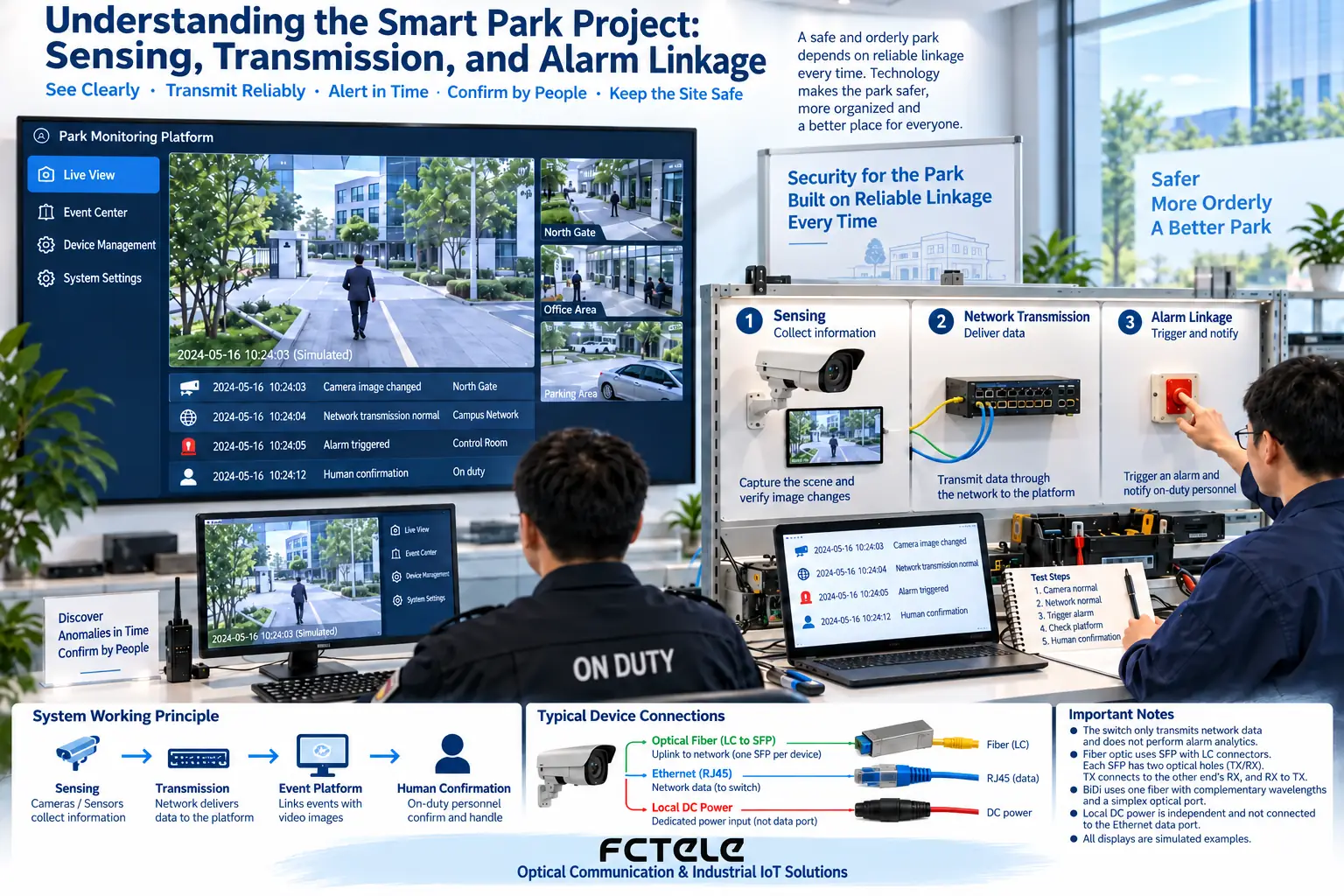
Operations and maintenance should be able to distinguish abnormalities at three levels
The device layer checks power supply, interfaces, and local status; the network layer checks links, addresses, and error counters; the business layer checks registration, permissions, and event rules. When a camera has a black screen, you should not directly conclude that it is a fiber optic fault. First preserve the phenomenon and time, then narrow the scope layer by layer to avoid changing multiple configurations at the same time.
Secure access also involves account permissions, management entrances, and upgrade maintenance. Dividing services into VLANs can limit the broadcast range, but it is not equal to physical isolation or complete security protection. Management permissions and necessary access policies should be checked independently, and configuration change records should be kept.
Use reproducible tests instead of vague conclusions
In an authorized test environment, trigger the specified input events and record the display, confirmation, and recovery process; then verify the prompts when a single device or link is abnormal. Tests must comply with on-site management requirements, and do not randomly unplug cables or turn off power on a running system. After recovery, check whether events were missed and whether the status is consistent.
Delivery materials should include equipment ledgers, port relationships, business rules, maintenance responsibilities, and test records. When communication equipment is needed, you can check interfaces and network capabilities at Feichang Technology Product Center. Selection should be based on verifiable requirements, and vague terms such as “comprehensive intelligence” should not replace clear engineering indicators.
The illustrations are general principle and campus scenario diagrams. They do not show real dedicated facilities, nor do they represent the performance or construction status of any specific project.
Translated from the Chinese technical article. Source first published: 2019-10-18. Source last revised: 2026-10-13T22:35:50+08:00. Read the Chinese source
