


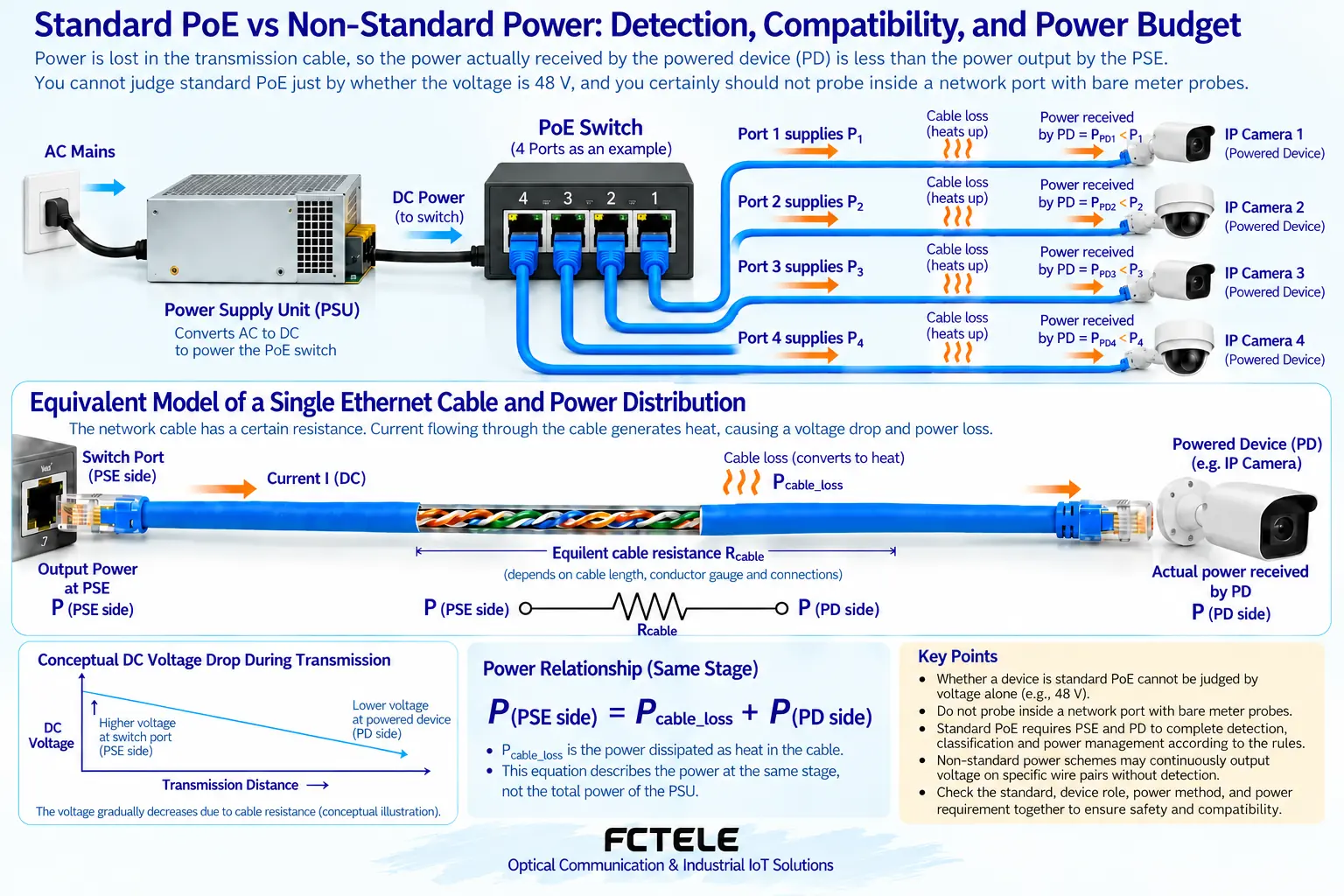
You cannot judge standard PoE just by asking whether it is 48V, and you certainly cannot poke around inside a network port with bare meter probes and draw a conclusion. The key to standard PoE is that the power sourcing side and the powered device side complete detection and power management according to the applicable rules; some non-standard power schemes may instead continuously send voltage to designated wire pairs. Whether something is safe and compatible requires checking the standard, the device role, the power method, and the power requirement together, not just comparing one voltage number.
Why can one network cable carry both data and power at the same time
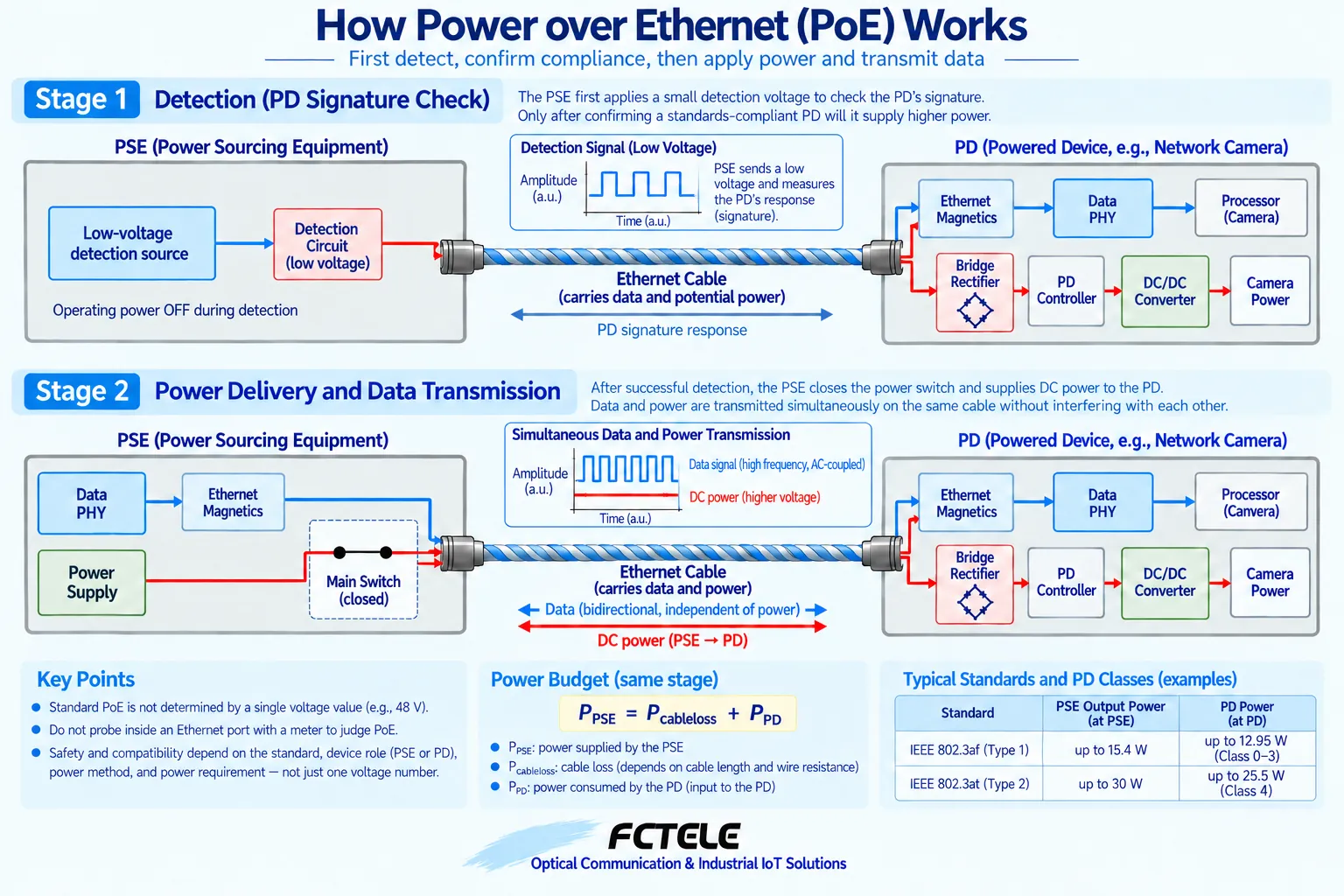
Ethernet data signals and PoE electrical power can be carried in the same cable through suitable circuits. The data passes through the corresponding coupling and receiving circuits, while electrical power is delivered to the device through the power sourcing and receiving paths. Sharing one cable does not mean you can directly connect a power supply to any conductor, and it does not mean an ordinary network port can naturally withstand every external power method.
The practical value of PoE is reducing the need to run a separate power line to a remote device, for example powering a compatible camera or wireless access point. It is still limited by cable, distance, power, and environmental conditions, and you cannot skip all electrical checks just because only one cable is connected. Network data being able to pass through and remote power being able to supply steadily are two conditions that must be met at the same time.
Who are PSE and PD respectively
PSE is the side that provides electrical power, for example a switch port that supports the corresponding PoE function; PD is the side that receives electrical power, for example a compatible camera. They do not merely output and input respectively; they also need the corresponding detection, protection, and management capabilities. Even if an ordinary switch can forward a camera’s data, it does not automatically become a PoE power sourcing device because of that.
Likewise, an ordinary network terminal should not be treated as a powered device suitable for every power method. Some devices need a dedicated power supply or dedicated passive power, and although their connector shape looks similar to a standard PoE terminal, they do not have the same compatibility. Before buying a device, you should check clear standard statements and power receiving requirements, rather than relying on vague descriptions such as power over network cable or compatible with cameras.
Why the standard detection mechanism matters
Taking an applicable standard PoE system as an example, the power sourcing side first uses a detection mechanism to determine whether the other end has the required power receiving characteristics, and then manages classification, startup, and power supply according to the corresponding rules. This process lets the power sourcing side distinguish terminals suitable for receiving power from other connection states. The specific classification and management methods vary with the standard and implementation, so you cannot write one fixed startup time for all versions.
After normal power supply begins, the system also needs to monitor the corresponding conditions and handle situations such as terminal disconnection or abnormality. In other words, PoE is not simply power is always supplied as long as it is present; it includes state judgment and controlled power supply. This article explains the mechanism through functional paths and does not provide network port pin testing or chip circuit construction plans. The detection and protection performance of an actual product should be verified through the corresponding documentation and suitable test equipment.
How non-standard power should not be misunderstood
Some passive power devices continuously send a specified voltage to designated wire pairs and do not use the same standard detection process. They can be used in dedicated systems that are clearly defined and correctly paired, but this dedicated compatibility cannot be extended to any network terminal. Any mismatch in voltage, polarity, power wire pairs, or device requirements may bring risk.
Non-standard does not equal one fixed voltage, and standard cannot be judged by only one measured value either. Non-standard power may use a voltage close to that of a standard system, and the working and detection states of a standard system cannot be fully identified by an ordinary multimeter. Do not treat the inability to measure a stable voltage at a port as proof that the device is damaged, and do not treat a measured voltage as evidence of standard certification.
Why power numbers depend on where you measure
The power output at the power sourcing port and the power finally available at the remote terminal are not the same number, because cable resistance causes loss. For the same current path, resistance causes voltage drop and heat, so the energy obtained by the terminal is less than the output at the power sourcing side. Cable quality, connection state, and actual operating current all affect this process, and you cannot look only at a device’s usual average power consumption.
You also need to distinguish single-port capability from the whole device total budget. The fact that each port of a switch is marked with some power supply capability does not mean all ports can reach that value at the same time; the external power supply and the whole device budget must also meet the requirement. The demand of a camera when infrared, heating, or other functions are turned on may change, so during design you should check maximum operating and startup conditions, rather than using one reading taken during the day to represent year-round use.
A hypothetical example with four cameras
Suppose four cameras each have a clearly stated maximum power requirement. First confirm each camera’s PoE standard and power receiving conditions, then calculate the total power needed for simultaneous operation, and leave a margin determined according to the design requirements. Then check the switch whole-device budget, single-port capability, power supply, and cabling conditions. The example does not specify a uniform wattage because different models have different loads and allowable conditions.
If one camera restarts intermittently, record whether the restart is related to infrared or other functions being enabled, and also check the switch power supply status and error messages. Using a short cable that meets the requirements and is known to be good can help determine the effect of the cable, but a normal short cable does not mean a formal long cable is necessarily qualified. Checks should be carried out step by step, to avoid changing the camera, port, and power supply at the same time and then not knowing which factor actually worked.
How to accurately cite Feichang PoE model features
The industrial managed switches listed in the 3243 product details on the Feichang official website include corresponding optical and electrical ports and optional PoE capability. This can serve as a selection clue when industrial installation and fiber uplink are needed, but under the same model name you should also confirm which power version was ordered. You cannot write optional PoE as meaning that any configuration can power a camera.
In particular, distinguish the switch input power requirement from the PoE port output requirement. The ordinary power supply range of a product does not necessarily apply to the delivery configuration with PoE enabled; on site it must be confirmed according to the corresponding version. Optical port uplink, managed diagnostics, and PoE power supply can together meet project needs, but each function still has independent compatibility and capacity conditions. Official website information provides direction, and formal procurement must turn the conditions into a clear model and configuration.
How beginners can check safely
First read the terminal label, manufacturer manual, and switch documentation to confirm the standard, role, and power. When actual testing is needed, use a tester suitable for the corresponding PoE standard or have it performed by personnel with the capability; do not touch the internal contacts of a network port with bare probes, and do not disassemble wires to guess polarity. Before connecting an unknown passive power device, first confirm all of its requirements, and do not use someone else connected it and it did not break as a basis.
Also pay attention to whether a product description mixes standard support and experimental measurement together. One measurement result can only show the test conditions at that time and cannot replace a complete compliance and compatibility judgment. For conflicting parameters, confirm with the manufacturer and do not choose the number that is convenient for you. A safe selection method should be able to state its basis, rather than guessing from connector appearance or network port lights.
Acceptance should check data and power separately
On the business side, check images, network response, and continuous data transmission and reception; on the power side, check port status, stability when the load changes, and necessary fault records. Normal power supply does not mean the network configuration is correct, and having a link on the network port does not mean remote power can meet all operating conditions. Only by accepting both aspects together is it less likely that a power restart will be misjudged as a purely software or network problem.
Finally, save the terminal model, PoE standard, port assignment, cable information, power supply, and budget basis. After replacing a terminal or adding devices, recheck rather than continuing to use the original margin estimate. The truly important feature of standard PoE is controlled power supply and a clear compatibility mechanism, not a magical voltage; by putting detection, capacity, and site conditions together, the convenience of one network cable can be built on a verifiable basis.
Verification materials:Feichang PoE optional model 3243;TI PoE interface materials. The diagram explains a general mechanism and is not a wiring diagram for a specific model.
Translated from the Chinese technical article. Source first published: 2019-09-20. Source last revised: 2026-10-13T22:35:50+08:00. Read the Chinese source
