
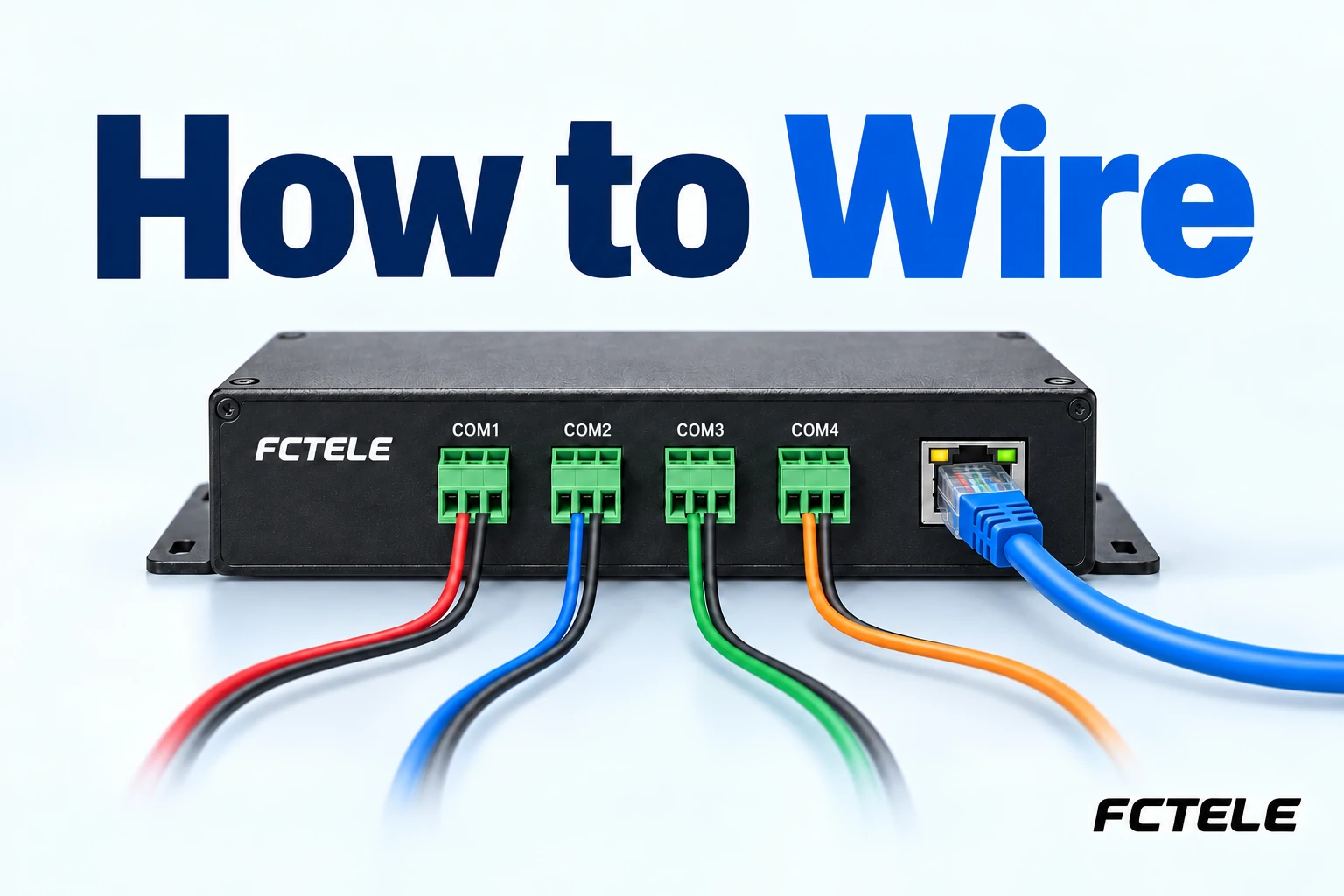
Channel mapping
How to Wire a Multi-Serial Server: Channel Mapping, RS232 and RS485
Map serial ports to their network services and check RS-232 and RS-485 wiring.

Check the OLED display and keys, 16 TXD/RXD channel indicators, power and run indicators, and reset button.
Identify the ordered power inputs, 16 numbered RJ45 serial ports, Console, WAN/LAN and USB-A. Follow the supplied serial pinout when wiring.
Front panel 480 × 45 mm. Chassis 440 × 200 × 45 mm. Leave clearance for rear cabling and side ventilation.
| Item | Specification |
|---|---|
| Processor / system | 650 MHz heterogeneous dual core (Cortex-A35 and Cortex-M4), Linux / OpenWrt. |
| Serial interface | 16 RJ45 ports. The S16 version selects one of RS-232, RS-422 or RS-485 per channel in the web interface. Fixed or mixed port assignments are factory options. |
| Serial line rate | RS-232: 300 bps to 256 kbps. RS-422/485: 300 bps to 1.5 Mbps. Line-rate non-blocking communication supported. |
| Ethernet | Two 10/100Base-T RJ45 ports. Dual IP and dual MAC, IEEE 802.3/802.3u, auto-negotiation, full/half duplex, auto MDI/MDIX and 4,096-entry MAC address learning. |
| Display and controls | OLED shows IP and serial type. Three panel keys, 16 TXD/RXD channel indicators, PWR/RUN and RESET. One Console interface and one USB-A port. |
| Power options | Nominal 220 V AC, −48 V DC or 24 V DC. Specify dual AC, dual DC or AC + DC at ordering. |
| Environment | Operating and storage temperature −40 to +85 °C. Relative humidity 0–95%, non-condensing. MTBF >100,000 h. |
| Chassis and weight | Fanless 19-inch 1U steel case. Panel 480 × 45 mm. Body 440 × 200 × 45 mm. Weight 1.6 kg per unit. |
| Standard | Signals |
|---|---|
| RS-232 | EIA/TIA-232 (ITU-T V.28). RXD, TXD and GND. |
| RS-422 | EIA/TIA-422 (ITU-T V.11). TxD+, TxD−, RxD+, RxD− and GND. |
| RS-485 | EIA/TIA-485. Four-wire: TxD+, TxD−, RxD+, RxD− and GND. Two-wire: A (TX+), B (TX−) and GND. |
The table identifies signals. Use the delivered RJ45 wiring diagram for pin assignments.
| Function | Capabilities |
|---|---|
| Network modes | TCP Server, TCP Client, UDP Server, UDP Client and Modbus TCP. |
| Sessions | Up to four TCP or UDP sessions per serial port. TCP permits up to four users to monitor or manage a channel. UDP supports single- or multiple-peer communication. |
| Network protocols | TCP, UDP, ARP, ICMP, HTTP, DNS, DHCP, SNMP, Telnet, SSH and MQTT. |
| Modbus | Modbus RTU to Modbus TCP conversion and Modbus to MQTT. |
| MQTT and JSON | Multi-topic publish/subscribe, transparent transmission, Modbus-to-JSON packets, JSON distribution and scheduled reports. |
| Cloud platforms | MQTT integration with Huawei Cloud, Alibaba Cloud and Mobile Cloud, subject to platform settings. |
| Encryption and access | SSL encryption for serial data and access control. |
| Legacy software | Virtual COM driver option and standard TCP/IP socket access. |
| Network recovery | Gateway and cross-routing support, with automatic connection restoration after a network interruption. |
| Data framing | Configurable serial packetization. |
| Monitoring and management | Web, SNMP, SSH, Telnet and Windows setup tools. Serial status monitoring and local or remote firmware upgrade. |
| Network organization | Dual IP and MAC. Network sessions can be assigned separately per serial channel. |
| Interface / Test | Rating | Notes |
|---|---|---|
| Power interface | 6 kV open circuit | Surge test on power inputs. |
| All serial ports | 6 kV open circuit | Surge protection with 2.5 kV serial channel isolation. |
| Ethernet ports | 4 kV open circuit | Surge test on RJ45 network ports. |
| Serial optical isolation | 2.5 kV per channel | Isolation provided per serial port. |
| RS-485 grounds | 2.5 kV electrical isolation | Independent line shielding and grounding. |
| AC fault isolation | 220 V or 380 V AC test | Protection of other ports on the isolated side under the specified fault test. These voltages do not apply in normal serial operation. |
Surge test: GB/T 17626.5 (IEC 61000-4-5), 10/700 μs open-circuit waveform, 40 Ω source impedance. Ratings describe the test conditions. Follow the installation requirements for grounding and wiring.
Connect instruments to the numbered serial channels, match settings per channel and use the Ethernet network for host access. The figure illustrates four of the 16 channels.
Configure the client to reach the peer server IP and service port. Verify the routed path and assign sessions separately for each serial channel.
F2 specifies two 100 Mbps copper Ethernet ports. The suffix lists serial interface types and counts. Specify power and accessories separately.
| Ordering Model | Configuration |
|---|---|
| FCT-1700-F2S16 | 16 Web-selectable RS-232/422/485 channels. Specify the dual-power combination and individual nominal input voltages when ordering. |
| FCT-1700-F2D16 | 16 fixed RS-485 channels. |
| FCT-1700-F2R16 | 16 fixed RS-232 channels. |
| FCT-1700-F2X16 | 16 fixed RS-422 channels. |
| FCT-1700-F2D8R4X4 | Fixed mixed build: 8 RS-485, 4 RS-232 and 4 RS-422 channels. |
Yes. In the S16 version, the web interface selects one standard per port: RS-232, RS-422 or RS-485. Fixed and mixed builds are configured at the factory.
Use WAN or LAN for Ethernet. The numbered RJ45 serial ports have a separate signal assignment. Follow the delivered wiring diagram.
The datasheet specifies four TCP or UDP sessions per serial port. Each channel has its own serial parameters and network session settings.
Yes. Configure Modbus RTU-to-TCP conversion, then match the serial settings and device address to the terminal.
The datasheet lists dual AC, dual DC and AC + DC. Specify 220 V AC, −48 V DC or 24 V DC for each applicable input.
Map serial ports to their network services and check RS-232 and RS-485 wiring.

Set up a known terminal and verify wiring, network access and virtual COM.
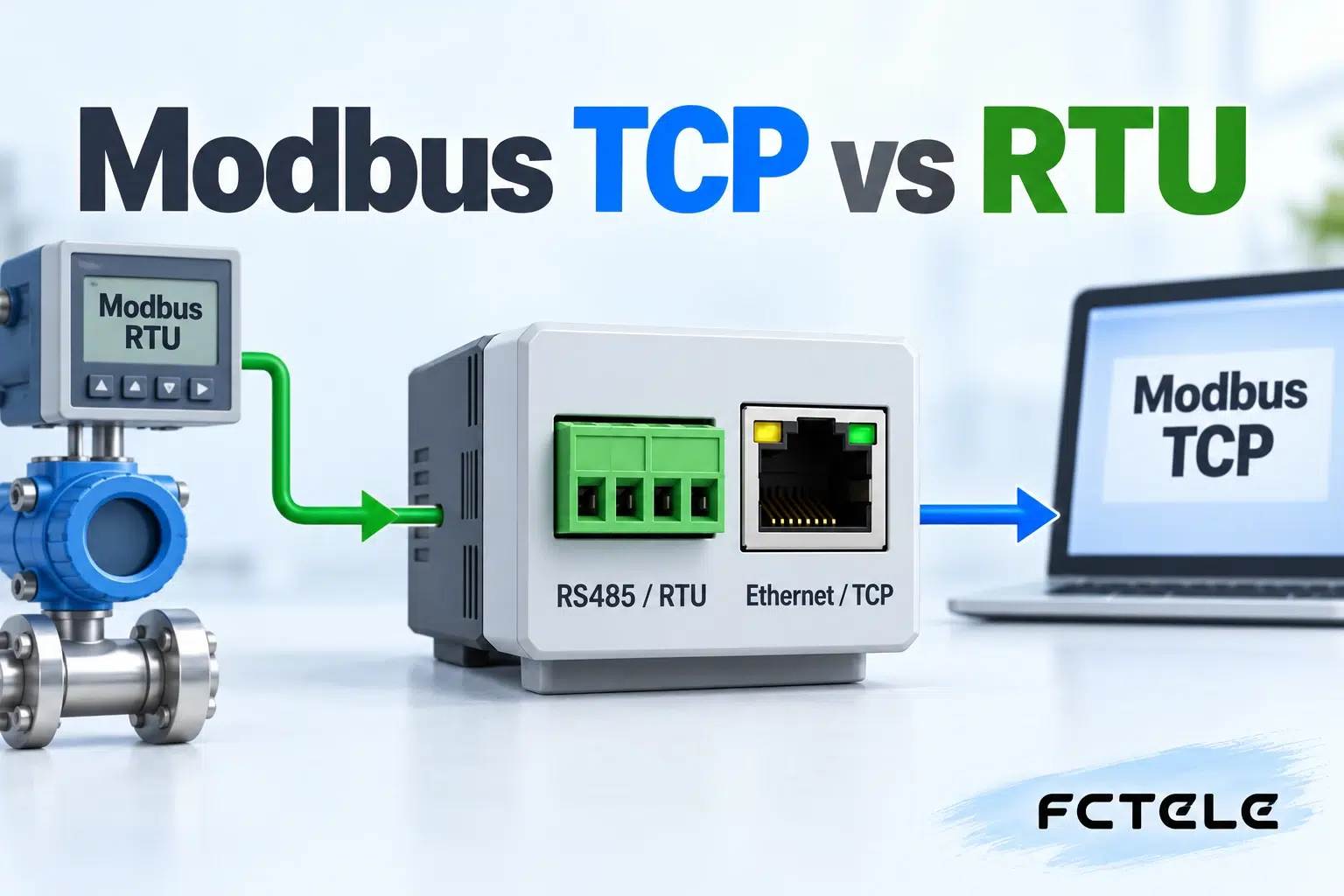
Check message formats, gateway conversion and response timing.
Tell us your application, quantity and preferred configuration.
