


In smart factories, rail transit, energy sites and campus video surveillance, once industrial Ethernet carries PLC control, industrial camera video, HMI operation and sensor data, a single uplink fiber can easily become a weak point in business continuity. Engineers usually add another link to form a ring network, but “connecting into a ring” does not equal “having redundancy”: if there is no correct Layer 2 loop control, broadcast frames will be continuously copied in the ring, causing broadcast storms, MAC address flapping and port congestion, and in severe cases devices across the entire network may lose contact.
Therefore, the core of industrial switch ring network design is not to connect one more fiber, but to let the protocol deliberately block one redundant path under normal conditions, and quickly enable the protection path after a link or node failure. This article combines the actual capabilities of Feichang Technology industrial switches to explain the differences between STP, RSTP, MSTP and ERPS, as well as the complete engineering method from planning and configuration to acceptance.
1. What problem does ring redundancy actually solve?
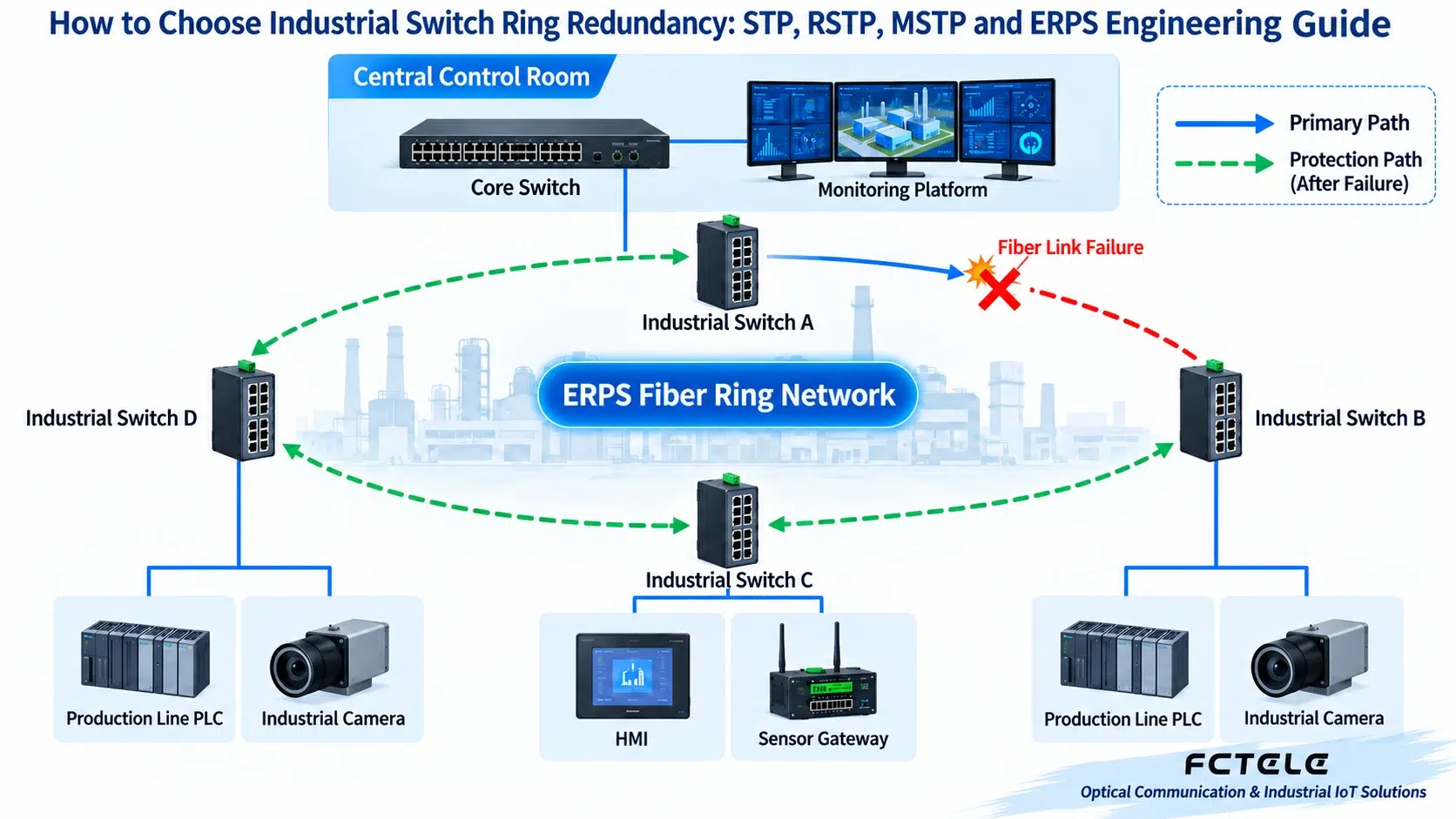
A tree network structure is simple, but when an aggregation link or an upper-level switch fails, downstream nodes may be completely interrupted. A ring network uses two paths in different directions to turn a single point of failure into a switchable event. During normal operation, the protocol selects the primary link and controls the backup link; after detecting an optical port disconnection, an unreachable node or a protocol packet timeout, it reopens the protection path so that data bypasses the failure point.
It should be noted that the recovery effect is jointly determined by the switch protocol implementation, ring network scale, optical module and fiber quality, service traffic, multicast policy and terminal reconnection mechanism. Switch port recovery does not mean the upper-layer application will necessarily be unaware, so project acceptance must use real service traffic tests, and cannot only observe port indicator lights.
2. How to choose between STP, RSTP, MSTP and ERPS?
1. STP: a basic solution with compatibility as the priority
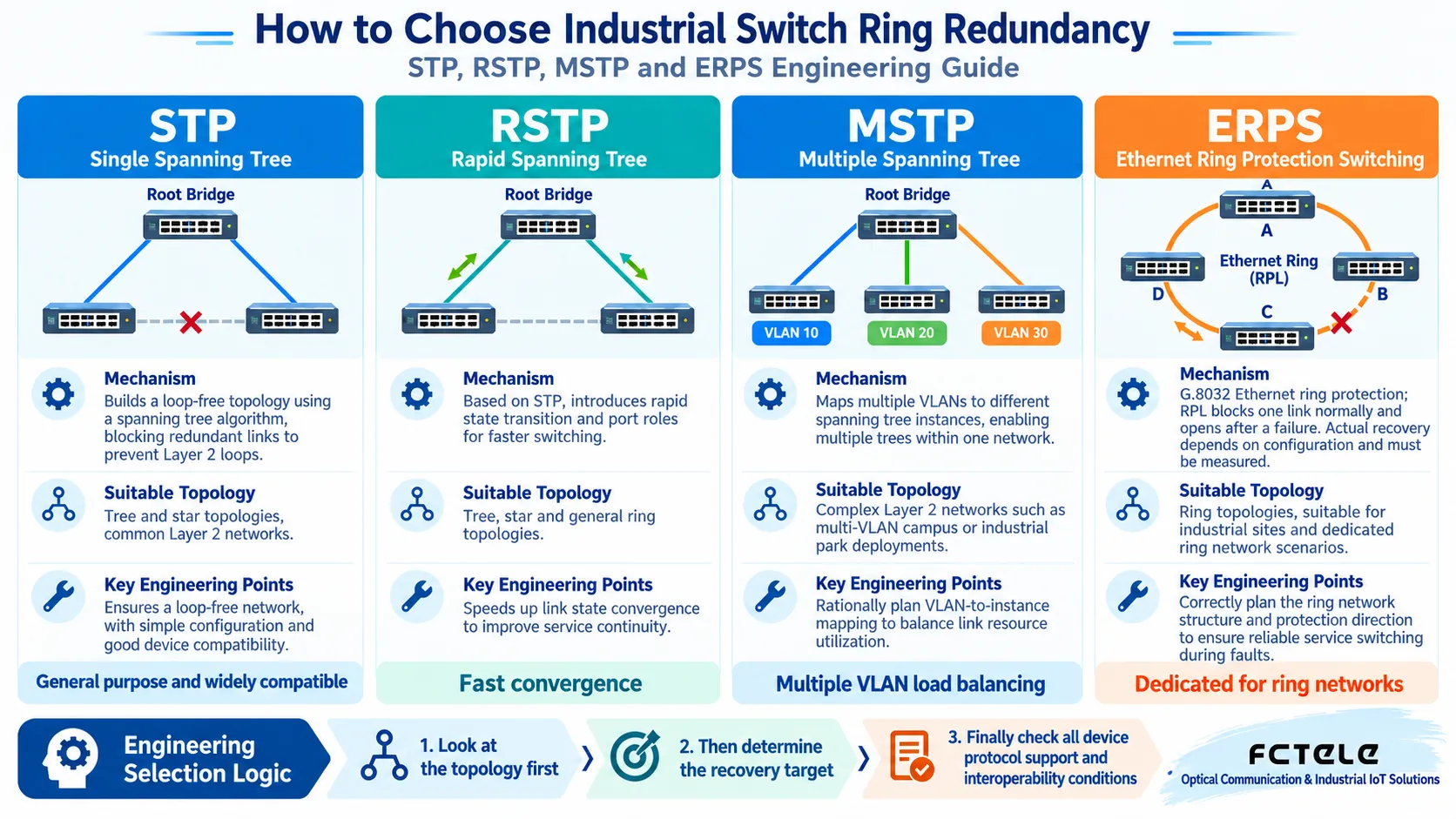
STP blocks redundant ports by electing a root bridge and calculating a loop-free forwarding tree. The standard is mature and compatibility is broad. It is suitable for general Layer 2 networks that are not sensitive to recovery time, and is often used as a foundation for understanding spanning tree mechanisms. However, industrial control and real-time video usually pay more attention to service recovery after a failure, so the convergence process of traditional STP is often not the first choice.
2. RSTP: rapid spanning tree in general networks
RSTP optimizes port roles and state transitions on the basis of spanning tree, and can handle topology changes faster. For tree-shaped, star-shaped plus redundant uplink networks, or projects where devices come from multiple vendors and standard interoperability is required, RSTP is often easier to deploy. During configuration, the root bridge and backup root bridge should be actively specified, and edge ports, point-to-point links and loop protection settings should be checked, avoiding complete reliance on default priority.
3. MSTP: a path planning tool for multi-VLAN networks
MSTP can map different VLANs to different spanning tree instances, allowing multiple physical links to carry different services while retaining redundancy capability. For example, control, video and device management can be divided into different VLANs, and instance paths can then be designed according to bandwidth and criticality. It is suitable for larger factory networks with many VLANs, but the region name, revision number and VLAN mapping must remain consistent; otherwise devices will fall into different regions, increasing troubleshooting difficulty.
4. ERPS: a dedicated protection mechanism for Ethernet rings
ERPS performs protection control for ring topologies according to ITU-T G.8032. The engineering model is clear, and it is suitable for scenarios where sites are connected in series along roads, tunnels, production lines or pipe galleries. In the ring network, the ring protection link, owner node and control VLAN need to be clearly defined, and the protocol version and parameters of participating devices must match. Feichang Technology’s 24-port gigabit electrical ports plus 4-port gigabit optical-electrical combo ports industrial switch public product information shows that it supports ITU G.8032, STP/RSTP, MSTP, EAPS and ERPS, and can be used as an equipment option for multi-service access and industrial ring network solutions; specific ports, optical modules and protocol configurations should still be checked according to project requirements.
3. Five key points in industrial ring network planning
First, clarify the service and failure boundaries.List control, video, voice, management and other services, estimate the bandwidth during normal and failure bypass conditions, and confirm the allowed interruption time. The protection path must carry the total traffic after a failure, and cannot be calculated only according to the normal direction.
Second, unify physical layer conditions.Check optical port rate, single-mode or multimode, wavelength, transmission distance, interface type and transmit/receive optical power. The transmit end of a dual-fiber module must connect to the receive end of the opposite end; single-fiber modules must be matched in pairs. Insufficient link budget, fiber bending or contaminated connectors may all cause intermittent jitter.
Third, plan VLANs and the management plane.Control traffic, video traffic and device management traffic should be reasonably isolated. The control VLAN used by the ring network protocol should not conflict with service configurations; management addresses, gateways, time synchronization and log servers should also be planned uniformly, avoiding the inability to locate remotely after a failure occurs.
Fourth, fix protocol roles and priorities.RSTP/MSTP should clearly define the root bridge, and ERPS should clearly define the protection link and node roles. Do not let devices determine key roles only by default MAC address, because the topology may change unexpectedly after a device is replaced.
Fifth, support multicast, QoS and security policies.Multicast services such as industrial cameras should be constrained with IGMP Snooping; key control packets can be given QoS according to service requirements. Unused ports should be shut down or access-restricted, and configuration baselines should be saved, avoiding temporary on-site wiring that damages the ring network.
4. How to perform fiber break and failure acceptance before going live?
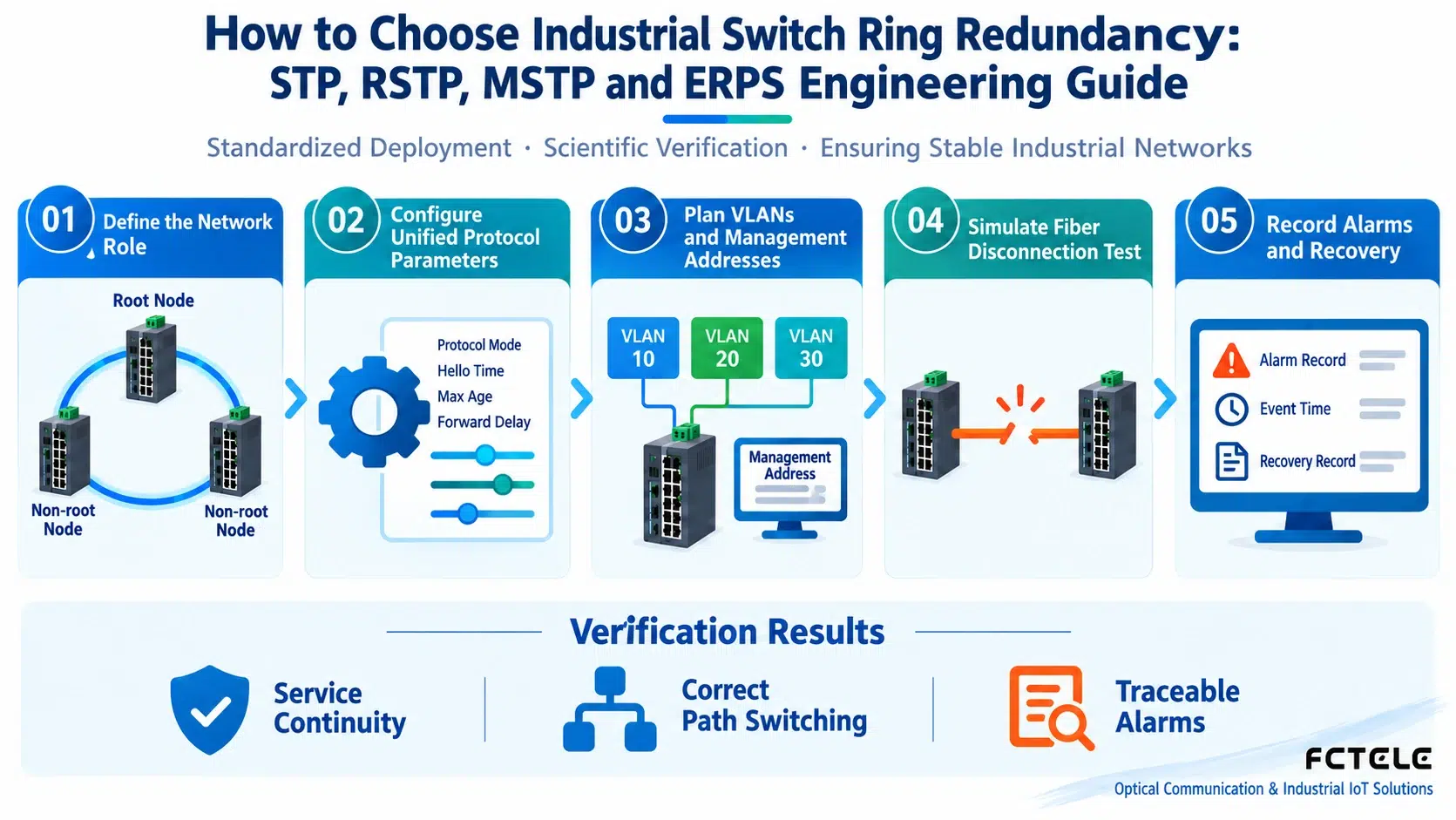
Acceptance should be carried out during off-peak service hours, and all switch configurations should be saved in advance. First record the ring network roles, blocked ports, MAC table and service latency under normal conditions, then simulate in sequence the primary link disconnection, protection link disconnection, single switch power loss and repeated link flapping. During the test, continuously monitor PLC communication, video images, management platform alarms and packet loss, and confirm that the actual traffic direction is consistent with the design.
After restoring the link, also observe whether the network returns to the expected stable state, whether there are frequent topology changes, repeated alarms or ports switching back and forth. The final acceptance record should at least include test time, failure location, protocol events, service impact, recovery result and configuration version. Only when “service continuity, correct path and traceable alarms” are satisfied at the same time does the redundancy design truly have operational value.
5. Common problems and troubleshooting ideas
After the ring network is connected, the whole network is sometimes connected and sometimes disconnected: First check whether multiple mutually affecting ring network protocols are enabled at the same time, or whether a device has not joined the same protocol domain. Then check broadcast and multicast traffic and MAC address flapping records.
After a fiber break, the port has switched but the application is still interrupted: Check whether the protection path bandwidth is insufficient, whether terminal ARP/MAC learning has updated, whether multicast membership has been re-established, and the timeout and reconnection mechanisms of the upper-layer application itself.
After replacing a switch, the topology is abnormal: Check the configuration backup, firmware and protocol version, root bridge priority, ERPS role, control VLAN, port numbering and optical module parameters. Do not restore only the IP address.
Conclusion
The value of an industrial switch ring network is to turn unpredictable link interruptions into engineering events that can be detected, switched and traced. Small general networks can first evaluate RSTP, multi-VLAN and multi-path scenarios can evaluate MSTP, and industrial ring networks with a clear structure can focus on ERPS. No matter which protocol is used, it should be based on unified planning, clear roles, real fiber break testing and complete operation and maintenance records. Feichang Technology can provide product selection and technical support for industrial Ethernet redundant networking based on port quantity, fiber type, service bandwidth and on-site environment.
Translated from the Chinese technical article. Source first published: 2026-09-09. Source last revised: 2026-10-13T23:36:13+08:00. Read the Chinese source
