


Converters are sometimes named after their plugs, sometimes after their protocols or uses, and the same word may refer to completely different devices. A practical classification is not about memorizing a list of product names, but about judging whether the device actually changes the connection method, the electrical signal, the transmission medium, or the meaning of the messages. Only after the classification is clear can you write your needs as checkable product conditions.
The first category only changes the mechanical connection method
Some adapter cables or connectors are used to connect specified contact relationships, on the premise that both ends already have compatible electrical and signal capabilities. They do not actively process circuits, cannot automatically turn analog video into digital video, and cannot arbitrarily change the operating voltage. A connector fitting in only means the shape is suitable. When choosing this kind of product, check the pins and direction, not just male or female. If the systems themselves are incompatible, even the most refined passive adapter cannot perform protocol translation, and may even damage equipment due to incorrect wiring.
The second category changes the electrical expression or interface system
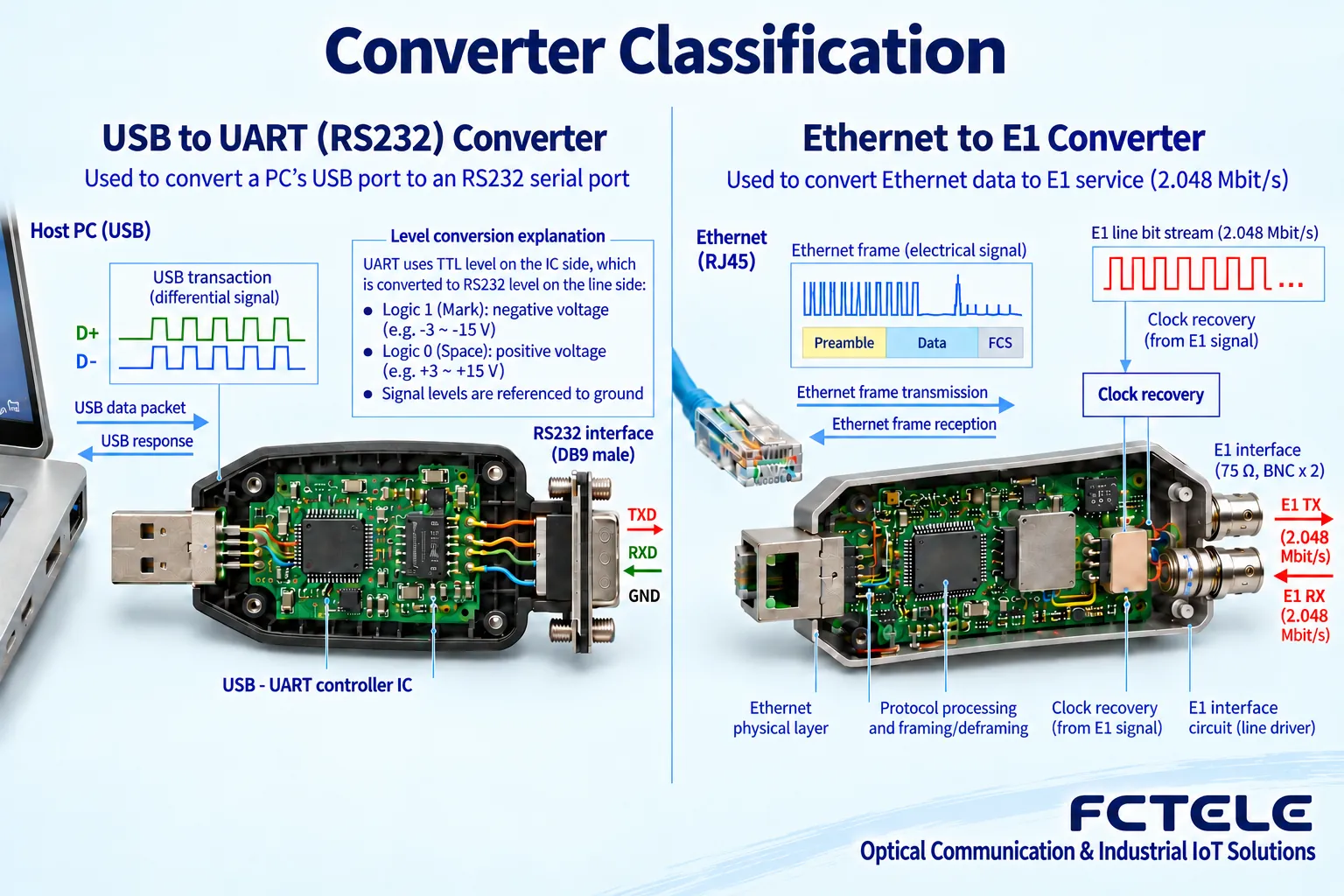
RS232 to RS485 changes the voltage expression through receiver and driver circuits; USB to serial also involves data processing between USB and serial, so it should not be simply treated as a cable that changes voltage. Both require checking the driver, serial parameters, and direction. They usually do not understand the meaning of temperature, position, or commands in the user protocol. Beginners can understand this as changing to an expression that can be delivered to the destination, while the content still needs to be understood by software at both ends. Whether it is isolated and how power is obtained are also conditions of the specific model.
The third category mainly extends the transmission medium
fiber optic transmission devices, or optical modems with corresponding interfaces, convert suitable electrical signals into optical transmission and then restore them at the other end. Different products may serve Ethernet, serial, E1, or video, and they are not compatible with each other just because they are all called fiber optic transmission devices. The optical port wavelength, fiber core, rate, and internal organization rules still need to be checked. Changing the transmission medium does not mean the application protocol changes automatically. Ethernet fiber transceivers are usually not responsible for directly converting CVBS camera images into network video that an NVR can recognize, nor are they universal optical extenders for ordinary telephones.
The fourth category maps one transmission organization to another
Ethernet-to-E1 equipment can carry Ethernet data in a suitable E1 channel and then restore the corresponding interface. It requires buffering, encapsulation, or mapping, and handles clock and frame conditions. At this time, the physical port rate at both ends and the actual capacity in the middle are not necessarily equal. A 100 Mbps Ethernet inlet connected to a limited E1 channel cannot be used to infer from the inlet number that the entire system has 100 Mbps throughput. Bandwidth, frame mode, and time slots should be confirmed at the same time. This type of equipment does not perform semantic translation for every application, and still needs to be distinguished from measurement gateways or control gateways.
The fifth category handles application protocols and data meaning
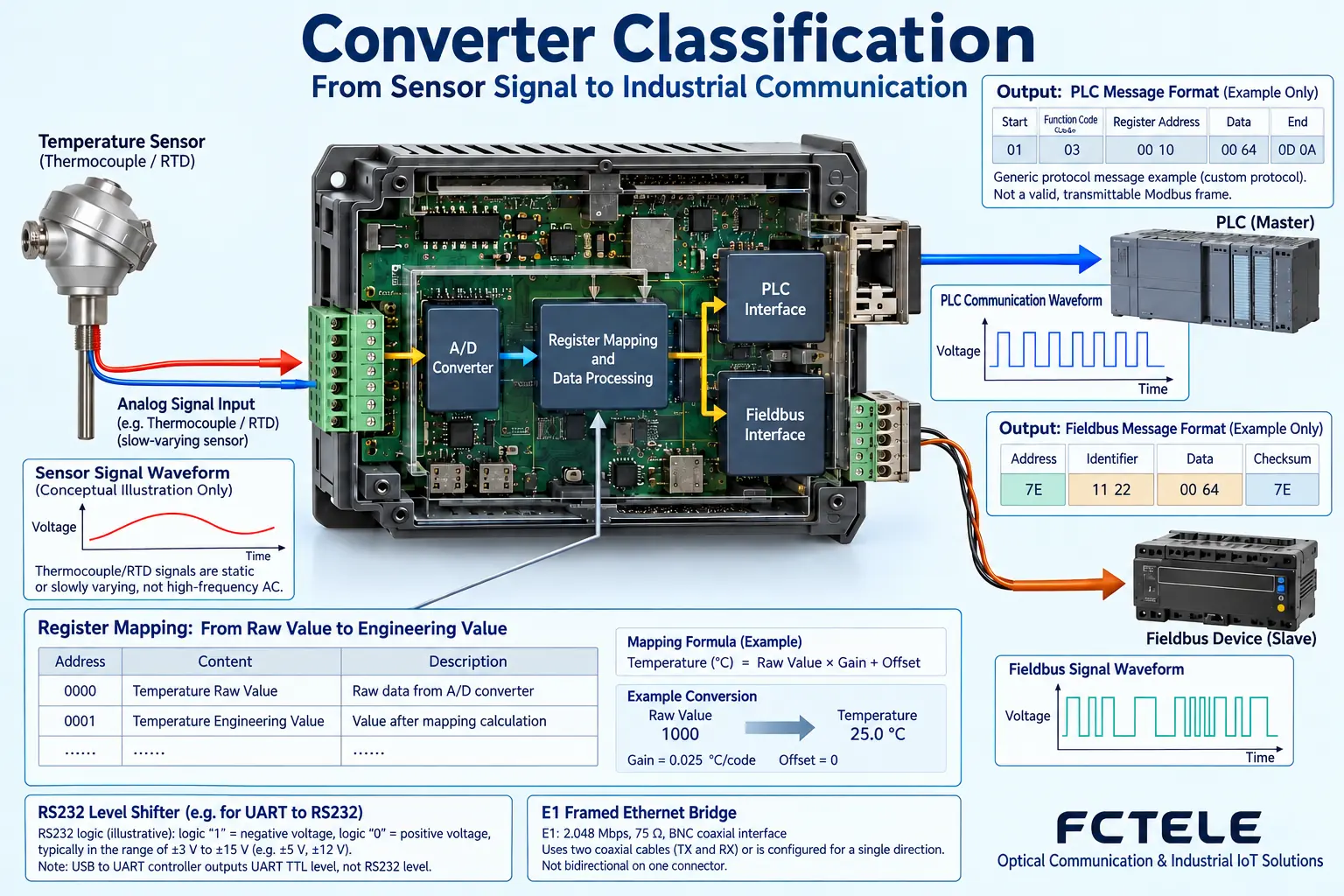
A true industrial protocol gateway, according to explicit protocol support and mapping rules, delivers requests, statuses, or measured values to another system. CAN is just one name for the relevant communication layer, and it does not mean that all devices using CAN have the same application definition; similarly, RS485 is not a synonym for Modbus. The gateway must clearly state which applications and objects it supports, and if necessary, establish a point table. Register order, units, read/write restrictions, and timeout strategies all affect the result. You cannot assume it can complete the task just because the device has two types of ports at the same time.
Video conversion and video extension require separate conditions
Active conversion such as VGA to HDMI requires handling analog sampling and digital display interfaces; HDMI optical extension mainly helps the corresponding video link cross distance. They may appear in the same solution, but they undertake different tasks. Conversion also does not guarantee that image quality will improve out of thin air, and extension does not guarantee support for all modes. You should list the input and output directions, resolution, refresh rate, audio, and control requirements. The differences between analog video, SDI, and IP video cannot be omitted, especially you should not treat identical BNC plugs as the same video format.
How Feichang Technology’s official website classification helps screening
Feichang Technology sets serial interface conversion, serial servers, optical modems, Ethernet-to-E1, etc. as different product directions, which can help narrow down the candidates first. FC-2001 describes USB to RS485 and direction handling; FCP-Vn details involve V.35, clock, and time slots; FCC-E1fF1 belongs to E1 and Ethernet mapping. This verified information can support preliminary screening, but it is not a delivery commitment for all configurations. If the official website fields conflict, confirm the version and manual with the supplier, rather than picking the sentence most favorable to your solution.
Organize requirements with four questions
First ask what the complete input signal and protocol are, then ask what the output system needs, then ask whether the device must change the meaning of the data, and finally ask what restrictions the intermediate channel and environment have. For example, when connecting an old instrument to the network, if the host computer still processes it according to the original serial protocol, transparent serial networking may be needed; if the host computer only accepts another application protocol, a clearer conversion or software solution is needed. This reasoning is more precise than “I want a serial-to-network box,” and can also discover in advance the situation where there is no directly compatible product, avoiding buying a device with the right interface but the wrong business function.
Check the role by classification when evaluating a sample
For electrical adapters, check waveform conditions, direction, and byte correctness; for media extenders, check the link at both ends and end-to-end errors; for E1 mapping equipment, observe the clock and actual throughput; for application gateways, verify data and exception handling item by item. Do not unify the acceptance of all equipment as lights on or Ping. Use simple, repeatable known inputs to establish a baseline, then add load and lines. If writing commands involves production execution, test in a safely isolated environment and obtain corresponding authorization; do not randomly try errors with real actuators.
Classification must ultimately be implemented as a traceable checklist
The delivery checklist should include the complete product model, hardware and firmware, input and output protocols, direction, rate, mapping, and power supply. Record which capabilities are standard and which are optional, and keep configuration and test reports. When changing products, reconfirm the classification and role, and do not skip verification because the appearance is similar. There is no universal ranking where the more versatile a converter is, the better; there is only whether it solves the current problem. Distinguish passive wiring, electrical adaptation, media extension, transmission mapping, and application conversion clearly, and you can reduce selection ambiguity and let maintainers know what each segment is responsible for.
Product and principle verification materials:Feichang Technology product details 2336;Feichang Technology product details 269;Feichang Technology product details 166;Principle verification material 1. The general mechanisms and hypothetical examples in the text do not replace the corresponding model manuals.
Translated from the Chinese technical article. Source first published: 2019-07-23. Source last revised: 2026-10-13T22:50:44+08:00. Read the Chinese source
