


fiber optic transmission devices usually transmit specific service signals over fiber, while fiber optic switches mainly learn and forward Ethernet frames. Video, telephone, and serial fiber optic transmission devices differ from Ethernet switches with SFP ports in interfaces and service handling methods, and they cannot be directly interconnected just because both have optical ports. First determine the original service, then decide whether transparent extension, protocol conversion, or multi-port switching is needed.
Even if they both use fiber, what is transmitted inside may not be the same thing
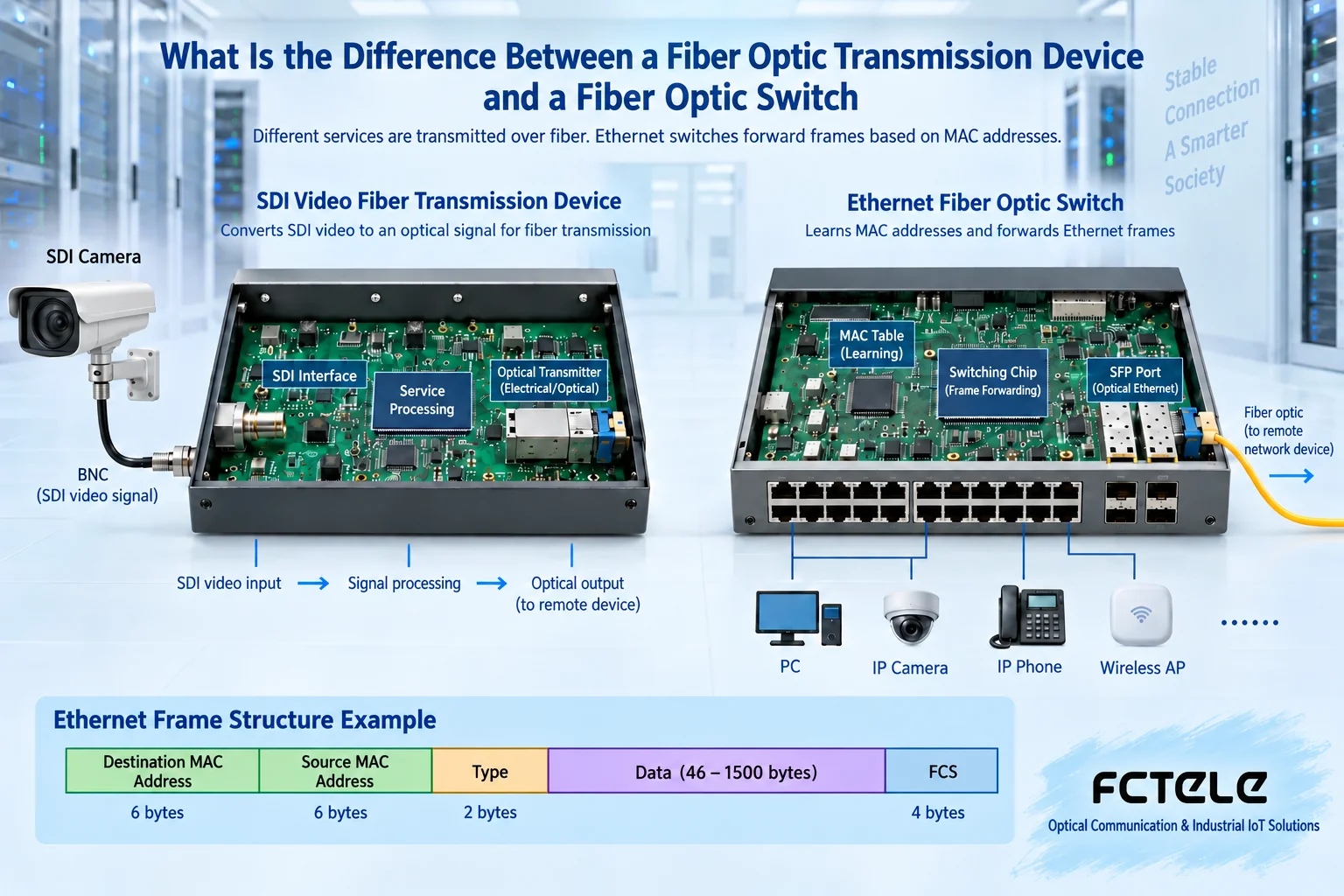
Fiber is like a road, and optical interfaces are like vehicle entrances and exits; having the same road does not mean the transportation rules are the same. A video fiber optic transmission device may receive SDI video, a telephone fiber optic transmission device may connect to analog telephone interfaces, and a serial fiber optic transmission device may extend RS485 data. They complete optical transmission within their respective services and usually require matching devices at both ends.
An Ethernet switch with optical ports connects multiple Ethernet terminals, reads the MAC addresses in frames, and decides from which ports to send. IP cameras have already packaged video into network data streams and can connect to Ethernet switches; a camera with only SDI output cannot become an IP camera just by changing a cable.
Do not simply equate fiber optic transmission devices with ‘analog devices’
fiber optic transmission devices are not a unified protocol standard. Some devices digitize analog signals, some transmit SDI, HDMI, or serial data that is already digital, and there are also multi-service multiplexing models. The so-called ‘digital fiber optic transmission device’ does not automatically mean it can connect to Ethernet; ‘fiber optic switch’ in this article refers to an Ethernet switch with optical ports, while a Fibre Channel switch in the storage field is another type of device.
When judging, first read the service port names: BNC may carry different video formats, RJ11 usually indicates a telephone interface, terminal blocks may be serial or switch quantity, and RJ45 does not absolutely guarantee Ethernet. Also read the pinout, electrical standards, and data format; do not rely only on the casing and plug.
Where switching occurs determines the expansion method
Dedicated fiber optic transmission devices often transmit signals in units of channels, and the correspondence between the two ends and the number of multiplexable channels are determined by the device design. Ethernet switches can aggregate frames from multiple ports into an uplink and can also divide broadcast domains through VLANs; Layer 3 models can also perform IP routing according to configuration. When adding network cameras, you need to account for uplink capacity, multicast handling, and server capability, not just increase the number of fibers.
Dedicated links are usually easy to understand as paths by channel, but channel capacity and interfaces are relatively fixed; networked solutions facilitate multi-point expansion and centralized management, but they need to handle addresses, bandwidth, latency, and network security. There is no universal conclusion that ‘fiber optic transmission devices are necessarily more reliable than switches’; reliability comes from designs and maintenance that match the service.
Three on-site selection questions
Only analog telephones need to be extended across buildings?First check the FXS/FXO roles and signaling compatibility of the telephone fiber optic transmission device, rather than buying an ordinary Ethernet transceiver.Multiple IP cameras converge to the center?Usually consider an Ethernet switching solution with appropriate ports and uplink capacity, and confirm power supply requirements such as PoE.Existing RS485 instruments need to cross long distances?Consider transparent serial optical transmission; if it needs to enter an IP system, then a serial server or a gateway with explicit protocol conversion is also needed.
Even if the service is the same, you must check the optical port rate, encoding, single-mode/multi-mode, single-fiber/dual-fiber, wavelength pairing, and power range. SFP is a pluggable module form factor, not a guarantee of interoperability for any optical service. Dedicated fiber optic transmission devices from different manufacturers especially cannot be assumed to pair just because the wavelengths are the same.
Acceptance is based on service results
For video, check the picture and delay under the real format; for telephone, test incoming calls, outgoing calls, and hang-up release; for serial, test request-response and error rate; for Ethernet, test throughput and network recovery under load. Recording the actual interfaces, formats, and test conditions is more useful for locating future problems than vaguely writing ‘optical port normal’.
Two paths for upgrading an existing video point
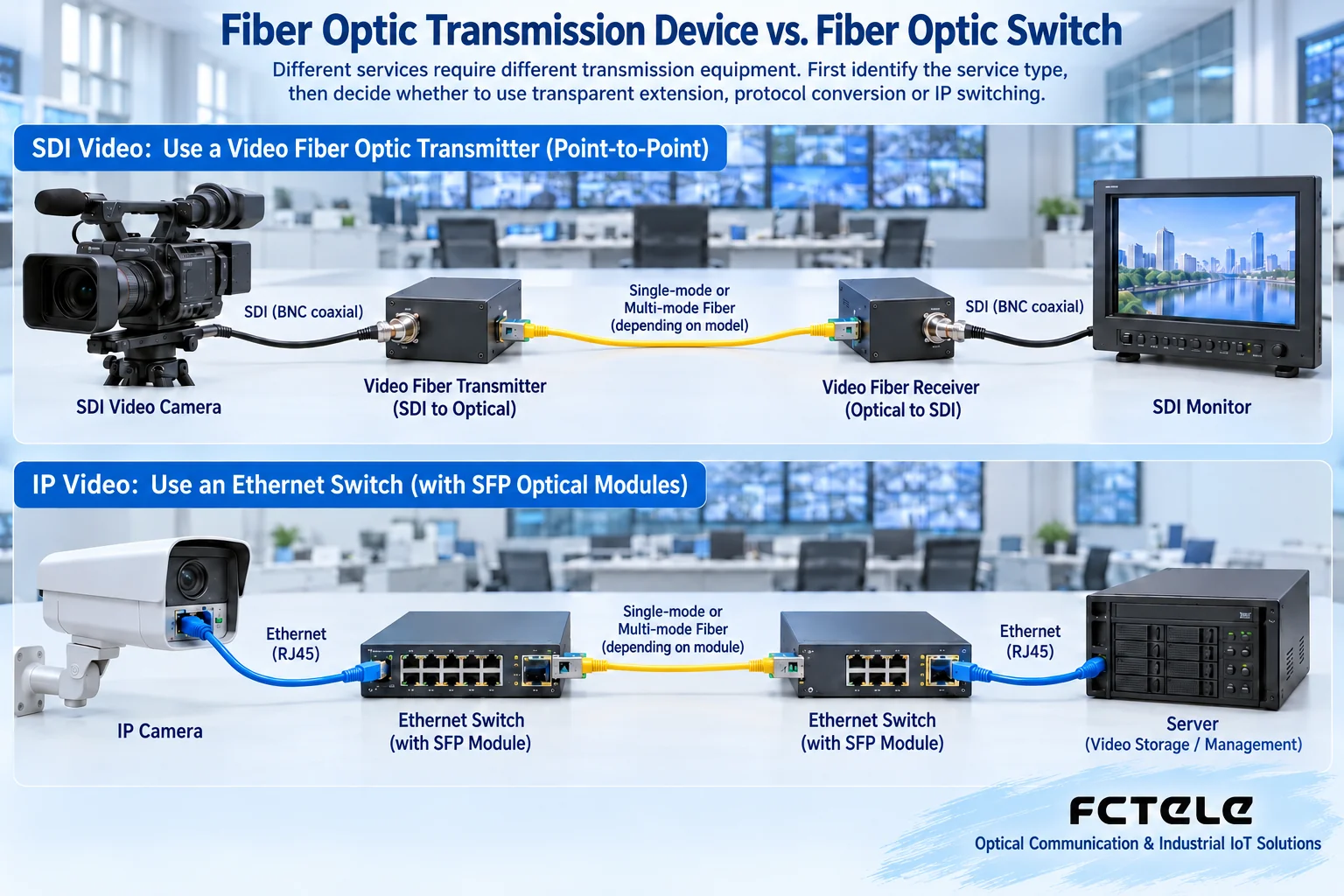
If the original camera outputs SDI and the center also has SDI receiving equipment, using a matching video fiber optic transmission device can continue this dedicated link. If multiple clients are expected to view over the network, then video encoding or networked equipment is needed to convert the service into an appropriate network stream. The fiber optic switch is responsible for carrying these Ethernet frames, not for completing video encoding on behalf of the camera.
If the original camera is already an IP device, a common choice is an optical port switch or an Ethernet transceiver for extension. When multiple points are centralized, a switch provides port aggregation more conveniently; when a single point spans a distance, a media conversion solution may be more straightforward. The trade-off between the two still depends on power supply, environment, management, uplink capacity, and future expansion, and should not be based only on comparing box sizes.
When budgeting, include terminal adaptation, encoding and decoding, optical modules, pigtails, power supply, and maintenance tools. Even if it is written as ‘transmitting video’, different service paths may require different center equipment. Drawing the interfaces at both ends clearly first can help promptly discover missing encoders or incorrect connector assumptions.
Fault location also follows the same approach: first test whether the source device outputs a qualified service, then test the optical link, and finally test the receiving or network forwarding. The optical alarms of a dedicated fiber optic transmission device and the VLANs and MAC tables of a switch are not the same diagnostic tools; choosing the correct test point is more effective than blindly swapping devices.
Translated from the Chinese technical article. Source first published: 2019-07-31. Source last revised: 2026-10-13T19:01:44+08:00. Read the Chinese source
