


Home, commercial, and industrial switches all forward Ethernet data, but the installation conditions and maintenance needs they are designed for are often different. This is like vehicles that all carry cargo: some are suited to city roads, while others need special loading and site conditions. You cannot rank which one is definitely faster just by the name. For beginners choosing a model, first answer: what devices will be connected, where will it be placed, and who maintains it if it fails? Then compare the specific model’s ports, power, environment, and management. Below, we first explain the common forwarding mechanism, then explain why the differences affect the actual choice.
Compare the business first, not the label first
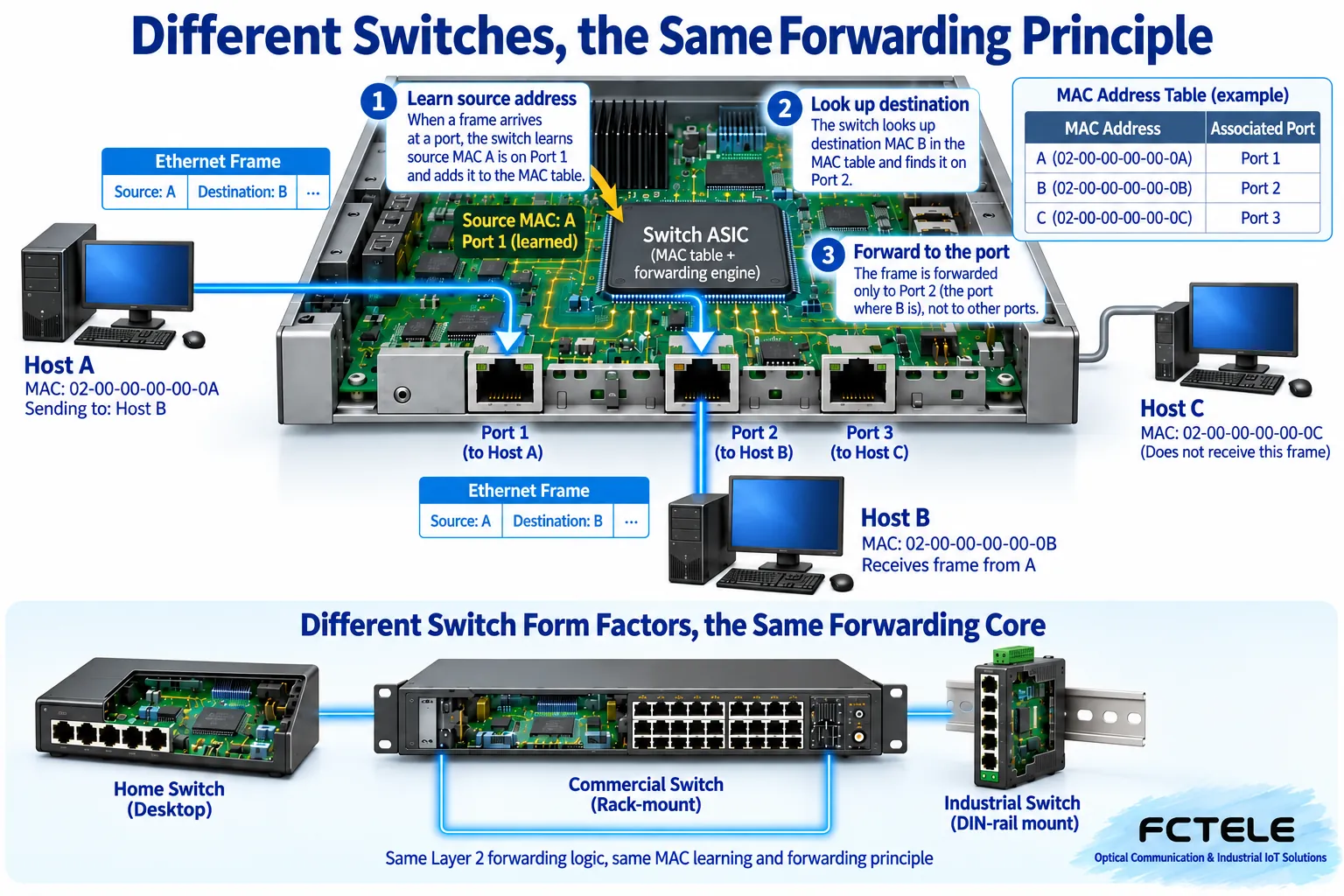
In the example in Figure 1, terminal A sends a piece of data to B. The switch learns which port the source address appears on, then looks up the port for the destination address. When it has already learned where B is, ordinary unicast can be sent in the corresponding direction without giving every piece of data to C. This is a simplified working mechanism: broadcast, unknown destinations, and other services have different handling requirements, so this one figure cannot summarize all forwarding. Both home and industrial devices may do this basic work, but speed, capacity, buffer, and extra functions vary by model, so a shared principle does not mean identical performance.
List the number of terminals, port speeds, uplink bandwidth, PoE needs, and whether VLAN, multicast, and redundancy are required. A home network may only need simple connections, or it may need management or a high-speed uplink; an office may involve authentication, wireless APs, and centralized monitoring; a field control site may have special requirements for latency, recovery, and environment. Each item must be met by the specific product’s capabilities. Having “industrial” in the name does not mean it has all industrial protocols, nor does it mean an unmanaged device can configure access control.
Environmental differences require verifiable conditions
The business checklist should be specific down to ports and traffic direction. Ten terminals do not necessarily need ten times the uplink of one terminal’s peak, and you cannot ignore whether they transmit at the same time just by counting terminals. Surveillance may continuously occupy the uplink, office devices may have different peaks, and control services may care about timing. Estimating and testing with actual business traffic is more reliable than just saying “is gigabit enough?” If PoE is needed to power APs or cameras, the total power budget is another limit; normal data port speed does not mean the power supply capability is also sufficient.
Home devices often serve a relatively stable indoor environment, commercial devices may suit a server room or weak-current room, and industrial products may face cabinets, vibration, and larger temperature differences. But these are positioning trends, not shared specifications. You should check the actual operating temperature, humidity, installation clearance, and relevant test documents. Do not assume all industrial units are waterproof or corrosion-resistant. Commercial server rooms also need long-term operational reliability, so you cannot compare by saying “only industrial devices can run continuously”; reliability still depends on product design, environment, and maintenance.
Power and installation change the total cost
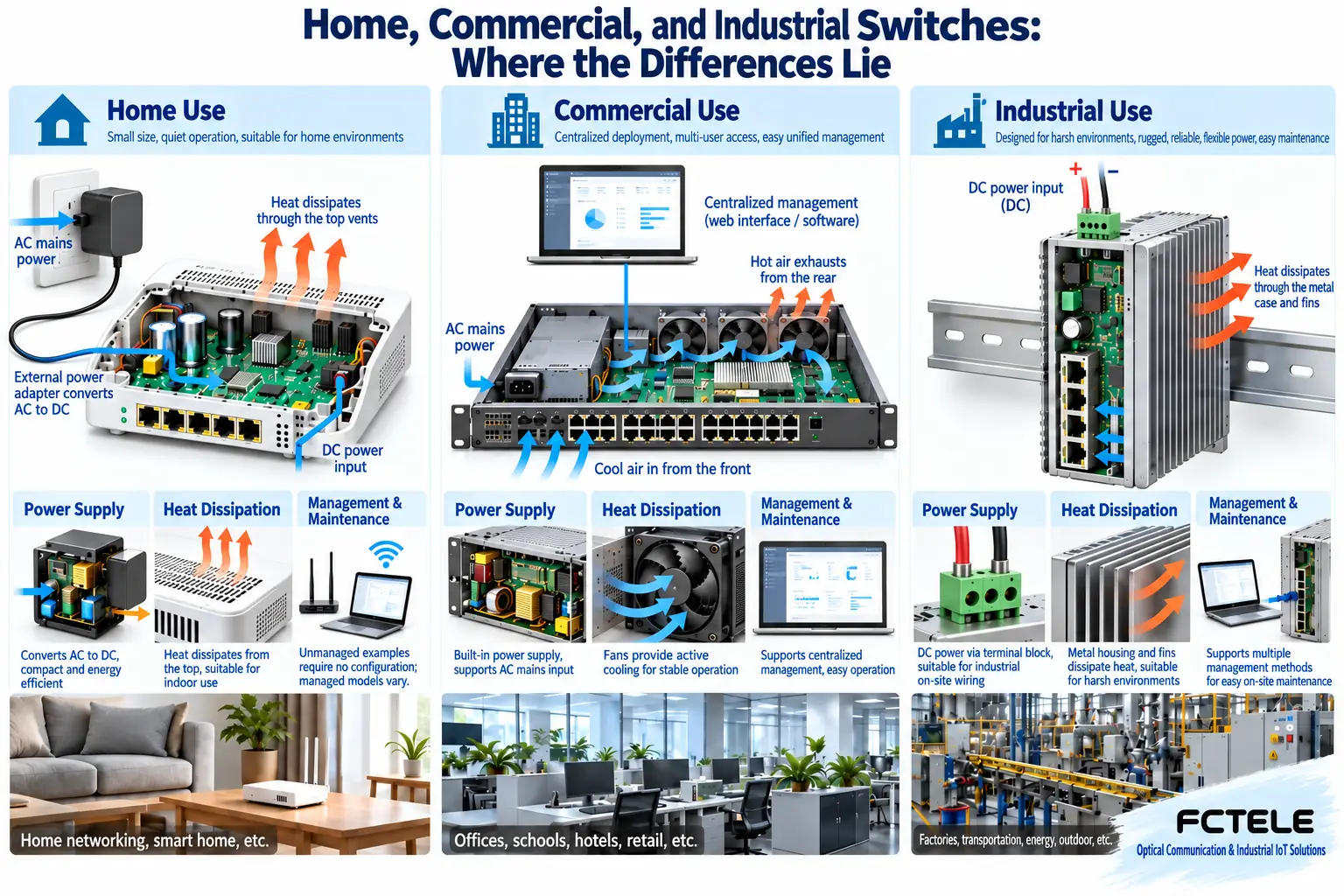
Figure 2 shows typical installation differences, not a uniform structure for all categories. Desktop devices may come with an adapter, rack devices may use centralized installation and fans, and DIN-rail devices may rely on the enclosure for heat dissipation and use DC input. Each structure must be placed in a suitable environment to work. A desktop device in a sealed hot cabinet may not be suitable, and an indoor office may not need to buy an industrial model for some special environmental requirement. To judge waterproof, dustproof, vibration, or temperature capability, look at the specific documents; you cannot infer all ratings from a metal enclosure.
Desktop adapters, rack power supplies, and DIN-rail DC inputs meet different installation conditions. An industrial site may already have DC power, but you still need to check the voltage range, protection, startup, and redundant paths. PoE devices require checking the total budget, terminal peaks, and temperature derating; do not look only at the wattage of one port. Installation costs include matching power supplies, cabinets, optical modules, cabling, heat dissipation, and spare parts. Cheap equipment plus mismatched installation modifications may instead increase the total lifecycle cost.
Management features and industrial rating are not the same axis
Management is a functional dimension, while industrial grade is an application positioning. Do not mix the two. A home-positioned device may also provide VLAN or other management functions, while an industrial unmanaged device may not be able to configure these rules. VLAN can be understood as grouping Layer 2 services, access control determines which communications are allowed, and ring protocols handle redundant paths; these are different issues. Whichever capability the project needs, check whether the corresponding version provides it and verify it. A long function menu does not mean correct configuration, and whether the maintenance team can master it also affects the result.
Optical ports, real-time performance, and security are verified separately
The actual purchase price is only part of the cost. Equipment may also need power supplies, compatible optical modules, cabinets, cables, installation, and protection; whether replacement is convenient during a failure, whether spare parts are compatible, and whether configuration can be quickly restored also create costs. If cheap equipment is placed in an unsuitable environment and repeatedly loses links, the maintenance cost may be very high; if expensive equipment only uses the most basic functions, it may not bring the needed benefit. When comparing options, try to use the same business and environmental conditions, and list one-time accessories and long-term maintenance separately.
The number of optical ports does not equal uplink capacity; module compatibility and optical power still need to be checked. Low latency and recovery time must be confirmed under the actual topology and load; a single ping cannot prove that a control service meets requirements. VLAN segmentation also does not equal packet encryption; network security still requires accounts, access control, and system-level measures. Whether a device has specific certifications and test scope depends on the materials. Do not extend one series’ report to all products, and do not replace engineering verification with a brand name.
Example: Evaluate office and production line network expansion separately
For the office, first calculate AP, computer, and telephone ports and the PoE budget, and evaluate centralized management and rack installation; for the production line, additionally test cabinet temperature, power fluctuations, and fault recovery. If office equipment fully meets the environment and business needs, do not add complexity just for the word “industrial”; if the production line exceeds its conditions, do not try to compensate only with a higher-power adapter. Compare candidate devices under the same test conditions, record purchase price, accessories, maintenance access, and spare parts strategy, and form an explainable selection conclusion.
Write the selection conclusion as executable procurement and maintenance instructions
Do not just give the conclusion “buy industrial” or “buy ordinary.” Write clearly the terminals, traffic direction, allowed environment, power interface, and maintenance personnel for each installation location, then note which conditions must be met and which are for future expansion. A home room, an air-conditioned weak-current room, and a production control cabinet may each choose different models. They are connected together in one network, and it is not required that every access location use exactly the same structure.
The delivery list should also include power supplies, optical modules, mounting parts, configuration files, and necessary spare parts. For managed devices, record addresses, how authorized accounts are kept, and recovery steps, and give unified numbers to ports, lines, and cabinets. When replacing, first check firmware and configuration in an isolated test environment, then switch during an approved maintenance window; do not connect a spare device to an unknown loop at the same time to try “automatic takeover.” This work turns function and environmental requirements into actual maintenance, rather than only comparing port counts on a quotation.
Common misconception: Are industrial switches definitely faster and safer?
Not necessarily. Speed is determined by interfaces, forwarding capability, and business conditions; security involves management, access rules, terminals, and system measures; environmental reliability is yet another set of requirements. Industrial models suit the application conditions they declare and have verified, not all indicators are automatically the highest. First write a minimum requirements table, then compare candidate models, and finally accept them with the same repeatable tests. Only then does the conclusion have a basis, and it is easier to explain to users why this one was chosen.
Use Feichang Technology product materials to check specific capabilities
The Feichang Technology product catalog lists unmanaged DIN-rail, managed DIN-rail, and rack products separately, which shows that industrial positioning is not a single management function. For small-scale basic access, you can check installation and interfaces from the mini five-port product; when service grouping and diagnostics are needed, you can check VLAN, port statistics, and mirroring from the 8-port electrical 4-port optical managed product. Match requirements to product capabilities, rather than adding unnecessary functions uniformly to every location.
Materials and notes:Feichang Technology industrial switch categories;mini five-port product material;8-port electrical 4-port optical managed product material;Ethernet switching mechanism;standard PoE detection and power supply explanation. The principle illustrations are general mechanism diagrams, not product photos, measured data, or certification evidence; example parameters are not commitments for specific models. Ordering and deployment are subject to the actual model, version, valid materials, and approved test results.
Translated from the Chinese technical article. Source first published: 2020-06-10. Source last revised: 2026-10-13T17:22:03+08:00. Read the Chinese source
