


Industrial switches and ordinary switches can both forward Ethernet data. The differences are mainly in the applicable environment, power supply and mechanical design, installation and maintenance, and specific management functions. Industrial equipment is not necessarily faster than ordinary equipment, and ordinary equipment is not necessarily unable to transmit video. Selection should be based on real working conditions and model specifications.
Breaking down “learning addresses” into one actual forwarding event
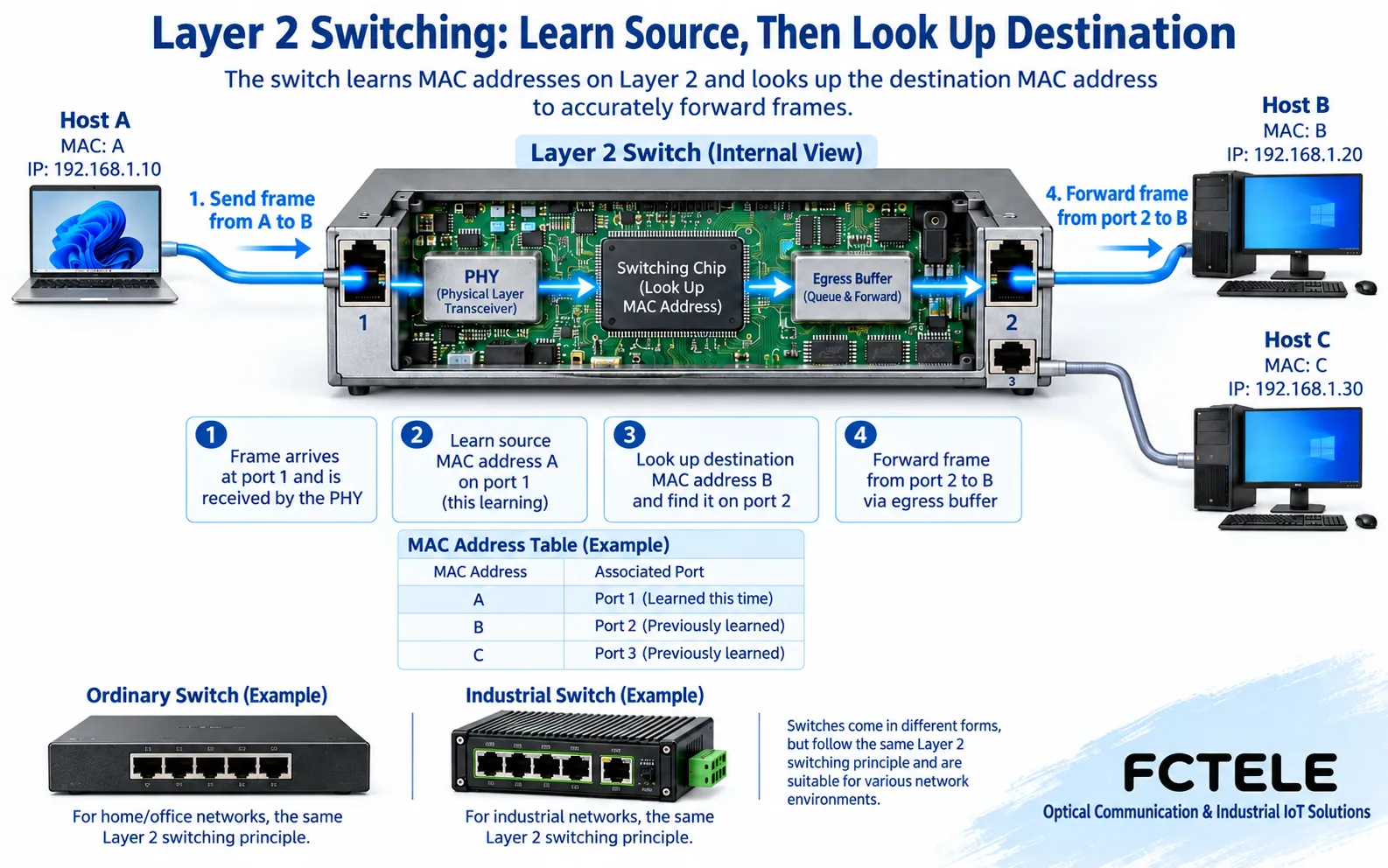
An Ethernet frame is a formatted piece of data on a link. A MAC address is used to identify a network interface. A common Layer 2 switch learns from the source address “which port this interface can be reached from,” then looks up the destination address. Suppose host A is connected to port one, B to port two, and C to port three; the switch has already learned the locations of B and C. When A sends to B, the ingress circuit recovers the frame, the switching chip updates A’s source relationship, and then sends the frame into the transmit path of port two, rather than copying this known unicast to C.
Learning means building relationships from received source information, not scanning file contents to identify a computer. After a device moves or there has been no communication for a period of time, address relationships are also updated and aged out; therefore the address table is not a permanently fixed contact list. When the destination address is not yet known, the common behavior is to flood within the allowed same Layer 2 broadcast domain to other suitable ports. Broadcast and multicast have their own rules, and the unicast example in the figure cannot be taken as a guarantee that all messages are sent out only one port.
The port PHY is the transmit and receive circuit that handles physical signals, the switching chip is responsible for forwarding decisions, and the buffer is used to temporarily store frames waiting to be sent. The three have different tasks: cable damage may cause receive errors, egress congestion may cause queuing and drops, and a VLAN configuration error may prevent communication even with correct wiring. Industrial equipment also will not automatically know which two devices you want to communicate with; you should separately check the physical link, forwarding rules, and terminal application.
What is the same: the Ethernet switching task
A switch receives data through ports, learns source MAC addresses, and forwards based on destination addresses and related rules. Optical ports and electrical ports are different transmission media and do not change this basic task. Industrial models and office models may use similar network principles, but specific switching capacity, buffers, and functions still differ.
Modern full-duplex switched networks differ from early shared half-duplex networks. The collision problem of shared media cannot be used as a reason that all industrial networks must replace equipment. Data stuttering may come from bandwidth, incorrect configuration, terminals, or applications, and cannot be diagnosed merely by the category “ordinary switch.”
What is different: what the equipment endures every day
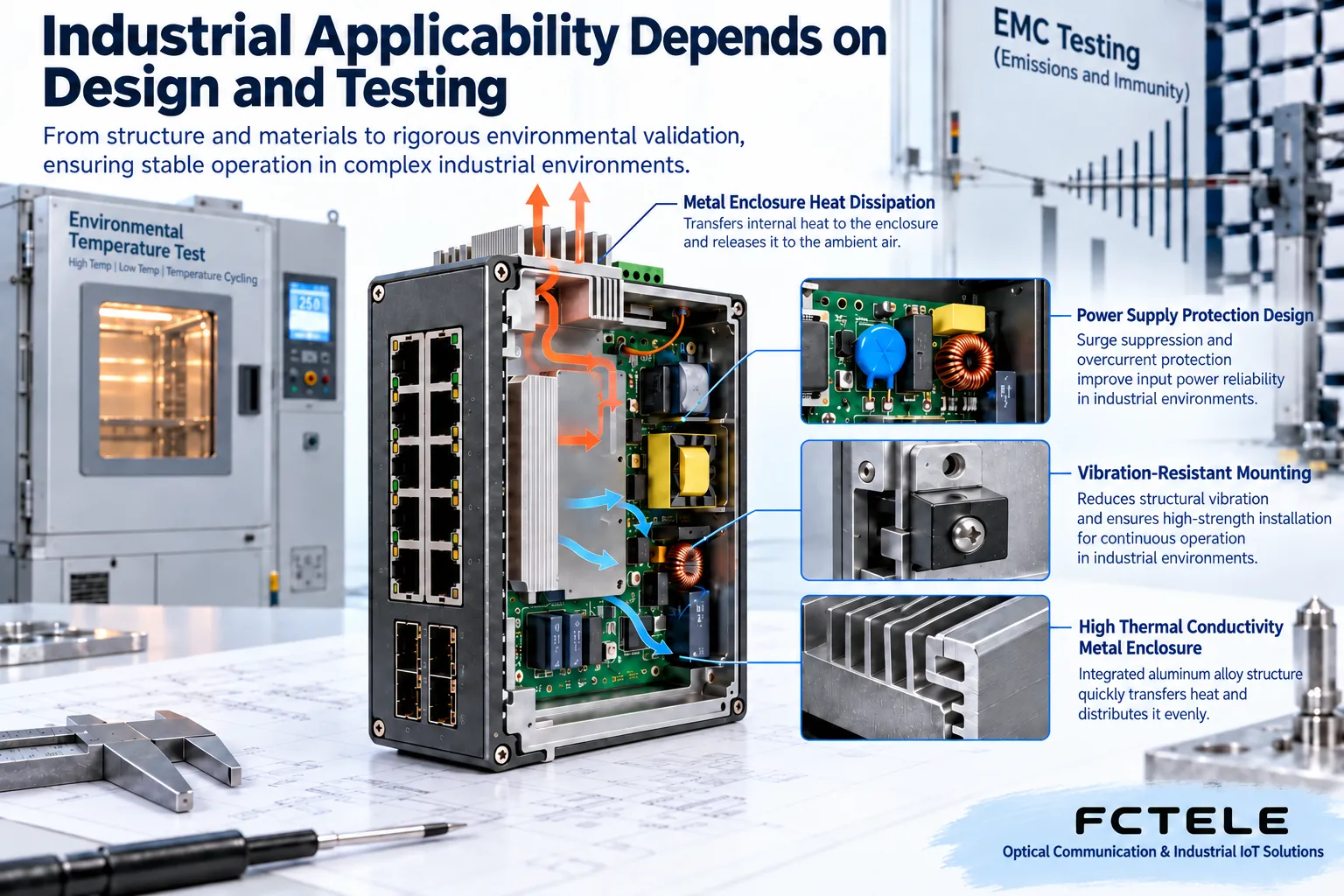
An air-conditioned computer room and a production control cabinet differ in temperature, dust, humidity, vibration, and power disturbances. Industrial switches may be designed for these conditions, but “industrial grade” is not a unified temperature or protection promise. Check the specific model’s operating temperature, installation requirements, and applicable reports; storage temperature cannot replace full-load operating temperature.
A metal housing can help with heat dissipation and mechanical protection, but it cannot automatically prove water resistance. If the equipment is required to be installed in a protective cabinet, it cannot be exposed to rain. Temperature rise inside the cabinet, ventilation, and heat from surrounding power supplies also change the conditions the equipment is in.
Power design requires looking at the complete path
The site may use DC power, and office equipment may use AC adapters, but this should be checked by model, not inferred by category. Input voltage, polarity, protective grounding, and power margin all need to be confirmed. Dual power inputs can reduce the impact of some faults, but if both paths come from the same single upstream point, they will still fail together.
Equipment that provides PoE must also check port power and the overall power budget. Industrial PoE does not mean that any voltage can be sent to any terminal. Standard powered device detection, passive power, and forced power have different conditions, and incorrect connections may cause faults.
Functional differences must be confirmed item by item
Industrial switches may support ring networks, VLAN, multicast, or alarms, and ordinary switches may also support some of these functions. Whether they have them and whether they can meet project requirements should be checked item by item. Two optical ports do not equal automatic ring protection; before closing the device loop, the applicable protocol still needs to be configured correctly.
If a factory only needs small-scale stable connections, complex management functions may not be needed; if production and maintenance network isolation, redundancy, and centralized monitoring are involved, corresponding management capabilities are needed. More functions do not mean lower configuration risk, and the maintenance team should also have the ability to use and recover them.
How to prove where the problem comes from
Seeing a port light on only means that some link state has been established; it cannot prove that the complete service is normal. First confirm whether the terminal has obtained the correct address, whether it is in the expected VLAN, and whether it can reach the application service; then compare error frames, drop counters, and port negotiation speed. If error frames increase with a certain cable, check the cable and connector first; if multiple ingress ports are normal but drops on a shared egress increase, check the aggregation bandwidth first. Do not call both types of phenomena “insufficient interference resistance.”
For example, if four gigabit computers send files to one hundred-megabit terminal at the same time, the last segment may still be limited by one hundred megabits. This is not because ordinary switches and industrial switches have different basic Ethernet principles, but because egress capability and traffic do not match. Conversely, a group of low-traffic instruments working on a long-distance fiber link may need suitable optical modules, power, and environmental capabilities more than simply increasing access port speed.
When comparing candidate devices, use the same cables, terminals, traffic direction, and configuration. First obtain a normal baseline within the allowed environment, then observe temperature rise, restarts, and service load according to the project’s verification plan. Tests such as temperature, vibration, and surge should be performed by qualified personnel according to specifications, and cannot be replaced by a heat gun, water spray, or casually shorting the power supply. Save the test objects, firmware, and configuration so the results can be reproduced.
How to avoid two extremes in selection
Do not upgrade all office scenarios to industrial equipment, and do not put products that do not meet environmental conditions into on-site cabinets just to save budget. First record the environment, services, ports, bandwidth, power supply, and maintenance conditions, then choose a model that meets these requirements. For questions, request specific information and do not accept unconditional conclusions about category superiority or inferiority.
Acceptance should cover actual load, restarts, temperature rise, and the required redundancy recovery, and save the configuration and baseline. Model information can be found in Product Center. Reliability comes from the joint matching of equipment, cabling, power, configuration, and maintenance, not just from the industrial label on the housing.
Use Feichang Technology product information to check specific capabilities
The Feichang Technology mini industrial rail-mounted 5-port gigabit electrical product page lists five auto-negotiating electrical ports and rail and wall mounting methods, and can be used as a screening candidate for small-scale on-site access; when centralized configuration, port mirroring, or complex service segmentation is needed, managed products should be checked separately. Being able to transmit frames with VLAN tags does not mean VLAN can be configured on an unmanaged device. The installation form solves the fixing problem, and network functions still must be checked item by item.
Information and notes:Feichang Technology industrial switch category;mini five-electrical-port product information;8-electrical-4-optical managed product information;Ethernet switch mechanism;Standard PoE detection and power supply explanation. The principle illustrations are general mechanism diagrams, not product photos, measured data, or certification evidence; the example parameters are not commitments for specific models. Ordering and deployment are subject to the actual model, version, valid information, and approved test results.
Translated from the Chinese technical article. Source first published: 2019-06-20. Source last revised: 2026-10-13T17:34:48+08:00. Read the Chinese source
