


Whether 100M is enough depends on the actual data volume, peak concurrency, and aggregation location. You cannot judge just by “industrial equipment” or “video system.” A small amount of status collection may be far less than 100M, while multiple video streams or bulk files may quickly fill the uplink. First calculate access, then aggregation, and finally check environment, maintenance, and expansion costs to determine whether saving on purchase cost is worth it.
1. 100M limits the link, not the number of devices
100M usually means the rated rate of each corresponding link is 100 megabits per second. Bytes and bits are different: one byte has eight bits, and the theoretical converted byte rate has not yet deducted communication overhead. It is not a guarantee that “every device can transmit a fixed-size file every second,” nor does it mean “one switch can only connect a fixed number of terminals.” Whether the number of devices is feasible depends on both ports and traffic volume.
Switches forward Ethernet frames and are not responsible for automatically compressing the data required by applications. Frames enter the receiving circuit, the switching chip looks up the egress port, waits in a limited queue if necessary, and then sends from the egress port. The rated rates of ingress and egress may differ, and multiple data streams may also concentrate to one destination port. Choosing every ingress as 100M does not mean the total traffic of the entire network can only be 100M.
2. Why status collection may not use much bandwidth
PLC is a programmable logic controller, often used for control and status processing; a sensor gateway organizes field readings into data that can be transmitted over the network. Temperature, pressure, switch status, etc. are usually messages composed of numeric values and status fields. Update frequency and message size determine application data volume. A graphical monitoring interface may look rich, but that does not mean the entire screen is transmitted from the sensor every communication. The actual protocol still needs to be checked.
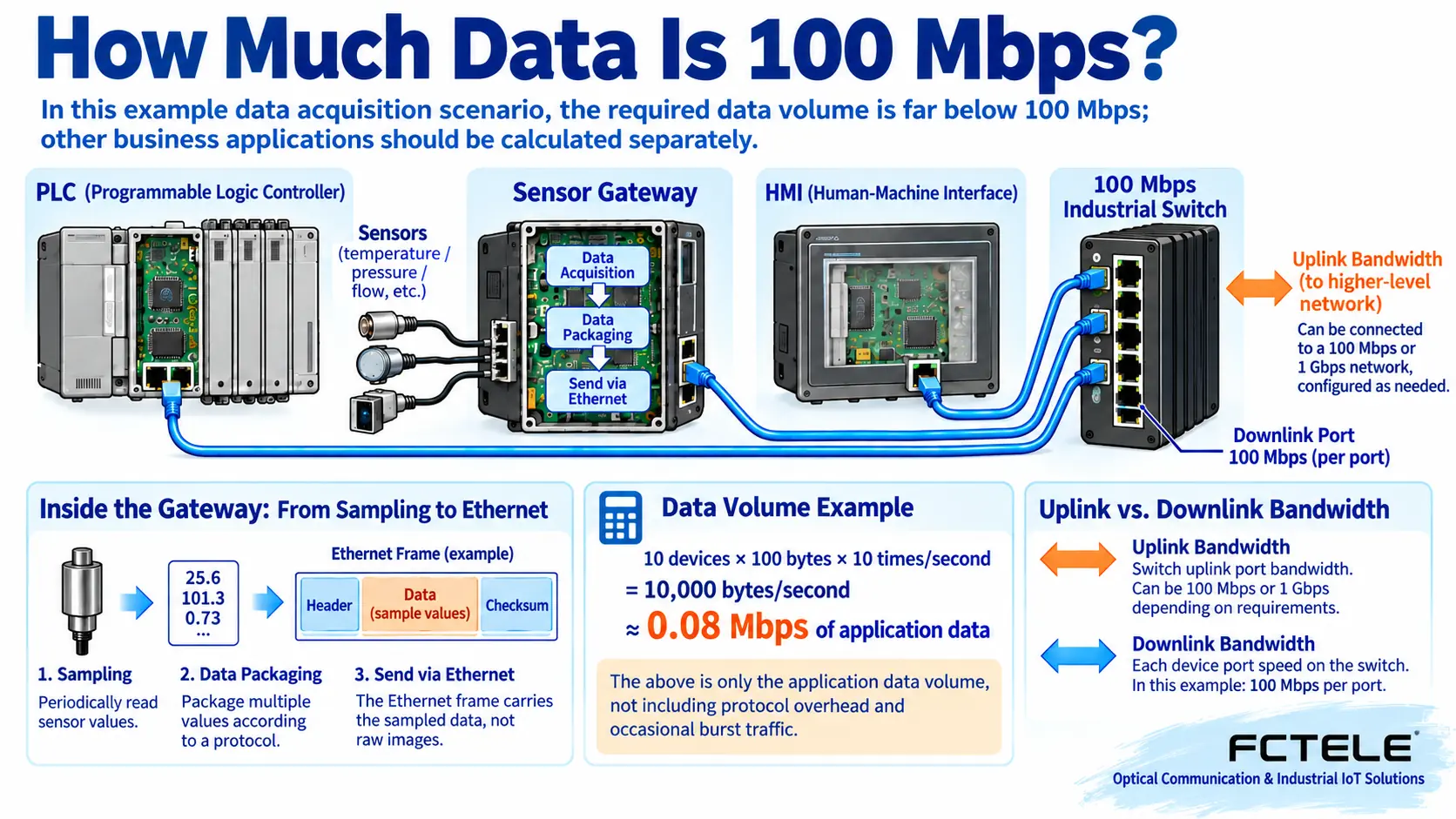
When estimating, use “application data bytes per time × times per second × number of devices,” then multiply by eight to convert to bits. For example, ten devices, each ten times per second, 100 bytes each time: the application part is 10,000 bytes per second, about 0.08 megabits. Requests and responses may be in two directions, and message headers, retransmissions, and other traffic must also be added. This is a starting point for order-of-magnitude judgment, not a precise on-site capacity test.
Actual protocols may have small messages with high-frequency interaction, broadcast discovery, multicast, or bulk uploads. Even if average traffic is low, instantaneous peaks may occur. You should also pay attention to the latency and packet loss allowed by the application. You cannot claim suitability for any real-time control just because there is ample bandwidth margin. Network latency is affected by queues, paths, terminals, and scheduling. For control systems with deterministic requirements, acceptance should be based on their protocol and system design requirements.
3. Multi-channel aggregation is where it is easy to miss calculations
Assume four video streams each continue at 30 megabits per second and enter four 100M ports respectively. Each ingress does not exceed 100M. But if all are sent to the same recorder and share one 100M uplink, the total of 120 megabits exceeds the long-term capability of that egress port. At first it may only appear as queuing. After the buffer is full, some frames will be dropped, and the application may experience stuttering, retransmission, or incomplete recording.
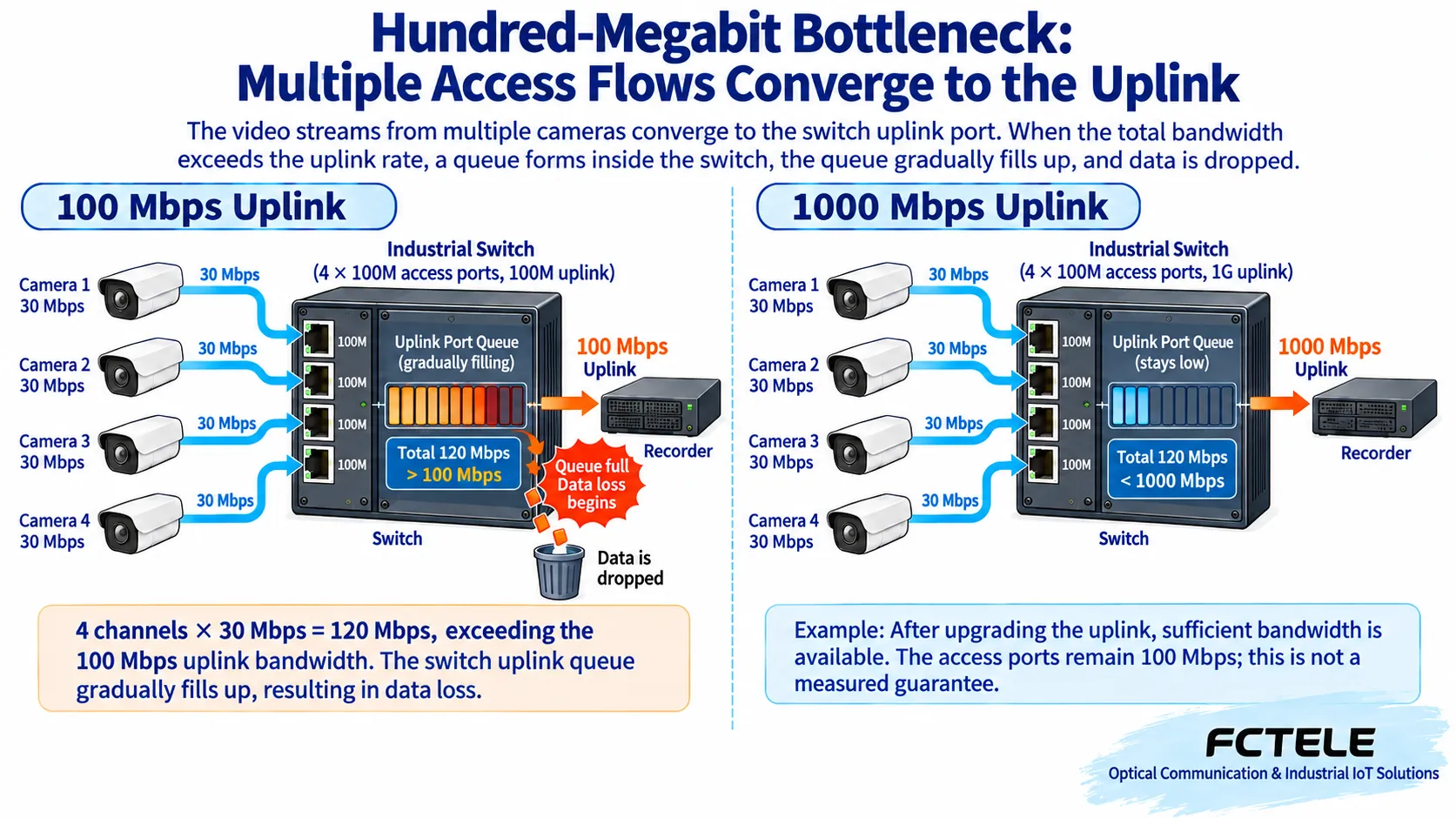
Therefore, add up segment by segment along the data destination. Cascade lines between switches, recorder ingress, and server network ports may all become shared egress ports. If the server and terminals are on different ports of the same switch, local traffic may not pass through the remote uplink; if the server is in another building, the amount carried by the uplink will differ. If you only count terminals and do not draw destinations, it is easy to calculate the same network incorrectly.
4. 100M access and gigabit uplink can be chosen separately
Some networks use lower-rate terminal access and higher-rate aggregation, allowing small-traffic devices to retain appropriate cost while giving the common egress margin. But you cannot infer from the product name “mixed rate” that all port combinations are usable; you should check the interfaces one by one. A 100M terminal connected to a gigabit switch may still be 100M after negotiation; upgrading aggregation will not make it become gigabit by itself, but it can reduce competition when multiple streams are aggregated.
Switching capacity, forwarding rate, and buffer should also be combined with actual frame size and load. Large file transfers and many small messages do not place exactly the same pressure on the device. The same number of ports and the same nameplate rate do not mean the same performance under any forwarding conditions. Providing typical traffic and peaks before purchase and requiring verification under similar conditions is more likely to yield meaningful answers than just asking “how many ports before it lags.”
5. When it is more suitable to upgrade directly
If there are machine vision images, higher-bitrate video, centralized backup, or frequent large file transfers, you should prioritize recalculating the 100M limit. If terminals will clearly be added or services changed in the future, expansion margin should also be included in the plan. You should not establish a site-wide rule that “once a certain average utilization is reached, replacement is required”; averages mask peaks, and applications allow different latencies. Judgment should combine time distribution, drop statistics, and service experience.
A higher link rate will not fix bad network cables, incorrect VLANs, unstable power, or slow terminal processing. First check the negotiated rate and duplex status, then check error frames, uplink utilization, and queue drops, and finally locate the application and server. A single computer speed test cannot replace acceptance testing of all terminals working simultaneously; the speed test tool itself, storage read/write, and remote services may also limit the result. The test topology and conditions need to be written down.
6. Cost-effectiveness cannot be calculated only from the bare-unit price difference
An industrial model with a lower port rate may also have specific power supply, installation, and management capabilities; a gigabit model may not necessarily meet the on-site environment. Temperature, electromagnetic compatibility, power protection, and heat dissipation conditions should be checked as independent requirements and cannot be inferred from 100M or gigabit. IP rating is not a network reliability rating, and a metal enclosure does not guarantee zero packet loss forever. Choose environmental capabilities based on actual evidence, then compare rates among models that meet the conditions.
Total cost also includes power supplies, optical modules, cabling, configuration, spare parts, and subsequent replacement. The bare-unit cost saved today may not be worthwhile if construction is redone soon due to insufficient capacity; conversely, for devices that only send a small amount of status for many years, useless high specifications may not be needed. Include whether existing cabling can be reused, downtime windows, and configuration migration in the comparison, and avoid looking only at one purchase number.
7. How to use materials for Feichang Technology 100M products
Feichang Technology’s official website’s mini industrial rail-mounted five-port 100M electrical switch provides small 100M wired access and rail or wall mounting structure. For a small number of nearby terminals, this structure is convenient for fixing inside a cabinet. The five ports still need to deduct the ports used to connect to other networks; whether it meets latency, environment, and power requirements should be determined according to the actual supply description and project testing.
When more bandwidth is needed, you can compare gigabit or other uplink structures in the rail-mounted industrial switch category. You cannot assume that the management, ring network, or PoE capabilities of a certain series are available on all 100M models. This article discusses capacity judgment methods and does not replace specific model compatibility, real-time, or stability commitments. The example traffic is also not a manufacturer product test report.
8. A practical acceptance sequence
First record devices, connection relationships, and the negotiated rate of each port. Verify the application correctly on a single unit, then let multiple units run concurrently at actual frequencies. Cover startup, bulk upload, and maintenance operations, and observe latency, errors, and drops, not just average traffic. If the service has a backup path, test link disconnection and recovery within the authorized scope, and record whether the application reconnects. You cannot directly equate the link recovery claimed by the protocol with all applications recovering.
Save configurations, port labels, and load records, and recheck aggregation egress ports after adding terminals. When traffic is low and there is sufficient margin, the environment matches, and maintenance is convenient, 100M can be reasonable; when continuous concurrency approaches or exceeds the bottleneck and the service needs to be upgraded, the architecture and rate should be adjusted. The core of cost-effectiveness is to meet verifiable requirements at a suitable cost, not to insist on 100M for a low price or upgrade everything for nice-looking numbers.
Data note: Forwarding mechanism reference Cisco network switching explanation; product information is subject to the corresponding Feichang Technology page and ordering configuration. The two figures are mechanism illustrations, and the data calculation examples are not measured results.
Translated from the Chinese technical article. Source first published: 2024-09-10. Source last revised: 2026-10-13T17:34:48+08:00. Read the Chinese source
