


Industrial switches and ordinary switches can both forward Ethernet-compatible data, but the applicable environment, power supply and installation, management, and verification conditions may differ. When comparing, you must match the same business and site conditions; you cannot assume that industrial equipment is automatically faster, and you cannot assume that ordinary equipment cannot be used in any industrial location.
First, clarify the shared work
A Layer 2 switch learns source MAC addresses and, according to the destination address and the corresponding rules, decides whether to forward, filter, or flood. The basic mechanism has no direct high-or-low relationship with whether it is called an industrial switch. The business still needs correct IP, VLAN, and application configuration; an industrial label will not automatically solve networking errors.
The real difference comes from the device’s specific capabilities and usage boundaries. Ordinary office racks and outdoor industrial equipment cabinets have different temperature, power, and maintenance conditions, and the same device may be suitable for the former but not the latter. Comparison needs to clearly write out these conditions.
Temperature and heat dissipation are most easily oversimplified
Operating temperature depends on the actual environment around the device, installation spacing, sunlight, and heat sources inside the cabinet. Fanless industrial equipment dissipates heat through conduction and air flow, which does not mean it can be packed together in a completely sealed space. A metal case generating heat may be part of the heat dissipation path, but the allowed conditions still need to be checked.
Ordinary rack equipment may also have appropriate environmental capabilities, while industrial equipment may have different temperature grades. You cannot use the wide-temperature range of another model from a certain brand to replace this model, and you cannot infer the internal components and long-term reliability only from the case material.
Power supply and installation affect the scope of failure
Terminal power supply, DIN rail installation, redundant input, or alarm contacts may be suitable for on-site maintenance, but the specific functions must be stated. Redundant power is not just about the number of sockets; you also need to check whether the two upstream sources are independent and whether there is a common switch or power failure point.
Racks and DIN rails each have space, force, and wiring requirements, and connectors affected by vibration or cable pulling also affect stability. Surge, isolation, and electromagnetic compatibility materials need to correspond to the model and test conditions; you cannot treat the word “industrial” as proof of protection for all items.
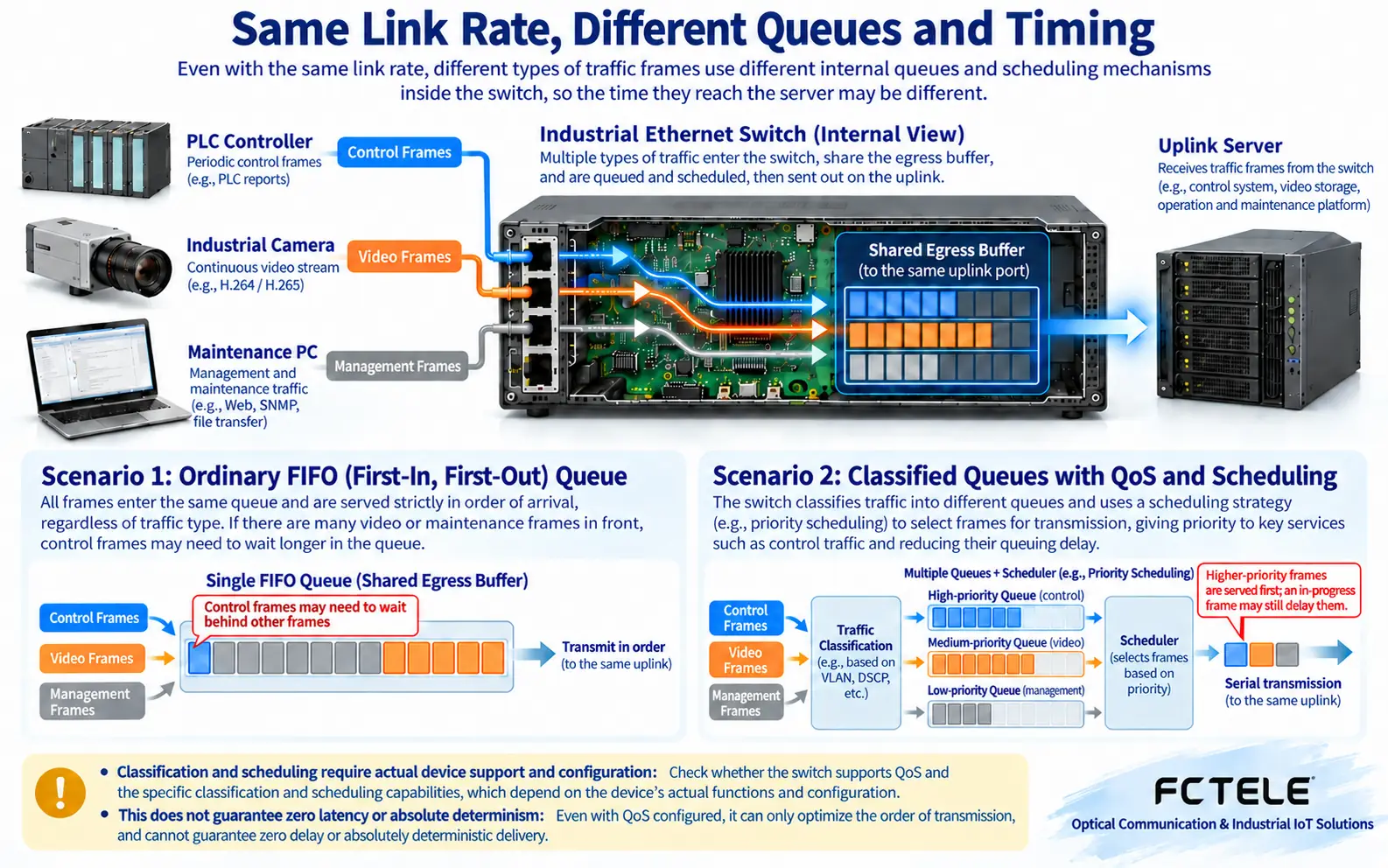
Same port speed, why does control traffic still queue?
An Ethernet outlet can only send the corresponding data according to link rules one at a time. Controllers, cameras, and maintenance computers may send frames to the same outlet at the same time; when the outlet is busy, other frames must wait. A port marked gigabit indicates the nominal link speed, which does not mean any message arrives immediately, and even less does it mean that the entire network control cycle is already guaranteed. Latency includes terminal processing, network forwarding, queuing, path, and application response, and cannot be inferred only from the device name.
QoS is a mechanism for classifying, queuing, and scheduling different businesses. After the corresponding function is available and correctly configured, control traffic can use a priority that matches the design; but ordinary scheduling usually cannot immediately interrupt a frame that is already being sent on the link. Strict priority may also make low-priority traffic wait too long, so bandwidth allocation and business requirements should be designed together. The order in the figure is used to explain the mechanism and does not promise zero latency or a fixed cycle.
During testing, run control, video, and maintenance services at the same time, record application cycles, abnormal retries, and queue counts, and compare the difference between no load and load. If only one small-message Ping succeeds, you still cannot judge whether continuous control meets the requirements. Systems that truly need time-sensitive or dedicated real-time communication capabilities should be configured according to the protocol and system vendor requirements, and cannot replace compatibility verification with the four words “industrial gigabit.”
Different functions cannot all be attributed to industrial or ordinary
VLAN, Layer 3 routing, PoE, multicast, and port diagnostics may appear in different categories of products. Industrial protocols, time synchronization, and ring protection are also not default functions of all industrial models. Listing the necessary functions item by item and comparing equivalent configurations is more meaningful.
For ring networks, confirm the protocol, role, and interoperability; for QoS, confirm the specific business and queue behavior. Advertised recovery time or latency can only be compared when the topology, nodes, traffic, and firmware conditions are noted, and cannot be unconditionally turned into an on-site guarantee.
Automation projects: verify protocol compatibility, real-time performance, and security separately
A switch being able to forward a certain Ethernet message does not mean it is responsible for interpreting or converting that business protocol. Modbus TCP applications are usually handled by the terminal, while systems such as PROFINET still need to check devices, topology, and corresponding capabilities according to specific communication requirements. EtherCAT uses a dedicated processing mechanism and topology; you cannot arbitrarily insert an ordinary Ethernet switch into its process data link just because the device is called an industrial switch; you should select the corresponding node or branch device according to the system vendor and protocol organization requirements. Reference:EtherCAT Technology Group technical description.
Describe PLC, robot, monitoring, and maintenance traffic separately, and verify cycle, jitter, packet loss, and application response under the expected load. High port speed does not automatically bring determinism, and support for a certain redundancy protocol does not guarantee that any topology will recover in a fixed number of milliseconds. Topology, number of nodes, detection mechanism, configuration, firmware, and terminal reconnection all affect the result. You should record the actual business recovery after a link break, not just that the network port light is on.
Security and redundancy solve different problems: VLAN is a means of business partitioning, not message encryption; ACLs, identity authentication, and management permissions need to be confirmed item by item, and commercial equipment may also have these capabilities. Dual power and ring networks mainly reduce the impact of specific failures and will not automatically prevent unauthorized access. In the selection table, list environment, communication compatibility, recovery, and access control requirements separately, deploy according to the minimum necessary functions, and keep configuration backups and fallback plans.
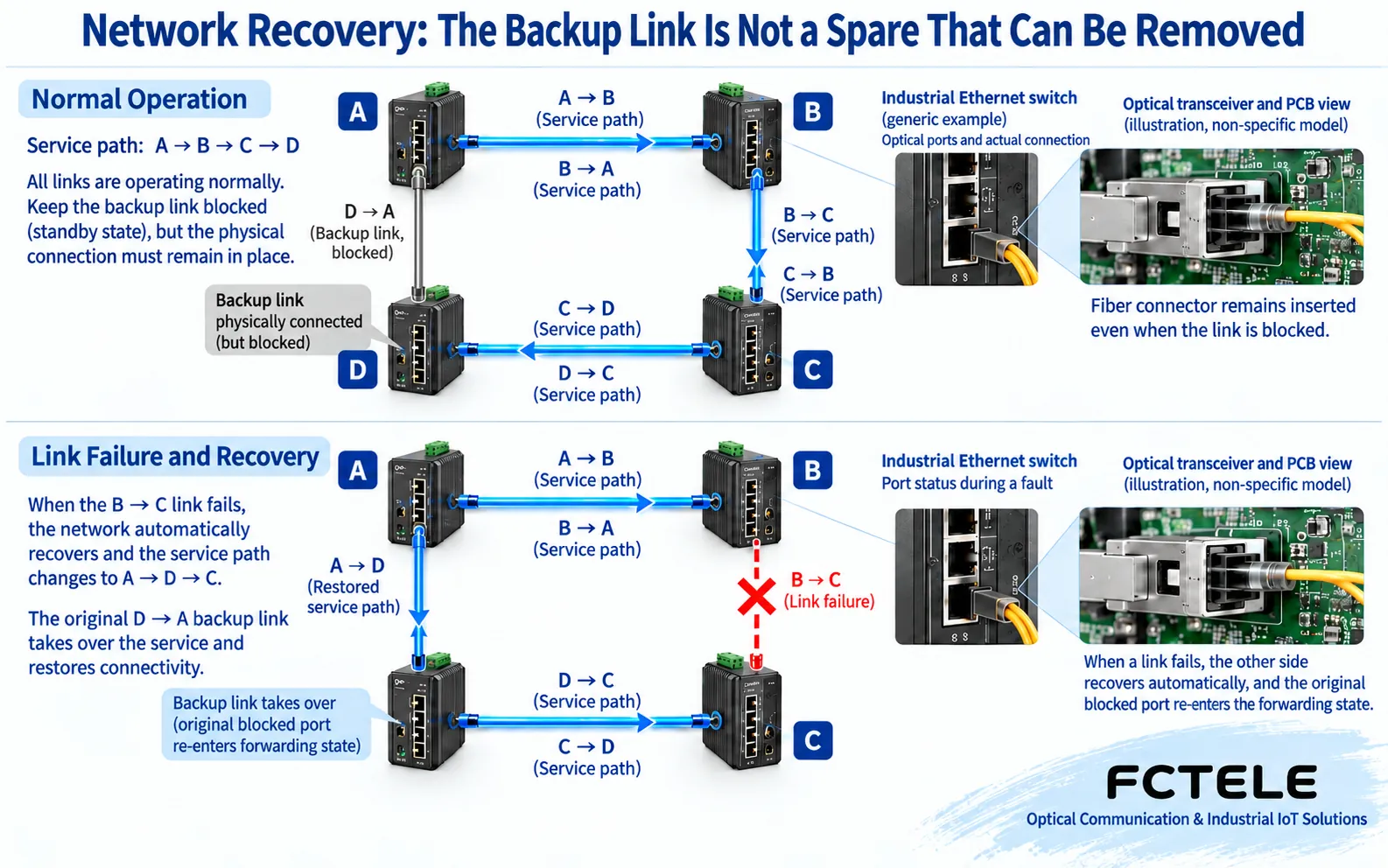
How does a backup link change from waiting to available?
Connecting switches into a physical ring can provide another path, but if all ports forward Layer 2 broadcasts without control, messages may loop and quickly occupy the network. A suitable ring protection protocol usually blocks business forwarding on one link in normal times while keeping the physical connection; after detecting a failure that meets the conditions, the protocol changes the forwarding state so that the original backup path carries communication. This is different from directly unplugging the backup fiber.
In the example, four nodes A, B, C, and D form a ring. In normal times, business on the D-to-A side is blocked, and A reaches D through B and C. If the connection between B and C breaks, after the original D-to-A path is released, A can reach C through D. The node positions and the original fiber do not need to change out of thin air. The specific protocol also involves detection, roles, timing, status, and recovery processing. Before wiring, confirm that all devices can interoperate, and do not mix incompatible private protocols.
Acceptance needs to time network forwarding recovery and application recovery separately. After the switch has restored the path, the terminal may still be waiting for a timeout or re-establishing a connection, so a green network port does not mean that all production business has recovered. In the maintenance window, separately test the allowed link breaks, device power loss, and recovery operations, and record which terminals are affected, whether duplicate business is generated, and whether the configuration can be restored. Redundancy can only reduce the impact of the designed failure and will not automatically solve single points of failure in the common power supply, host computer, or configuration.
Cost comparison also includes maintenance
Beyond the device price, there are optical modules, power accessories, configuration management, spare parts supply, and downtime costs. Complex network management functions require accounts, backups, and personnel maintenance, and a lack of diagnostics may also increase troubleshooting time. The choice should match the team’s capabilities and business risks.
For locations with controlled environments and simple requirements, ordinary equipment that meets the requirements may have reasonable uses; for harsh locations, clear test and protection requirements should be proposed. The conclusion is not that one type of device always wins, but which device can use evidence to satisfy this location.
The comparison table should finally come down to testing
Compare interfaces, capacity, environment, power, functions, and services, then use the same target load to verify packet loss, errors, and application response. In an approved environment, perform link-break recovery and record the phenomena on both the device and terminal sides; port Up is not full business recovery.
You may refer to Environmental evidence and industrial vs. commercial selection. Formal procurement is based on specific model descriptions, compatibility materials, and repeatable records, and does not use unsupported conclusions about grade, lifespan, or zero failure.
Use Feichang Technology product materials to check specific capabilities
The Feichang Technology 8-port gigabit electrical plus 4-port gigabit SFP managed product material lists QoS scheduling, ERPS, VLAN, port statistics, and mirroring, which can be used to further check the queuing, redundancy, and diagnostic requirements discussed in this article. The recovery time in the material still needs to be verified together with topology, nodes, configuration, firmware, and business; it cannot be directly treated as a guaranteed value for all projects; support for switching functions also does not prove that it can be arbitrarily inserted into a dedicated real-time bus.
Materials and descriptions:Feichang Technology industrial switch category;mini five-port product material;8 electrical 4 optical managed product material;Ethernet switching mechanism;standard PoE detection and power supply description. The principle illustrations are general mechanism diagrams, not actual product photos, measured data, or certification evidence; the example parameters are not commitments for specific models. Ordering and deployment are subject to the actual model, version, valid materials, and approved test results.
Translated from the Chinese technical article. Source first published: 2019-09-03. Source last revised: 2026-10-13T17:22:03+08:00. Read the Chinese source
