


A serial card expands ports on one computer; a device server places serial equipment on a network. Both may expose COM ports, but paths, power, drivers, failures and maintenance differ. Choose by location, software access and required recovery from network/computer faults, not port count alone.
Two ways to read one instrument
For four laboratory instruments beside one computer, a local PCIe or suitable card adds ports through its driver. USB-to-serial is another local expansion form, not identical PCIe hardware. Both require electrical and driver compatibility.
For instruments across workshops with central software, servers can sit near devices so serial wiring stays local and networking covers distance. Software accesses sockets or virtual COM drivers. This comparison does not imply removal of distance, timing or permission limits.
How a card cooperates with its host
Transceivers handle RS232/422/485, UARTs handle characters and controller logic exchanges data over the host bus. Drivers expose ports to the OS and application. Host power, OS and driver remain dependencies. A powered-off computer normally cannot keep its local card serving another host independently.
Using host resources does not inherently mean poor performance, nor does external equipment eliminate application CPU work. Compare load, driver efficiency, design and failure requirements. Modern multiport card counts and supported systems vary; old fixed counts and obsolete OS lists are not universal.
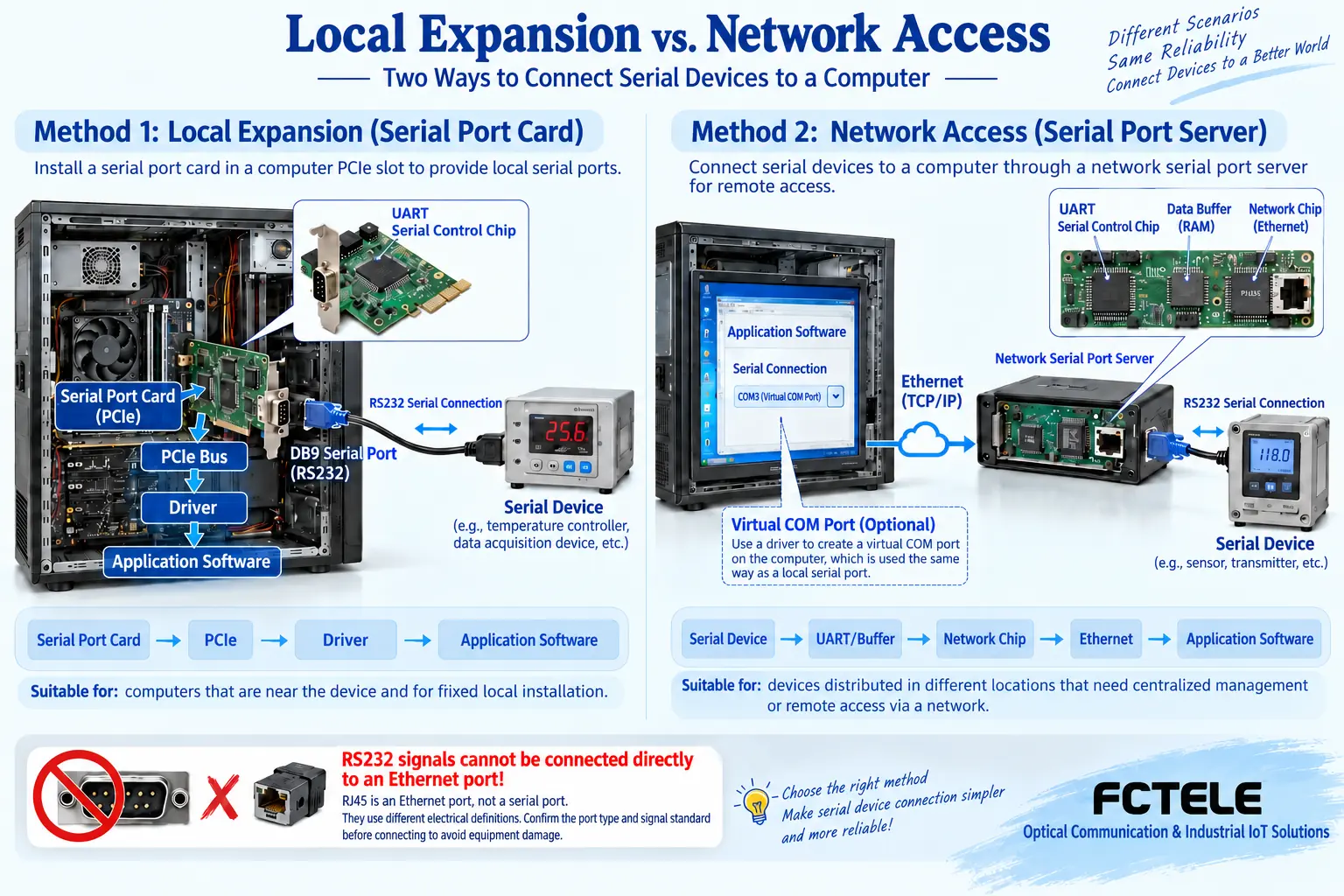
What networking adds
A server handles serial reception, buffering and network sending independently. The computer need not drive its internal hardware, but virtual COM still needs suitable software/driver. Socket applications can use TCP/UDP if they parse service messages correctly. TCP/IP support cannot guarantee every OS and legacy program.
Networking adds addressing, sessions, access control, packetization and reconnection. These enable distributed deployment and introduce failure conditions. Faster Ethernet cannot accelerate instrument serial output. Evaluate strict timing across complete requests/replies, not network rate alone.
The same COM name does not mean the same behavior
A virtual driver lets legacy software open a COM name while transporting reads/writes remotely. Test control lines, baud changes, disconnection returns and OS versions. Similar entry points do not establish equal delay/error behavior.
A program that quickly checks replies may work locally but time out after network/packetization waits. Adjusting timeouts needs limits and checks for response ownership, residual buffers and repeated actions. Hardware-flow-control applications need server/driver status support, not only a three-wire text test.
Sharing among computers
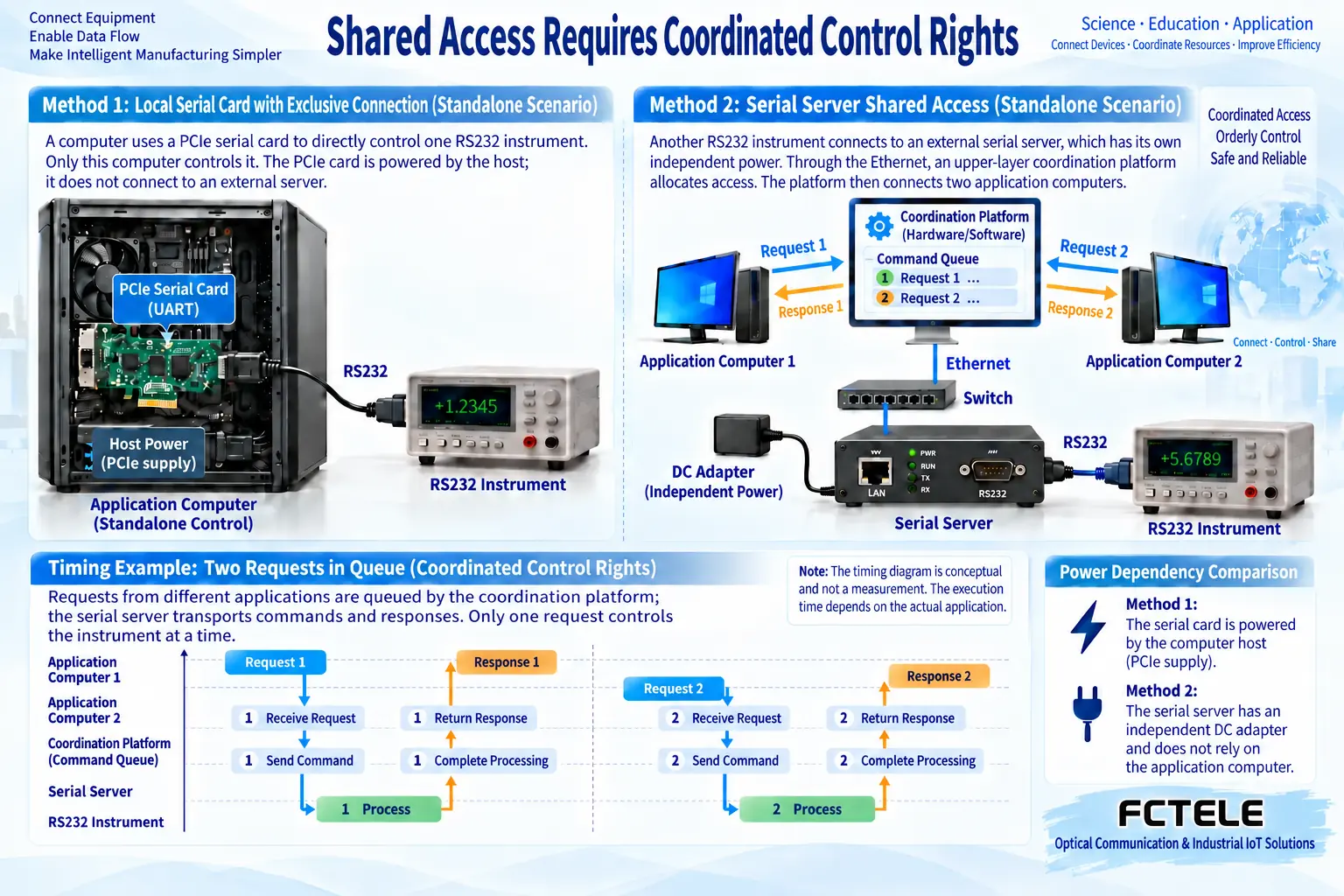
Network reachability does not make an instrument multi-master. Serial requests/replies may need strict ordering; interleaved commands cause ownership errors or conflicting control. Define one controller, distribute results through a platform or use explicit scheduling.
A local card can also be shared through a software service; it is not inherently incapable of networking. Conversely, multiple server sessions do not guarantee seamless failover. Transfer of authority, unfinished transactions and duplicate control require system design/tests.
Choose by failure scope
Local designs depend on host, upgrades, slots and serial cabling. Network designs depend on site power, links, central equipment and secure access. One four-port server creates a shared four-channel failure; four servers add maintenance points. Neither concentration nor more devices is universally more reliable.
Specify physical interface, software entry, location, concurrency and recovery. Compare total cabling, power, development, driver upkeep and diagnosis costs rather than hardware price alone. No universal price ratio or metal-case-derived isolation/environment rating applies. Check model evidence.
Test migration with the original software
Record working local characters, messages and timing, then test the candidate in a lab. Include continuous reads, writes, abnormal replies and software restart. For virtual COM verify actual OS/driver; one text line in a utility is not complete compatibility.
During outage tests observe detection time, stale data after reconnect and repeated actions. Production tests need authorization. Check FCTEL server categories for matching models. This is an architectural comparison, not a basis for assigning one server features to cards or every serial product.
Product reference:FCTEL serial device server details. Figures show generic mechanisms, not products or measurements.
Translated from the Chinese technical article. Source first published: 2022-05-12. Source last revised: 2026-10-13T15:49:49+08:00. Read the Chinese source
