


A PDH optical-terminal label cannot guarantee every digital interface. Extending E1, accepting E3 and moving leased circuits onto SDH or packet transport are different tasks. Identify level/interface, transport equipment and remote recovery first. A small E1 unit cannot handle E3, E4 or arbitrary Ethernet simply because all are associated with PDH.
1. What the PDH hierarchy describes
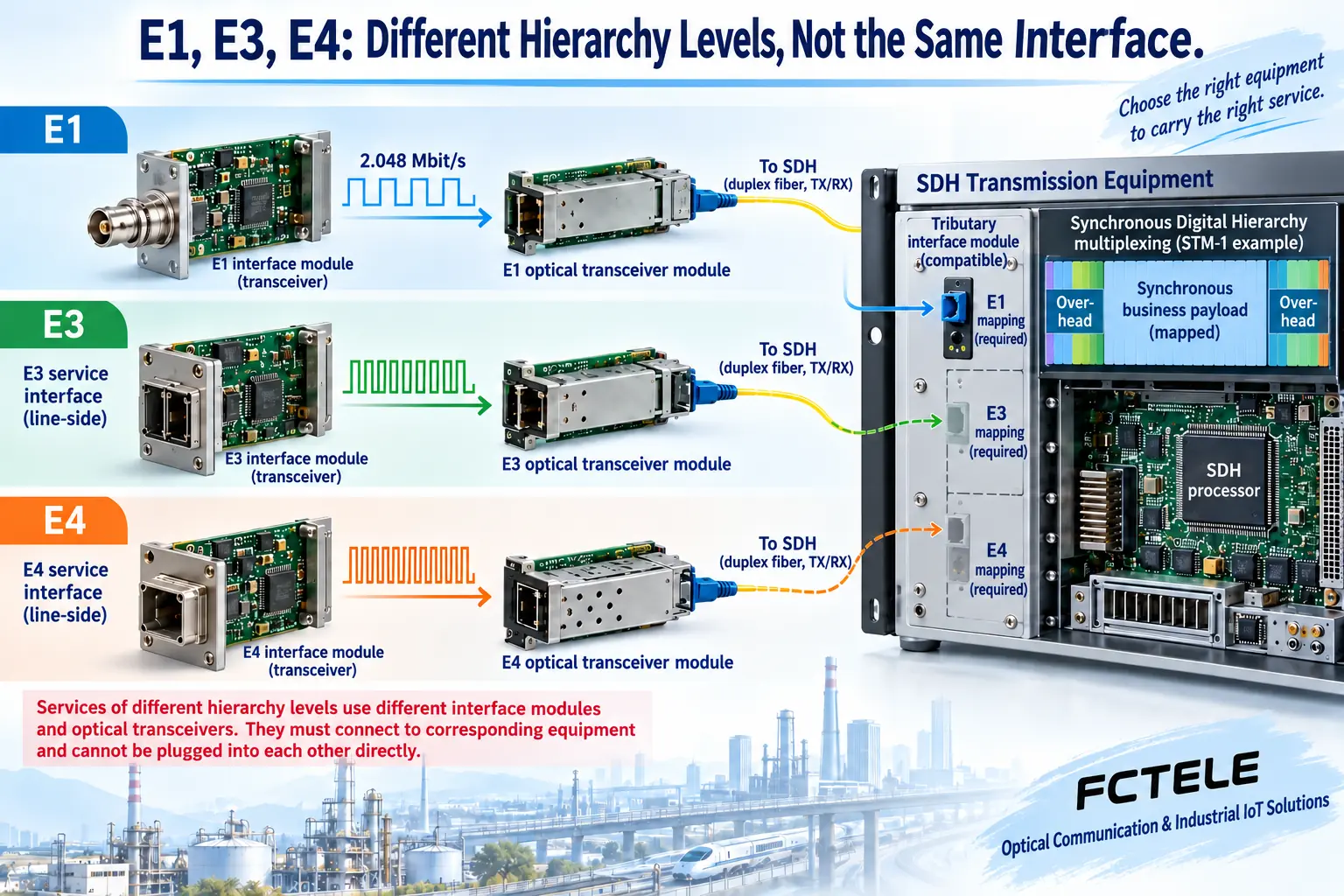
PDH, plesiochronous digital hierarchy, organizes/multiplexes digital services at defined levels. E1, E3 and E4 are hierarchy levels, not enclosure model labels. E1 commonly has a nominal 2.048 Mbit/s rate. Higher rates have their own interface and multiplexing requirements; changing a cable connector cannot create a higher-level service.
Different shipping-container sizes provide an analogy, but actual multiplex frames are not physical nested boxes. Data needs the relevant organization and receiver recognition. Specify actual levels and ports rather than merely a PDH terminal pair.
2. Multiplexing and optical conversion are separate
Optical conversion changes media: electrical signals drive light and are recovered remotely. Multiplexing changes organization by combining inputs into a supported stream. A device may perform both or merely extend one level. An optical port does not imply every multiplexing, demultiplexing or hierarchy-conversion function.
With a four-E1 product, first verify correct end-to-end correspondence of the four channels. A faster optical aggregate does not create an E3 electrical input. E3 needs explicitly supported interfaces/electrical conditions. Similar connectors do not establish coding, impedance, rate or framing.
3. SDH migration requires more than new optical terminals
SDH, synchronous digital hierarchy, has its own frames and mapping. Carrying legacy E1 through a supporting SDH network normally requires tributary interfaces and mapping into supported structures. Fiber carries light; it does not translate PDH into SDH automatically.
Confirm new tributary ports, supported level, clocking, remote extraction, protection and management before migration. SDH byte structures/protection cannot define every PDH terminal. Optical ports at both ends prove media use, not interoperability.
4. E1 over IP needs dedicated adaptation
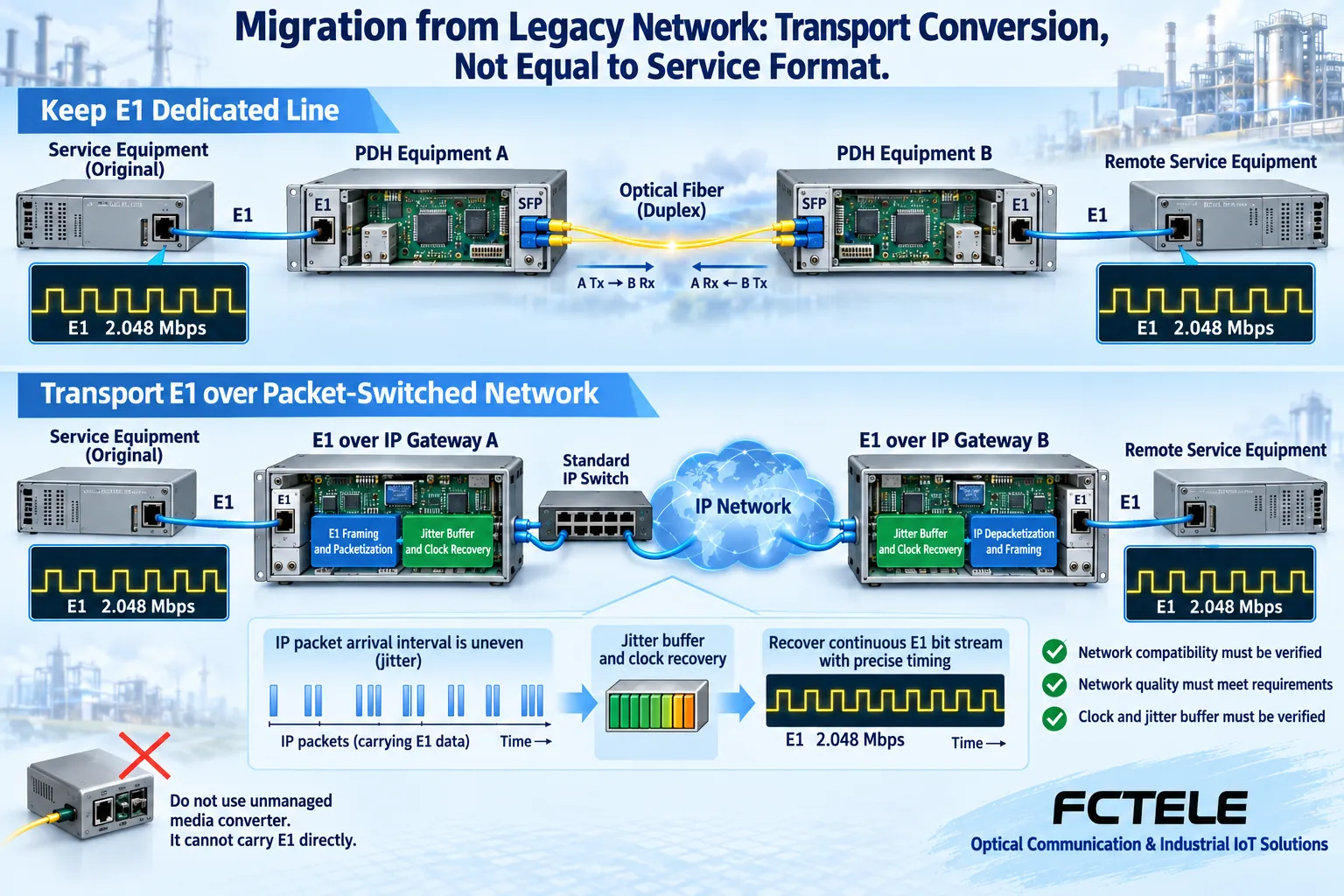
Ethernet/IP forwards frames/packets with variable arrivals; E1 needs continuous correctly timed output. Packet migration needs compatible circuit-emulation/TDM-over-IP equipment rather than direct E1-to-switch wiring. Gateways handle segmentation, encapsulation, receive buffers and output timing, with matching implementations at both ends.
A jitter buffer queues irregular arrivals before scheduled output. Larger is not universally better: delay, network variation and recovery matter. The illustration gives no universal setting. Test loss, reordering and delay variation in the actual design against the required service.
5. Define FCTEL product boundaries
FCTEL lists ordinary PDH, E1-plus-Ethernet PDH, SDH and TDM Over IP separately because their interfaces/tasks differ. FCP-E4m lists one to four E1 and optional orderwire; FCP-E4F1m additionally lists one Fast Ethernet interface. These establish listed ports, not E3/E4 acceptance or automatic SDH migration.
For simultaneous E1/Ethernet between sites, check explicitly dual-service models. For existing IP transport, check gateway details and pairing. Optical-transmission marketing names cannot make categories interchangeable. Request exact models, port lists, version and endpoint design rather than series illustrations as evidence.
6. Inventory the legacy system before testing
Record service levels, interfaces, channel counts, clock modes and peer requirements. Separate voice already organized into E1 from ordinary analog telephone wiring, which normally needs voice interfaces. Video likewise needs identification of the equipment creating a compatible digital service.
Map the new end-to-end route. Simple E1 extension may use matching point-to-point devices; new sites/aggregation require access, mapping, management and protection design. Connecting ordinary devices in a circle cannot establish automatic protection. A spare fiber alone is not a working protection system.
Plan a maintenance window and rollback. Verify interfaces/channels/services individually in isolation, retaining errors, alarms and endurance results. Check recovery, mapping and actual terminals after installation. Remove test loopbacks afterward: a passing loopback instrument result may not represent the live service path.
7. Evaluate a migration example
For three retained E1 circuits where only an aging optical segment changes, start with equipment supporting three E1 and matching optics rather than unrelated higher hierarchies. If shared IP transport is later required, reassess gateways, clocks, bandwidth and QoS with separate acceptance. Earlier media-replacement results cannot validate the new transport system.
If the actual service is E3, four-E1 equipment is not a direct replacement. Extending the original service and changing its transport hierarchy require different purchases. Defining this scope prevents mistakes better than pursuing a more impressive generic name.
References:ITU-T G.703;ITU-T G.707;FCTEL PDH/SDH categories and FCP-E4F1m details. No unverified higher-order model specifications are supplied. Generic figures are not products or measurements. Actual migration follows manuals, complete design and authorized tests.
Translated from the Chinese technical article. Source first published: 2023-11-21. Source last revised: 2026-10-13T15:49:49+08:00. Read the Chinese source
