


Serial-to-Ethernet modules normally serve internal integration; complete device servers normally serve external field installation. Both can network serial equipment, but a module plus enclosure is not necessarily the same product. Differences include electrical interfaces, supply/protection, software, structure/cooling and responsibility for final verification. Manufacturers and field users should distinguish these responsibilities.
Embedded and external serve different users
For a working instrument that cannot conveniently be opened or redesigned, an external server often simplifies deployment: connect serial to server, Ethernet to LAN and provide suitable supplies. For a new instrument design, an internal module can make networking part of the complete product. This is an engineering division, not a quality ranking.
Modules have no universal form. Some have Ethernet connectors; others need host connectors, protection and additional circuitry. Complete servers do not guarantee every interface either. Read actual interfaces/pinouts rather than treating third-party dimensions, rates or prices as category-wide facts.
Internal digital serial pins may not connect to field RS485
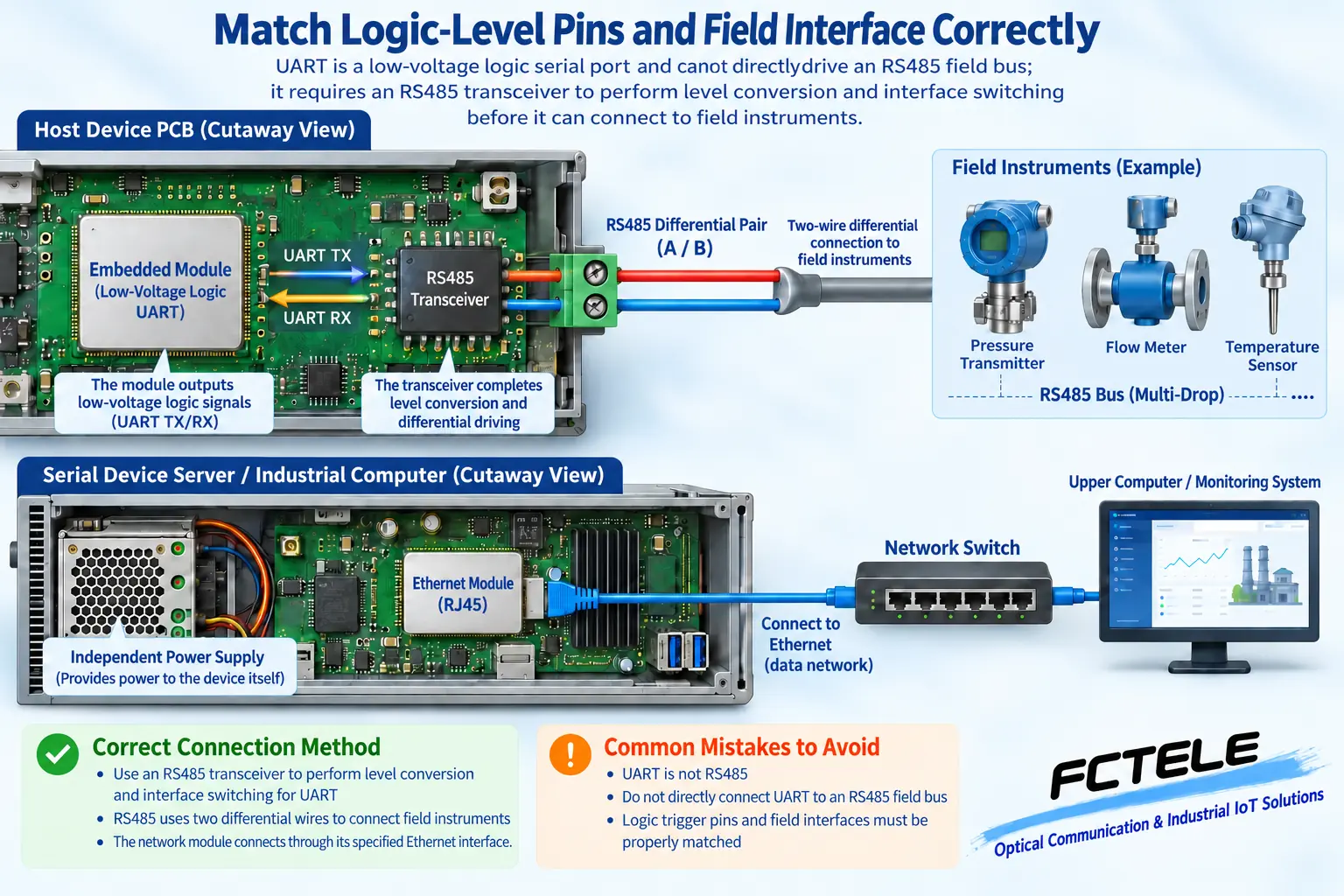
Some modules expose low-voltage UART logic. RS232/RS485 field wiring needs appropriate transceivers with different voltages, signaling and protection. The shared word serial does not permit RS232 into logic pins or RS485 differential lines into ordinary TX/RX pins.
Where the host must provide transceivers, the designer handles direction control, termination, references and protection. RS485 naming varies, so check actual definitions. Complete field ports may include some functions, but isolation/surge ratings remain model-specific rather than determined by enclosure material.
Complete-product engineering extends beyond networking
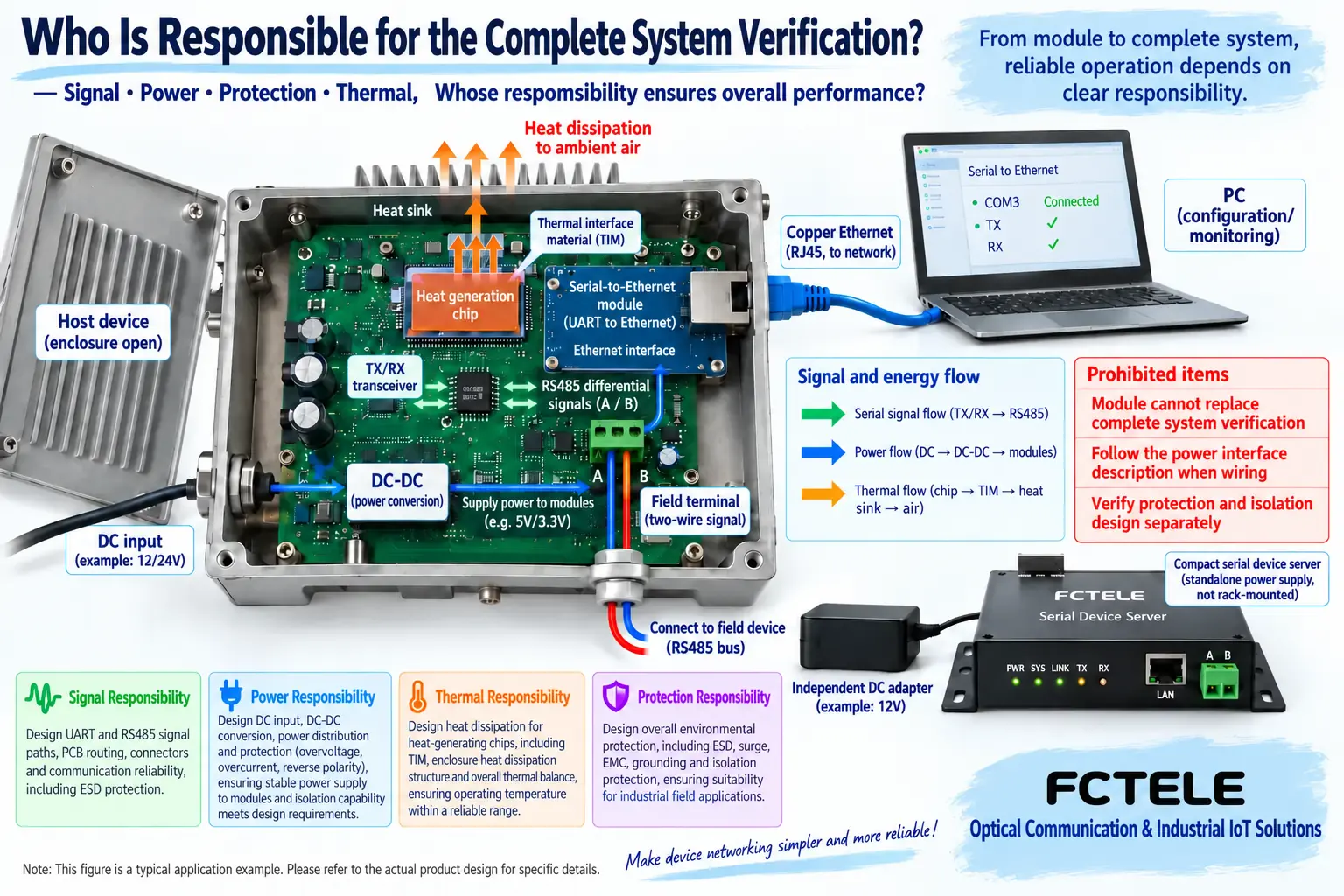
Match a module to host voltage, startup, current changes and reset. Design mounting, connector strain, grounding and cooling. A sealed enclosure may be hotter than a bench. A working development board cannot prove long-term complete-unit operation under planned environment/load.
A complete server supplies structure and power interfaces, reducing some integration work while adding site space and wiring. Confirm rail/wall mounting, temperature and protection. Modules are not inherently weaker, and external devices do not automatically hold every industry certification. Evidence must cover the final object.
Similar data paths can have different capabilities
Transparent paths commonly receive characters, buffer and send over network, reversing for output. Compare virtual COM, gateway, connection monitoring, encryption, upgrades and logs separately. Modules and complete units may share technologies or expose very different software. Identical functionality requires evidence.
If software sends Modbus TCP while an instrument uses RTU, verify a gateway mode. A transparent TCP path may still require software handling raw RTU. Neither internal nor external architecture bypasses protocols. Multiconnection support also needs coordinated access; connection count is not safe controller count.
Who maintains software and lifecycle?
Embedded products must track module version, configuration, upgrades and supply lifecycle. The final product owns incomplete-data handling during host restart, module recovery and account protection. Provide a usable controlled field configuration process rather than requiring repeated dismantling/soldering.
External servers still need firmware, accounts and backups, with clearer independent responsibilities. Do not expose web/serial services publicly merely for convenience. Encryption, authentication and authorization address different risks. One supported module protocol cannot make a complete deployment automatically secure.
Compare engineering responsibility with cost
Module price excludes design, prototypes, software adaptation, environmental verification, production testing and support. External hardware adds installation, cabling, field power and service space. No older article can establish that modules always cost half as much. Quantity alone ignores development investment.
Complete units may suit small retrofits, unopened equipment or rapid deployment. Modules may suit production designs with development/test capability. Confirm permissions and validation before changes affecting certification, warranty or safety. Choose by requirements and capability rather than price slogans.
Accept characters, networking and recovery
Use known-good serial equipment as a baseline, then verify planned rates, characters and real messages. Cover continuous bidirectional traffic, slow host reads, reconnect and power recovery. One short string misses buffer/framing/driver problems. Unauthorized field actions cannot replace laboratory tests.
For embedded systems, also test host power disturbance, installed temperature, reset and upgrade. For external systems, check field supply/cabling. Retain interfaces, modes, firmware and fault procedures. Confirm FCTEL complete models from official manuals. Without verified embedded-product evidence, do not invent FCTEL module dimensions, certifications or one-to-one product equivalents.
Product reference:FCTEL complete serial device servers. Figures show generic mechanisms, not specific pinouts or test evidence.
Translated from the Chinese technical article. Source first published: 2022-05-07. Source last revised: 2026-10-13T15:49:49+08:00. Read the Chinese source
