


A four-port server normally offers four physical serial interfaces for separate devices or buses. Four means channel count, not a four-device maximum or every standard, unlimited concurrency and arbitrary protocols. Understand each electrical interface, byte path and network mapping rather than memorize an old parameter table.
What each serial port handles
A cabinet may contain a barcode reader, scale, temperature meter and access controller with different settings. A suitable multiport unit can connect them if the order supports their electrical interfaces. Record device, baud and host service for each channel; do not join four sets of wires together.
Each receiver handles electrical signaling and its UART reconstructs characters, delivering bytes to the corresponding buffer/network path. A shared processor/interface must retain ownership. Four mail counters sharing a vehicle is an analogy, not a claim that every real protocol adds particular address tags.
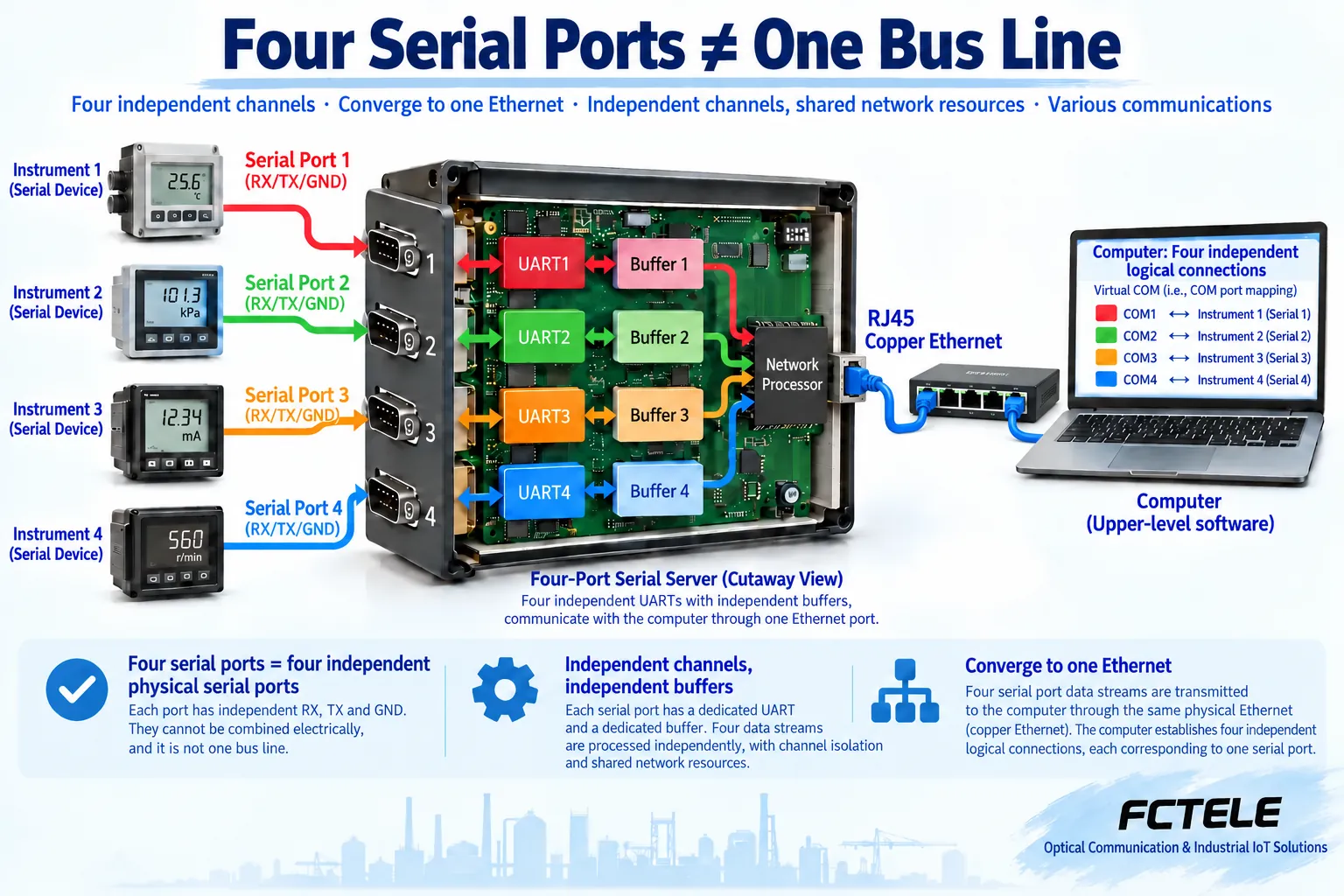
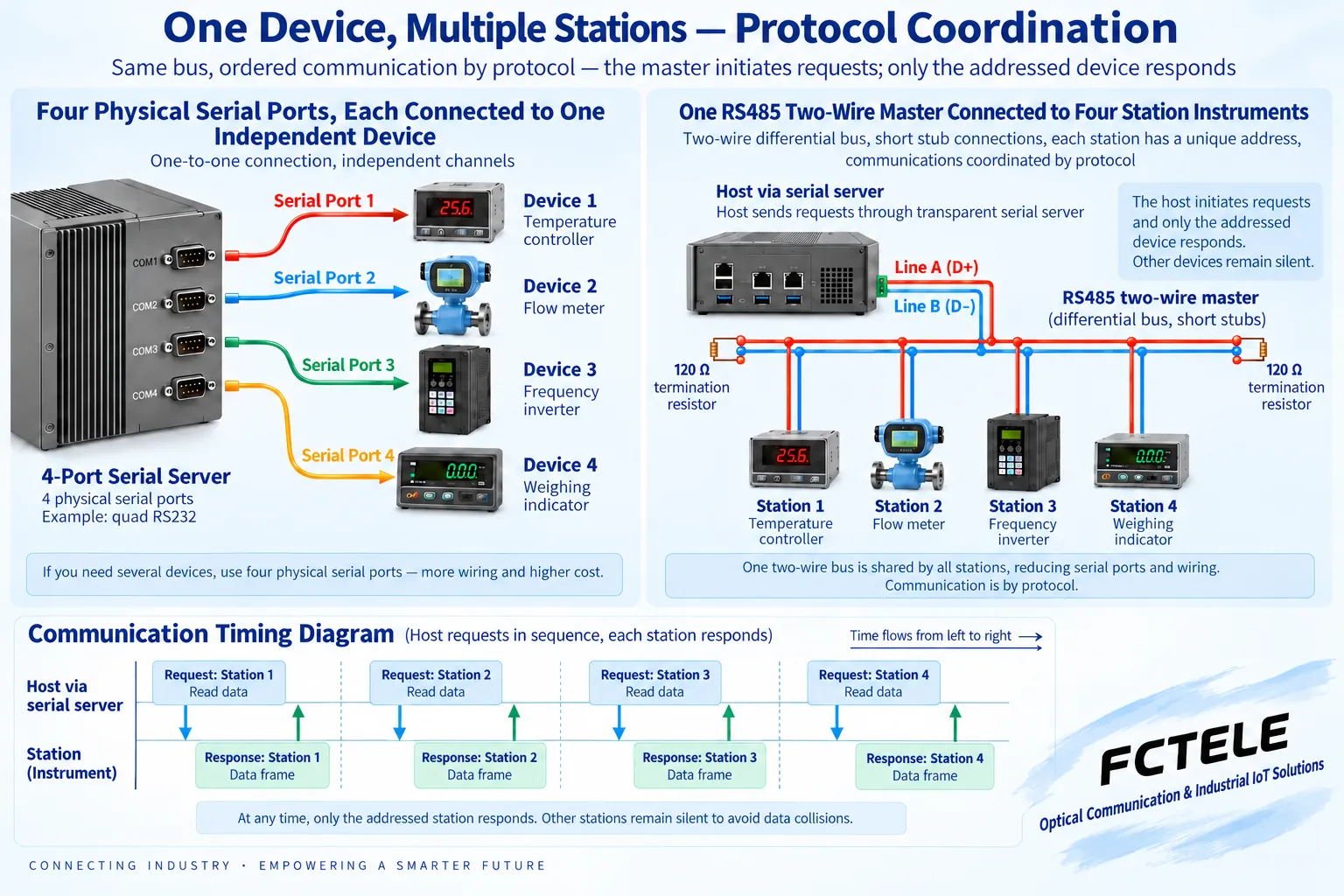
Four independent lines differ from one multidrop bus
One RS485 interface can host multiple stations under a suitable protocol, distinguished by addresses while sharing transmission. Four ports can instead support four separate lines, potentially with several stations each. Count serial interfaces, bus stations and network sessions separately.
A continuously transmitting bad station may affect its bus. Separate serial ports can limit line faults, but supply, processor and uplink remain shared failure points. Define whether independent means parameters, channel ownership or galvanic isolation. Port count cannot prove per-port isolation.
Interface versions determine wiring
RS232 is commonly point-to-point with defined TX/RX/reference. Common two-wire RS485 needs differential wiring, direction and bus topology. RS422 has separate conditions. Identical terminals do not mean identical functions. Some ports are fixed; others switch modes. Confirm the order and switching procedure.
Do not guess using DIP switches or random wiring. Field RS232 connected to logic UART can damage circuitry. Multiple interfaces may not operate simultaneously. Verify one device on a short line before adding installed cables, termination, references and protection.
How one IP reaches four channels
Products may distinguish serial channels by TCP service ports, sessions or other mappings. TCP ports identify software services, not physical RJ45 sockets. One interface can carry several connections, and four Ethernet sockets do not mean four serial channels. Follow actual mapping rules, not universal port-number assumptions.
Define network roles per channel. Server waits; client initiates. This does not establish instrument master/slave roles. Several connected computers cannot automatically control one serial device simultaneously. Coordinate requests, response ownership and authority.
Why old four-port parameter tables cannot be reused blindly
Old articles may mix vendors, obsolete drivers and absolute zero-loss promises. Four channels do not specify CPU, maximum baud, OS, supply or protection. Check current model, interface version and firmware rather than assign another old device specifications to FCTEL.
For example, FCTEL FCT-081206 documentation illustrates multiport/interface configuration choices, not a universal four-port table. A four-channel project still needs the ordered version, modes and software compatibility. An eight-port description cannot certify an unrelated four-port product.
Estimate concurrency and serial capacity
At simultaneous load, per-channel production must match host consumption. Finite buffers absorb bursts, not sustained backlog. Ethernet faster than one serial channel does not prove no system bottleneck. Scheduling, packetization, timeouts and serial transactions all affect response.
For multidrop channels, include request, processing, reply and retry in each cycle. Device count alone cannot establish speed. Slow/faulty stations need controlled lower frequency and alarms to avoid retry saturation. Verify complete transactions, not only byte throughput.
Accept each channel, then simultaneous load
Build a channel table with terminal, interface, character settings, station address, network mapping and software entry. Verify actual messages individually, then all planned traffic, checking cross-channel leakage, timeouts and repeated actions. Use authorized equipment/windows rather than arbitrary broadcast writes to production actuators.
Test network loss, device power loss, host restart and configuration recovery, retaining channel failures and recovery times. Follow supply/grounding manuals, restrict management and back up settings. Success means each channel completes its service with explained fault boundaries, not every LED lit.
Reference:FCTEL multiport serial device server details. Figures show generic mechanisms, not pinouts, specifications or tests of a particular four-port model.
Translated from the Chinese technical article. Source first published: 2022-04-06. Source last revised: 2026-10-13T15:49:49+08:00. Read the Chinese source
