


Ring networks and PoE solve two different things
PoE uses suitable copper network cables to supply power to compatible terminals, while a ring network provides a backup data path in the network design. They can be integrated into the same industrial switch, making it convenient to connect and aggregate dispersed cameras. However, successful data detours do not prove that cameras always have power; stable power supply does not prove that the uplink is always clear.
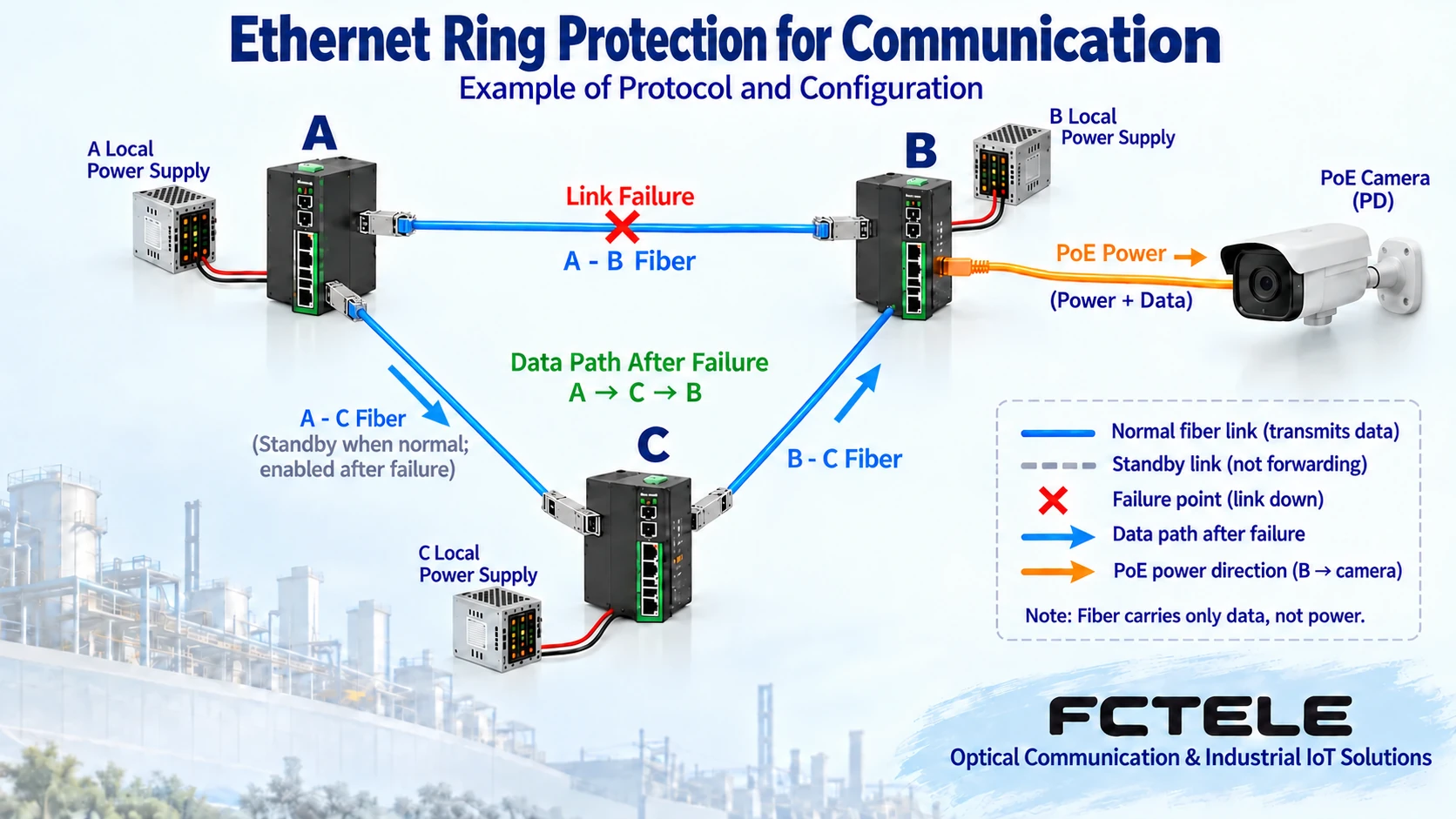
For example, three field nodes are connected by fiber and each uses a local power supply to power itself and its PoE cameras. Communication data is transmitted over the fiber links, and power goes from each node’s local power supply through the PoE port to the terminal. A fiber failure in one section and a power failure at one node have different effects, and reliability design must clearly draw these two paths separately.
Why Ethernet cannot simply be connected into a loop
When an uncontrolled loop appears in an ordinary Layer 2 forwarding network, frames such as broadcasts may circulate repeatedly, affecting links and switching resources. Adding a backup line only provides a physical connection; appropriate protocols and configurations are still needed so that the data path under normal conditions does not form a harmful loop. Connecting interfaces together cannot be treated as completing a ring network solution.
Spanning Tree Protocol establishes a suitable loop-free forwarding structure by exchanging control information. Rapid Spanning Tree Protocol, abbreviated RSTP, improves the recovery process through port roles and state management. Blocking or discarding here refers to the corresponding data forwarding state; it is not unplugging the fiber, nor does it mean that all power functions attached to that port are turned off at the same time.
How traffic switches to a backup path when a data link breaks
When the design and configuration are valid, after the device detects a relevant link change, it may change the applicable backup port to the forwarding state so that data reaches the destination along another path. Control information, port conditions, and the actual topology affect the result. A single recovery time in milliseconds cannot be written for all RSTP networks, and network recovery cannot be equated with zero loss of frame alignment.
The service side may also be affected by terminals, recorders, and application reconnection mechanisms. A continuous test stream recovering does not necessarily happen at the same time as the image recovering; some services require additional handling. Acceptance records should separately state the link failure time, network forwarding changes, and actual service recovery, rather than only observing that the switch light is still on.
What is the difference between node power loss and fiber breakage
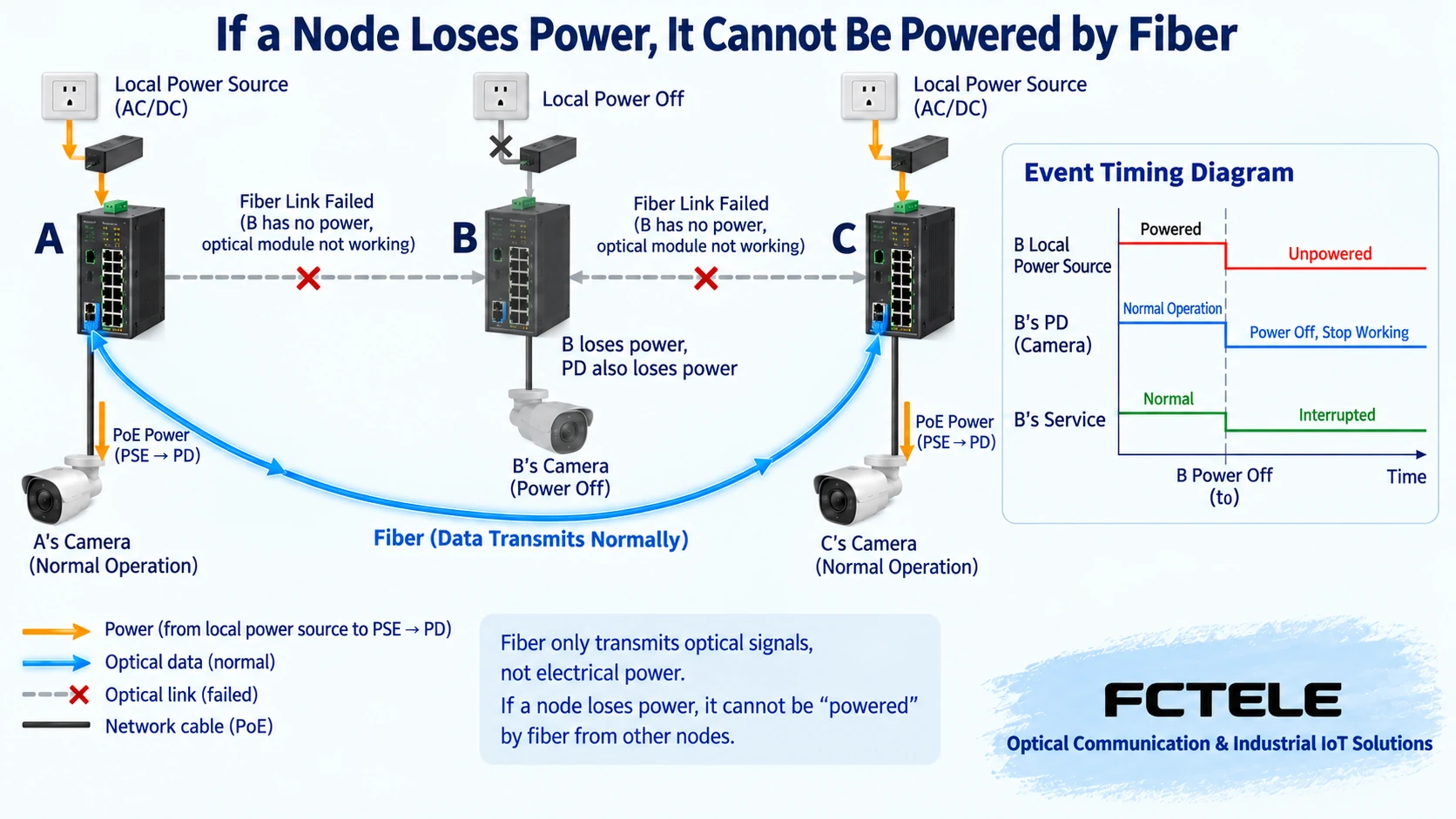
If a node’s switch loses input power, its switching chip and PoE power supply function may both stop; the PD connected to it therefore loses power and restarts. Even if the remaining nodes can continue to communicate through the backup path, they cannot supply power to the camera through the fiber in place of the powered-off switch. A fiber ring has no mechanism to automatically deliver DC power over copper.
Therefore, passing a single-link failure test only covers the corresponding link event and does not prove that node power loss, two simultaneous link failures, or internal device failures can keep all terminal services running. It is necessary to consider which failures are the target of the solution and which remain single points, then determine power, node, and service arrangements. The phrase ring network self-healing cannot cover all situations.
Dual power inputs still require checking remaining capacity
Dual power supplies help with input redundancy design, but whether the two paths are independent, how switching occurs, and whether a single path can handle the entire device and all PoE loads must be confirmed according to the device and site. If two power supplies share one upstream protector or power circuit, a common failure point may still exist. Two sets of terminals are device interface information, not evidence of complete system independence.
Assume all terminals in the solution require a total PSE allocation of 120 watts. This can be met when both paths are normal, but if the allowable capacity of a single path is insufficient, after losing one path some ports may refuse to supply power or terminals may restart. This example does not specify switching time or actual model parameters; the design should be implemented according to the single-path capability, temperature conditions, and protection requirements of the delivered version.
Different ring protocols cannot be compared only by advertised speed
RSTP, MSTP, and proprietary ring mechanisms each have applicable topology and configuration requirements. Two devices both saying ring network does not mean they use the same protocol, roles, or functions, and cross-brand interoperability also needs verification. Confirm the required service VLANs, port purposes, and fault conditions, then see whether the corresponding solution meets the project goals.
The recovery specification provided by a model needs to be accompanied by test conditions, such as the number of nodes, link status, and configuration, and cannot simply be extended to any ring scale. Network backup paths also have bandwidth limits, and switching to another line may produce different aggregation loads; being able to communicate and having sufficient capacity should be verified separately. The PoE budget of node devices will not increase because data takes a detour.
How to use Feichang Technology’s optical, electrical, and management features
The Feichang Technology official product page 3243 list 4 Gigabit copper ports and 2 Gigabit fiber ports, STP/RSTP-related management capabilities, and PoE options. This provides a configuration direction for combining field copper port access with a fiber backup data path. Its ring network capability serves communication, and its PoE capability serves power for compatible terminals. During procurement, the delivered version and input power conditions should be stated separately.
The details use different descriptions for ordinary input and PoE configurations, and the ordinary wide voltage range cannot be treated as a power guarantee for all PoE versions. PoE power specifications and total budget should also be obtained from clear documentation. The general diagrams in this article do not represent the internal circuit of that model or a committed topology; actual optical modules, protocol configuration, and single-path input performance all need to be confirmed according to the delivered solution.
Fault acceptance should retain at least two types of timelines
During an approved maintenance window, first test a specified communication link failure according to the design, recording each node’s status, test data, and actual video recovery. Then test the agreed power failure scenario, observing input switching, PoE status, whether terminal runtime resets, and service recovery. Do not unplug the fiber and cut power at the same time, which would make it impossible to match the phenomenon to a specific cause.
After restoring the original connections, also check whether port roles and services return to the expected state, and retain the topology, configuration, and results. Ring network acceptance answers how the data path detours, while power acceptance answers whether terminals can keep running; only when both meet the project’s specific conditions can there be a reliability conclusion. There is no need to promise zero interruption for all faults; instead, clearly state the scope that has been verified.
Documentation note: The principle diagrams have been checked against technical content and are used to explain general mechanisms. They are not product photos or measured records. Specific interfaces, modes, and capabilities are subject to the selected model, version, and on-site verification.
Verification materials: Cisco Rapid Spanning Tree working mechanism
TI PoE interface and powered device conversion materials
Cisco industrial switch PoE management materials
Feichang Technology 4 copper ports and 2 fiber ports managed industrial switch and PoE options
Translated from the Chinese technical article. Source first published: 2023-11-22. Source last revised: 2026-10-13T13:42:26+08:00. Read the Chinese source
