


One less power cable does not necessarily mean less electricity used
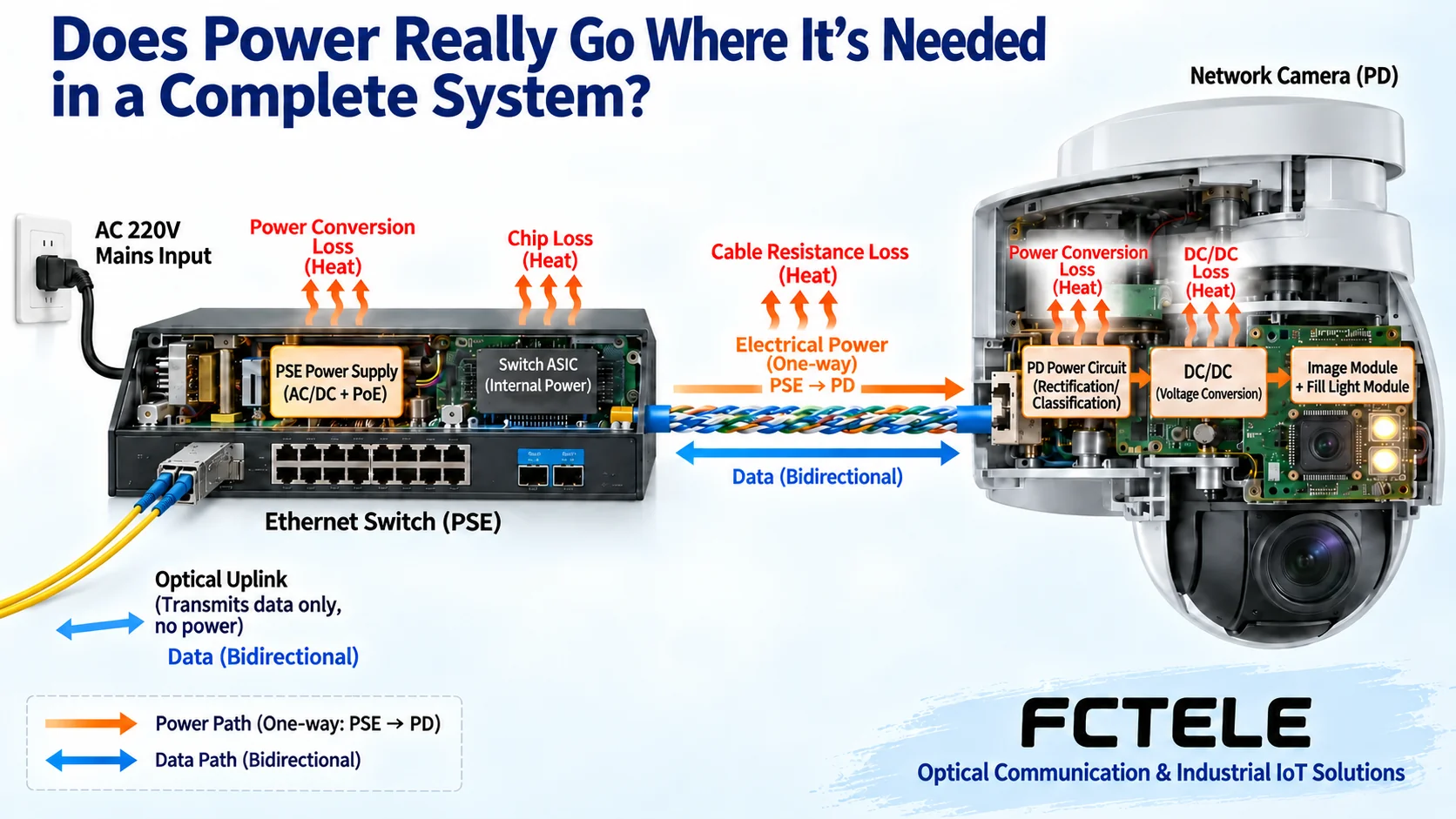
The most direct convenience of PoE is using suitable copper network cable to power compatible endpoints, reducing remote adapters and power wiring. It still has to provide the energy needed for cameras, APs, and other devices to operate, and there are also switch power conversion losses, cable losses, and powered-device conversion losses. To compare energy-saving effects, you should compare the complete system under the same service and installation conditions, not draw conclusions based only on the power supply method.
For example, if six cameras are changed from independent adapters to PoE, and the camera operating mode, fill-light time, and bitrate have not changed, the endpoint demand will not disappear into nothing. Centralized power may make unified control and maintenance easier, but the effect also depends on power supply efficiency, cable length, and management strategy. An “energy-saving percentage” must have a corresponding test scope, and the result of another model cannot be used to promote the entire category.
Follow the power path to see where losses are
At the power sourcing end, the PSE sends power into the cable; at the powered device end, the PD obtains energy and then converts it to the voltage needed by its own circuits. The input power supply also has loads such as the switching chip, management processor, and optical modules. PSE output, PD input, and the effective load inside the endpoint are different locations. When calculating efficiency, the measurement point must be clearly marked, and different readings at the two ends should not be directly treated as a fault.
Copper conductors have resistance, and at the same current the loss is related to the equivalent loop resistance. Connector quality, cable material, cable bundle temperature, and load affect real performance. So-called “low voltage safety” cannot cancel wiring and engineering requirements; PoE also cannot unconditionally exempt surge protection or grounding design. Reducing unnecessary losses with compliant wiring is more practical than guessing that all power conversions have the same efficiency.
Why the budget number is not the meter reading
The whole-device PoE budget indicates the upper limit of capacity allowed to be allocated to ports; it does not mean the device consumes that much electricity at every moment. If an endpoint requests or is allocated 30 watts, it may also consume only part of that in its current operating state. On the other hand, the switch may still reserve quota according to classification or configuration, and you cannot assume that because a reading becomes smaller, the same quota can immediately be used for any new endpoint.
Assume the PD currently needs ten watts. The PSE does not force 30 watts into the endpoint just because the “budget is 30 watts.” It maintains the power supply conditions that meet the requirements, while the actual load is consumed according to the operating state, and it also performs applicable monitoring and protection. During measurement, you must distinguish the switch input total energy consumption, each port output, and the PD-end reading, so you can know which part a certain change actually affected.
What EEE saves is part of the power used by the data interface when idle
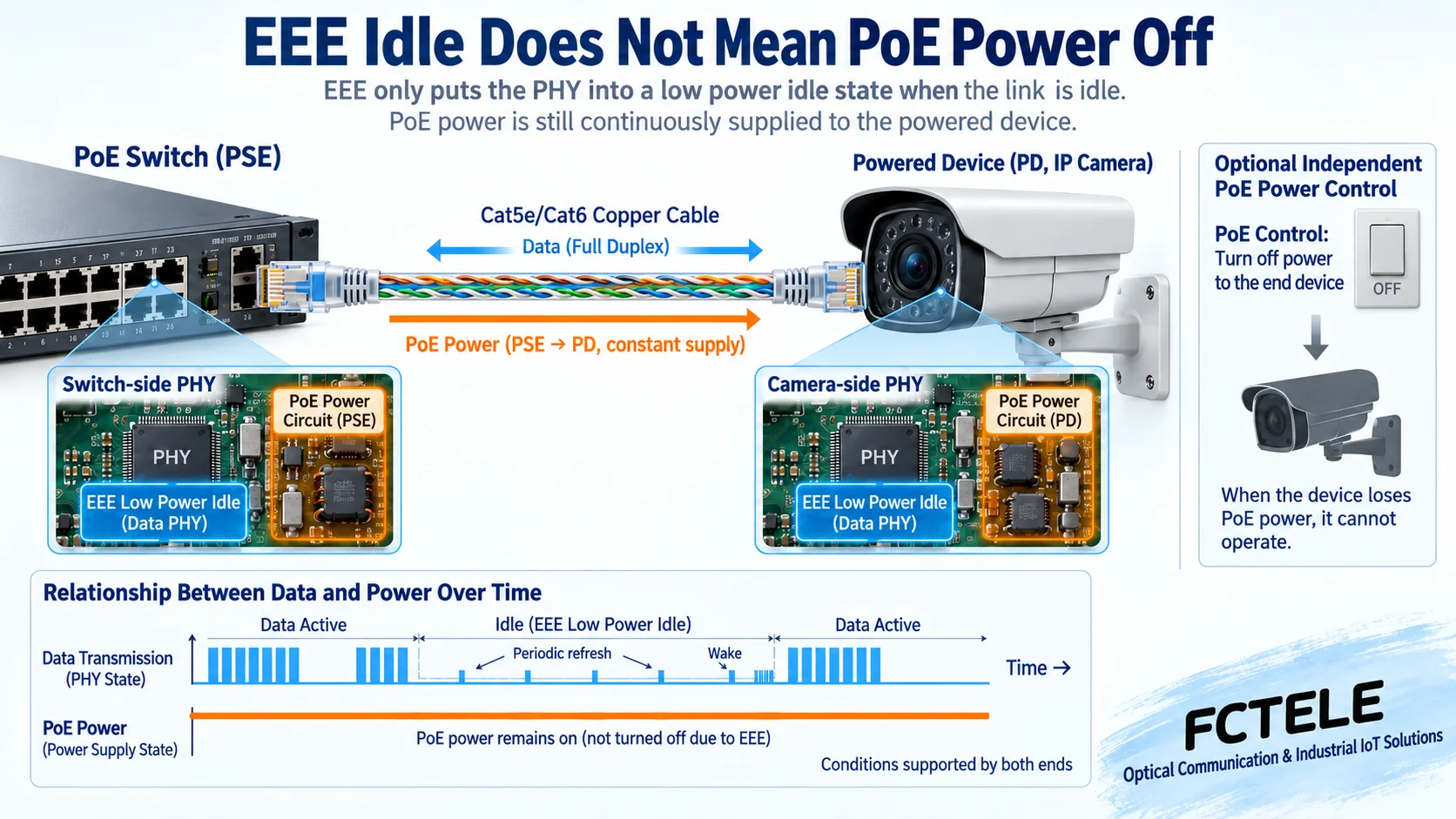
EEE means Energy Efficient Ethernet. Its low-power idle mechanism allows a link that supports the function to reduce the activity of some physical layer circuits when there is no data to send, and to resume transmission according to the rules. It is still a working mechanism of the data interface, and it should not be understood as cutting power to the camera. Whether it is supported, how it is negotiated, and at which speeds it is available should be confirmed according to the platforms at both ends.
Therefore, “the port has no video stream” does not mean PoE is necessarily off. The camera may still be running, waiting for requests, or maintaining network status. Enabling EEE also does not automatically change the camera’s fill-light and heating strategy; when the business has real-time requirements, you should check function compatibility and the impact of wake-up on the actual application, and not copy another brand’s settings and claim energy has already been saved.
What is the relationship between endpoint sleep and maintaining power supply signature?
A PD that supports sleep may reduce its own power consumption, but it still needs to let the PSE determine, according to applicable rules, that the powered connection should be maintained. Maintain Power Signature, abbreviated MPS, is part of the PoE electrical mechanism, not the “online” status in a camera web page. Different standards and implementations have corresponding requirements, and a low-power endpoint design must work properly with the power sourcing end.
Confusing a temporarily quiet network link with a PD that has already disconnected will lead to misjudging the power supply state. The fact that a certain system can maintain power supply at lower power consumption does not prove that any ordinary endpoint can approach zero load indefinitely without being restricted by rules. This article only explains the mechanism; specific current, timing parameters, and chip design should use the corresponding materials, and a general diagram should not be treated as a product circuit solution.
Scheduled PoE shutdown will make the endpoint truly lose power
If the device clearly supports scheduled port power, the PD usually cannot continue operating during the shutdown period, and re-powering also requires startup and service recovery. This is a power control strategy, not the same function as EEE. Some APs or display devices in office areas outside working hours may be suitable for shutdown as needed, but all-day recording, emergency communications, and access control may not allow the same treatment.
Before implementation, confirm that the service owner accepts the window, and check the time zone, exception dates, recovery time, and configuration save behavior. Whether data port disabling and PoE shutdown are linked should also be confirmed by model. Turning off a critical camera and seeing the meter reading drop does not by itself prove the solution is effective; the agreed service availability must also be met, otherwise the service load has simply been removed.
How to compare one day’s electricity use of two solutions
Use a suitable power or energy measurement method, and record a representative period under the same endpoint, mode, and line conditions. Watts indicate power at that moment, and kilowatt-hours indicate accumulated energy over a period. Night fill light, PTZ movement, wireless traffic load, and environmental conditions should be recorded, and a low-load moment cannot be directly compared with another high-load moment.
In a teaching example, if the complete system average power changes from 100 watts to 90 watts and runs continuously for 24 hours, the corresponding daily energy changes from 2.4 to 2.16 kilowatt-hours, a difference of 0.24 kilowatt-hours. This is only an arithmetic example, not an actual measurement or a product energy-saving promise. Only when the service conditions are confirmed to be comparable does the difference have meaning; added management and maintenance costs should also be included in the actual solution comparison.
How Feichang optional capabilities fit energy-saving needs
The Feichang 3243 details give directions for optical and electrical access, management, and PoE options. Centralized power helps organize endpoint access and maintenance points. However, those details do not automatically prove that EEE, scheduled port power, or a specified energy-saving ratio is present. When these strategies are needed, obtain support statements for the clearly delivered model and firmware, then test according to the business.
The power supply version and input power still need to be matched, and the wide voltage range of an ordinary model cannot replace PoE conditions. To reduce long-term energy consumption, you should also check whether the load functions are truly needed, whether the cable is compliant, whether the power supply is suitable, and whether heat dissipation is reasonable. Keeping measurement records for the complete system is the only way to draw evidence-based conclusions separately about “simpler wiring” and “whether energy is reduced.”
Data note: The principle diagrams have been checked against technical content and are used to explain general mechanisms; they are not product photos or actual measurement records. Specific interfaces, modes, and capabilities are subject to the selected model, version, and on-site verification.
Verification materials: Cisco EEE low-power idle mechanism
Microchip Maintain Power Signature mechanism
TI PoE interface and powered-device conversion materials
Feichang 4-copper-port, 2-fiber-port managed industrial switch and PoE option
Translated from the Chinese technical article. Source first published: 2021-10-27. Source last revised: 2026-10-13T13:42:26+08:00. Read the Chinese source
