


Start with the conclusion
Before asking for a quote, write your requirements as verifiable conditions
There is no single price for a network extender that fits every project. Different transmission media, pair counts, capacity, power, and protection conditions change equipment and engineering costs. First clarify which two locations you need to connect, what the existing line is, and how much actual capacity the service needs, then compare total quotes under the same conditions; a cheaper single unit does not necessarily mean a cheaper project.
This article is for procurement planning in old building wiring renovation, remote monitoring, and industrial equipment networking. The core is not to find an advertised maximum distance, but to confirm the bidirectional services, remote power, and maintenance conditions on the target line. Acceptance priorities should be given together with the request for quote: actual load, continuous operation, errors or reconnections, and recovery behavior, to avoid discovering after purchase that the test criteria were different.
Explain the site line and terminal situation clearly
State whether the line is ordinary Ethernet cable, telephone pair, coaxial, or whether new fiber can be laid. Measure the actual path length, and record wire gauge, material, connectors, and whether other services share it. Writing only “distance 500 meters” lacks key conditions: different media and installation quality correspond to different technologies and may also change usable capacity. Whether the line can be changed, whether equipment can be installed in the middle, and whether power can be taken at the far end also affect the solution.
List the number of terminals, communication direction, and peak traffic clearly. Video mainly uploads to the center, but management and control usually still require reverse communication; you cannot substitute the manufacturer’s faster-direction test value for the direction your project needs. For industrial control, also state acceptable response and interruption conditions; being able to open a web page once is not proof of capability for a long-term control system.
Why the port’s nominal rate cannot be directly used as usable bandwidth
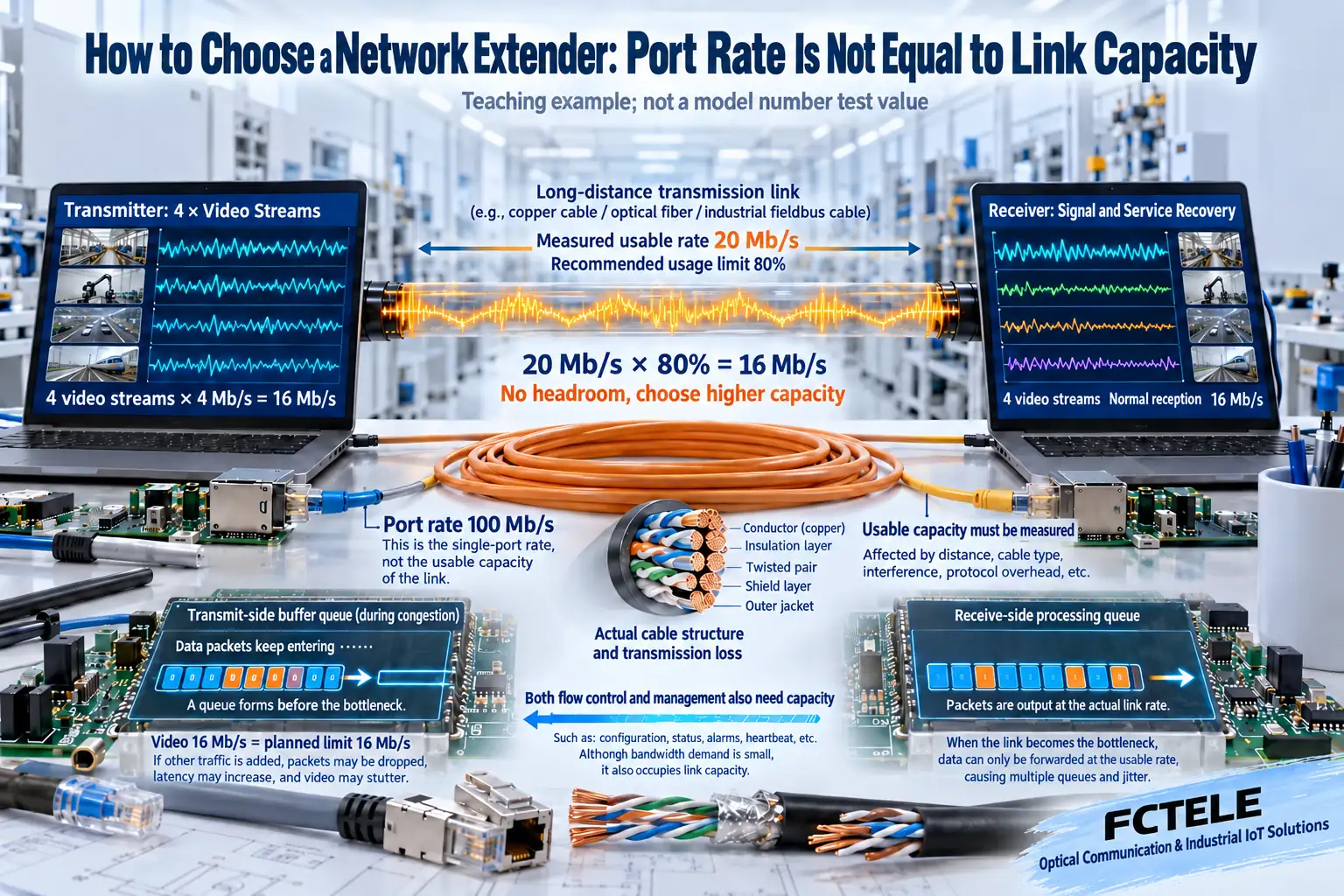
A 100 Mbps or 1 Gbps LAN port is an access-side specification; the capacity of the long line in the middle also depends on the technology used, the line, and the mode. A bridge device can forward frames to the opposite end; bridging means connecting Ethernet network segments, and does not mean all traffic has constant latency or automatically guaranteed priority. When requesting a quote, ask separately for access port specifications, line performance conditions, and actual throughput evidence in the target direction.
Teaching example: four video streams are planned at 4 Mb/s each, totaling 16 Mb/s. Suppose a certain line has a measured usable capacity of 20 Mb/s, and 20% capacity margin is reserved for business; then the planned usage upper limit is 20×80%=16 Mb/s, which is already fully occupied by video, leaving no margin for management traffic and bitrate fluctuations. You should increase capacity or adjust the business, and cannot purchase with confidence just because the network port is labeled 100M.
The same maximum distance may hide different modes
Some copper-line modulation devices reduce negotiated capacity on long lines and may also be asymmetric in upload and download; fixed-rate technologies have their own loss and error boundaries. A manufacturer’s longest distance, highest rate, bidirectional mode, and test cable are often not the same set of conditions. Require the quote to include the operating mode, direction, cable requirements, and test results at the target distance, not just a maximum value.
High-capacity parameters for short lines cannot be directly moved to long-line scenarios. The number of electrical ports also does not mean each terminal has independent long-line bandwidth; multiple terminals may share one uplink. Whether VLAN transparent transmission, management, loop protection, or specific services are supported requires corresponding model evidence. Transparent transmission usually means frames can pass through, and cannot be inferred to be unaffected by congestion, line errors, or power fluctuations.
Power budget: equipment, terminals, and line loss all must be calculated
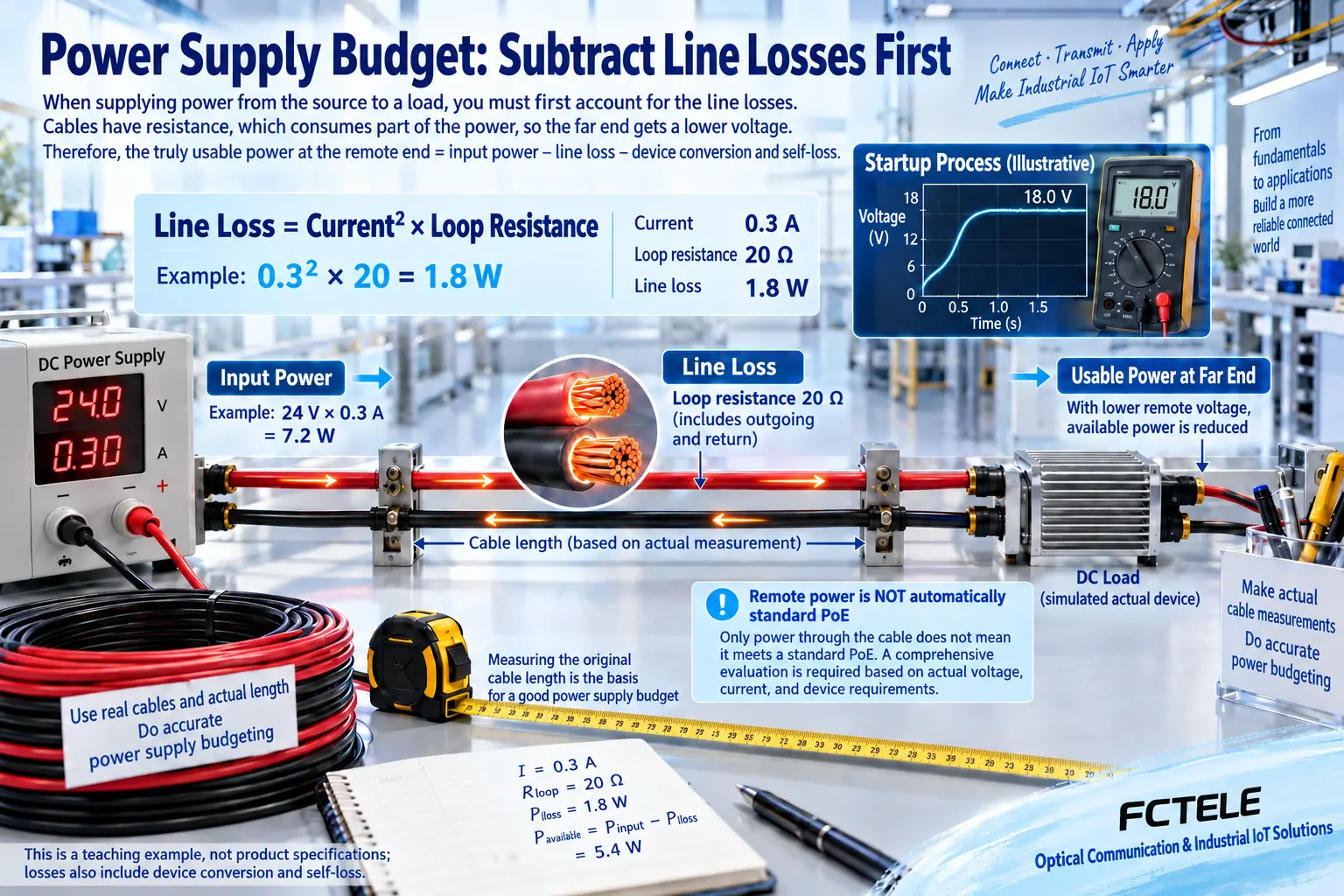
Confirm how many extenders a set requires, whether power adapters are included, whether the far end takes power locally, and whether standard PoE is truly provided at the terminal port. PoE supplies power over network cabling according to the corresponding standard; dedicated-line remote power is not the same capability. When a camera starts up, turns on infrared lamps, or heats, the required power may be higher than daytime standby, so you cannot check only one light-load value.
Copper line power consumption can be understood as current squared times loop resistance. Teaching example: loop resistance 20 ohms, current 0.3 A, line loss is 0.3²×20=1.8 W, voltage drop is 0.3×20=6 V; this does not yet include device self-consumption and conversion losses. These are hypothetical calculations, not model measurements. Rated source-end power cannot be directly treated as usable power at the terminal; verify the actual operating state at the far end.
List total cost when comparing prices
Equipment items include both ends of a pair or a dedicated remote end, power, necessary optical modules, and installation accessories. Engineering items include site survey, cabling or line repair, enclosures, waterproofing, grounding, protection, and commissioning. Maintenance items include replaceable spares, remote service conditions, and fault localization. When comparing, note the quote date, quantity, taxes, service, and lead time; do not write unverified fixed market prices or delivery promises.
If a cheap copper-line solution requires repeatedly repairing old connectors and adding multiple intermediate power points, the total cost may rise. Conversely, if good lines already exist, capacity requirements are clear, and installation is constrained, reusing lines may also have value. Economy comes from comparing total cost under the same business standard, not from putting unit prices of different media, different capacities, and different services together.
How Feichang Technology products enter solution comparison
When fiber can be laid, you can choose 100 Mbps or 1 Gbps directions from Feichang Technology’s fiber optic transceiver category. The B-series 2-port 100 Mbps fiber optic transceiver performs Ethernet media conversion through electrical and optical ports and can be included as an alternative for long-distance networking; you should continue to verify the optical interface, power, and installation requirements of the specific version. It is not a telephone-line network extender, and it will not automatically provide all power functions for terminals.
When copper lines already exist, submit site cable information to the supplier and obtain the corresponding long-line model, version, pairing, and performance evidence. NE300-related introductions can only serve as communication clues; the complete manual and target line testing still need to be verified. Temperature, protection, recovery time, and compatibility capabilities without public product evidence cannot be replaced by the words “industrial grade,” and certainly cannot be assumed as supported on a quote.
How trials and acceptance reduce procurement risk
Prefer testing on a representative original line, using confirmed normal short access cables at both ends, and measure upload, download, and simultaneous communication separately. Then connect the actual terminals and check peak load, startup power, errors, and reconnections, covering representative interference conditions. Then disconnect or power off to verify recovery, and confirm according to the business whether recording, communication, and control recover, not just whether the device lights turn on again.
Write the measurement method, duration, test load, pass threshold, model, and configuration together into the record, to facilitate future retesting and spare replacement. The purchase order should be bound to this set of conditions: after the line changes or the device version is replaced, old results cannot be reused. To first understand different media principles, read the basic article; installers should read the wiring article and implement it according to the same model evidence.
Information note: The principle diagrams have been checked against technical content and are used to explain general mechanisms; they are not product photos or measured records. Specific interfaces, modes, and capabilities are subject to the selected model, version, and on-site verification.
Verification materials:PLANET: VDSL2 pairing, line, and performance conditions
TI: Cable and signal conditions for long-distance single-pair Ethernet
Feichang Technology: Fiber optic transceiver product category
Feichang Technology: B-series 2-port 100 Mbps fiber optic transceiver
Translated from the Chinese technical article. Source first published: 2021-03-12. Source last revised: 2026-10-13T11:40:22+08:00. Read the Chinese source
