


Judging the quality of a serial server manufacturer cannot rely only on the enclosure, chip brand, or a photo of a production workshop. A serial server restores serial signals on wires into bytes and then hands them to the network; if any part of the software, power supply, or buffer has a problem, the host computer may not read correct data. Procurement should write the actual application into repeatable trials, have the manufacturer explain test conditions, product versions, and exception handling, and then verify in the project environment. Production capability and one successful communication are different kinds of evidence.
1. Understanding along the data path why quality differs
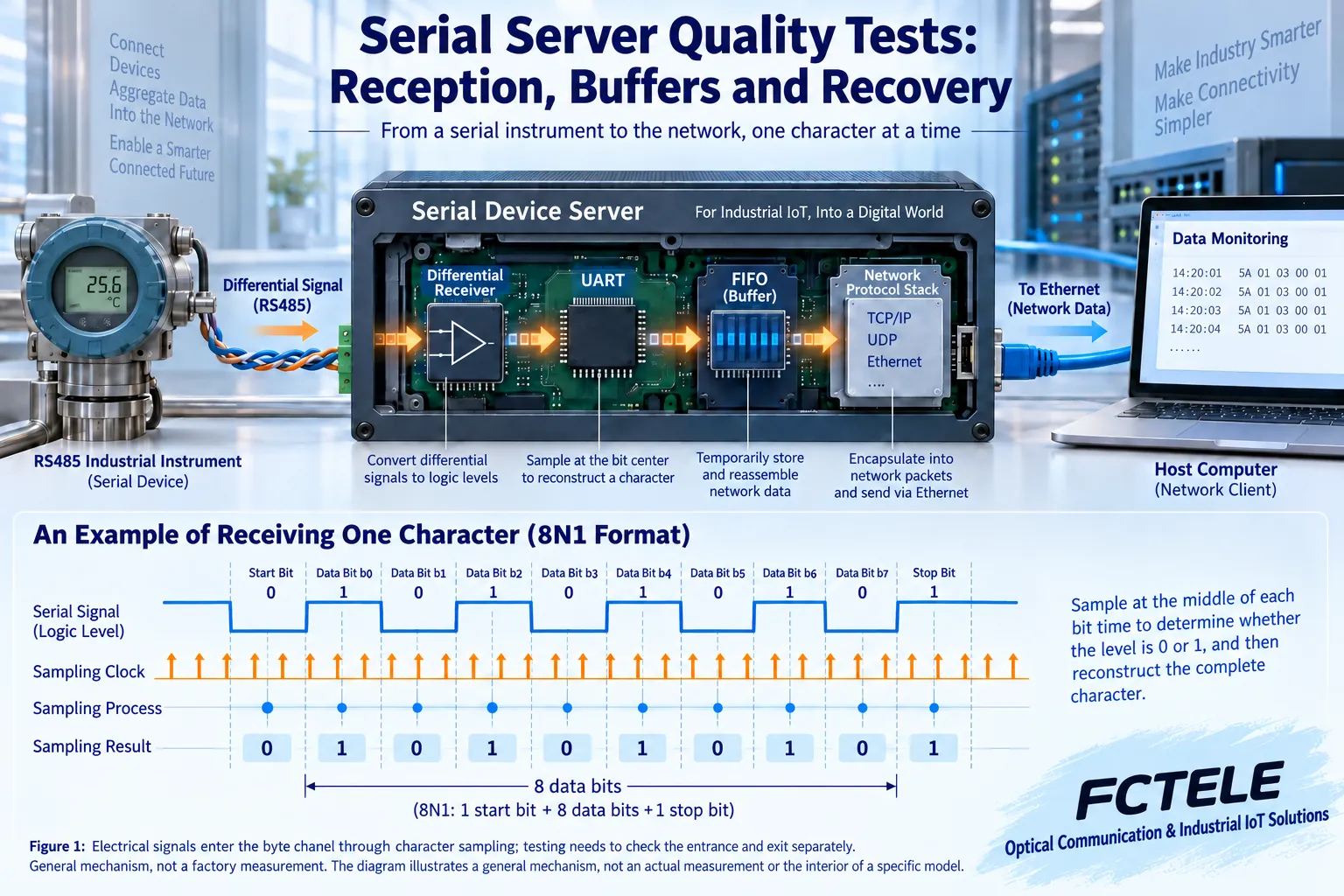
Take one RS485 instrument as an example. At the entrance, the transceiver first senses the voltage difference between the two wires. UART, or Universal Asynchronous Receiver/Transmitter, reconstructs characters according to the agreed rhythm; valid bytes enter the buffer, and the processor hands them to the network connection. The reverse direction also needs buffering and character-by-character transmission. The meaning of the instrument reading is still defined by the application protocol; transparent transmission cannot replace protocol parsing. So-called quality should come down to correctness, usable capacity, and recovery behavior along this path.
Normal electrical reception does not mean the application reading is correct. If the baud rate, data bits, parity, and stop bits at both ends are inconsistent, the entrance characters will already be wrong; if the host computer interprets the register multiplier incorrectly, the bytes may be complete but still show the wrong temperature. Manufacturer testing should distinguish the electrical interface, byte transmission, and application parsing. Procurement personnel should likewise clarify which layer the fault occurs at, avoiding replacing chips to solve a software configuration problem.
2. Character sampling tests must have clear conditions
Asynchronous characters usually start from the start bit, then read data and the stop condition according to the agreed bit time. The receiver’s clock error, signal edges, and interference can all affect judgment. The test report should list interface type, character format, cable, load, and test length, rather than only saying “communication is normal.” A short line passing at low speed cannot be used to infer that a formal long line, all rates, or all interfaces will pass.
Use permitted test equipment to input a known byte sequence, then compare the received content and length. Test patterns with different bit changes can be used to cover continuous transmission and intermittent transmission, observing whether errors are related to a certain channel, a group of parameters, or wiring. Do not directly judge garbled characters displayed by a debugging tool as lost bytes; first check the raw data in hexadecimal. When voltage or waveforms need to be measured, personnel with the corresponding capability should operate according to the interface specification.
3. Buffer stress reveals resource boundaries
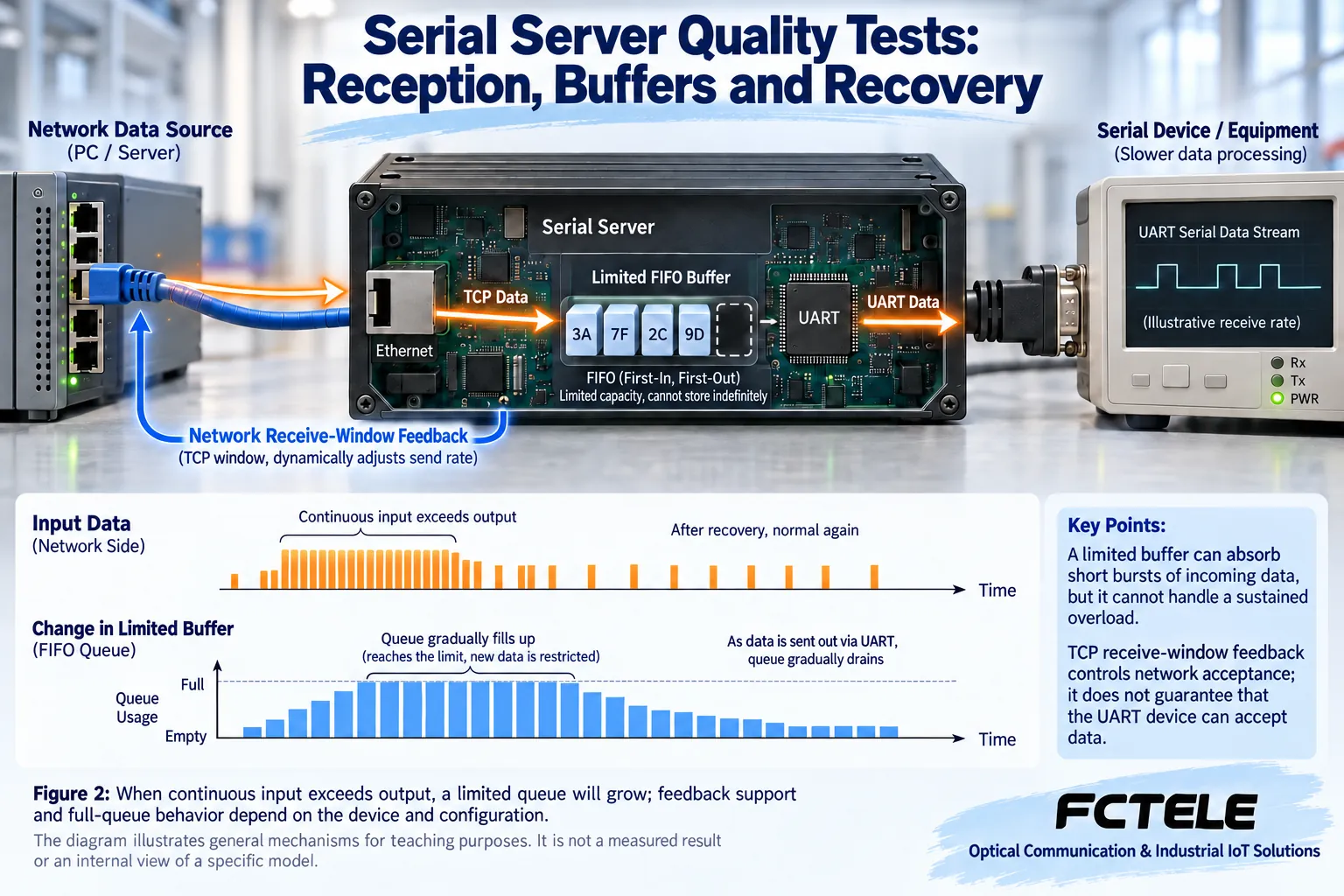
A buffer is a limited waiting area. The network may deliver many bytes at once, while the serial port can only send bit by bit; short bursts can queue first. If continuous input exceeds output capability, the queue will eventually fill. A large buffer does not automatically mean low latency; waiting for more bytes may also delay the application response. The manufacturer should explain behavior when the queue is full, flow control support, and statistics methods, rather than promising that no loss will occur under any load.
During testing, first establish a normal load baseline, then gradually increase the planned burst, recording input, output, queue behavior, and response time. TCP receive capability feedback occurs on the network side; whether the serial source can pause also depends on the device and flow control. Multi-port products should be verified port by port, then operated simultaneously, to check whether shared processing resources cause some channels to wait for a long time. The nominal network port rate cannot replace the continuous application capability of each serial port.
4. Recovery testing is more valuable than repeated restarts
Reconnecting after a network disconnection only proves that the session may recover; it does not prove that old control commands were not executed. Suppose a write command has reached the instrument, but the response is lost during the disconnection. If the host computer directly resends it, duplicate actions may result. The system must explain how to judge the result and how to handle expired buffers and duplicate requests. The manufacturer providing automatic reconnection is a starting point for testing, not a direct guarantee of application safety.
In a controlled prototype environment, separately simulate network interruption, center program exit, and device power loss, then check whether addresses and configurations are retained, who restores the connection, and how old bytes are handled. Test records should have a unified time, firmware version, and recovery steps. Disconnection tests in formal production require a scheduled window; do not casually unplug a running control link for acceptance. Emergency stop and protection should also not rely on an ordinary transparent serial network to replace a dedicated safety system.
5. How to ask about manufacturing and environmental evidence
Ask the manufacturer for test items, judgment conditions, and batch traceability methods corresponding to the ordered version. See clearly whether the record is design verification, a test of one prototype, or factory inspection of that batch. If aging duration, temperature, and power conditions have no traceable records, keep them as pending verification; do not infer that every unit has undergone the same test because of the words “specialized production.” The cause classification for repair and return, and how versions are handled, can also help judge whether the support process is clear.
Power supply, temperature rise, grounding, and surges in industrial sites affect the complete machine. Rated ranges, isolation boundaries, and applicable test reports should be checked, but do not create dangerous voltages yourself or damage equipment with non-standard interference tests. A component’s rated temperature is not the complete machine’s operating temperature; wide temperature does not equal waterproofing, and a metal enclosure does not prove that all interfaces are isolated. Necessary environmental verification should be completed under suitable laboratory conditions, and the report should clearly state which model it covers.
6. Turning Feichang Technology product materials into acceptance questions
The public details of Feichang Technology FCT-081206 list multiple serial ports, network management, and networking modes such as TCP and UDP, which can be used to check centralized access requirements. The working modes and management capabilities on the page are public manufacturer statements; at procurement, the specific interface version, firmware, and usage mode should still be confirmed. One multi-port product cannot be used to infer that all serial servers have the same session count, buffer, or protocol functions.
You can ask the supplier to provide demonstrations of per-port mapping, parameter saving, continuous transmission and reception, and recovery tests, then repeat the verification using the project’s software and terminals. Transparent mode and Modbus conversion mode should be accepted separately; supporting a protocol name does not mean that any register type and control application are already compatible. The main text discusses general quality verification methods. It does not claim that the Feichang Technology factory has performed every test in the article, nor does it fabricate certifications, factory yields, or actual customer results.
7. Forming quality records that can be handed over
Suppose a project needs eight instrument channels. The record table should list each port’s terminal, interface, character format, network mapping, and application request, then fill in the response and exceptions during simultaneous operation. Whether a single-port fault affects the remaining channels, whether there are old responses after reconnection, and whether configuration recovers after restart should all have corresponding evidence locations. Items not tested should be clearly written as not tested, rather than leaving blanks to mean pass.
The final handover should preserve model, serial number, hardware and firmware versions, wiring, configuration backup, test inputs and outputs, and problem handling records. After the test passes, the maintenance owner, the source of compatible upgrade packages, and the fault replacement process must still be confirmed. A manufacturer’s reliability is ultimately reflected in product behavior that can be explained, re-verified, and maintained; a promotional phrase without conditions cannot replace these records.
Verification materials: Feichang Technology FCT-081206 product details ; Modbus official specification and implementation guide ; TCP specification RFC 9293 . Product functions come from public statements on the official website; general diagrams, test steps, and assumptions are not certifications or performance guarantees.
Common on-site questions
If the serial server’s network port is gigabit, will eight low-speed serial ports definitely not accumulate a backlog?
This cannot be directly inferred. Each serial port still sends character by character according to its own format, and multiple ports may also share buffers and processing resources. When continuous input exceeds output capability, the queue will grow. Loss, waiting, and flow control behavior should be recorded according to actual bursts and concurrency. The network port rate is not the application capability of each serial port, and a large buffer does not equal low latency.
If the manufacturer only tests continuous sending, can it cover occasional on-site commands and network recovery?
No. Intermittent, burst, multi-port concurrent, and controlled interruption tests are also needed to check whether old bytes, reconnection, parameter saving, and request responses correspond. A write command timeout does not prove it was not executed, and resending may cause duplicate actions. Testing should use real protocols and terminals and define recovery criteria, rather than relying on repeated restarts until it appears normal.
At procurement, how can prototype verification be distinguished from factory inspection of that batch of equipment?
Require records to be linked to the exact model, options, serial number, batch, and hardware/firmware, and note the test purpose, conditions, and scope. Design prototypes, environmental tests, and unit-by-unit inspection are not the same evidence. Items without provided records should be marked as unverified, then supplemented by prototype and delivery re-verification. A production line photo cannot be used to infer that every unit has completed all tests.
Continue reading: How to connect RS232 devices to the network: wiring, virtual serial ports, and compatibility verification ; How to choose a protocol converter manufacturer: telecom and industrial needs, compatibility evidence, and acceptance ;
Translated from the Chinese technical article. Source first published: 2024-07-05. Source last revised: 2026-10-15T22:31:43.863560+08:00. Read the Chinese source
