


When requesting a quote, first state which type of conversion you are buying.
When choosing a protocol converter manufacturer, first divide your needs into two paths: telecom and industrial. Telecom types often involve E1, V.35, and Ethernet interface or bearer conversion. The purchasing focus is circuit mode, time slots, clocking, capacity, and testing. Industrial types often involve connecting serial devices to a network, message encapsulation, and point table mapping. The focus is protocol role, data semantics, refresh behavior, and exception behavior.
The same name for two types does not mean they can be interchanged. A supplier showing many interfaces, factory photos, or protocol logos can only serve as communication clues; it cannot independently prove actual interoperability. You should ask them to provide a verifiable solution based on your complete topology, models at both ends, and service task. If you are purchasing a transparent serial server, also clarify that it preserves the original message. Whether protocol mapping is needed should be confirmed separately.
For telecom requirements, clearly write the service and bearer direction.
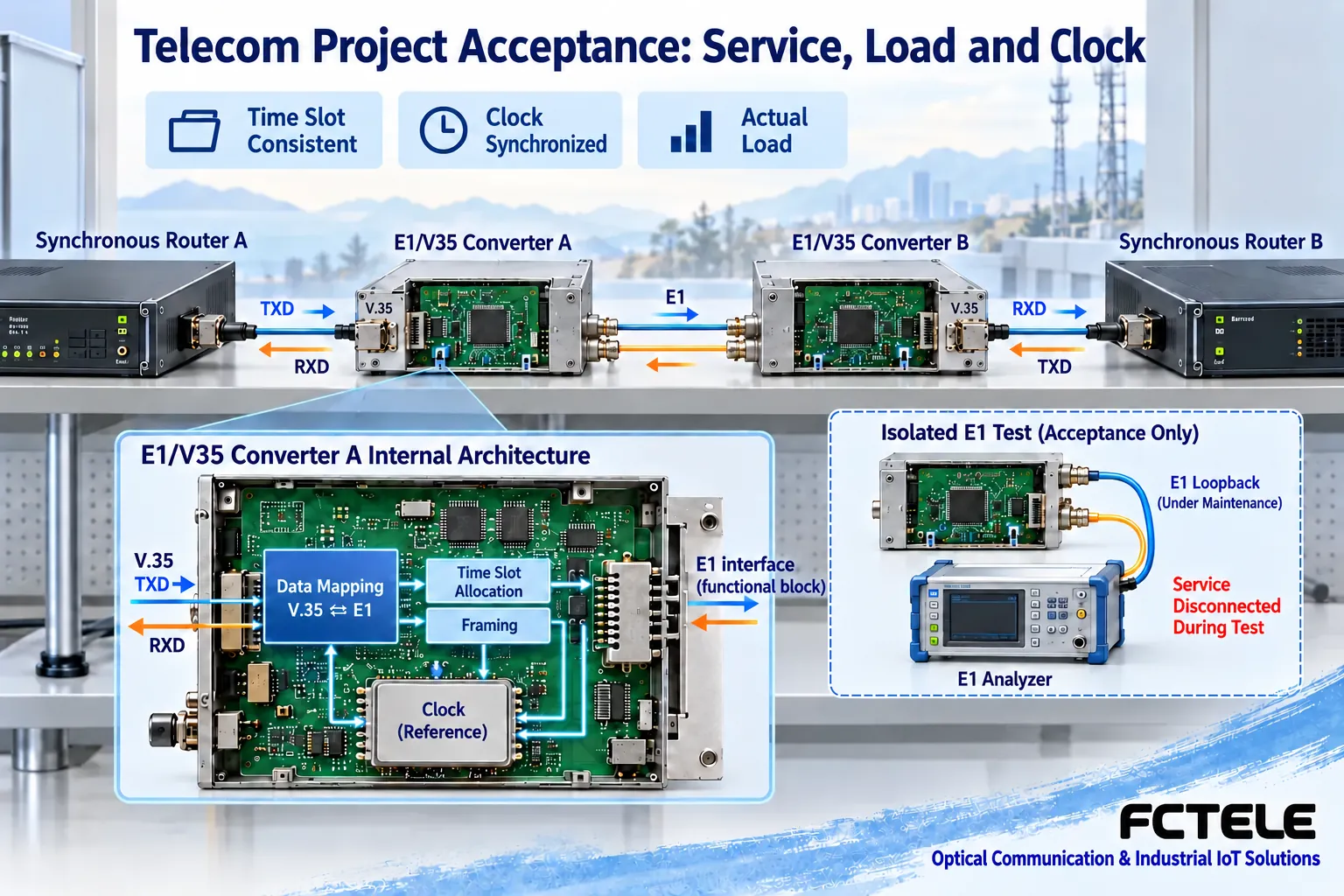
Extending an E1 terminal over fiber, sending Ethernet frames over an E1 leased line, carrying an E1 circuit over an IP network, and connecting V.35 synchronous data to E1 are four different directions. The requirement sheet should state the interfaces at both ends, line resources, framed or unframed mode, required channels, and clock reference. If you only write that you need an E1 converter, the supplier may choose a product with a similar interface but a different purpose.
Capacity must also be checked against real channels. A single E1 line is 2.048 Mbit/s. Framing overhead and service mapping affect the effective payload. A 100 Mbit/s electrical port does not prove that 100 Mbit/s of service can be transmitted across sites. Multi-channel aggregation, E1 over IP buffering, and timing recovery each have their own conditions. You should require the model, version, and configuration basis. You cannot derive all delivery capabilities from common industry features.
For industrial requirements, clearly write the data task beyond the interface.
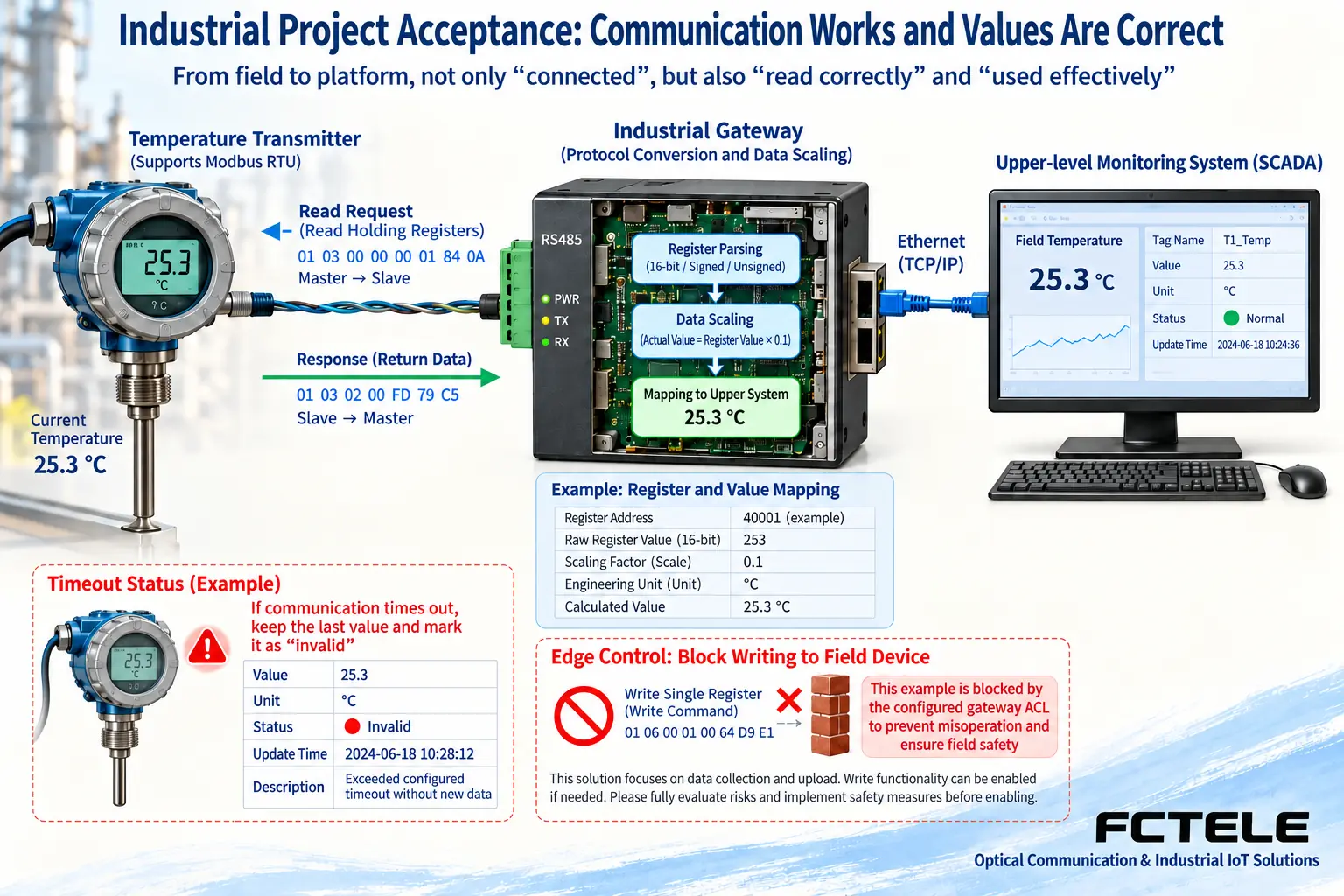
Industrial projects should provide device manuals, protocol combinations, communication roles, address point tables, and read/write requirements. RS485 terminals, TCP connections, and application protocols are each different conditions. Even if both ends use Ethernet, they may completely fail to understand each other’s data. For Modbus, you need to confirm RTU or TCP, function codes, address representation, data types, word order, and units. You cannot just ask whether Modbus is supported.
For example, a temperature instrument has a raw value of 253, which according to the manual scale of 0.1 represents 25.3 degrees Celsius. The supplier’s sample unit must not only read the bytes but also provide the correct engineering value and valid status. This is a hypothetical acceptance example, not an existing customer achievement. Writing commands, exception codes, stale offline values, and post-recovery handling should also be part of compatibility testing to prevent the control path from failing while read values appear normal.
Ask the supplier to provide corresponding functional evidence.
Documentation should correspond to the exact model, hardware, and firmware version, and state which features are standard, optional, or available only in specific modes. Telecom types require interface, frame structure, clocking, and loopback descriptions. Industrial types require protocol role, function and point limits, configuration mapping, and diagnostic interfaces. A list of protocol names without roles and operating scope is still insufficient to confirm project usability.
Diagrams of internal chips or generic standards can explain mechanisms, but they cannot prove that a manufacturer’s specific product implements all capabilities. Protection, temperature, isolation, certification, and recovery time require corresponding product documentation and conditions. They should not be replaced by general statements such as strong R&D capability or good customization ability. A successful configuration on a sample unit should also be retained to confirm whether the same version and feature combination can be used in volume delivery.
Feichang Technology product categories can be used for initial positioning.
The Feichang Technology official website groups Ethernet to E1, V-series, serial interface conversion, serial servers, and industrial gateways into related categories. FCC-E1V1 is an example in the direction of unframed E1 to V.35 conversion. FCC-E1fF1 belongs to the direction of Ethernet to E1 conversion. Both can help locate telecom requirements, but they cannot replace an industrial point table gateway just because they are also called protocol converters.
Serial server documentation is used to check the interface and mode for connecting devices to a network. You cannot infer arbitrary protocol translation capability just because it has RS485 and a network port. During procurement, give the actual task to the manufacturer to confirm the specific model, and keep the corresponding details, manuals, and compatibility test records. If there is no matching product evidence, clearly state that it is a general solution discussion. Do not write unconfirmed functions into acceptance commitments.
Sample testing should cover the complete link.
For telecom samples, first verify the interface and mode on a short link, then include the production bearer and remote terminal. Confirm framing, time slots, timing, and bidirectional real load, and record alarm and bit error trends. Management reachability and local loopback can only prove a limited scope and cannot replace remote service. Test codes and service-affecting loopback may cause interruptions, so arrange a maintenance window or an independent test bench.
For industrial samples, first verify a single device and single variable, then add points, slaves, and host connections, and observe the real polling cycle and timeouts. Compare the device display, the raw response at the source side, and the host result, and clarify scaling and quality flags. Simulate the source station going offline or a network interruption to confirm that old values are not still presented as normal real-time status. After recovery, requests and responses should still correspond to the correct device.
Delivery quality is not just about one sample demonstration.
For volume procurement, check model and version consistency, factory configuration, included cables, labels, configuration backups, and acceptance records. If long-term maintenance is needed, confirm documentation access, firmware support, fault diagnosis, and replacement compatibility conditions. Whether the supplier can provide evidence for a problem is more helpful than a set of performance figures without a stated test method. Delivery differences should be specified in the technical annex of the contract.
Total cost includes equipment, installation, commissioning, on-site maintenance, and system downtime impact. Adding unnecessary complex functions may not bring benefits, while lacking key diagnostics may make later troubleshooting difficult. For functions such as encryption, access control, and remote maintenance, evaluate them after checking the implementation and configuration. Do not equate protocol conversion itself with having obtained network security protection.
End procurement with reproducible acceptance.
The acceptance table should separately list service correctness, capacity or data timeliness, exceptions and recovery, permissions, and documentation completeness, and clearly state test conditions and pass criteria. Telecom types should not apply the standards for reading industrial variables. Industrial types should not take a passed E1 loopback as successful protocol mapping. Shared power and installation checks for both types can be recorded together, but core service evidence still needs to be separated.
Finally, keep the topology, versions at both ends, interface definitions, parameters, point table or channel table, test records, and recovery plan. A qualified supplier solution should enable users to explain how data enters, what changes it undergoes, why it is subject to certain limits, and where to check when a fault occurs. In this way, choosing a manufacturer and product is based on actual requirements and verification, not on similar names or the number of advertised projects.
Documentation note: The principle diagrams have been checked for technical content and are used to explain general mechanisms. They are not actual product photos or measured records. Specific interfaces, modes, and capabilities are subject to the selected model, version, and on-site verification.
Verification materials: ITU-T G.704 framing structure
Feichang Technology FCC-E1V1 product documentation
Feichang Technology FCC-E1fF1 product documentation
Modbus application protocol
Feichang Technology FCT-1400 serial server documentation
Translated from the Chinese technical article. Source first published: 2024-07-17. Source last revised: 2026-10-13T13:23:07+08:00. Read the Chinese source
