


NTP / STRATUM AND SOURCE STATE
Does a smaller stratum prove a more accurate clock?
No. Stratum describes the time-reference hierarchy, rather than measured clock error. Confirm the selected source and its state, then assess actual offset under defined conditions. A source can remain reachable while unsynchronized. Keep reference relationships, network packet delivery and local synchronization evidence separate; a single number cannot establish all three.
01 · Follow the reference chain
A primary server may supply a secondary server, which then supplies another device. Ordinary packet forwarding does not add a time-reference level.
02 · Separate hierarchy from error
Source quality, variable paths and local clock processing affect results. Measure offset under stated conditions; stratum is not an error unit.
03 · Check source state
A response can arrive from a source that is not synchronized. Check accepted samples, selected source and local state separately.
Identify the reference
Record the source actually selected, not just the configured list.
Compare like measurements
Use a common reference, measurement point, load and observation window.
Observe recovery
Retain source-state changes and timestamp continuity after reference loss.
Selection and verification checklist — expand
| Check | What to confirm | How to verify |
|---|---|---|
| Hierarchy | Reported versus local stratum | Trace the actual reference chain |
| Source | Usable and selected | Read valid sample and source-state evidence |
| Accuracy | Project timing requirement | Compare measured error under stated conditions |
Two industrial devices show different NTP strata. Can the smaller number identify the more accurate clock? Another device receives replies from a time server but remains unsynchronized. NTP, the Network Time Protocol, uses stratum to describe a position in the time-reference hierarchy. It is not a field accuracy ranking. Check the reference chain, network reachability, source usability and actual local offset separately to avoid treating a plausible number as proof of reliable time.
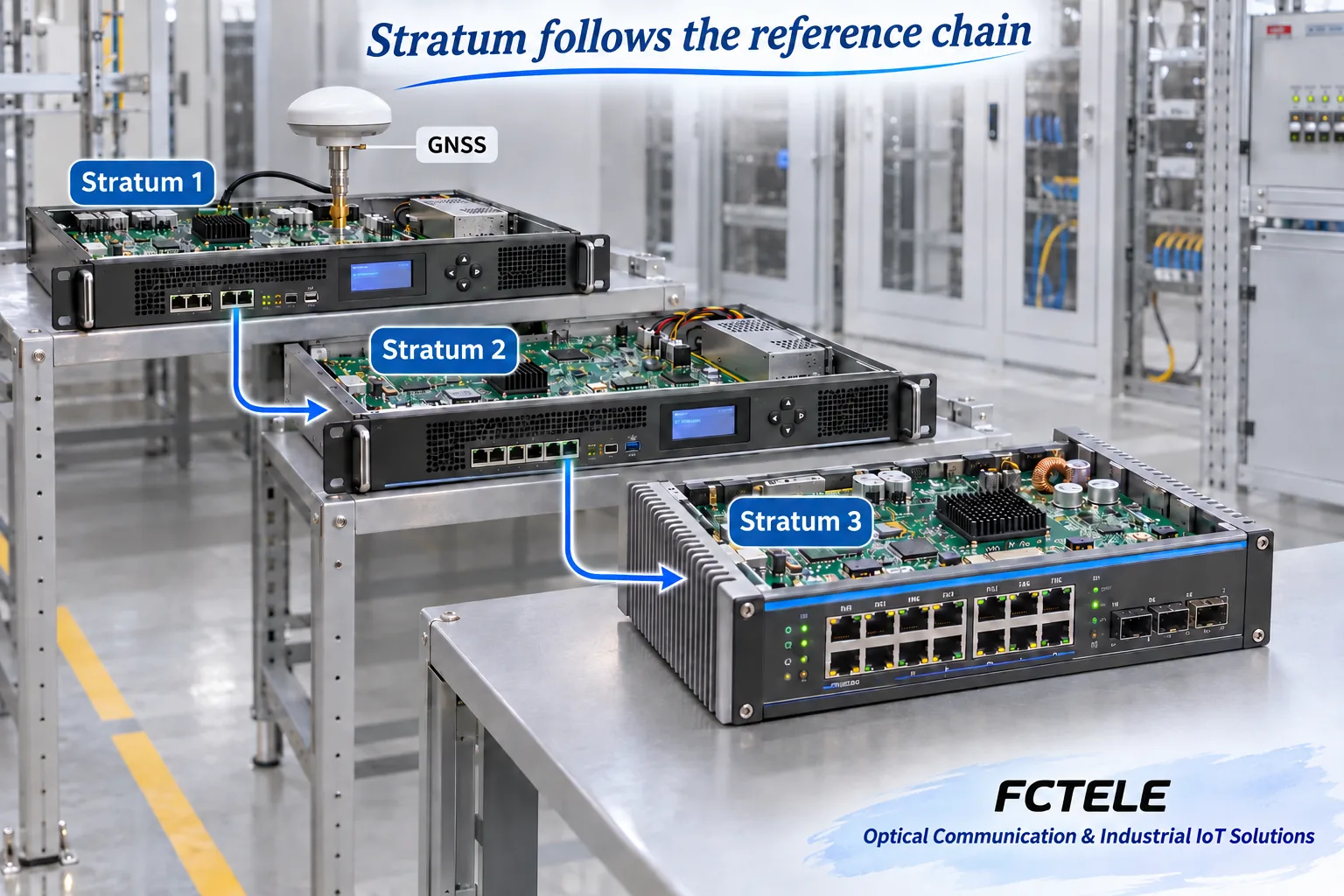
Stratum describes where the reference comes from
A device advances its local clock using an oscillator. Network synchronization supplies an external reference, allowing observations and adjustments to maintain a relationship with reference time. An Ethernet port does not become a time server simply because it forwards NTP packets. Forwarding packets, running an NTP client and serving time to other devices are separate roles.
In an NTP packet, stratum 1 identifies a primary server connected to a primary reference source; strata 2 through 15 identify secondary servers synchronized through NTP. Consider a normal reference chain: a primary server operates at stratum 1, an intermediate server synchronizes to it and serves downstream at stratum 2, and a downstream device synchronizing to that intermediate server normally operates at stratum 3. These values describe the time-reference relationship, rather than how many Ethernet switches a packet crosses.
If two ordinary switches sit between the stratum-1 and stratum-2 servers, their presence does not turn the second server into stratum 4. Conversely, a server physically nearby in the same cabinet can have a larger stratum if its reference passes through other NTP servers. Draw the data network and the time-reference chain separately, rather than mixing network hops and time strata in one table.

Why one number cannot describe measurement error
Stratum does not directly state how far the local clock is ahead of or behind its reference, or how variable that estimate is. Source quality, packet queueing and path asymmetry, timestamping location, the local oscillator and the clock-adjustment process all affect the result. A position closer to the top of the hierarchy does not remove these sources of error.
For example, one device may use a lower-stratum remote source over a path with changing load, while another uses a higher-stratum local source over a more stable path. The two stratum numbers cannot prove which device has a smaller error at a given instant. Compare results against a consistent reference, method, observation window and operating conditions, and retain the offset trend. Without measurement evidence, a topology-based expectation must not become a definite accuracy claim.
An offset estimate reported by a device also has a defined scope. It comes from the device’s processing of packet timing and clock relationships; it is not automatically the absolute error measured by an independent instrument. When validating the timing of control events, identify whether the observation concerns system time, the moment a log was generated or an external signal edge. Mixing those measurement points can invalidate a comparison even when all results use milliseconds.
When traffic shares a constrained output, packets may wait in a queue before being transmitted. A variable wait changes arrival timing and can affect synchronization observations. The queue illustration explains one source of timing uncertainty; it does not specify a product’s memory circuit, packet scheduling policy or a fixed latency. Replacing a stratum number does not by itself remove queueing.
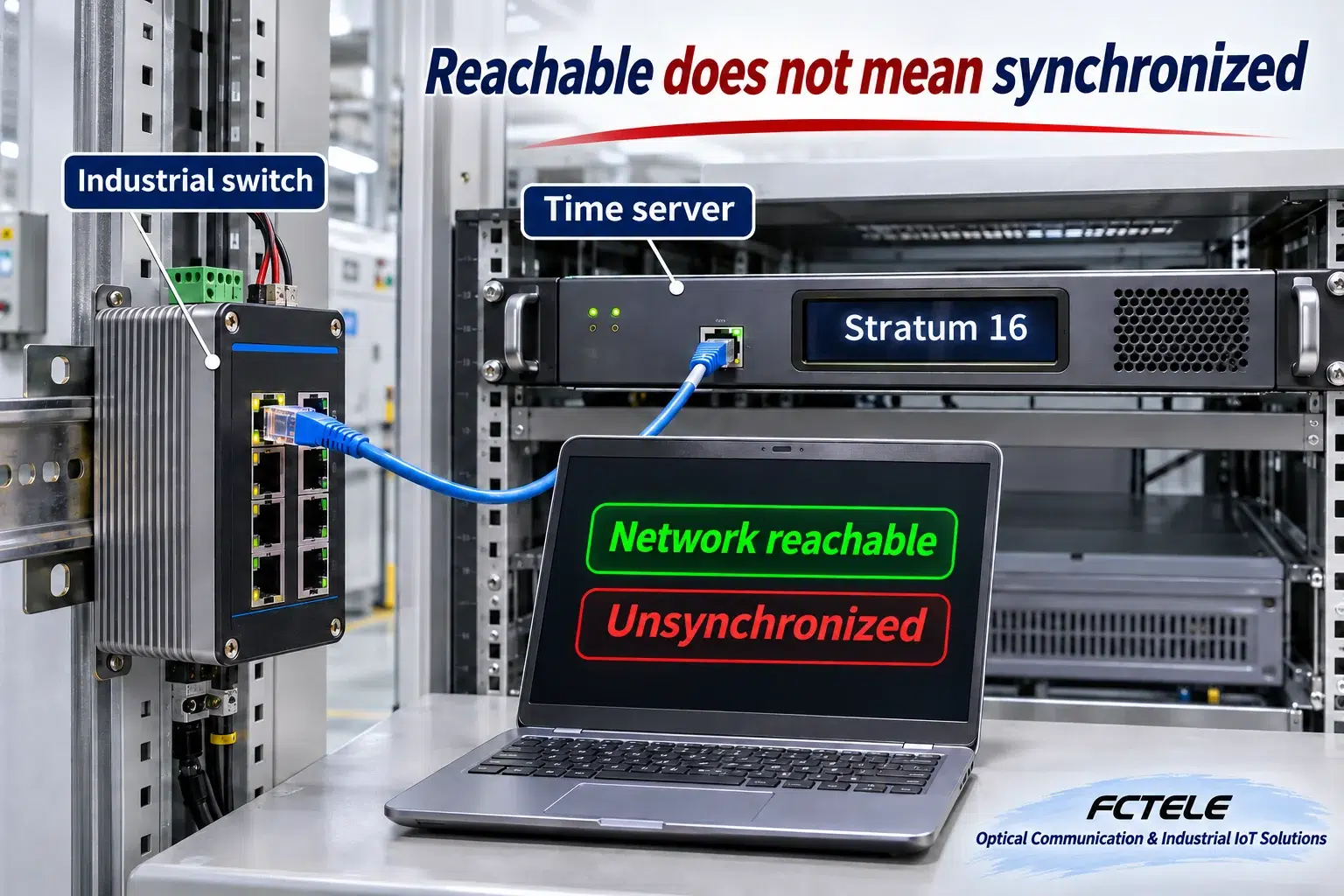
Reachable, usable and synchronized are different states
A successful ping only demonstrates a particular form of network communication. Even an NTP reply does not prove that the answer is suitable for synchronization. The client must check the packet and source state, decide whether to accept the sample, and then select a source and discipline its local clock according to its implementation. An illuminated link LED, a visible packet and a synchronized clock are different observations.
Pay particular attention to stratum 16: it indicates an unsynchronized state, rather than a superior grade of precise time. Stratum 0 is not a top accuracy ranking for a field client either. In a received packet it has an unspecified or invalid meaning and can occur with special control responses, so other fields and the implementation must also be considered. Calling a physical reference clock ‘stratum zero’ is not the same as receiving a stratum-0 network response.
After an upstream reference is lost, whether a service keeps replying, how it presents its state and how long the local clock remains useful depend on the implementation and configuration. There is no universal countdown for all equipment. A local clock that continues ticking has not necessarily retained its previous synchronization quality. Check the source identity, the time of the last valid update and the offset trend after reference loss.
Follow one reference chain through a fault
Suppose workshop device C uses server B, and B uses server A. Before maintenance, save the actual selected source and local state of A, B and C, and establish their normal reference relationship. Distinguish ‘stratum reported by the server’ from ‘current local stratum’ when recording values. If multiple sources are configured, identify which one is actually selected; a configuration list is not a record of the current working reference.
If C still receives replies from B but B reports an unsynchronized state, investigate B’s upstream reference and state changes first. B’s ability to answer is not a reason for C to accept it as a valid reference. If C switches to another suitable source D, its stratum may change with the reference chain. That change alone proves neither poorer time nor immediate stability after the switch. Continue observing source selection, offset trends and continuity of application log timestamps.
After recovery, retain evidence that a valid source has been selected, and compare observation windows before and after recovery. If a log timestamp jumps, preserve the original record and the adjustment time instead of rewriting history to make the timeline look tidy. Restored synchronization, restored application operation and reliable ordering of historical events are related but separate acceptance questions.
Agree what selection and handover must verify
FCTELE’s Chinese documentation for its modular 48-gigabit plus six-10-gigabit Layer-3 industrial switch lists SNTP/NTP and time-setting capabilities. It provides product context for management time synchronization. It does not establish that every model can act as a server, or guarantee a particular authentication method, holdover performance or external reference interface. Equipment cutaways and observation displays in this article are generic illustrations, not that model’s circuit or test software.
At handover, define device roles, permitted time sources, the expected indication after reference loss and the project’s acceptable time error. Then verify which fields and logs the deployed version actually provides. Where performance testing is necessary, use a suitable reference and instrument and retain load conditions and test duration. A screenshot of one stratum value is not an accuracy certificate.
Separate the time needs of management logs from those of motion control or synchronized sampling. Whether PTP and corresponding hardware are required depends on the application’s timing requirements; a smaller NTP number cannot substitute for another synchronization design. Establish a trustworthy source, visible state and verifiable error before treating a parameter as evidence of successful operation.
Finally, save source selection and configuration persistence before and after a restart. If the device returns to a default source or its displayed timezone changes, investigate configuration and display conversion separately before blaming NTP stratum. Synchronization concerns the time reference; timezone settings concern how time is presented to maintainers. Both need their own check.
Sources and scope
IETF RFC 5905: NTPv4, packet stratum and source state · FCTELE modular Layer-3 industrial switch documentation (Chinese)
Generic NTP hierarchy and state explanation; not a promise of a particular model’s server role, holdover accuracy or security capability.
Translated from the Chinese technical article: Read the original Chinese article.
Common questions
Is stratum 1 always more accurate than stratum 2?
Stratum alone cannot establish that. It describes the reference hierarchy; source quality, paths, timestamping and local clock processing also matter. Compare measurements under consistent conditions.
Does receiving an NTP reply prove synchronization?
No. The client must check the source state, accept valid samples and select a source. Stratum 16 means unsynchronized, even if the server remains reachable.
Does every Ethernet switch add one to stratum?
No. Ordinary forwarding does not add an NTP reference relationship. Distinguish the server-reported stratum, the local stratum and network hops.
Further reading
PTP synchronization principles (Chinese) · Industrial switch functions and NTP (Chinese)
