


MODBUS / EXCEPTION PDU
Is 83 02 a register value?
No. Once a response has been validated and paired with a function 03 request, 83 identifies an exception and 02 gives the illegal-address reason. Decode fields according to message type, then check the complete requested range. Keep this evidence separate from a timeout, which means the required valid reply was not obtained within the client’s waiting conditions. Neither observation alone proves a cable fault.
01 · Identify the function
Function 83 is the exception form of 03. The next byte 02 is the reason, rather than normal register data.
02 · Validate the whole range
A valid starting address is insufficient. A request spanning unavailable 2 can fail even when 0 and 1 exist in this hypothetical map.
03 · Separate reply from timeout
Retain raw bytes, pairing and validation results. A timeout has no decoded exception reason; a gateway reply may not come from the target.
Recover the message
Locate the PDU using the actual RTU or TCP framing.
Compare the span
Record the real register map, starting address and quantity.
Retain validity
Distinguish valid exceptions, invalid received bytes and no reply.
Selection and verification checklist — expand
| Check | What to confirm | How to verify |
|---|---|---|
| Function | 03 versus83 | Pair request and response before decoding |
| Address | Entire range is available | Compare real mapping and requested quantity |
| Transport | Valid complete reply | Check framing, validation and timing evidence |
A connection opens, but reading registers fails and the captured reply contains 83 02. Is 02 the value of a second register or an error reason? First identify each field. Modbus puts the requested operation and exception reason in different positions. An exception is a meaningful application reply, whereas a timeout means the required valid reply was not obtained within the client’s waiting conditions. Follow a read-only example through parsing, range validation and client interpretation to see why these two bytes change the investigation.

Find the function before interpreting its data
Modbus follows a request/reply model. A client requests an operation and a server processes it according to its implementation and state. The protocol data unit, or PDU, contains the function and related data. Serial RTU and network TCP add different outer fields. Do not assume that the first byte of an arbitrary receive buffer is the function: recover the actual message and locate the PDU first.
The hexadecimal function 03 reads holding registers. A normal response retains 03 and then carries the information needed to represent the returned data. An exception sets the most significant bit of the request’s function, making 83 in this case; the following byte identifies the exception reason. Thus 83 is not a new ordinary read operation, and 02 in this exception is not a register value. Position and message type determine meaning, rather than a number’s appearance.
Separate a captured record into transport framing, function and function-dependent data. Pair the response with its request before decoding. A client that ignores 83 and applies the normal read-response format may report a length error, misaligned data or a retained previous value. Such a display can reflect parsing or state management; it does not establish a cable failure.

Walk through a complete out-of-range read
Consider a hypothetical server whose accessible holding-register PDU addresses are only 0 and 1. This is a teaching map, not a register allocation for a FCTELE model. Reading two registers from 0 spans 0 and 1. Reading three from the same start extends to 2, which does not exist in this map. A valid starting address does not make the whole request valid.
The three-register request PDU is 03 00 00 00 03. The first 03 selects the operation;00 00 is starting address 0;00 03 specifies quantity 3. If the server returns an address exception after validating the full span, its PDU is 83 02. The 83 marks an exception to function 03, and 02 means illegal data address. These examples omit outer framing and are not complete RTU frames ready for transmission.
Changing only the quantity to two gives 03 00 00 00 02. With the assumed function, state and address conditions satisfied, a normal response becomes possible. That response also needs its byte count and register data, rather than a lone 03. Changing just the quantity isolates range validation; it does not demonstrate that an arbitrary real device supports address 0 or define any real process value.
Reproduce the example on an authorized test device or protocol simulator with a documented read-only map. Save both request/response pairs and compare functions and lengths. If results differ, investigate the actual implementation and address mapping rather than writing plant registers to force an expected result. A small explainable test leaves clearer evidence than repeated unrelated changes.
The same 02 can have different meanings
In the reason field of an exception PDU,02 means illegal data address. In the example request,02 is part of the quantity. In a normal read reply, a byte-count field can also contain 02, meaning two following data bytes. Finding 02 in a hexadecimal string is therefore insufficient to diagnose an address exception. Interpretation starts with message and field boundaries.
Distinguish the register number shown in documentation, the address encoded in the PDU and the requested quantity. Some manuals use prefixed numbering; PDU addresses are zero-based, and client software may offer an offset option. Record the manual notation alongside the two actual address bytes. Do not automatically add or subtract one before establishing the convention, because that may only move the error elsewhere.
Exception 02 is not evidence of damaged memory hardware. The logical region may be unavailable, or a function may refer to a different data table. The same numerical address under different functions need not identify the same object. Establish which addresses this operation may cover, then check the full quantity and boundary. Units, scaling and process meaning still require product documentation; the exception cannot explain them.
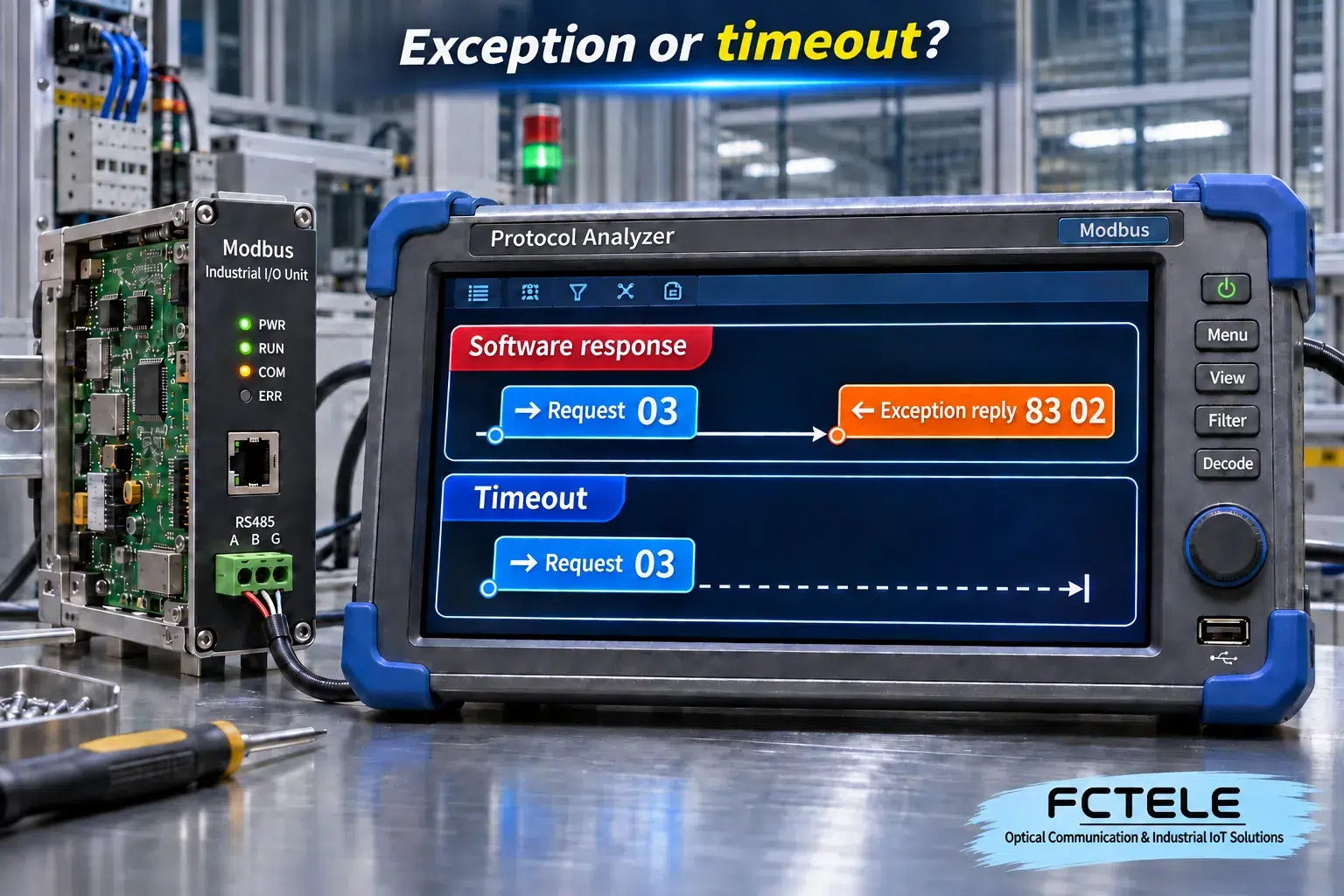
Exceptions and timeouts provide different evidence
A validated exception paired with the request shows that the exchange reached a protocol entity capable of producing that reply. It did not return the requested normal data, but it was not silent. With a protocol gateway in the path, establish whether the gateway or target generated the exception. A TCP-side reply alone does not prove that a serial target performed an operation.
A timeout means the client failed to obtain the required valid response within its defined waiting conditions. Causes can include a request not arriving, no target response, a lost return, failed validation or waiting policy. A timeout does not itself carry a decoded exception reason. Retain requests, received bytes, times and validation outcomes, separating no bytes, invalid bytes and a valid exception before selecting the next observation point.
Avoid labelling all these states simply offline. A valid exception can preserve evidence of communication while marking this transaction unsuccessful; timeouts and parsing failures deserve their own states. If an older successful value stays visible, show its timestamp and validity so it is not mistaken for a newly acquired value. These are platform-design suggestions, not descriptions of a particular software interface.
Return from the PDU to the real system
An RTU investigation also checks server address, frame boundaries and CRC validation. A TCP investigation reconstructs messages using its header, length and transaction-pairing rules; a single network receive is not necessarily one complete protocol message. The five-byte requests and two-byte exception here are only PDUs. Their outer transport processing must follow the relevant specification and actual implementation.
FCTELE’s FCT-081219 documentation describes serial networking and Modbus RTU/TCP conversion applications, providing a real connection context. Confirm enabled conversion, address mapping and error-generation behaviour against the delivered firmware and mode. This does not promise every exception code, a specific register map or a diagnostic menu, and transparent serial transport must not be equated with automatic protocol conversion.
Retain model and firmware, the real register map, functions and permissions, request range, raw response, timing and client outcome. For an address error, correct a verified mapping or range first: extending a timeout cannot create a nonexistent address. After correction, check both a normally formatted response and the identity and meaning of the returned object, giving connectivity and correct reading separate evidence.
Sources and scope
Modbus Organization: Application Protocol V1.1b3 · PTC: Modbus exception codes · FCT-081219 product documentation (Chinese)
Only addresses0 and1 are available in the hypothetical example. Verify functions, maps, error handling and mode against delivered documentation.
Translated from the Chinese technical article: Read the original Chinese article.
Common questions
Is 83 02 a register value?
No. In a validated exception PDU paired with function 03,83 is the exception function and 02 is the illegal-address reason, not normal register data.
Why can a valid start still produce 02?
The complete range may cross an unavailable address. If only 0 and 1 exist, reading three from 0 includes unavailable 2. Confirm the real device map.
Can a longer timeout fix an illegal address?
No. Waiting cannot create a missing logical address. Confirm function, mapping and quantity, then verify normal reply format and process meaning separately.
Further reading
RS485 no-data diagnosis (Chinese) · RTU/TCP gateway configuration (Chinese)
