


Data centers use extensive fiber, but that does not make every optical device interchangeable. Server networks normally use Ethernet switches and compatible modules. Auxiliary telephone or serial acquisition links can instead use dedicated fiber transmission equipment matching their interfaces. Identify the actual application path before selecting equipment to avoid procurement and wiring errors.
1. Fiber is the medium; equipment roles differ
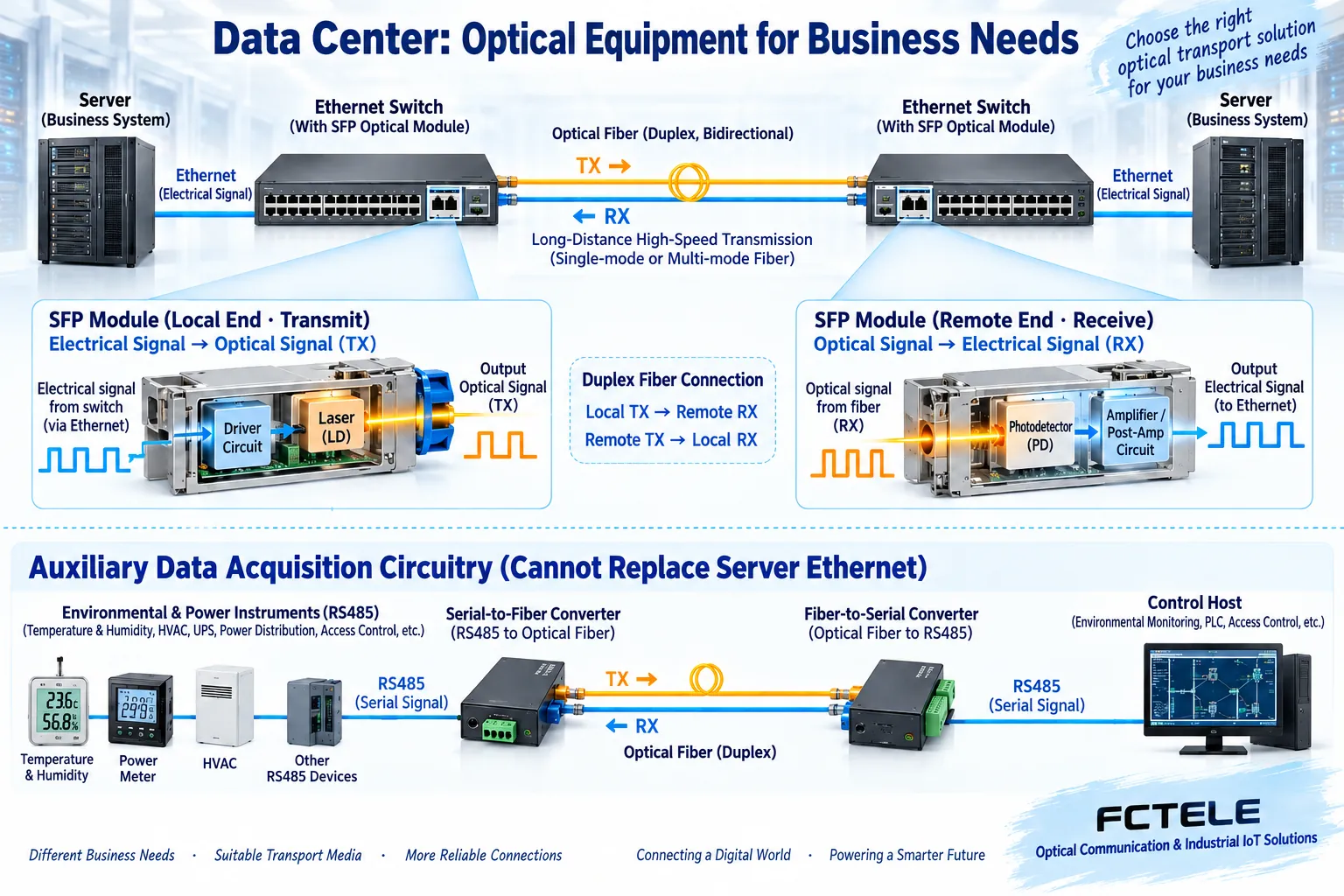
An optical module is a host component that performs electrical–optical conversion under the host’s supported conditions; a switch forwards data according to network rules. An external media converter or Ethernet fiber transmission unit can extend a corresponding Ethernet link. Serial, telephone and video devices serve other interfaces. Having optical in the name does not put them at the same layer or make them substitutes.
For example, a server needing an Ethernet switch cannot use a serial fiber modem merely because it has an optical socket. Conversely, an instrument’s serial terminals require proper electrical, data and direction adaptation; an optical module alone does not supply it. Identify endpoint equipment and its output interface before the transport device, rather than comparing cases or connector counts.
2. Where server-link conversion takes place
A switch or server network interface supplies data to its transceiver, whose optical transmitter produces a signal according to its design. The peer photodetector converts light changes into electrical signals for subsequent reception and network processing. Fiber propagates information; forwarding, addressing and applications remain the work of network and computing equipment. Do not attribute every function to one optical box.
Duplex fiber normally connects each transmitter to the remote receiver over separate directional cores. Single-fiber BiDi needs complementary wavelengths. Matching plugs does not establish correct speed, wavelength, interface standard or host support. Form factor is one condition, not complete compatibility. Follow official equipment support information and both endpoint configurations.
3. Dedicated fiber equipment can carry auxiliary acquisition
Environmental or facility systems may retain serial instruments and controllers. If their services need extension between areas, choose a serial fiber modem according to interface and communication requirements. It substitutes fiber for the middle wire span; instrument addresses, commands and serial parameters remain necessary. Carrying auxiliary acquisition does not turn that modem into a high-speed server backbone switch.
Within FCTEL’s serial fiber modem category, FCP-RDQ4G documentation lists configurable serial interfaces. That makes it a candidate for checking a specified serial requirement, not proof that industrial or fiber wording implies server-network support. State its auxiliary-service role and actual endpoint interfaces and configurations in procurement documents, preventing unlike equipment from being listed as interchangeable.
4. Capacity is not the largest advertised number
The entire data-center path can limit performance: NICs, switches, transceivers, cables and applications. Adding fiber cannot increase server processing or upgrade an unsupported port speed. Application throughput differs from the interface rate; overhead, shared load and congestion also affect results.
Where forward error correction is required, verify the supported host/module/link combination. Correction handles a limited class of errors; it cannot repair arbitrary attenuation or damaged connections. Enabling, configuration and limits follow official documentation. Do not describe one high-speed network technique as a universal feature of all fiber transmission units or promise that data can never be lost.
5. Acceptable received power completes only part of the checks
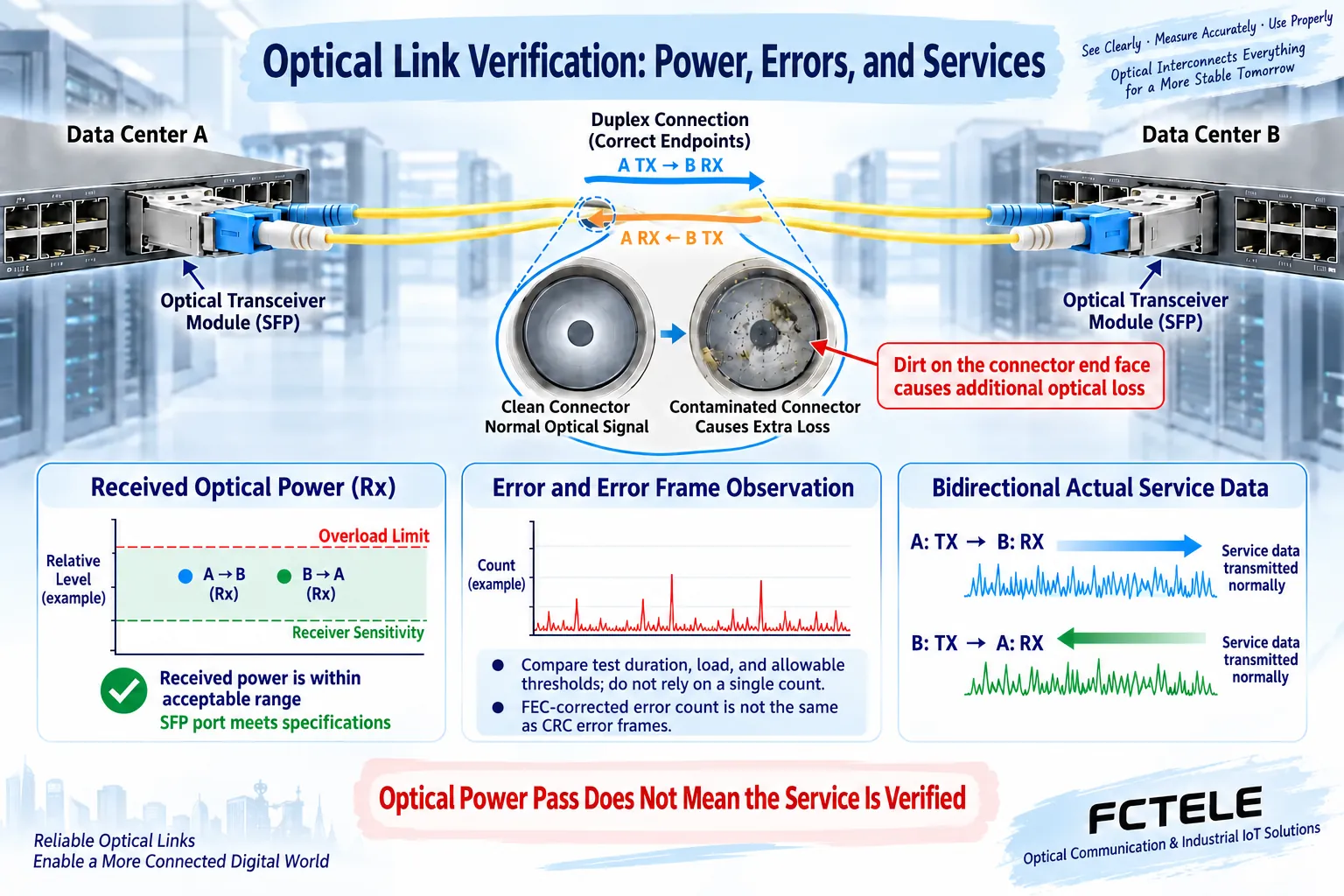
Received power must fit the receiver’s window; both insufficient and excessive input can fail. Loss includes cable, connectors and splices. Poor cleaning, bends and abnormal connections change conditions. Matching distance labels does not establish a compatible pair, and a short route does not necessarily suit a long-reach module. Plan measurements and any attenuation using actual specifications and results.
Even acceptable power requires checking bit or frame errors, link state and the application. A power reading cannot independently prove correct data processing. A failed application may involve port settings, network configuration or endpoints. Diagnose by layer rather than repeatedly replacing modules without evidence or blaming all configuration errors on fiber.
6. Fiber does not automatically provide security or high availability
The glass span is nonconductive, but power and grounding protection still require system design. Information security depends on access control, encryption and configuration management. Fiber can be accessed, and ordinary media conversion does not create encryption. Identify which equipment and setting supplies a required security function rather than attributing it to the medium.
Availability also needs complete design. Two fibers in one duct can be damaged together, and two devices sharing a power failure point can stop together. Include switching behavior, application recovery and maintenance visibility. Two optical ports alone do not establish a functioning redundancy mechanism.
7. Keep reproducible acceptance records
Within an authorized maintenance window, record devices, ports, transceivers and fiber correspondence, then check official support conditions. Use known-good connections to isolate segments and avoid simultaneous changes. Never look into optical ports; clean and test according to fiber safety procedures. Production disconnections and fault simulations need an approved maintenance plan rather than arbitrary experiments.
Test bidirectional communication under the agreed real load, checking errors, stability and application responses. For auxiliary serial links, verify requests and returns separately from server-network tests. Retain configuration, measurements, test conditions and recovery requirements together. Records should show exactly which span an optical device serves and where future diagnosis starts, rather than conclude only that the data center uses fiber.
Translated from the Chinese technical article. Source first published: 2024-03-25. Source last revised: 2026-10-13T14:32:54+08:00. Read the Chinese source
