


GVRP lets switches dynamically propagate VLAN membership information. It addresses repeated registration when a VLAN needs to extend across several switches. GVRP registers, maintains and withdraws VLAN information; it is not data forwarding itself and does not replace port VLAN settings, trunk policy or access control.
1. Why VLAN information needs registration
A switch can place ports in different VLANs. If a VLAN must cross an inter-switch trunk, the relevant membership and forwarding conditions must exist at both ends. With static configuration, administrators establish VLANs and appropriate allowed membership explicitly. GVRP instead lets participating switches advertise VLAN membership through control messages.
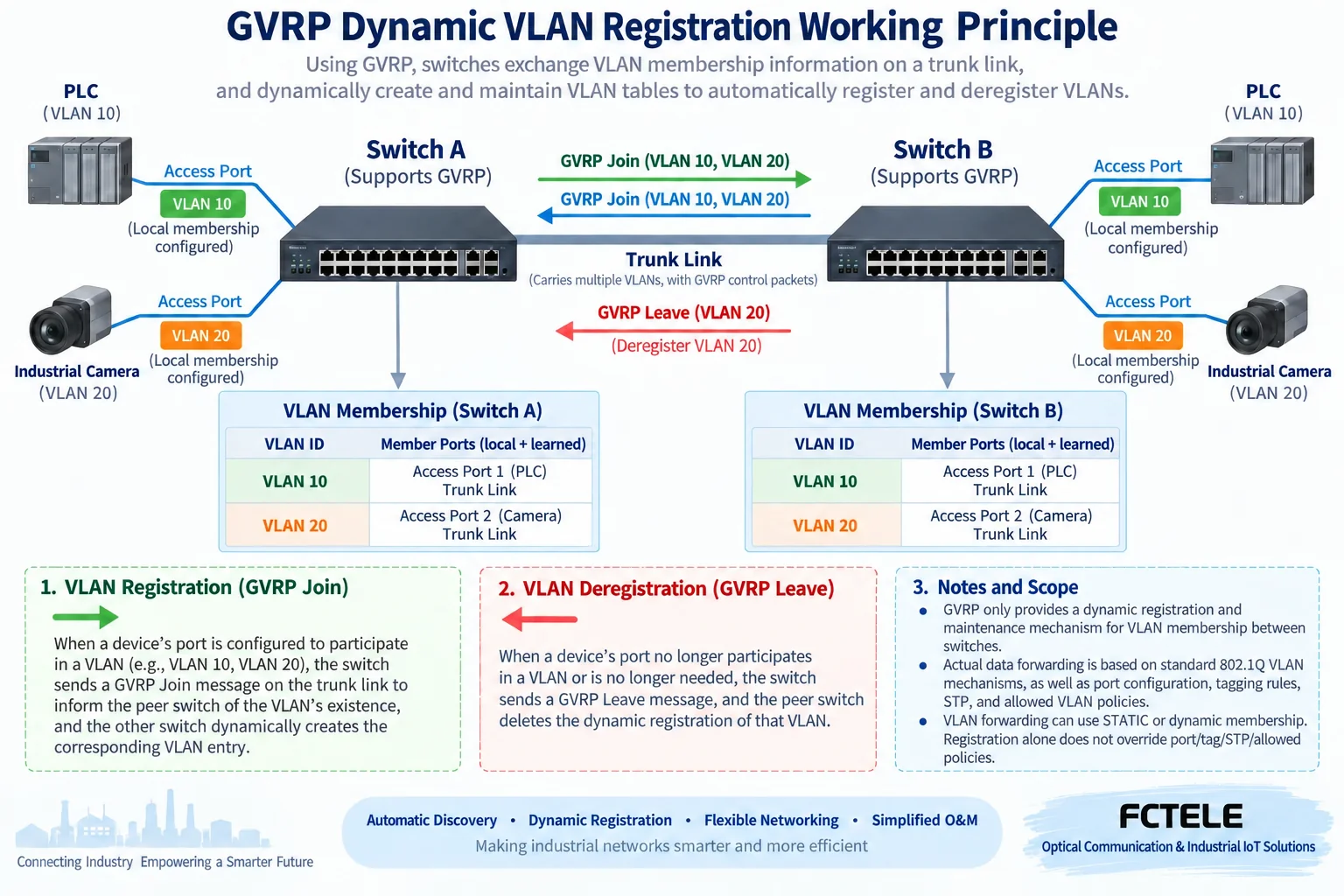
When configured access membership requires VLAN 10 or VLAN 20, a switch can send Join information on a participating trunk, allowing its peer to establish corresponding dynamic registration. Leave information withdraws membership when it is no longer required. Hold, Join and Leave timers affect state maintenance; verify defaults and commands in the model manual.
2. Registration does not guarantee application connectivity
In this trunk-based deployment, GVRP messages need a correctly configured participating link. A peer with GVRP disabled, a port in an unsuitable access role or a device filtering control messages can prevent remote learning. Even when a dynamic VLAN entry exists, port membership, trunk policy, STP state or other Layer 2 rules can still block data.
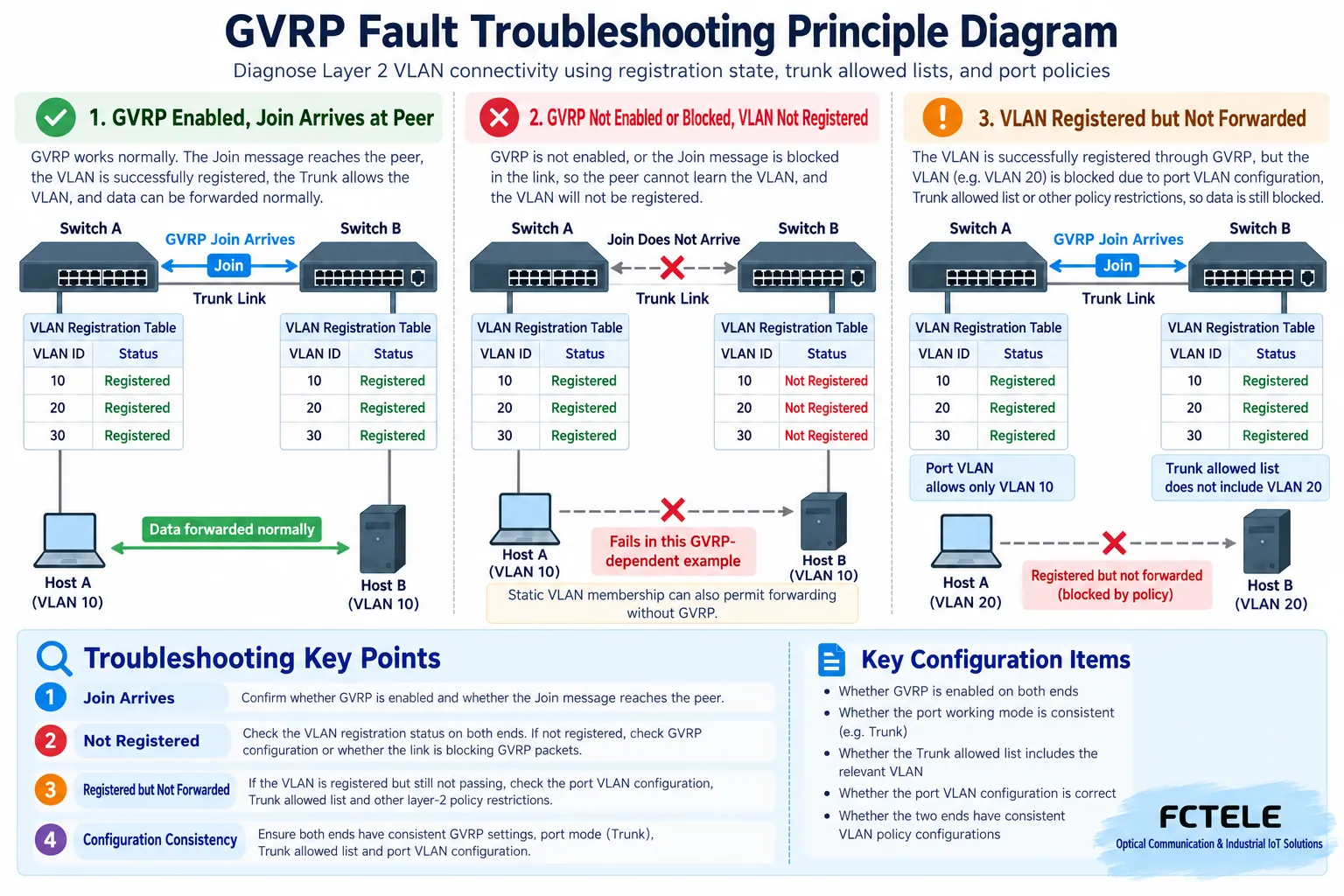
A visible VLAN entry does not prove the application path is open. Inspect GVRP state, the dynamic VLAN table, trunk policy and actual frames separately. GVRP distributes membership; 802.1Q tagging and forwarding rules still determine data movement.
3. When dynamic registration is useful
Dynamic registration can reduce repetitive work across multiple supporting managed switches where membership changes frequently. In fixed production-control networks, strict change audit requirements or mixed-vendor deployments, assess whether static VLANs are easier to maintain. Support for GVRP, compatibility modes and security policy differs between implementations. A protocol name alone cannot establish interoperability.
Confirm GVRP support, port modes and VLAN scope for the exact FCTEL model, firmware and manual. Do not generalize one model’s registration capability to every industrial switch or describe GVRP as automatically creating complete network security policy.
4. Troubleshoot with evidence
On a link that does not affect production, verify GVRP and trunk participation at both ends, then check whether Join arrives. If registration is absent, inspect control-message paths, port roles and timers. If registration exists but data fails, check access membership, trunk policy, STP and access rules. Finally send known unicast and broadcast traffic within the intended VLAN and record learning, loss and logs.
Save configuration and VLAN tables before changes. Change one item at a time and prepare rollback. Dynamic registration can change VLAN scope as topology changes. For control, video and production information, specify who can initiate registration and which ports may participate, and validate within an authorized window. Figures illustrate generic mechanisms; actual commands, timers and compatibility require equipment documentation and field testing.
Acceptance records need both registration state and application results. A dynamic entry is intermediate evidence. Expected endpoint communication, correct broadcast scope and reproducible recovery establish whether the configuration satisfies the project.
For long-term stability, document dynamic scope, trunks, port uses and responsible maintainers. Review unexpected members periodically. This avoids treating temporary connectivity as permanent configuration and supports future expansion and diagnosis.
5. Compare dynamic registration with static configuration
Static VLANs make changes explicit: administrators can read each link’s permitted networks in configuration. Repetition across many switches can nevertheless cause omissions. GVRP reduces repeated registration but introduces dynamic state, timers and interoperability questions. Fixed production lines and strictly audited networks often favor explicit settings. Frequent change on consistent equipment managed by a team familiar with the protocol is a more suitable setting for evaluating dynamic registration.
GVRP is not a VLAN security boundary. It does not decide whether an endpoint is trustworthy or replace ACLs, port security or management-plane isolation. Define application zones and failure impact for PLCs and industrial video before deciding which VLANs may register dynamically. Automation needs inspectable state and recoverable configuration.
Keep both models and firmware, trunk ports, VLAN IDs, GVRP enablement, dynamic-table changes, Join/Leave events, allowed membership and endpoint results. Time-ordered evidence distinguishes missing registration, registered traffic blocked by policy and application misconfiguration.
Test normal links, Join arrival, membership withdrawal and restoration separately. Remove temporary memberships afterward and confirm that no unwanted dynamic state remains. In control networks, ensure dynamic changes cannot admit unintended ports; record abnormal registration as a security event. Retain broadcast scope, endpoint learning and recovery timing to show existing zones remain intact. Keep interoperability results for mixed vendors, and approval, rollback timing and impact for production changes. Confirm final temporary-configuration cleanup.
Configuration completed and recorded.
Translated from the Chinese technical article. Source first published: 2022-11-25. Source last revised: 2026-10-13T14:32:54+08:00. Read the Chinese source
