


Remote monitoring needs more than transporting data to an office. Recognizing stale readings during outages and avoiding repeated control after recovery often matter more than connecting once. A serial server supplies a channel; the platform handles parsing, timestamps, alarms and permissions. Its server name cannot imply undocumented features.
Separate monitoring from control
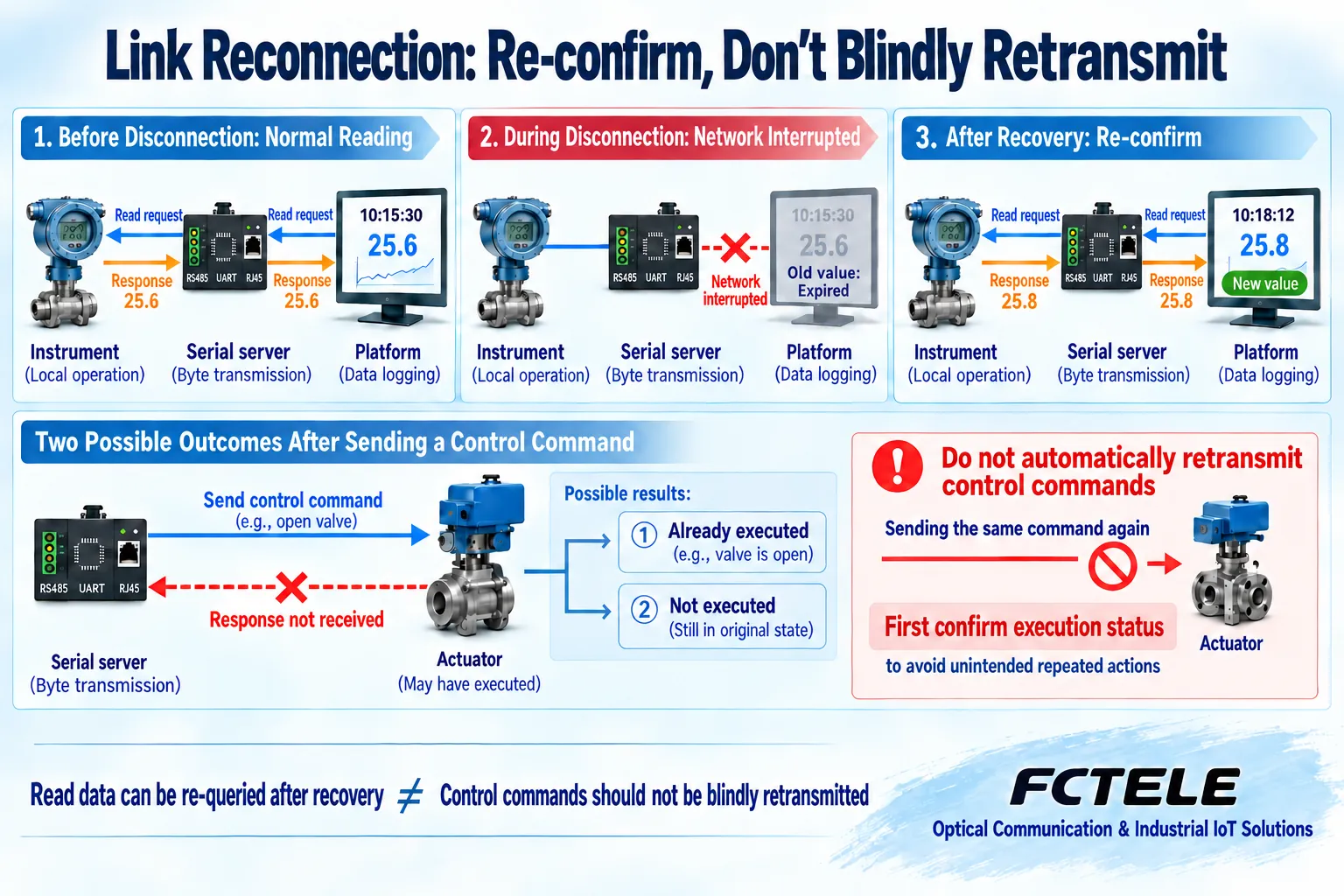
Monitoring reads values/status; control causes actions. Failed reads affect timeliness, while failed control may mean an action executed but its reply was lost. Do not share one retry rule. Ordinary remote serial transport cannot replace assessed onsite emergency-stop, protection or safety-interlock systems.
In a hypothetical pump house, instruments provide serial data, the server moves bytes, the site network connects and the platform parses/stores/alarms. This is not a customer case. Verify storage, unsolicited reporting and offline replay separately rather than attributing platform functions to a transparent server.
The stages of one reading
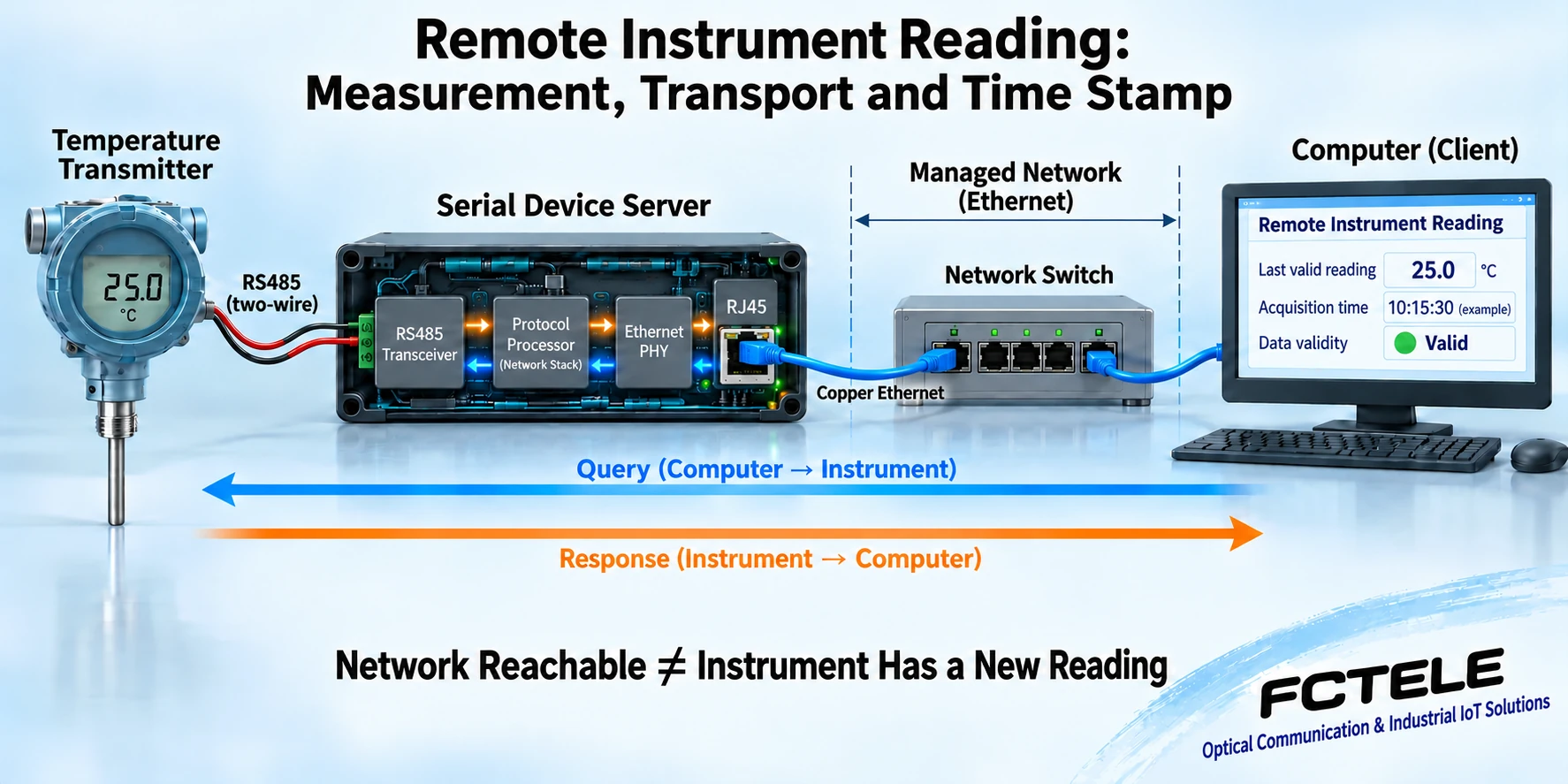
A platform query travels over network to server, becomes serial electrical signaling and reaches the instrument. Response bytes return to platform for protocol interpretation. A connected session proves a channel, not correct replies, registers or scaling.
RS232/422/485 are electrical interfaces, while Modbus is an application protocol. Match interface, characters, address and messages. Transparent servers carry bytes; gateways transform application formats. Raw RTU inside TCP cannot automatically satisfy a Modbus-TCP-only platform.
Connected without new data: what to check
An online session does not prove updating service. Instrument power, changed parameters, wrong addresses or invalid/no queries can stop readings. Observe network, serial counts and valid replies separately, recording the last successful reading. Ping to the server cannot establish instrument availability.
Label last values with acquisition time and validity. An old temperature can remain as history after disconnection but must not be marked live. Receipt time may differ from sample time because of queuing. Without source timestamps, state time meaning rather than inventing measurement precision.
Timeout covers the complete request/reply
Budget request transmission, processing, response, packetization and network. Short timeouts reject legitimate late replies and add retry load. Measure distributions under normal/high load before choosing timeouts and polling, not a universal millisecond value.
TCP orders bytes but applications still frame messages. UDP does not guarantee delivery; define confirmations and errors. Heartbeats help assess a connection, not replace valid instrument queries. Enabling them cannot promise perpetual online status or zero loss.
Reconnect does not mean replay old commands
Define who reconnects, waits and limits retries. Many sites reconnecting rapidly can overload a platform. Supporting software/devices may use increasing waits and randomized intervals; verify configurability rather than assume it.
After reconnect, confirm session/device state and expire old query associations so old responses cannot satisfy new requests. Never replay uncertain control blindly. Idempotence means repeating an operation creates no additional side effect; naming a command does not create this guarantee when the protocol lacks it.
Use alarms that identify the layer
Distinguish power loss, network interruption, serial silence and out-of-limit values. An offline platform does not know current field state and cannot declare a broken instrument. A valid reply above a threshold is a service-value alarm. Layered wording prevents unnecessary replacement and clarifies responsibility.
Associate logs with site, channel, time, result and configuration. Byte counters offer clues but do not prove checksums, addresses or values. Audit logs, detailed errors and remote diagnosis vary by model; require documentation and tests.
Remote reachability does not justify public exposure
Restrict management and transparent serial service sources. Do not leave defaults or unprotected control ports online. Use controlled private networking, segmentation, firewalls and assessed remote access as appropriate. Network owners must approve access paths rather than casual port forwarding.
FCTEL FCT-081206 lists multiple serial ports, management and network modes as a central-access reference. One supported protocol cannot secure the whole system. Verify encryption, authentication, permissions and firmware maintenance separately. Do not recommend listed VPN forms for high-risk industrial use without assessment.
Accept remote hardware too
Power and network failures may look similar. Verify supply range, interface version, mounting and environment. Fanless enclosures still need cooling; cabinet temperature, condensation and cable retention matter. Cross-building serial also needs consideration of isolation, surge and ground potential. A shield is not universal protection.
Establish a short-link service baseline before the full network. Test platform restart, network loss, nonresponding instruments and site power loss. Verify accurate alarms, obvious stale-data labels and fresh readings after recovery. For control, validate outcome confirmation safely and retain rollback configuration.
Good monitoring provides trustworthy normal readings, does not label unknown state normal and recovers predictably. LEDs or one successful query cannot prove this. Put validity and control risk into acceptance to reduce blind maintenance.
References:TCP specification RFC 9293;FCTEL FCT-081206 details. Figures show generic mechanisms; examples are not measurements or product guarantees.
Translated from the Chinese technical article. Source first published: 2025-02-18. Source last revised: 2026-10-13T15:39:27+08:00. Read the Chinese source
