


A managed fiber media converter is more than an ordinary converter with a web page. It collects status from ports and internal circuits, organizes queryable objects and delivers information through management interfaces. Understanding this path separates observation from changes that affect service, and explains why a central platform losing visibility of a remote device does not prove that device is damaged.
1. Service circuits forward; management circuits observe and configure
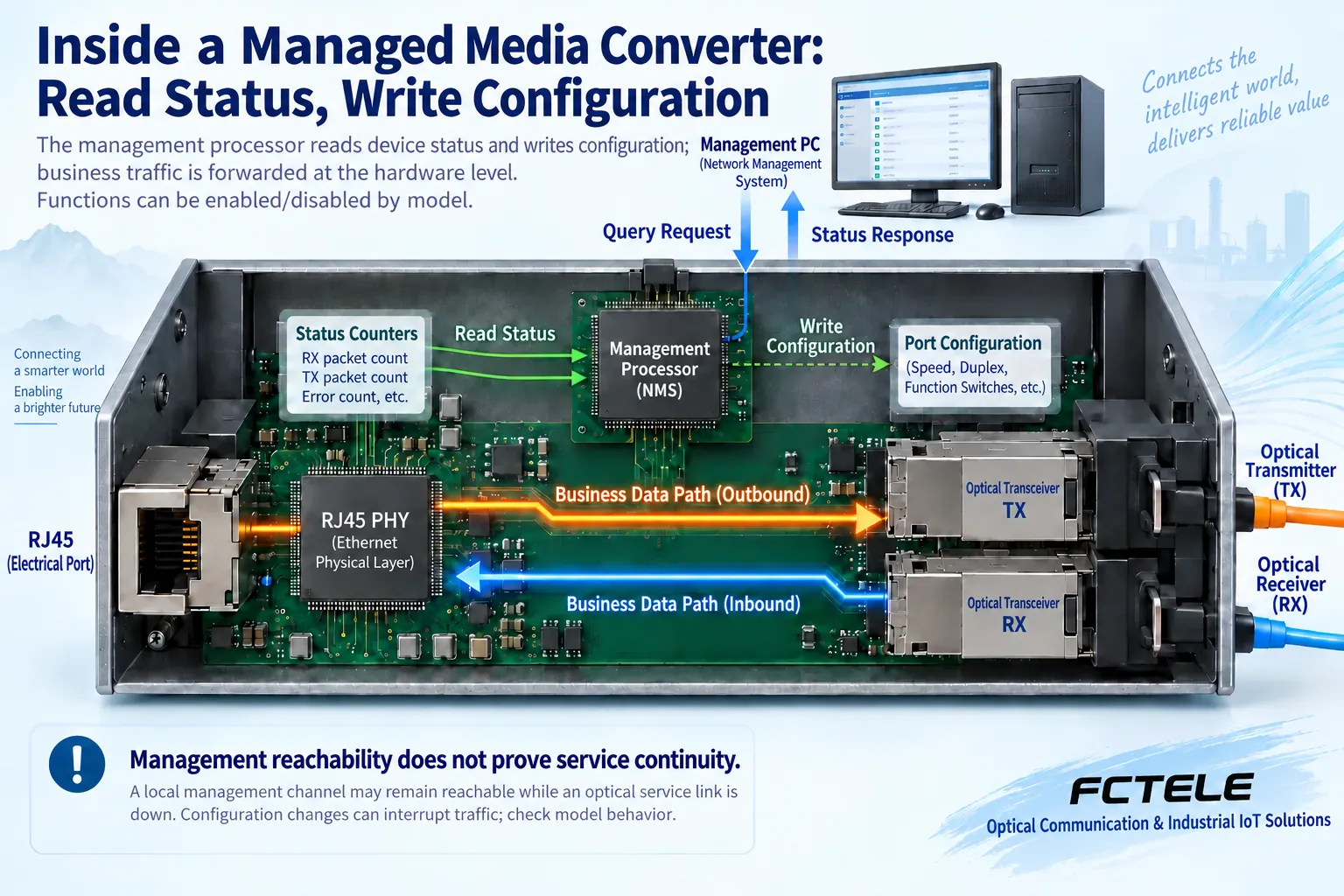
Traffic enters the Ethernet copper port. Physical-layer circuits process electrical signals and the transmitter turns the information into light. In reception, the optical receiver recovers it for copper output. Designs may use different conversion or switching architectures. Switching devices may learn addresses and buffer frames, but buffers are finite and cannot guarantee zero loss at every load.
The management processor reads port state, counters and supported sensors through internal interfaces, then responds to web or platform queries. Configuration requests may change port enablement, speed policies or other supported settings. Verify forwarding and management separately: an accessible web page proves only that management service is reachable, not every traffic port. Continued traffic with lost web access also does not prove the entire device has stopped.
Available information depends on hardware, firmware and management-object definitions. Port link status differs from module diagnostics. To display module temperature and power, the module must supply data and the converter must read and present it. Do not copy one model fields to all equipment or treat an unavailable reading as proof of sensor failure.
2. Central chassis management needs accurate object mapping
A chassis places multiple service cards in one enclosure, and its management unit can aggregate slot status. Chassis, power supplies, management unit, cards and remote devices are different objects. A power alarm differs from a copper-port disconnection. The platform must identify the source; one red dot alone leaves technicians unsure whether to inspect power or fiber.
Central management does not mean all traffic passes serially through the management processor. The management bus mainly reads and controls. Whether a backplane carries service data and whether cards operate independently depend on chassis design. Continued service after management-unit failure, retained configuration after card replacement and cross-version card compatibility require manuals and tests, not an inference from modular construction.
Older claims about sixteen slots, 2U height, dual supplies, hot swapping and cascade counts may describe particular historical products, not every managed converter. Distinguish independent power inputs, backup behavior and shared failure points. Hot-swap rules must identify permitted modules, procedures and service impact. They do not permit arbitrary board removal or touching exposed live contacts.
3. Polling and unsolicited notifications are different mechanisms
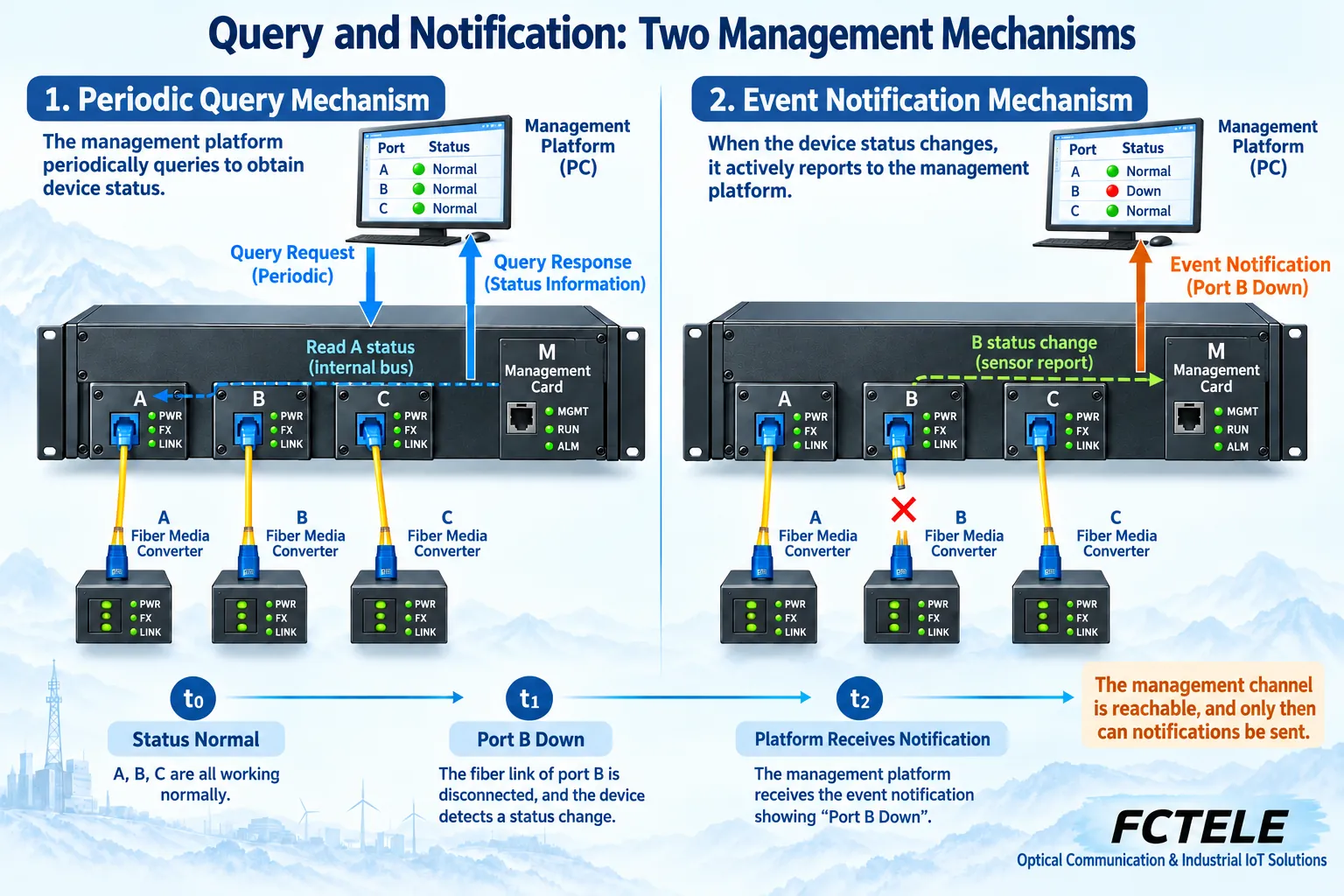
Periodic platform polling asks for current status. Associate each reply with device identity, query time and field. Shorter intervals are not always better: excessive polling adds traffic and processing load. Long intervals may miss brief changes. Set intervals against equipment and project needs rather than a universal number of seconds.
A device notification reports an event when conditions are met, such as a link change. SNMP notifications can help expose faults promptly, but delivery still depends on reachability and may fail. Combine polling, notifications and logs to cross-check events and state. Notification support cannot guarantee that no alarm is ever missed.
Alarms need onsite identifiers: chassis, slot, port and event. Time synchronization helps connect central and remote records, but confirm support and setup. Preserve recovery events too; a start event alone cannot show whether recovery was automatic, how long the outage lasted or whether the link repeatedly flapped.
4. Management cannot replace protection mechanisms
Link-fault propagation exposes a failure to adjacent devices so upper-layer equipment can recognize link loss. It does not create a backup route or necessarily switch routing. Rerouting needs a correct alternate topology and appropriate protocol or control policy, verified against actual failure conditions. Without another path, fault propagation identifies failure but cannot carry interrupted traffic.
Rate limiting constrains port traffic; it does not alone protect a network against attacks. A low limit can also queue or drop legitimate traffic. Jumbo-frame support is another compatibility condition: check permitted lengths at both ends and all intermediate equipment. One supporting converter cannot prove end-to-end support. State the scope of each feature rather than listing names alone.
The FCTEL remotely managed single-optical/single-copper Gigabit product describes a switch-chip/programmed-logic combination, remote OAM frames and compatible management-card interconnection for local and peer status. This requires coordinated endpoints, not arbitrary-brand chassis management. Check ordered version, firmware, platform and writable fields against product documentation.
5. Verify control and security before deployment
Before testing, save configuration and register models, versions, slots and wiring. Verify that read-only accounts can observe but cannot disable ports, and give modification accounts only to authorized personnel. Keep management on a controlled network with restricted sources. Protocol names alone cannot prove encryption or authentication; check actual supported options.
In an approved outage window, test disconnection, alarm generation, recovery notification and timestamps, confirming the alarm identifies the correct object. Then check configuration retention after power cycling and platform rediscovery. Use official firmware for the applicable model, understanding service effects and failure recovery. Generic file-transfer steps from old material cannot replace current instructions.
Acceptance should demonstrate the complete chain: a port changes, the device collects it, the management channel carries it, the platform identifies the right object and maintenance staff have a defined response. Feature names are only a starting point. Consistent mapping, access control and actual recovery exercises make central management useful.
Translated from the Chinese technical article. Source first published: 2020-07-16. Source last revised: 2026-10-13T16:02:51+08:00. Read the Chinese source
