


“Industrial-grade” is not a guarantee that applies to every site. The protection rating only answers part of the question of what enters the enclosure. Equipment is also affected by temperature, damp condensation, vibration and electromagnetic interference. This article starts from site conditions and explains why the environment affects communication, and what should be checked in selection, installation and acceptance.
1. Temperature depends on the small environment where the equipment is located
The switch’s chips and power circuits generate heat when working. That heat must pass out through device contact surfaces, the enclosure and the surrounding air. The outside weather temperature is not the temperature inside the cabinet, and even less is it the chip temperature. Power supplies, variable-frequency drives and other equipment inside the cabinet generate heat, and a closed box exposed to sunlight can all make the area near the switch hotter than outdoors. The operating temperature in the specifications should be understood according to the measurement conditions specified by the manufacturer, and cannot be directly replaced by the local weather forecast.
When selecting, first estimate the highest and lowest ambient conditions, load and ventilation, then confirm the equipment’s allowed power supply range and installation requirements. A fanless design relies on the housing for heat dissipation and air flow, which does not mean it can be placed right next to a heat source. Temperature changes can also affect connectors and component condition. Low-temperature startup, temperature cycling and long-term high temperature are different tests, and one maximum temperature number cannot answer all questions.
For acceptance, you can record the temperature, load and operating status near the equipment. Measurement should use a suitable method. Do not directly equate a hot-to-the-touch housing with failure, and do not assume there is enough margin just because “the network has not dropped yet.” If temperature rise is related to service abnormalities, first check heat dissipation space and power supply, then handle it according to the manufacturer’s recommendations. Do not modify the enclosure structure without authorization or add unsuitable cooling methods.
2. Condensation is not only caused by rain
Air contains water vapor. When the temperature drops to a certain condition, the water vapor condenses on cooler surfaces. The dew point is the temperature that describes this condensation condition; it is not a fixed parameter of the equipment itself. Moving cold equipment into a warm, humid environment, or a cabinet cooling down at night, can both form water droplets on metal surfaces and inside. Even if it is not raining, condensation can still occur.
Condensation increases the risk of corrosion and electrical faults. When a product states a “relative humidity range, non-condensing,” it means that beyond the humidity number there is also this precondition for use. It cannot be understood as being able to withstand internal water droplets. If a high-protection enclosure already contains water vapor inside, temperature differences can still cause condensation; sealing does not mean the air is always dry. It must be considered together with cabinet design, ventilation or controlled thermal management.
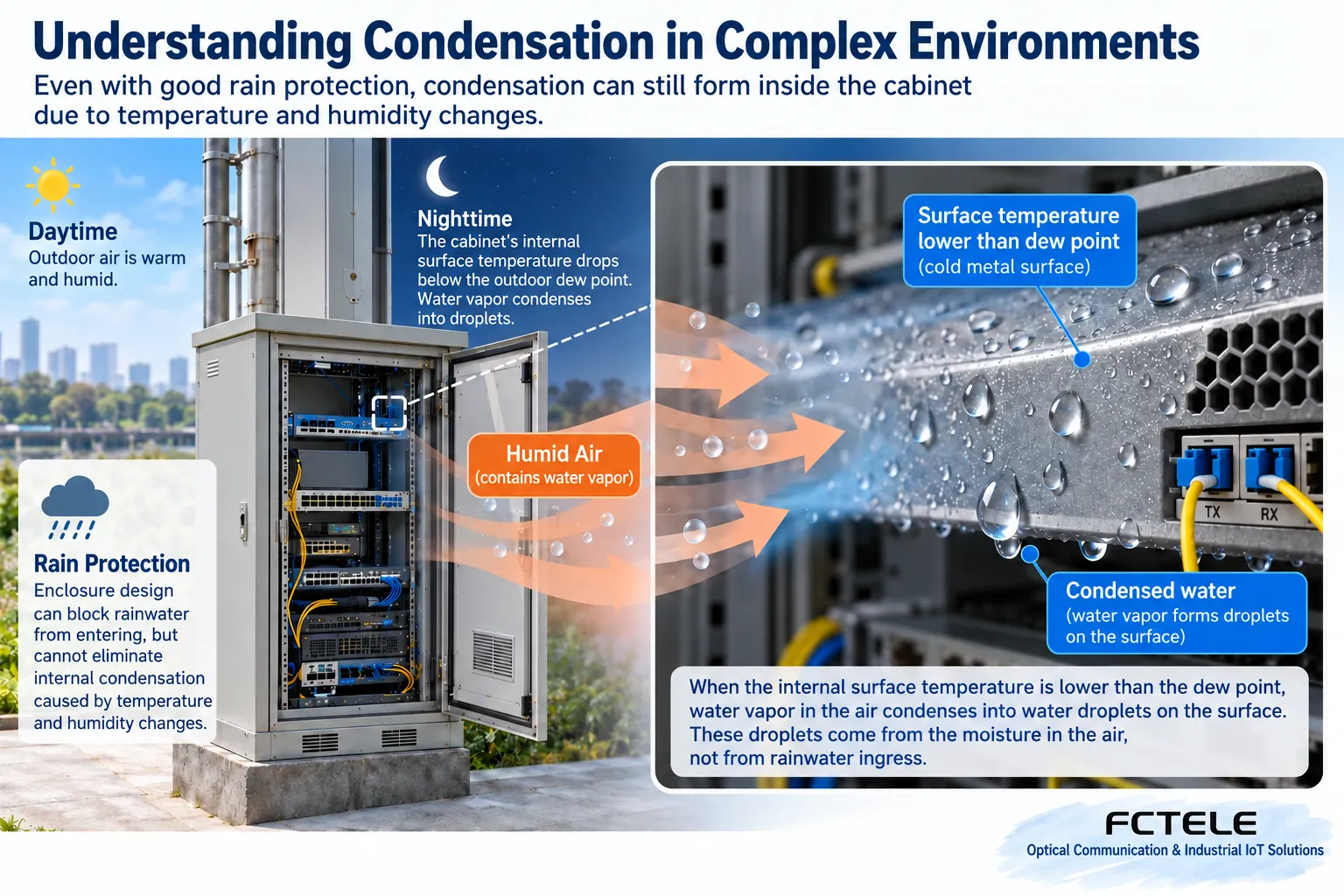
For example, in winter, when equipment is moved from low-temperature storage into a warm machine room, you should wait according to the manual until the temperature and moisture state are stable before powering on; if condensation appears, do not directly run it with power applied. The specific waiting conditions should be determined by the actual environment and equipment requirements, and a fixed number of minutes should not be applied to all scenarios. If water ingress or internal water droplets are found, isolate the power supply and have qualified personnel inspect it. Do not just wipe the outside dry and resume production.
3. Vibration is transmitted along the mounting structure and cables
Machine vibration can be transmitted to the equipment from the cabinet, backplate and DIN rail, and cable pulling force can also be transmitted to the ports. A sturdy enclosure cannot compensate for a rail clip that is not locked, a loose mounting surface, or heavy cables hanging. Long-term force may cause connections to make intermittent contact. On the surface it looks like a network drop, but the root cause is mechanical installation.
Use a fixing method that matches the equipment, check clips and fasteners, and provide independent support for cables as required. Keep a suitable bending radius and service space near the ports, and cabinet door movement must not pull on plugs. Do not tighten fiber optic cables with thick cable ties, and do not let power terminals bear the weight of an entire cable. Both structural acceptance and communication testing should be done. Do not stop just because Ping works while the system is stationary.
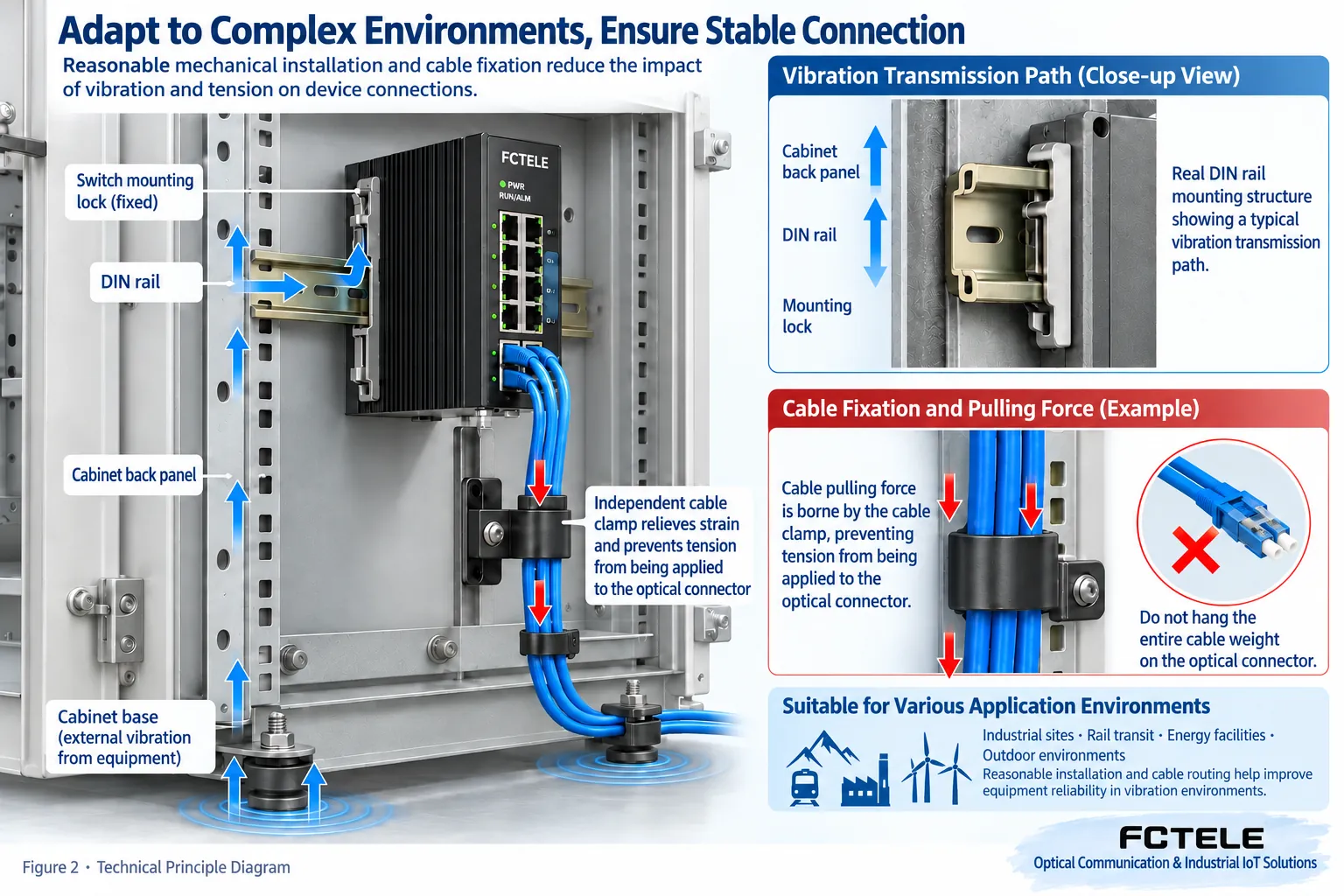
When vibration or shock resistance is required, check the complete machine test standard, severity and mounting method. Tests with different frequencies, directions and durations cannot be casually treated as equivalent; the strength of a certain enclosure material is not evidence that the complete machine passed the test. When site conditions exceed the scope covered by the report, the manufacturer and engineering personnel should evaluate it. Do not declare on your own that it is suitable for all transportation or mechanical environments.
4. Interference requires finding the coupling path
Variable-frequency drives, motors and switching power supplies may conduct interference through power lines or signal lines, and may also couple through electromagnetic fields in space. Wiring, shielding, grounding, power quality and port protection together affect the result. Reasonably separating communication cables from power cables and using cables and connection methods that meet requirements is often more well-founded than simply changing to a “thicker enclosure.”
Connect protective grounding according to equipment and site regulations. Do not disconnect the protective conductor just to temporarily eliminate interference. When lightning strikes and surges are involved, the overall protection of the building, power supply and line entry must also be considered. The capability of the equipment port is not a promise of lightning immunity. When an abnormality occurs, first record the time it happened, the start/stop of related equipment, port errors and power events, then look for patterns. Avoid attributing all timeouts to electromagnetic interference.
The IP rating does not state electromagnetic compatibility performance, and interference immunity tests do not directly state corrosion resistance, explosion protection or water resistance. Corrosive gases, salt spray, dust and cleaning agents should be checked separately. Hazardous areas need to meet the corresponding equipment admission requirements. An ordinary industrial switch cannot be treated as explosion-proof equipment just because it is temperature-resistant or has a metal enclosure.
5. Turn environmental conditions into an acceptance checklist
First describe the actual location: indoor cabinet, outdoor box or mobile machinery. Then record temperature and humidity, the possibility of condensation, vibration sources, interfering equipment, power supply and cable entries. For each risk, write down who provides protection, which document corresponds to it, and how to check it. In this way, cabinet capability, equipment capability and construction responsibility will not be mixed into the single phrase “industrial-grade.”
The Feichang Technology official website managed switch details list information such as fanless design, DIN rail or wall mounting, IP40 and environmental conditions, which can be used as a starting point for checking. The humidity in the details has a non-condensing precondition. The actual temperature, power supply and accessories must be confirmed according to the delivered version. Logs and port statistics can help observe when an abnormality occurs, but they cannot measure all environmental risks and cannot replace on-site electrical safety checks.
Suppose an outdoor cabinet works normally during the day but drops offline in the early morning. You should check the cabinet internal temperature, signs of condensation and power events at the same time, rather than immediately assuming a software fault. After improvements are completed, continue observing under representative load and environment, and keep records of measurement conditions, configuration and abnormalities. Acceptance cannot claim to cover all weather not yet experienced; seasonal changes and the sealing and fixing state after maintenance still require follow-up checks.
References:IEC 60529 scope information;Feichang Technology managed switch product details. The figures are general mechanism illustrations, not environmental tests, installation certifications or actual photos of specific models.
Translated from the Chinese technical article. Source first published: 2024-06-24. Source last revised: 2026-10-13T17:34:48+08:00. Read the Chinese source
