


Heat dissipation in an industrial switch is the process of transferring heat generated by chips and the power supply to the enclosure, and then to the surrounding environment. Thermal interface materials, metal enclosures, heat sinks, and air movement together affect temperature rise. Fanless does not mean no heat is generated, and wide temperature does not mean you can ignore the temperature inside the cabinet and the mounting clearance.
Where heat is generated and where it goes
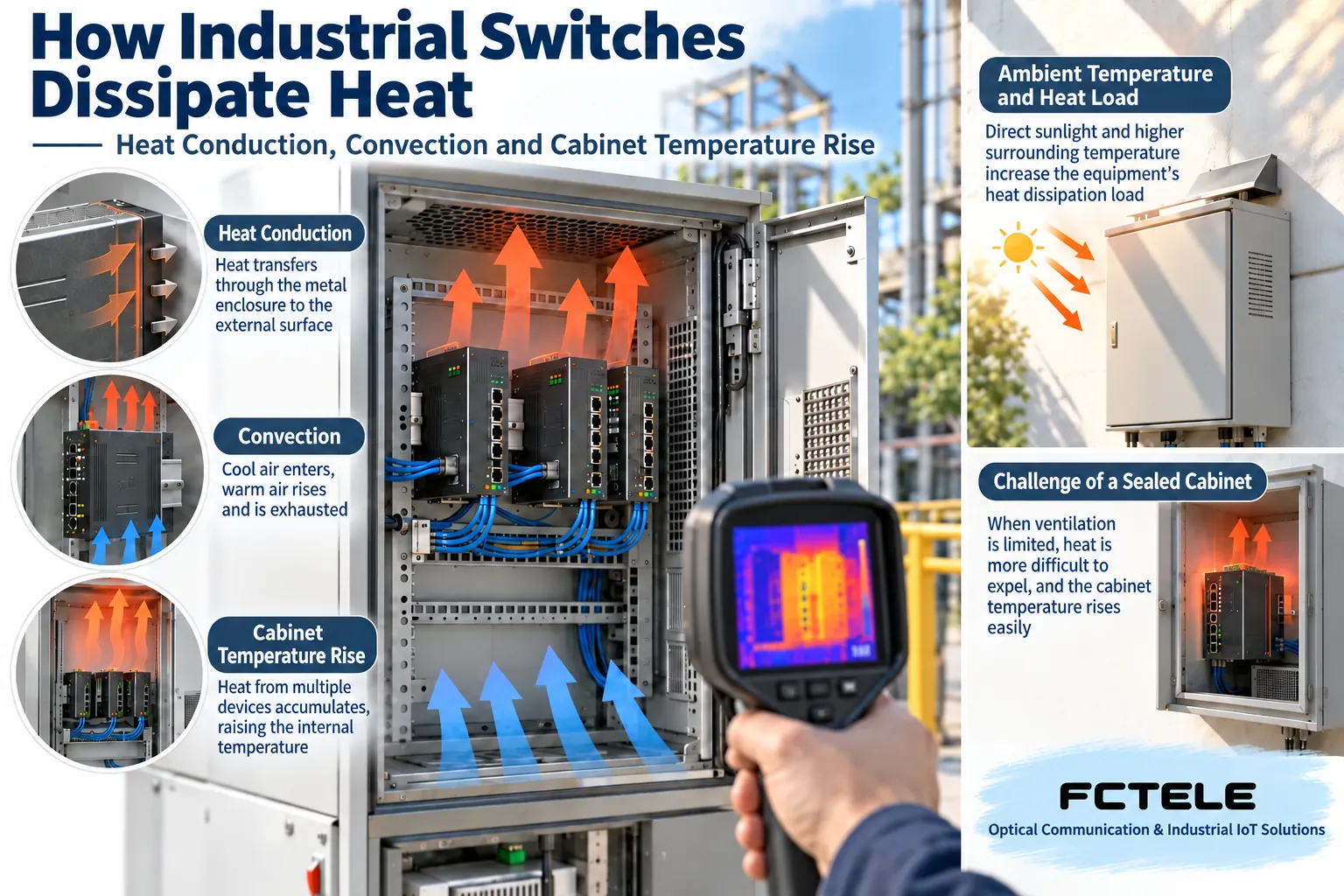
Switch chips, interface circuits, power conversion, and optical modules all generate loss heat. Heat first passes through the PCB, thermal interface, or mounting structure to the enclosure, and then dissipates to the environment through convection and radiation. Any poor contact or blocked air in the heat dissipation path can increase local temperature rise.
You can understand the principle as “temperature rise increases roughly with power consumption and total thermal resistance,” but in engineering, specific measurement and design verification are needed. The same enclosure temperature does not necessarily correspond to the same chip temperature, and touching the device by hand cannot replace measurement; touching it may also pose burn or electrical risks.

What thermal pads and heat sinks each solve
Materials such as thermal pads are used to improve contact between the component and the heat dissipation structure, and they cannot be selected based on “the thicker the material, the better.” Thickness, contact pressure, component tolerances, and material properties need to match. Disassembling the device without authorization to add pads may change insulation, mechanical stress, or warranty conditions.
Heat sinks increase the surface area in contact with air, but if the channels are blocked or the mounting direction obstructs airflow, the effect will be affected. A thick, heavy metal enclosure does not automatically prove excellent heat dissipation; the complete path and test conditions still need to be considered.
How fanless design depends on installation
Natural convection uses rising hot air to drive flow. Device documentation may specify direction, spacing, or surrounding space, and installation should follow the instructions. Multiple devices placed tightly together, wiring harnesses covering the top, or blocked air ducts inside the cabinet can all make the environment worse.
Fans can improve convection, but they introduce issues such as mechanical life, maintenance, and dust ingress. There is no absolute advantage or disadvantage between fanless and fan-cooled designs apart from the scenario. The choice should combine power consumption, enclosure, cabinet, and maintenance requirements, not just look at one word in marketing.
Why cabinet temperature matters more than the weather forecast
An outdoor cabinet is affected by sunlight, a closed structure, and heat from other power supplies, so the temperature inside the cabinet may differ from the outdoor air temperature. Indoor cabinets may also have local hot spots. The air intake near the device and environmental conditions should be measured, rather than directly using outdoor air temperature as a substitute.
PoE devices need to distinguish between the power delivered to the terminal and the switch’s own losses. The PoE budget affects the power supply and thermal design, but not all PoE output should be treated as heat generated inside the chassis. Optical module types, port load, and input conditions should also be included in verification.
How to perform meaningful temperature-rise verification
Record the environment, installation, input power, port load, and module combination, and measure after running to a state that meets the test requirements. Check error counters, disconnections, alarms, and service performance; you cannot draw a conclusion just by taking a thermal image photo.
Thermal imaging measurement is affected by material emissivity, reflections, and viewing angle, and surface readings need to be interpreted carefully. If the device shows abnormalities, first preserve the phenomenon and check the environmental conditions; do not disassemble the enclosure or change protective structures during operation without authorization.
Keep one set of materials for selection and one for operations
For selection, request the temperature and installation conditions for the specific model; for operations, keep cabinet measurement and load records. Documentation showing that one manufacturer’s model uses natural convection can only help understand the principle; it cannot prove that all industrial products are the same. You can refer to heat dissipation notes in industrial switch technical documentation.
through Product Center after filtering models, you still need to check the on-site cabinet plan. Heat dissipation is a capability formed jointly by the device and the installation environment, not a label that stops changing after the device leaves the factory.
Translated from the Chinese technical article. Source first published: 2022-08-31. Source last revised: 2026-10-13T17:37:33+08:00. Read the Chinese source
