


Two industrial switches with similar port counts can have different quotes, and that does not necessarily mean one seller is charging too much. Electrical ports and uplink speed, management capability, power supply, operating environment, validation and delivery scope can all differ. Before comparing prices, first write down the requirements of the same project clearly, then check item by item what is included and what is missing, and finally look at the total cost after installation and maintenance. This article provides a comparison method and does not treat old-year price lists as current transaction prices.
1. Why comparing only “eight-port gigabit” is not enough
Ports are the entry and exit points for data, but they are not the whole capability of the device. Beyond eight gigabit electrical ports, the uplink may be a 100 Mbps optical port, a gigabit SFP slot, or a shared combo port. Whether optical modules are delivered with the unit also changes the total price. Directly comparing a quote that includes modules, power supply and installation accessories with another bare-unit price can easily lead to wrong conclusions. When requesting a quote, you should write down the quantity, speed, medium and uplink method for each type of interface.
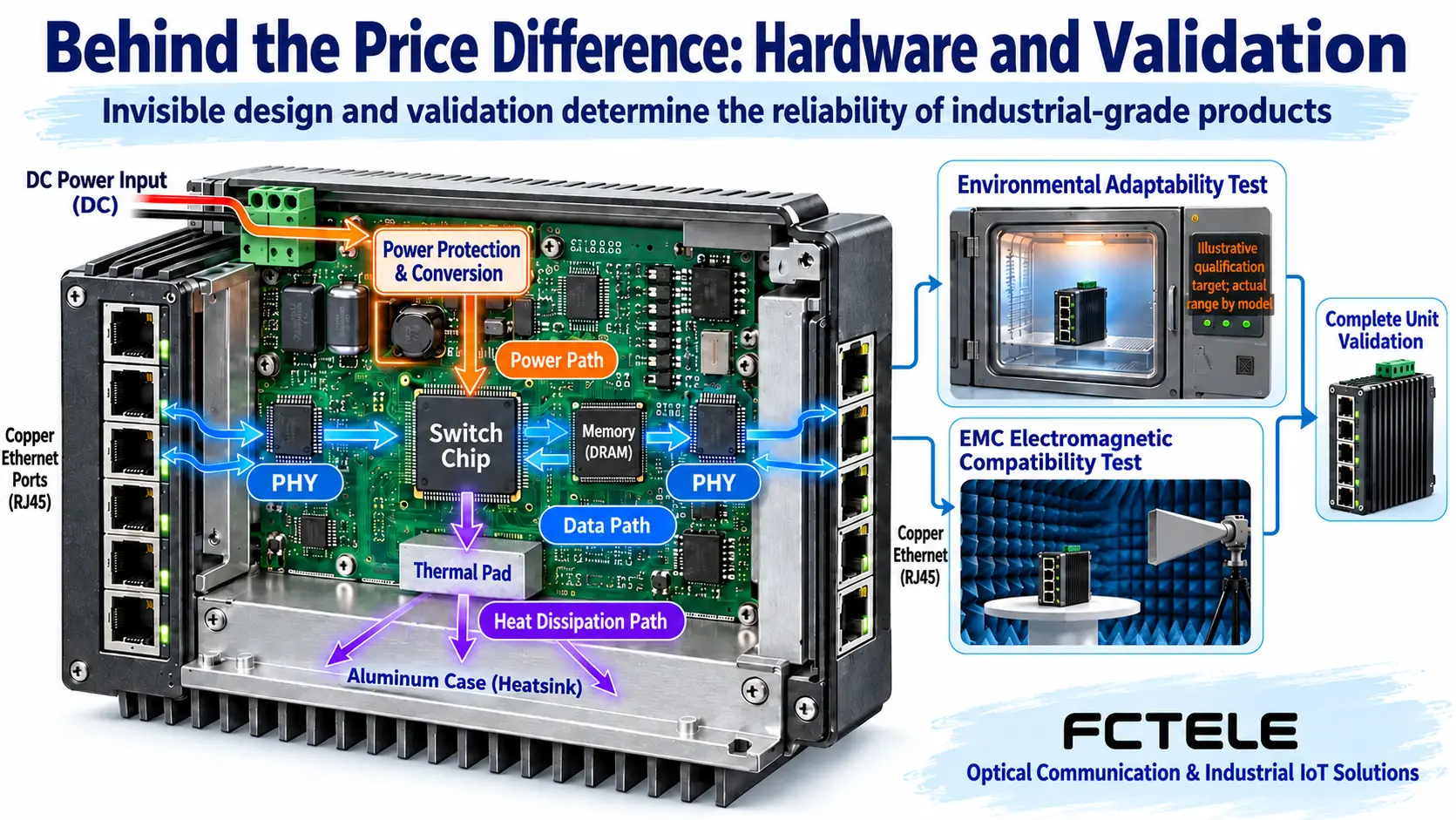
Inside a switch there are transmit and receive circuits, a switching chip, buffer memory, power conversion and management-related components. A managed model also needs configuration and maintenance functions. Different combinations of functions affect design and validation work, but you cannot assert higher throughput based only on managed capability or brand name. Only by looking clearly at port capability, switching capacity, forwarding conditions and actual service testing can you judge whether these costs match what the project needs, rather than buying a string of parameters with no use.
2. Money for bandwidth should be spent where it truly limits the service
When multiple inputs send to the same uplink at the same time, they queue before the exit. Suppose four service streams each continuously send forty megabits per second, totaling one hundred and sixty megabits. Even if the access ports are all gigabit, a 100 Mbps uplink cannot continuously carry this traffic. Buffering only temporarily stores frames during short congestion; if the queue keeps growing, data may still eventually be dropped. A larger buffer cannot turn a long-term 100 Mbps exit into 160 Mbps.
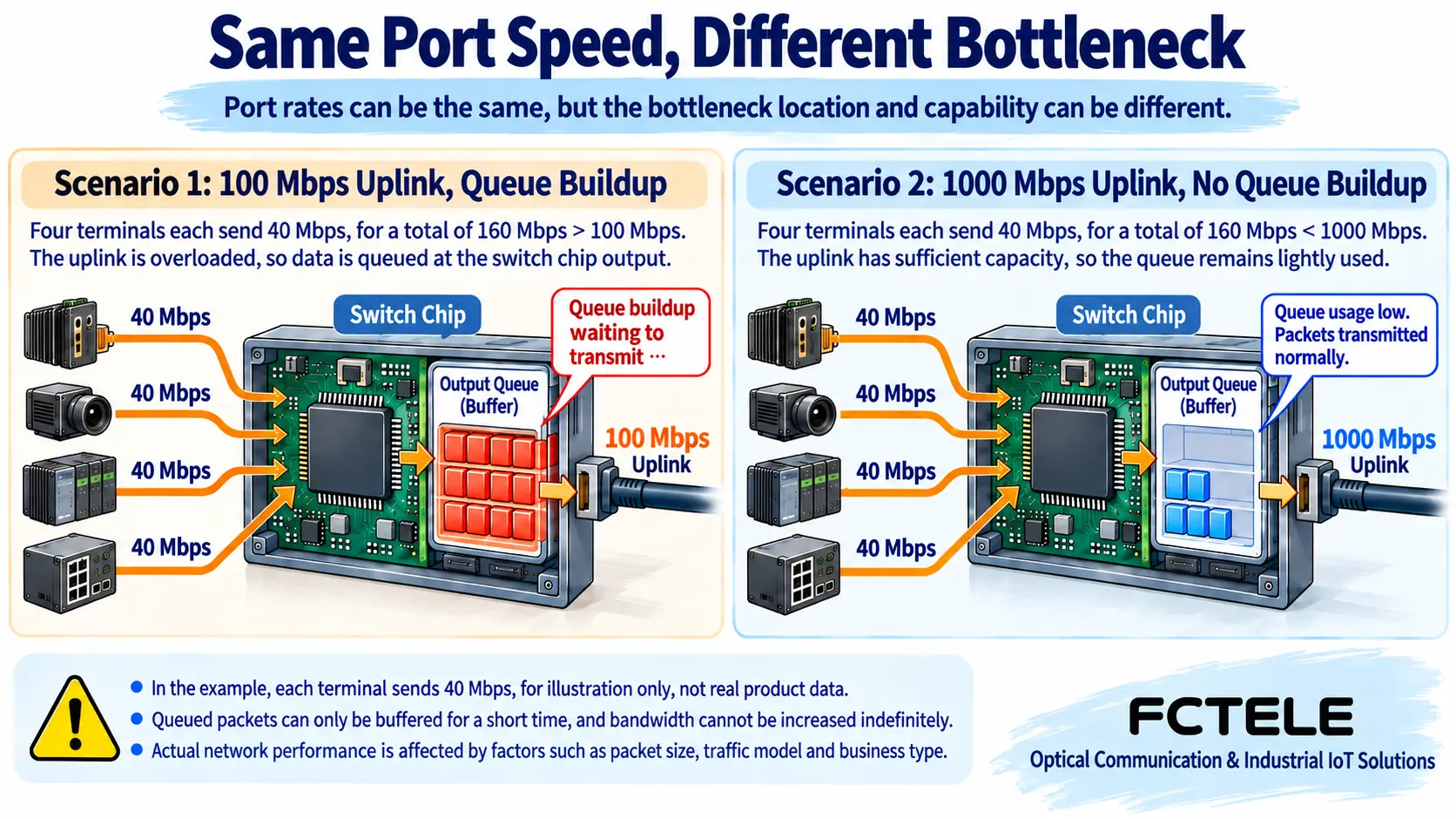
Conversely, if all terminals are only small amounts of status data and do not need high-speed file transfer, upgrading every port to a higher speed may not bring direct benefit. You should separately count the peaks at terminal access, aggregation uplink and server entrance. 100 Mbps, gigabit and higher speeds are link capabilities, not a fixed file speed for a certain application. Finding the bottleneck first and then buying usually makes it easier to get an explainable budget than using the highest specification everywhere.
3. Management, redundancy and PoE are not the same kind of price increase
VLAN is used for logical partitioning, port statistics help discover anomalies, and mirroring lets analysis tools see selected traffic; the value of these functions lies in maintenance and control. Ring protocols handle redundant paths and reduce the impact of certain link failures, but they require configuration across the whole network and protocol compatibility; randomly adding one more cable does not count as redundancy. For a small network without maintenance staff, complex functions may also increase configuration risk, and quote comparison should take training and delivery configuration into account.
PoE involves supplying power to compatible terminals and requires a power supply controller and corresponding power capacity. When comparing PoE models, you must write per-port capability, whole-device budget, power supply standard and power configuration under the same basis. An ordinary data switch and a model that can simultaneously power multiple APs cannot be compared only by the same number of RJ45 ports. Dual power inputs also do not automatically mean two independent power sources are included; on-site power supply and switching tests still need to be carried out.
4. Environmental capability needs evidence, not adjectives
Industrial environments may bring temperature changes, vibration, power disturbances and electromagnetic interference. Power protection, component selection, heat dissipation paths, connection firmness and whole-device validation all affect the solution. Ask the supplier to provide the operating conditions, installation limits and test materials for the corresponding model, and confirm that they cover this delivery configuration. Do not write all industrial switches as waterproof, absolutely packet-loss-free, or necessarily longer-lived than commercial equipment; these statements cannot replace project validation.
An IP rating describes the specific protection conditions of the enclosure against solid foreign objects or water; it does not equal an EMC rating, surge capability or network performance. A metal enclosure can participate in heat dissipation and shielding design, but having a metal shell does not directly lead to test results. Wide-temperature specifications should also be checked together with full load, installation direction and power conditions. A mild indoor environment does not necessarily need every environmental option purchased; a harsh site should not omit necessary protection just to save money.
5. Write the inquiry as questions that can be answered item by item
A valid inquiry should at least state: terminal types and quantities, speed of each port, fiber type and distance, management functions, PoE load, power conditions, installation method, environmental range and future expansion. It should also require the complete ordering identifier, hardware and software versions, accessory list, delivery time, warranty and support scope. Only by inquiring with the same requirement document can you see whether the difference comes from configuration or delivery service.
For price figures, confirm whether tax, transport, power supply, optical modules, wiring terminals, DIN-rail accessories and commissioning are included. Quote validity period, order quantity and payment terms should also be consistent. When encountering a “starting price”, first ask what configuration it corresponds to; you cannot treat the lowest configuration price of a series as the price of all models. This article does not provide unverified market ranges; actual prices are subject to a valid quote given by the supplier for a clear configuration, and numbers in historical articles are not continued as current market conditions.
6. Besides the purchase price, what other costs are there
Installation costs include wiring, fixing inside the cabinet, heat dissipation and power arrangement; commissioning costs include configuration, testing and documentation. During operation there are also electricity, spare parts, firmware maintenance and personnel time. Downtime loss is related to the production process and cannot be represented by one universal number for all factories. For critical points, suitable spare equipment, recoverable configuration and clear replacement steps are often more important than only pursuing the lowest bare-unit price.
You can set the same service life and compare “equipment and accessory purchase + installation and commissioning + operation and maintenance + expected replacement”. List certain costs and uncertain risks separately, and do not treat forecasts as guarantees. Power consumption should be estimated according to actual load and power supply method; the electrical energy that PoE provides to terminals must not be mistakenly counted as the switch chip’s own consumption. If the same function is achieved with different numbers of devices, you should also compare cabinet space, number of wiring connections and added failure points.
7. Use a specific product to explain “functions must be usable”
Feichang Technology’s Switch series with eight Gigabit Ethernet ports, four Gigabit optical ports, and optional serial or digital I/O interfaces, combines Ethernet access with some device data interfaces. When these services are needed, this integration has the opportunity to reduce separate gateways and connections; when they are not needed, you should not force a purchase just for “many functions”. Configuration and accessories are subject to clear ordering conditions, and you cannot assume all options are included by default.
For different port structures and management capabilities, you can first filter in Feichang DIN-rail industrial switch category, then confirm the model with on-site conditions. The product information here is used to explain the selection object and does not constitute a price, certification or performance guarantee. General price comparison methods also cannot replace the final technical agreement and acceptance standards.
8. Let the quote and acceptance form a closed loop
Commitments in the contract should correspond to checkable items: interface and accessory count, negotiated speed, typical concurrent services, PoE load, management policy, link recovery within the authorized scope and configuration backup. Tests should record load, time, topology and version; you cannot use only a lit port light as proof of “stability”. If it fails, first distinguish line, power, configuration and device causes, then negotiate how to handle it.
The final judgment is not “the more expensive the better” or “the cheaper the more cost-effective”, but whether this quote satisfies the same requirement, leaves reasonable margin, and is easy to maintain. Only by explaining hardware, installation, validation and service clearly is there a basis for discussing price. For fiber accessories and power budget, see separately industrial optical fiber switch quote, and for low-traffic scenarios you can refer to 100 Mbps product cost-effectiveness analysis.
Document note: This article summarizes port, environment, management and cost issues from old articles on the same topic, and corrects absolute performance and old price list statements. Product information links to the corresponding official pages; the two principle diagrams are general illustrations and do not represent measured tests, actual quotes or certifications.
Translated from the Chinese technical article. Source first published: 2023-09-20. Source last revised: 2026-10-13T17:34:48+08:00. Read the Chinese source
