


An ordinary serial fiber modem cannot complete industrial internet access by itself. It can extend a serial link, but it usually does not assign IP addresses, publish data to a platform, or provide VPN. When old instruments need to connect to a network, you should distinguish physical remote transmission, network encapsulation, and application protocol conversion, then decide whether to add a serial server or an industrial gateway.
Fiber is a medium, the internet is a communication system
Even when fiber is used in all cases, a serial fiber modem, an Ethernet transceiver, and a PON broadband terminal handle different services. A serial fiber modem restores the corresponding serial signal at both ends; an optical port connection does not mean it has obtained an internet identity. If a device only has a serial port and a dedicated paired optical port, you cannot infer from the word “modem” in its name that it has routing, switching, or broadband dial-up capabilities.
You can understand the layers as three tasks: first send the signal from the site to a suitable location, then put the data into network communication, and finally let the application know what the measured value represents. This layered analogy helps explain the tasks; it does not mean an actual product must have three separate boxes. Some composite devices integrate multiple functions, but this should be proven by the documentation for that model.
Transparent transmission preserves messages without understanding their business meaning
The corresponding electrical interface of the serial fiber modem receives the signal, forwards it internally to the optical link, and the remote end restores the interface. It does not know that the unit is degrees Celsius, which station the address is, or what a register represents just because it transmitted temperature instrument data. The terminals at both ends still need to use compatible protocols, parameters, and interaction timing. Transparent transmission cannot make incompatible devices understand each other.
Some products can provide multiple serial channels, but channel aggregation does not equal intelligent protocol parsing. Asynchronous serial capability also cannot be generalized to support all fieldbuses. For tasks such as specific synchronous, cyclic, or strictly timed operations, you should choose the corresponding device and test it. The original writing that directly attributes multiple protocols and management functions to an ordinary serial fiber modem should no longer be used.
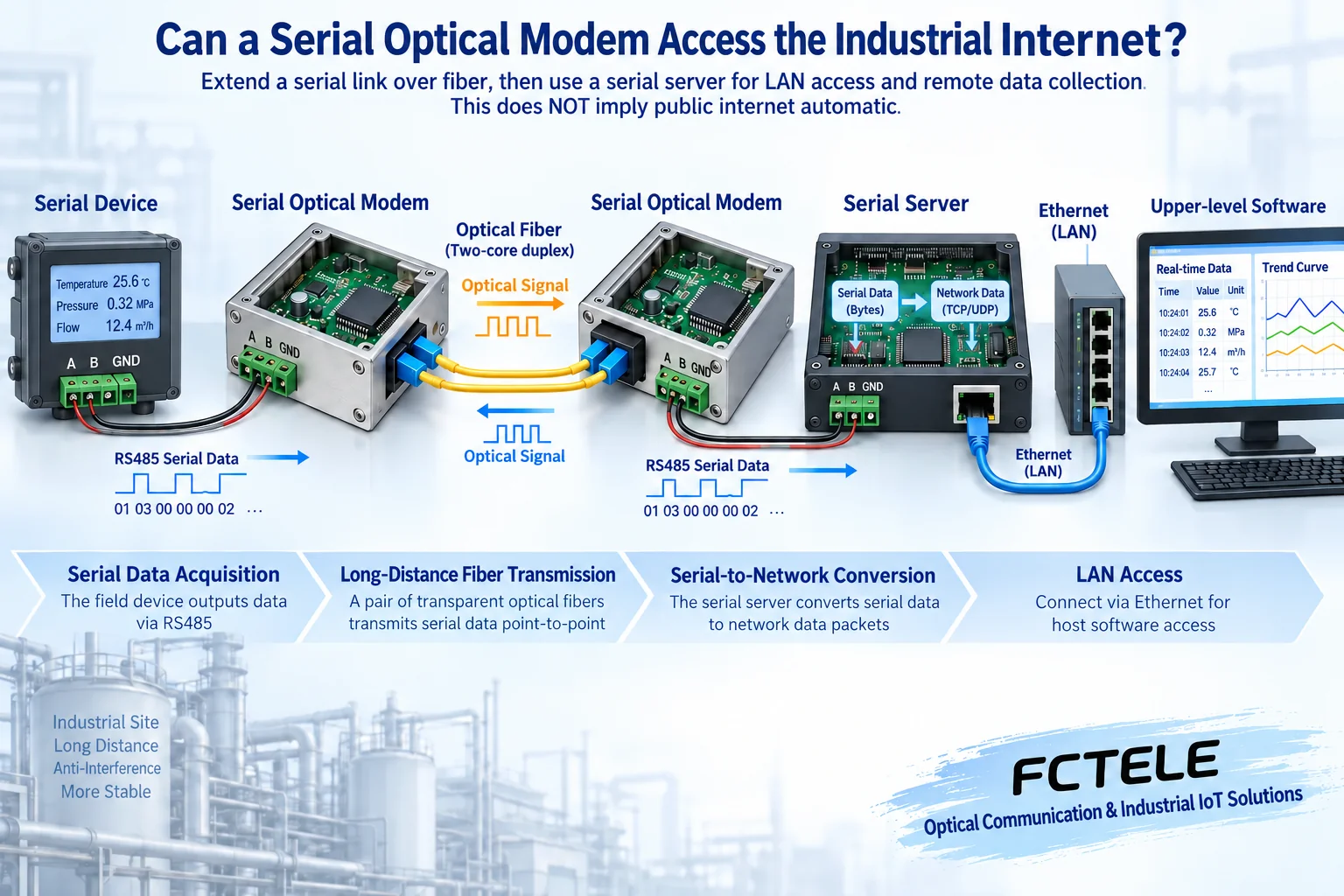
Serial servers add network encapsulation
A serial server connects to a serial port on one side and provides Ethernet communication on the other, placing serial bytes into some kind of network connection. Host software may use a virtual serial port or connect directly to a socket, depending on the product and software. This step adds IP addresses, ports, connection direction, and buffering settings; it is no longer just replacing a copper cable with fiber.
Network communication can affect waiting time and message grouping. If an application originally relied on serial intervals to determine the end of a message, you need to check the device’s packing conditions and receiving method. TCP data flow also cannot simply be assumed to mean that one send necessarily corresponds to one receive. Whether a serial server recognizes a certain application protocol depends on the function description; it cannot be inferred from the existence of an Ethernet port.
Industrial gateways may process data meaning
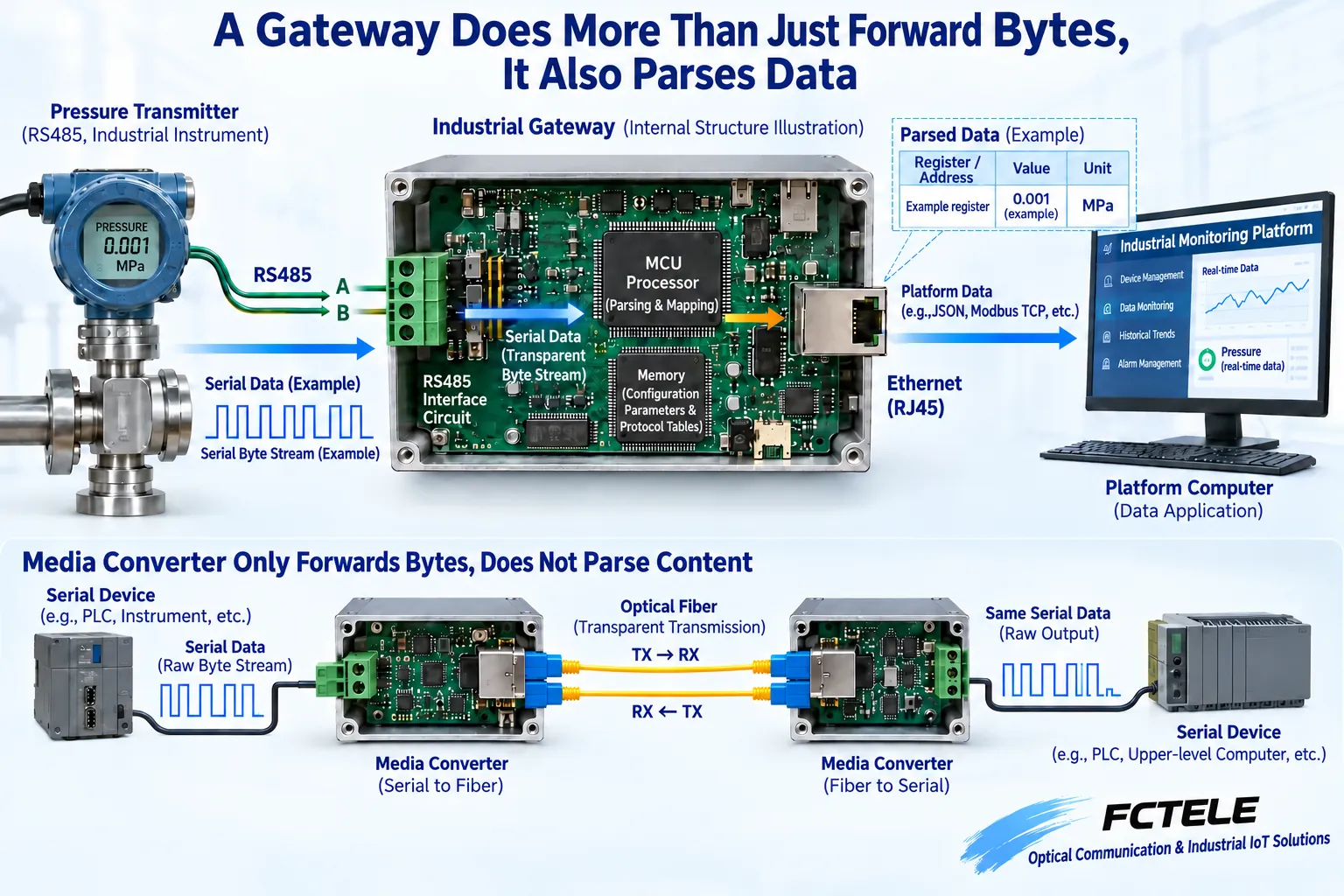
When a platform needs a certain network protocol and the instrument uses another application protocol, a gateway may be needed to parse addresses and data, then express them in the target format. Configuration usually involves registers, data types, byte order, scaling, and acquisition cycle. A gateway is not an arbitrary plug changer; it establishes a clear mapping between two business representations.
For example, if the field returns a value and the host platform needs to display pressure, you also need to know the data unit and conversion relationship. Even if communication has no errors, incorrect mapping will produce incorrect display. You cannot conclude that the measurement is correct just because the result changes; check it against instrument documentation and known test values. Analog acquisition, serial transparent transmission, and protocol conversion are different functions.
Determine device boundaries according to the customer’s task
If the goal is only to let the original software in the control room read a distant serial instrument, paired fiber modems may be enough to complete the middle-section extension. If the goal is to access the serial port from a local area network, check a serial server. If the goal is to publish old instrument data to a certain platform, check the gateway and platform interface. Do not use the phrase “industrial internet” to combine these customer problems into one unconstrained solution.
The fiber link can be placed before the server, or the Ethernet side of the server can use optical transmission, but the two topologies require different devices. Before choosing, record the site electrical interface, actual protocol, host software method, and network boundary. A network switch cannot directly parse a bare serial port, and an ordinary serial fiber modem cannot be directly plugged into the optical port of a switch.
After networking, access control must be added
Connecting a device to a network means adding access paths. Management accounts, allowed connecting hosts, network segmentation, updates, and logs should be designed according to system requirements. You cannot treat the non-conductive nature of fiber as a network security guarantee, nor treat a serial address as identity authentication. Whether functions such as VPN are provided by the gateway or the upper-layer network must be clarified, rather than assuming the fiber modem has them by default.
Between the formal control network and external platforms, an approved access solution should be used. Do not temporarily expose the control side to the public network for debugging. First verify read permissions and abnormal operations in a test environment, then go online according to approval. This article explains device responsibilities; it does not provide connection methods that bypass network management, nor does it claim that a certain type of device is naturally immune to eavesdropping or attack.
How to use Feichang Technology product information for verification
The Feichang Technology official website lists serial fiber modems, serial servers, and industrial gateways as different categories. When selecting, you should look them up according to the corresponding task. The data interface item of the FCP-D1 is RS485, so it can be a candidate for remote asynchronous serial transmission. It should not be described as a general internet terminal with IP, VPN, or cloud platform protocols. Multi-function requirements need another model with clear functional evidence.
The product page mentions automatic direction control and polling capability, which are clues about physical and interaction configuration; they do not prove that it understands all instrument application messages. Especially when both data remote transmission and platform access are required, you should separately ask about the supported content at the transmission end and the gateway end, and confirm the delivered configuration, firmware, and interfaces. Do not use third-party chip capabilities to replace proof for Feichang Technology products.
Acceptance is not just checking that the platform is connected
First verify local serial communication, then verify fiber extension, then verify network connection and platform mapping. Keep raw data, timestamps, and error records at each layer. Suppose you read an instrument value that can be checked; you should compare the source end, serial message, and platform display, and confirm units and order. Do not use the presence of a number on the page as the basis for completion.
Then check disconnection, reconnection, duplicate messages, timeouts, and approved security restrictions. You cannot use unlimited retries to hide communication abnormalities, and you must not write untested remote upgrade or management capabilities into delivery conclusions. Assign each function to the responsible device so the customer knows whether to check the fiber link, serial parameters, server settings, or platform mapping when an error occurs.
Reference basis:TI RS485 Design Guide;Feichang Technology FCP-D1 Serial Fiber Modem Product Information. The images are general principle illustrations; configuration and testing are subject to the actual delivery manual.
Translated from the Chinese technical article. Source first published: 2023-11-22. Source last revised: 2026-10-13T13:52:20+08:00. Read the Chinese source
