


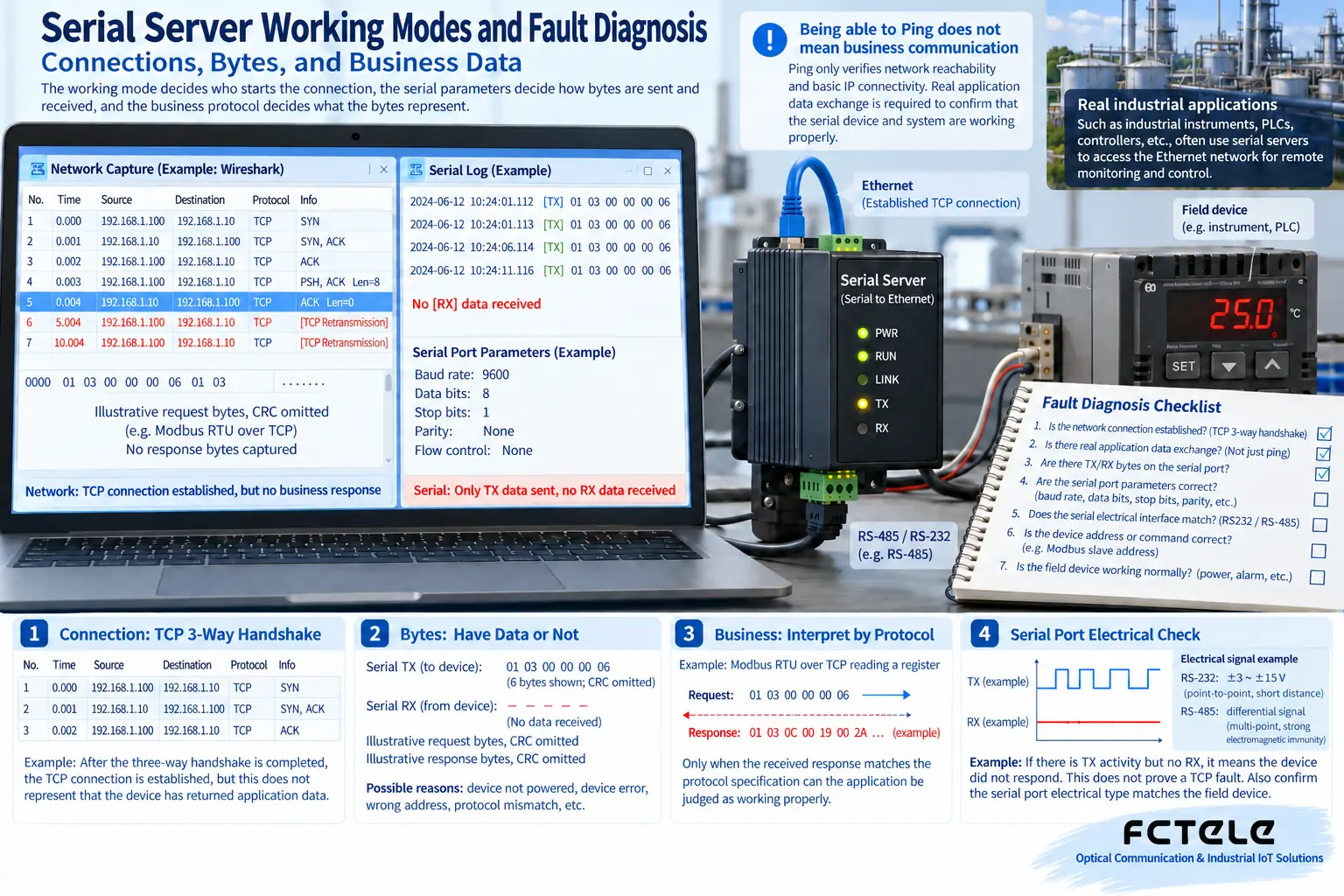
The working mode of a serial server decides who starts the network connection, the serial parameters decide how bytes are sent and received, and the business protocol decides what the bytes represent. Troubleshooting must separate these three layers: being able to Ping does not mean a TCP connection is established, a TCP connection being established does not mean the serial port responds, and receiving bytes does not mean the business data is correct.
How listening and active connection differ
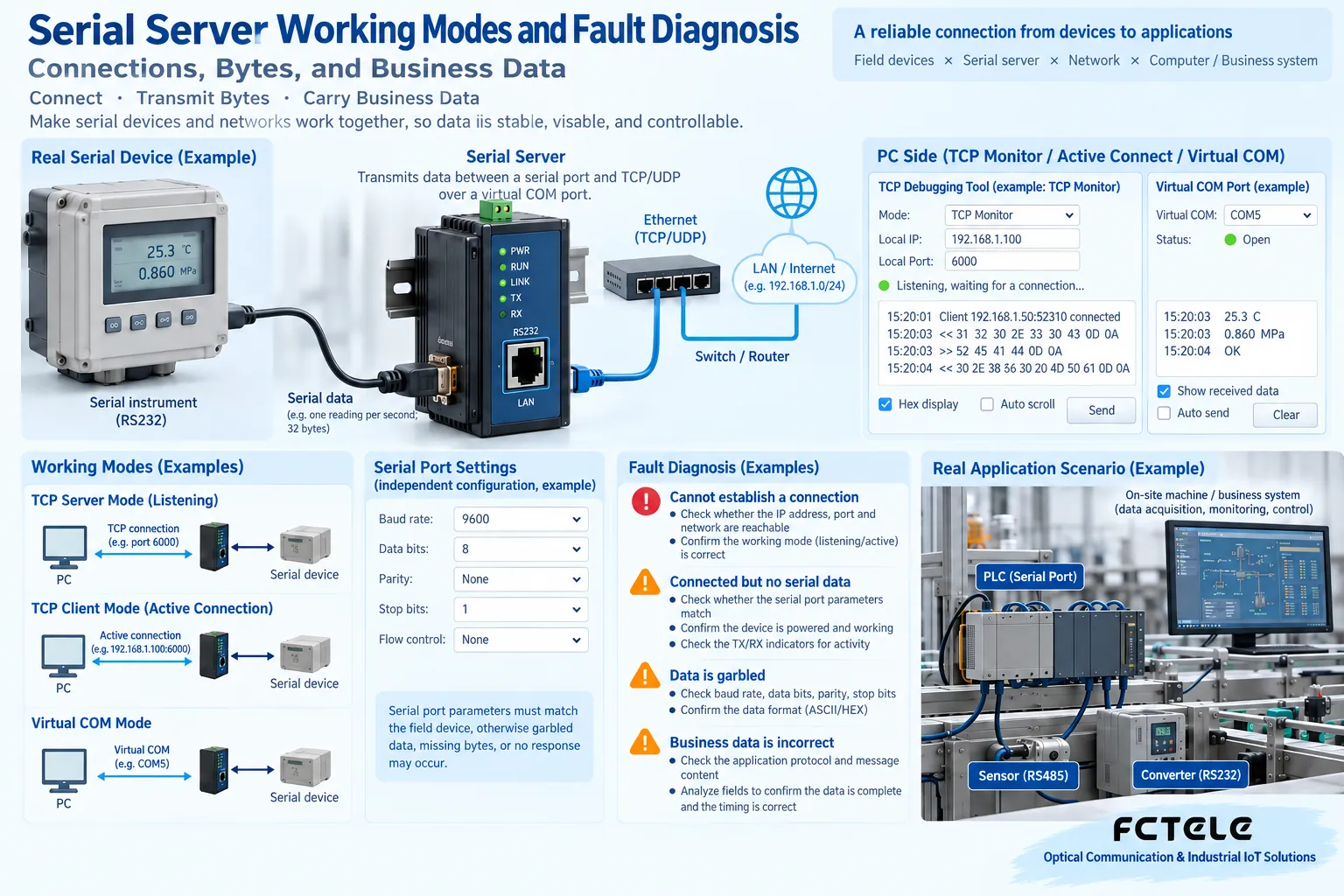
In TCP server mode, the device waits for a computer to connect to a specified port; in TCP client mode, it actively connects to a remote host. The mode choice should correspond to the role of the host computer program. If both ends wait, or both connect to the wrong target, the network may be reachable but there is no data channel.
A virtual serial port lets an old program continue to access a COM port, with a driver mapping it to the remote server; a Socket program directly uses a network connection. Whether control lines, concurrent connections, or disconnection buffering are supported must be checked against the model and software; do not infer all capabilities from one mode name.
First confirm the serial port actually connected
RS-232 usually requires checking TX, RX, and the reference terminal; RS-485 requires checking the differential signals and bus structure; RS-422 may have independent differential pairs for transmit and receive. The number of connector pins or the letters A/B must not be treated as a unified wiring standard; the device terminal definitions take priority.
The serial baud rate, data bits, parity, and stop bits should match, and the business station number and address also need to be correct. Transparent transmission only moves bytes; it does not turn any serial protocol into Modbus TCP. When protocol conversion is needed, confirm that the device explicitly supports the corresponding gateway function.
How to check when there is no connection at all
Confirm whether the power, Ethernet port, and IP are correct, and check the subnet, gateway, target port, and listening role. Ping may be restricted by policy, so observe an actual connection test at the same time. Do not judge that the device is broken just because Ping gets no response, and do not treat a successful Ping as proof that the port is open.
Check whether another program already has an exclusive connection, or whether a firewall or network policy is blocking it. Use an isolated test network and a known-good client to reduce variables, then add it to the live network after normal operation is restored; do not keep public network management open long-term just for convenience.
Already connected, but the device does not respond
Confirm whether the request actually reaches the serial output, then check the electrical wiring, parameters, station number, and command. Seeing only the network send counter increase does not prove that the device received a valid command. When necessary, test with a known-good short cable and a single device to avoid interference from other variables on a large bus.
If the response is only half received, check buffer packaging, serial idle time, and application timeout. TCP is a byte stream, so one network read may not yield one complete business frame; the application should assemble frames according to protocol boundaries. Do not mask parsing errors by adding arbitrary delays.
Incorrect values or occasional data loss
When there is a response but the values are wrong, check the address offset, type, multiplier, and byte order, and save the raw messages. For periodic timeouts, observe the polling frequency, serial port occupancy, and network latency, and avoid multiple control programs requesting the half-duplex bus at the same time without coordination.
After a disconnection, reconnection needs a defined way to handle unfinished commands. Control services especially must avoid repeated actions caused by buffered retransmission. Performance judgment should include continuous operation and fault recovery, not just compare the response speed of one request.
How to deliver a maintainable configuration
Save the channel-to-device mapping, serial parameters, IP port, mode, and host computer version, and keep examples of normal requests and responses. Through Feichang Technology Product Center confirm the actual connection and protocol capabilities, back up before changes, and retest according to the original business load after repair.
Do not use “serial server failure” as a general term for all abnormalities. Record which layer the fault occurred at and what evidence supports the judgment, so maintenance work can move from repeated restarts to repeatable localization and reduce interference with production equipment.
The illustrations are schematic diagrams of scientific principles and application scenarios; the interfaces, structures, and measurement values shown do not represent specific product parameters. Actual specifications must be based on model documentation and on-site measurements.
Translated from the Chinese technical article. Source first published: 2019-11-26. Source last revised: 2026-10-13T20:37:04+08:00. Read the Chinese source
