
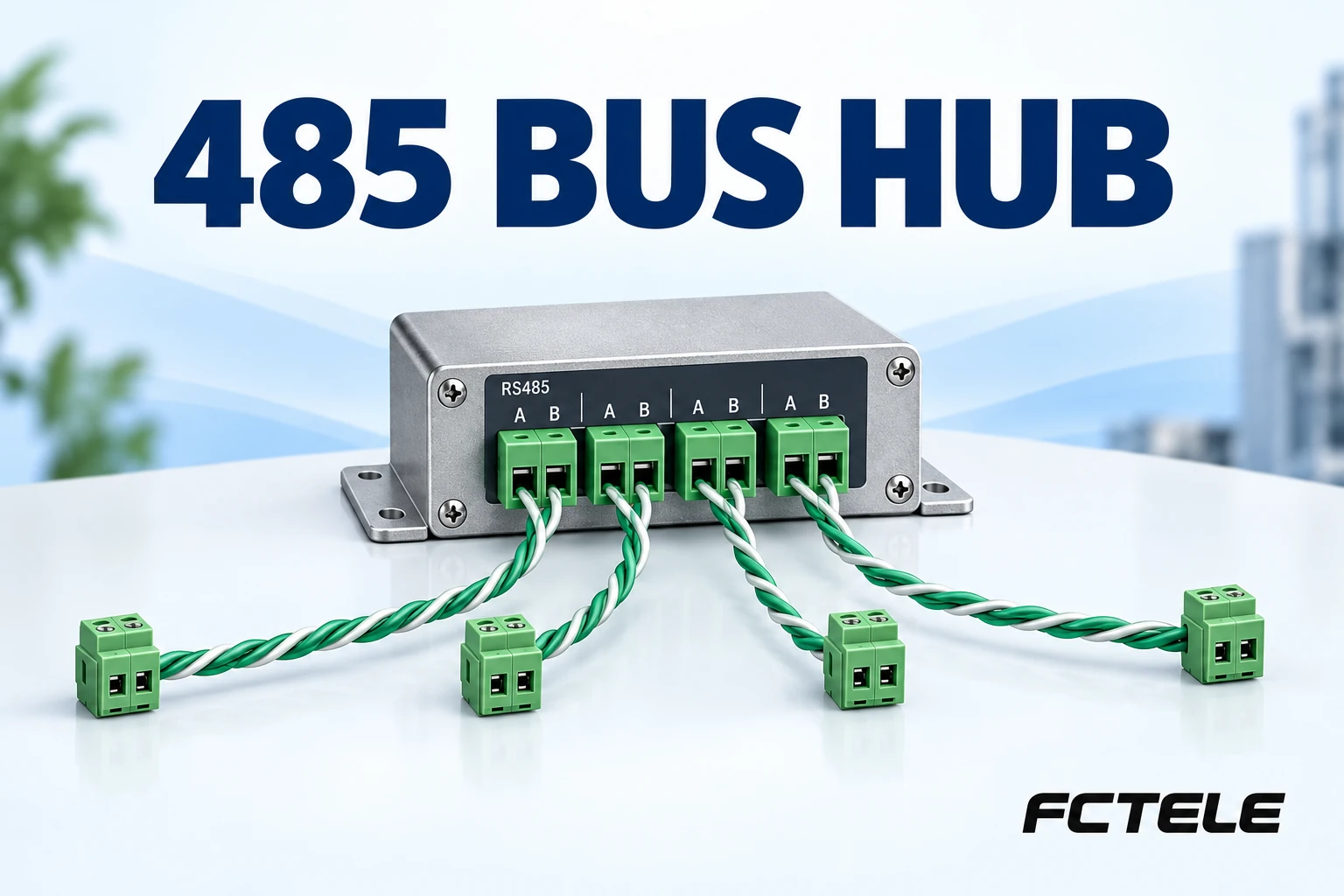
Segment wiring
How RS485 Hubs Work: Segmentation, Termination and Polling
Check termination and polling when adding a repeater or hub to an RS-485 network.

Port 0 is the uplink. Ports 1–24 are active RS-485 branches.
The power terminals run left to right: V2−, V2+, V1−, V1+. DIP-1 controls digital filtering. DIP-2 to DIP-4 are reserved.
Use the 35 mm DIN clip or wall-mount holes with the appropriate mounting accessories.
| Interface | Markings | Connection |
|---|---|---|
| Uplink Port 0 | Three-pin terminal | D1 RS-485: 1=A, 2=B, 3=GND. R1 RS-232: RXD, TXD and GND. Follow the delivered wiring order for the R1 model. |
| Branches 1–24 | 1=A (TX+), 2=B (TX−), 3=GND | Connect the twisted pair to A/B. Keep the shield/reference ground independent for each branch. |
| Dual DC input | V2−, V2+, V1−, V1+ | Left to right, PWR2 then PWR1. Apply 9–70 V DC with correct polarity. |
| Switch | Position | Result |
|---|---|---|
| DIP-1 | OFF (default) | Digital filtering off. Maximum 200 kbps. |
| DIP-1 | ON | Digital filtering enabled. Up to 38,400 bps. |
| DIP-2 to DIP-4 | Reserved | Leave in the delivered position. |
164 × 132 × 50 mm (L × W × H), approximately 1.152 kg. Rail or wall mounting.
| Item | Specification |
|---|---|
| Uplink standards | RS-485 on FCC-1600-D1D24, EIA/TIA-485. RS-232 on FCC-1600-R1D24, EIA/TIA-232 (ITU-T V.28). |
| Branches and forwarding | 24 independently isolated RS-485 channels. Transparent protocol-independent forwarding, automatic transmit enable and per-channel transmit indicators. |
| Rate and loading | Up to 200 kbps with filtering disabled. Higher rates require factory confirmation. Each channel supports at least 32 standard nodes or up to 128 enhanced nodes. |
| Filtering | Common-mode inductor and differential filtering, plus selectable FPGA digital filtering. Up to 38,400 bps with digital filtering enabled. |
| Item | Rating | Conditions |
|---|---|---|
| RS-485 branches | 6 kV surge per channel | Independent protection against induced and switching transients. |
| RS-232 uplink and DC input | 6 kV surge | Applies to the RS-232 uplink configuration and the supply input. |
| Signal and ground isolation | 2.5 kV | Optical signal isolation and separate branch shield/reference grounds. Power ground is isolated from all 24 RS-485 branches. |
| AC misconnection test | 220 / 380 V AC | Fault isolation can protect devices across the barrier. The misconnected port may be damaged. |
| Item | Specification |
|---|---|
| Power | Dual redundant 9–70 V DC, isolated, <10 W. Overload and reverse-polarity protection. Four-pin 5.08 mm pluggable block. |
| Mounting and enclosure | Fanless IP40 anodized aluminum, DIN rail or wall. 164 × 132 × 50 mm, approximately 1.152 kg. |
| Environment | Operating and storage −40 to +85 °C. Operating humidity 0–95% RH, non-condensing. |
| Reliability | MTBF >100,000 hours, 100% burn-in tested and industrial Level 4 EMC per datasheet. |
The D1 example connects the PLC to Port 0 and one instrument to each active branch. Use A/B for each twisted pair and the corresponding isolated GND.
Both versions include 24 RS-485 branches. Specify the baud rate and mounting accessories when ordering. Higher-speed versions require factory confirmation.
| Ordering Model | Configuration |
|---|---|
| FCC-1600-D1D24 | RS-485 uplink, 24 isolated RS-485 branches |
| FCC-1600-R1D24 | RS-232 uplink, 24 isolated RS-485 branches |
Ports 1 through 24 are isolated RS-485 branches. Port 0 is the host uplink.
Pin 1 is A (TX+), Pin 2 is B (TX−) and Pin 3 is the branch GND. Keep branch reference grounds separate.
D1D24 uses RS-485 at Port 0. R1D24 uses RS-232 at Port 0. Both have 24 RS-485 branches.
DIP-1 OFF allows up to 200 kbps. DIP-1 ON enables digital filtering and allows up to 38,400 bps.
Use redundant 9–70 V DC on the marked PWR2 and PWR1 inputs. The enclosure supports rail or wall mounting.
Check termination and polling when adding a repeater or hub to an RS-485 network.
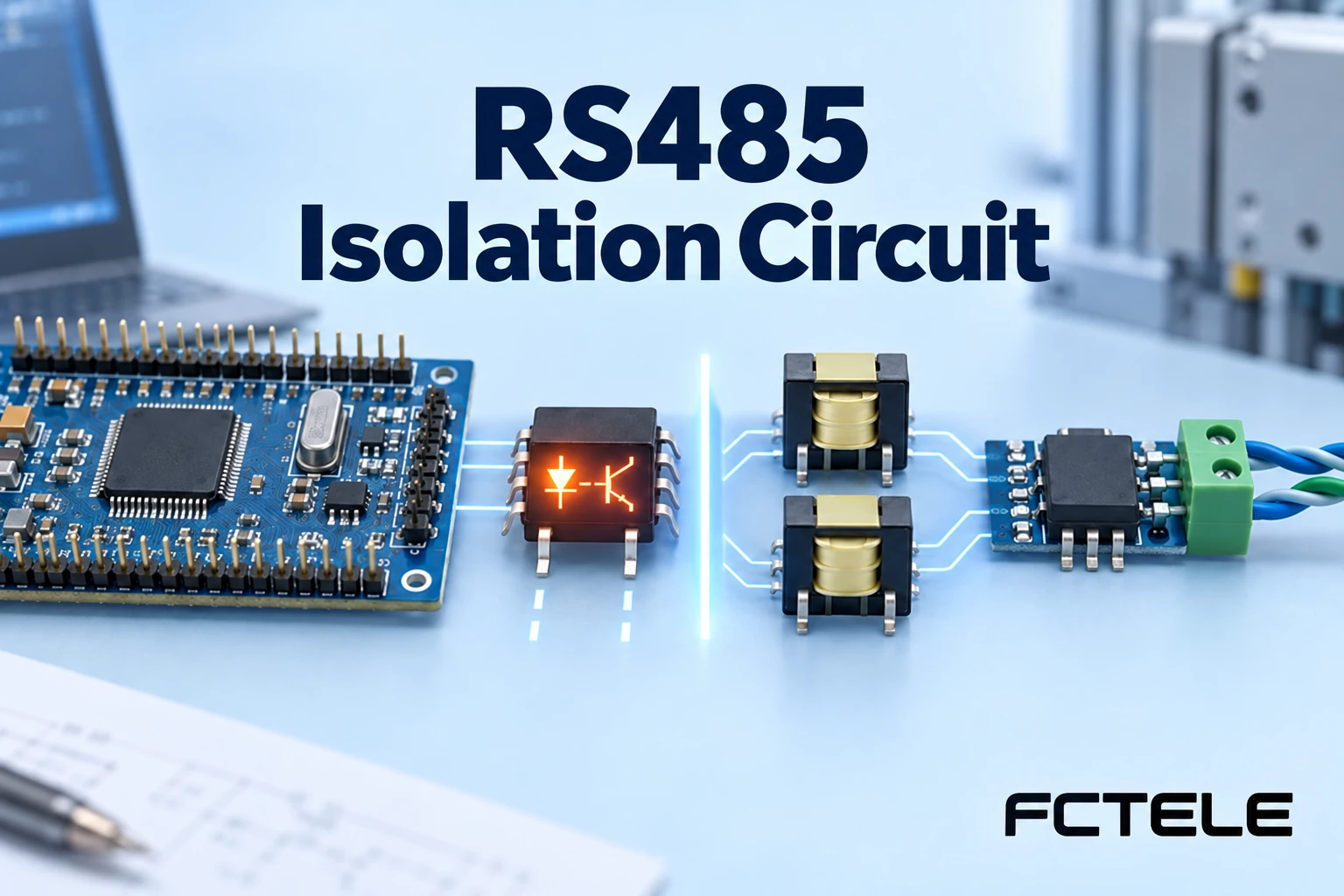
Understand isolated power, signal barriers and port protection.
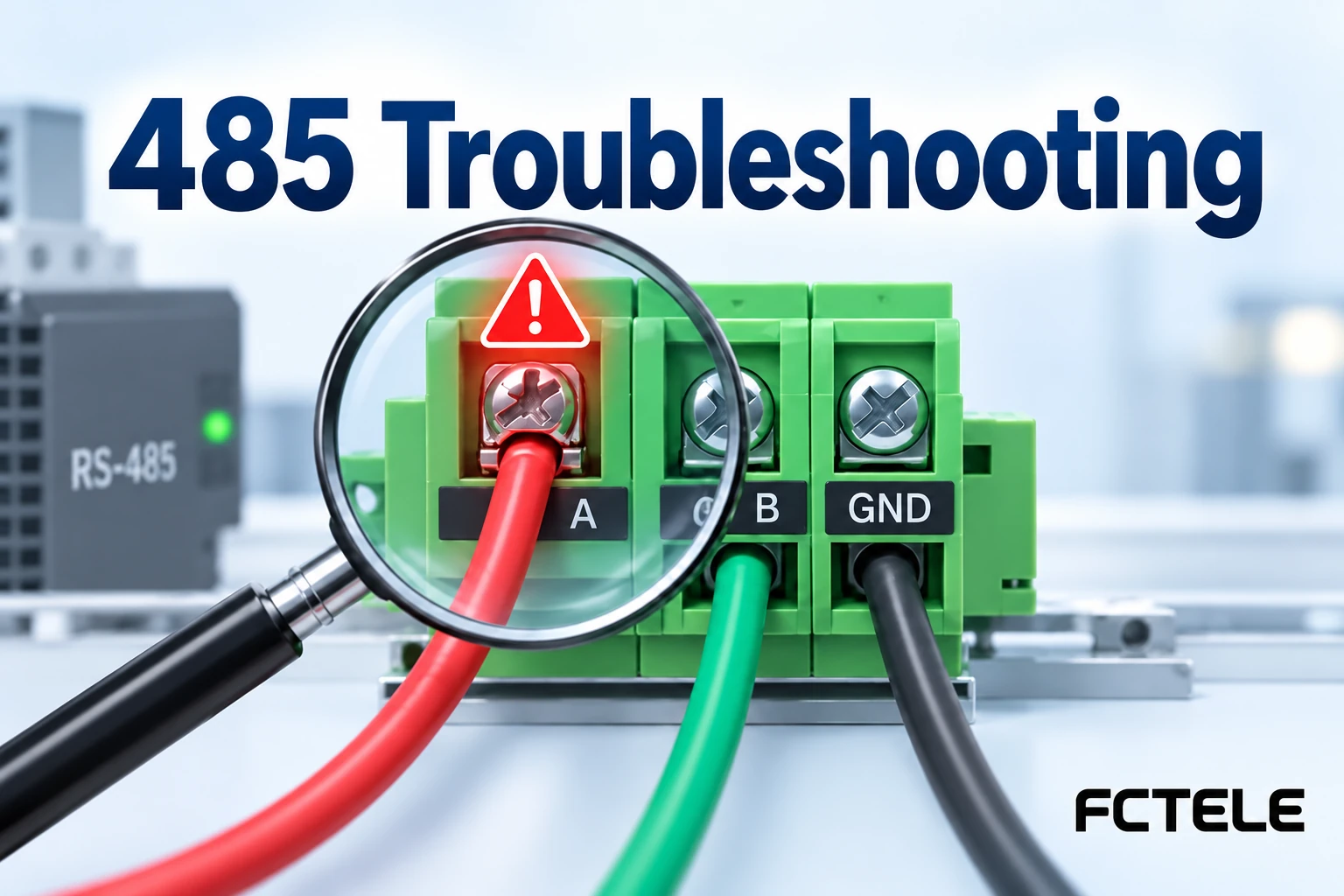
Trace power, differential signals and frame errors one segment at a time.
Tell us your application, quantity and preferred configuration.
