


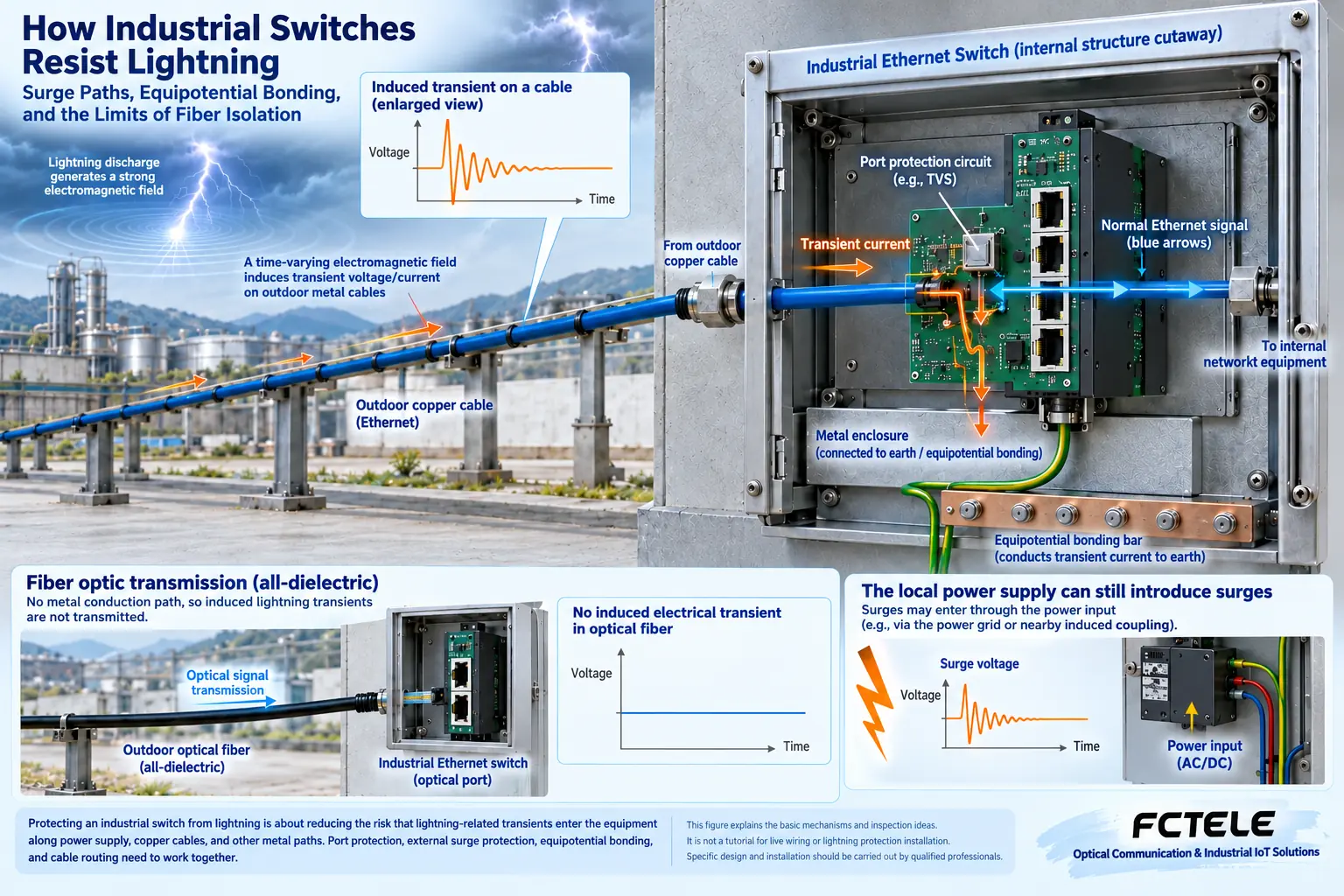
Protecting an industrial switch from lightning is not about putting a “lightning protection” label on the enclosure. It is about reducing the risk that lightning-related transients enter the equipment along power supply, copper cables, and other metal paths. Port protection, external surge protection, equipotential bonding, and cable routing need to work together. This article explains the basic mechanisms and inspection ideas. It does not provide a tutorial for live wiring or lightning protection installation; specific design and installation should be done by qualified professionals.
Why an Ethernet port can be damaged even without a direct lightning strike
A lightning process produces rapidly changing currents and electromagnetic fields. Nearby metal lines can develop transient voltages through electromagnetic coupling, and ground potentials at different locations can differ for a short time. Therefore, damage does not necessarily come from lightning striking the switch directly. Long outdoor copper cables, power supplies, and connected equipment can all become paths of influence.
You can think of the switch as a node connected to several external roads at the same time. An external abnormality does not enter through only one road, and protection cannot guard only one entrance. Here, “surge” means a short-duration voltage or current disturbance. It is not the same as long-term overvoltage, network congestion, or software failure. A network outage after a thunderstorm is only a clue for troubleshooting. You should still check ports, power supply, logs, and site records together. Do not first assume that all problems are caused by lightning.
Why port withstand capability is not a guarantee of immunity on site
Product documents may list electrostatic, fast transient, or surge test capabilities. They use different test methods, waveforms, and coupling conditions. They are not several names for the same capability. Only when the corresponding port, test standard, level, and acceptance criteria are stated can the numbers be compared easily. You cannot directly treat a test value for a power port as the capability of all Ethernet ports, and you certainly cannot understand it as being able to withstand any direct lightning strike.
The actual impact on site is also related to cable length, installation location, grounding relationships, and connections between devices. Even if two switches have the same test marking, different installation conditions can lead to different results. Product protection is one part of system protection. It cannot replace building lightning protection or complete engineering design. The point of using an industrial switch is to choose equipment suitable for the conditions, not to cancel external protection measures.
Why equipotential bonding is more important than “each grounding separately”
Whether equipment is damaged often depends on how large the transient potential difference is between its different ports, enclosure, and connected devices. If each part is connected to an uncoordinated reference point, these points may not stay at similar potentials during a strong disturbance, and current may find a path through communication lines and internal circuits. Simply adding more ground electrodes does not automatically prove safety.
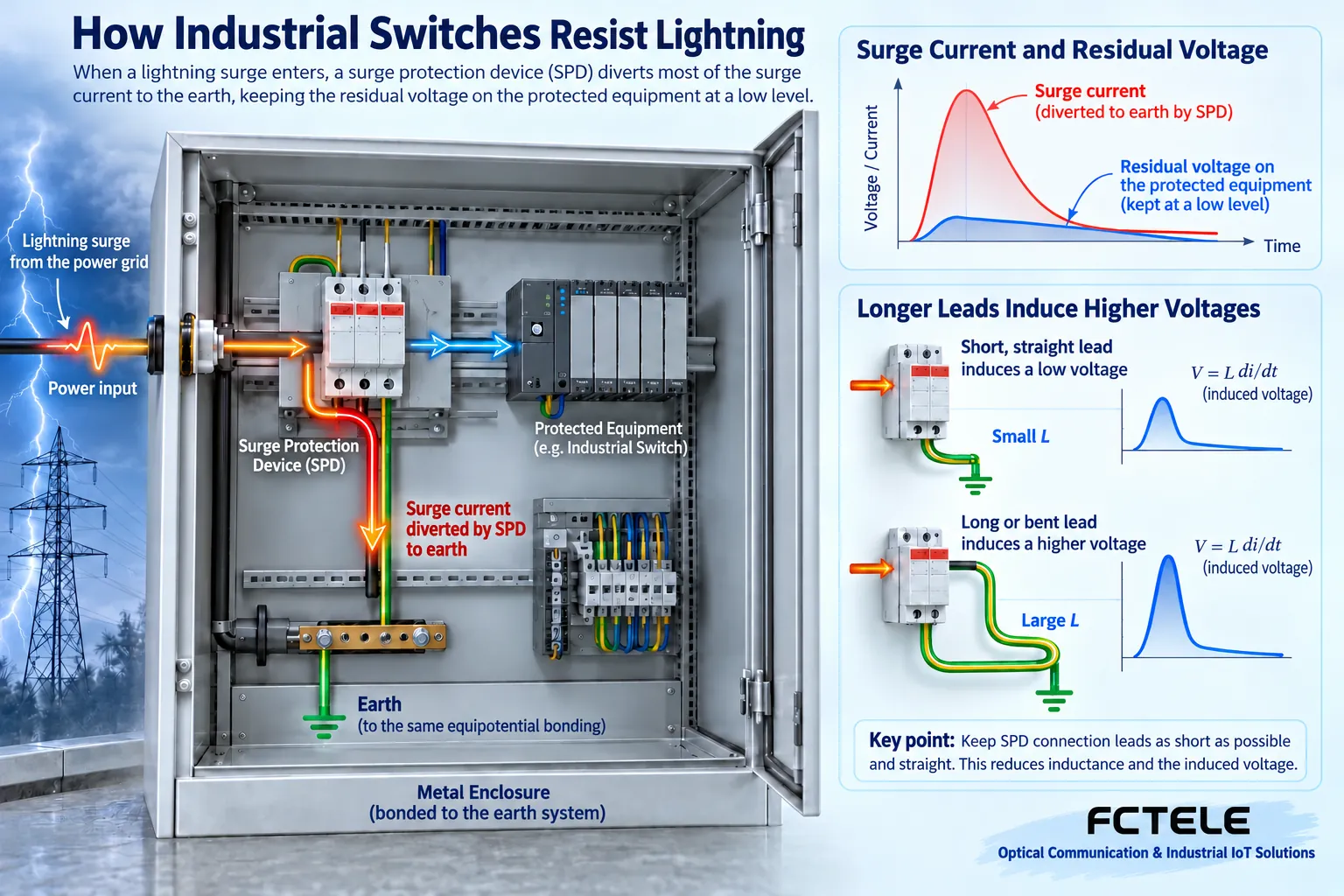
The goal of equipotential bonding is to bring conductive parts that should be connected into a coordinated reference system according to professional design, reducing dangerous differences. It has specific requirements with protective grounding, shield connection, and building lightning protection. You cannot mix connections arbitrarily based on online articles. A seemingly very short wire inside a cabinet can still produce extra voltage under rapidly changing current, so the connection path and layout are equally important.
How surge protective devices work, and what they cannot do
A surge protective device is often abbreviated as SPD. Its basic function is to limit voltage when a disturbance meeting the design conditions occurs, and to provide a corresponding current diversion path. It does not eliminate lightning energy out of thin air, nor is it a fuse box that remains permanently effective once installed. Equipment after protection may still experience residual voltage, and connecting leads and system coordination also affect the result.
Selection needs to consider the protected object, continuous operating voltage, protection level, current-carrying capacity, and coordination between stages. It also needs to take into account the bandwidth and signal requirements of communication lines. A power SPD cannot be casually installed on a network interface. A wrong choice may affect normal communication or create new risks. If the status indicator is abnormal, maintenance conditions are reached, or a severe event has occurred, handle it according to the manufacturer and engineering maintenance requirements. It is not advisable to conclude that the SPD is fine just because “it can still connect to the network.”
Why fiber has advantages, and why it is not lightning protection for the whole system
All-dielectric fiber transmits information through light. Unlike copper communication lines, it does not provide a metal conductive path along the line. Changing suitable cross-area communication to fiber can reduce the electrical connection formed through that communication path. However, this does not mean the equipment has no other entrances: local power, grounding, other copper cables, and metal accessories still need to be evaluated.
You also need to distinguish all-dielectric optical cables from cables with metal armor or strength members. Even if the fiber core itself is not conductive, the metal parts in the cable may still involve grounding and protection design. You cannot ignore all metal paths just because you see “fiber.” If the site already has a fiber uplink but the switch is still damaged, continue checking the power supply and other ports, rather than concluding from this that fiber has no isolation effect.
How to use Feichang Technology product information for protection checks
Industrial switch models on the Feichang Technology website can provide corresponding installation, power supply, and protection information. For example, the 3325 product details page lists its industrial applications and related port protection descriptions. In a solution, you should further check the delivered model, applicable standards, and actual ports. You cannot extend the test numbers of one product into a unified promise for all Feichang Technology products.
When mixed optical and electrical access is needed, you can combine the optical and electrical port arrangements of the corresponding model to reduce unnecessary long-distance copper connections, and then check the local power supply and in-cabinet wiring. Such product features and engineering measures are complementary, not a replacement relationship. During procurement communication, it is best to list the line environment and test items that need confirmation as questions and request corresponding documents, rather than only asking “is it a lightning-protection switch?”
How to safely narrow down the problem after a thunderstorm
First, personnel with the proper qualifications should confirm on-site electrical safety. Ordinary users should not plug or unplug outdoor lines, open the enclosure, or measure exposed terminals during a thunderstorm or when electrical abnormalities are unknown. Under safe and approved maintenance conditions, record the fault time, power supply status, which ports failed, and which services are still normal. Keep logs and device status. Avoid resetting all configurations at the very beginning.
If only one port is abnormal, you can verify the port with a compliant and known-good local test device. If the whole device repeatedly restarts, consider the power supply and internal protection status. If multiple different devices are abnormal at the same time, pay attention to the common power supply and shared lines. Change one condition at a time and record the result. Only then can you distinguish line faults, equipment damage, and application-layer abnormalities. Do not cover up the problem by repeatedly power-cycling.
What evidence should be kept for acceptance and maintenance
Protection acceptance should include professional design documents, installation checks, the models of applicable equipment and protective devices, and the tests and maintenance requirements that should be performed. Normal service testing can demonstrate communication performance, but it cannot replace formal lightning or surge testing. Beginners should certainly not create pulses on site to “give it a try.” When type or system testing is needed, it should be carried out by a capable organization according to the corresponding specifications.
IEC 62305-4:2024 addresses surge protection measures for electrical and electronic systems inside buildings, including design, installation, inspection, maintenance, and testing. After understanding this system approach, lightning protection is no longer a set of grounding distances and current numbers separated from conditions. It becomes identifying entrances, controlling potential differences, coordinating protection, and continuous maintenance. Only by connecting these links is it possible for the switch to obtain well-founded protection in a real site.
Verification materials:Feichang Technology industrial switch 3325;IEC 62305-4:2024. The diagrams explain general mechanisms and are not wiring diagrams for a specific model.
Translated from the Chinese technical article. Source first published: 2019-09-27. Source last revised: 2026-10-13T19:01:44+08:00. Read the Chinese source
