


An industrial optical module is not just a regular module with a new name, and you cannot buy one by only looking at the words “wide temperature.” Selection must check host support, optical path pairing, installation temperature, and reliability evidence together. A temperature range statement explains how the module is allowed to be used under specific conditions; it does not directly prove vibration resistance, interference resistance, or compatibility with all switches. This article starts with how heat in a cabinet reaches the module and explains the conditions that need to be confirmed in industrial sites.
1. Module operating temperature is not the same as outdoor weather temperature
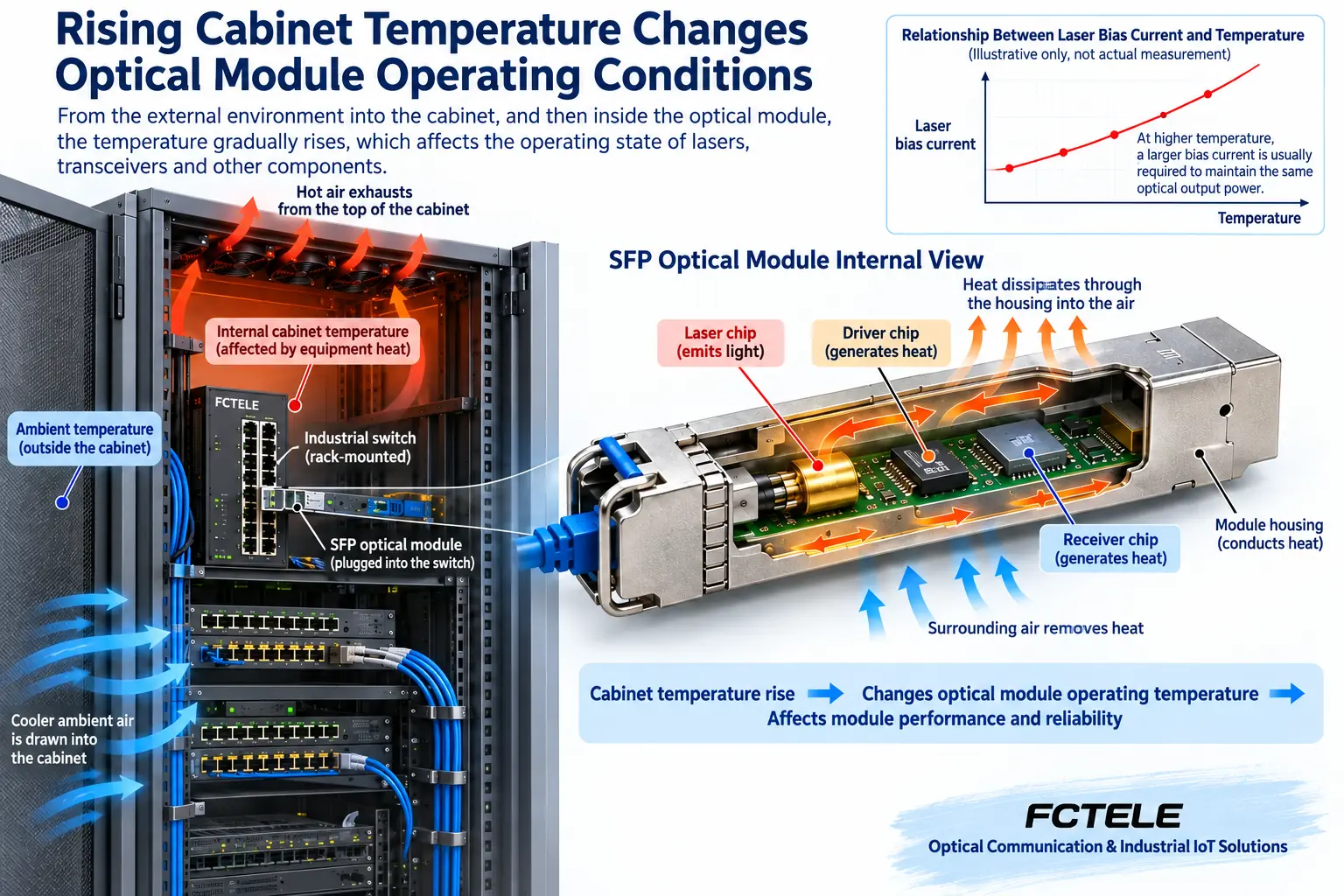
Suppose the equipment is installed in an outdoor cabinet. The temperature shown in the weather forecast is only the outside condition. Sunlight, power supplies inside the cabinet, and equipment heat can make the air inside the cabinet hotter, and the module itself also generates heat. So the outside temperature, the air temperature inside the cabinet, and the temperature inside the module are not the same number. If selection only checks the local minimum and maximum air temperatures, it may miss the thermal conditions at the actual installation location.
The operating temperature in a manufacturer’s specification may also refer to different measurement locations, such as ambient temperature or case temperature. When purchasing, confirm the definition and the supporting conditions. Do not treat the common range of one type of module as an industry-wide promise. The allowed storage temperature is also not the same as the temperature allowed for powered operation. System evaluation should consider low-temperature startup, continuous service operation, cabinet temperature rise, and possible condensation at the same time.
2. Why heat affects optical communication
The laser, driver, and receiver circuits inside an optical module all have operating conditions. Temperature changes affect device characteristics, such as laser output and receiver circuit noise; some modules adjust the operating point through control circuits, but the adjustment capability has limits. The fact that a module can work normally within the allowed range does not mean temperature changes have no effect on it, nor does it mean any heat dissipation condition is acceptable.
Heat is first conducted through structures and materials, and then carried away by surrounding air and other paths. The host slot, module enclosure contact, and airflow all affect this process. A fanless host also needs heat dissipation space; relying on natural convection or structural heat conduction does not mean it generates no heat. Do not seal openings with tape, and do not completely wrap the device to keep out dust. For specific installation spacing and cabinet design, follow the manufacturer’s instructions.
3. “Industrial grade” must be broken down into verifiable conditions
“Industrial grade” cannot replace a parameter list. Operating temperature, humidity conditions, electromagnetic compatibility, mechanical environment, and power supply adaptability should each be checked in the corresponding documents. A certain certification addresses a certain type of regulatory or test requirement; it does not prove that all functions have been verified. For example, FCC-related compliance cannot be used to prove that a module interoperates with any host, and vibration test results cannot replace optical link bit error testing.
Effective documents should correspond to a specific model, hardware version, test conditions, and scope of application. If only a wide-temperature slogan appears, without stating the measurement location, load, test duration, or judgment method, the buyer will find it difficult to judge whether it meets the project. Do not fill in unknown parameters with common numbers just to complete a form, and do not extend one module’s report to an entire product line.
4. First make the host and module a correct pair
First clarify what package and rate the host’s optical port supports. SFP and SFP+ are similar in appearance, so you cannot assume they are interchangeable for that reason; host software, module identification, and the manufacturer’s support list may also affect use. When selecting, record the host’s complete model and version, and give the module you plan to use to the supplier for confirmation. No matter how suitable the cabinet environment is, a module not supported by the host cannot be solved by “industrial grade.”
If the host supports digital diagnostic monitoring, you can use module temperature, voltage, and optical power data to observe trends. However, whether these functions are supported and how alarm thresholds are defined are also determined by the model. Diagnostic functions help provide clues; they are not a third-party calibration certificate. Which external measurements are needed in formal acceptance should be determined according to project risk and test requirements.
5. The optical paths at both ends still need to be paired item by item
An industrial environment does not change the basic transmit-receive relationship. The transmit end of a dual-fiber module must be connected to the receive end at the other end; a single-fiber bidirectional module must have a complementary wavelength relationship. Both ends must also check fiber type, service rate, connectors, and optical power conditions. The nominal distance is only a capability statement under specific conditions; it does not guarantee that a project with multiple splices, dirty end faces, or a high-loss line will necessarily reach it.
The optical power budget can be understood as how much light the transmit end can provide, how much the line will lose, and how much the receive end needs. But when calculating, you must use the guaranteed parameters of the corresponding model, not treat typical values as worst-case values. The receive end also has a maximum input limit, so even for a very short distance, confirm whether overload is possible. Whether to use an attenuator and the specific value should be determined according to the optical path and module parameters.
6. Why temperature testing still needs to carry service traffic
Putting a module in a temperature chamber and finding that it “did not break” and having it continuously transmit correct data during temperature changes are conclusions at different levels. More valuable verification records the test conditions, host and module combination, service load, link status, error statistics, and related optical data. Whether high-low temperature cycling or constant temperature operation is needed, and how long it should be maintained, should be specified by the product specification or project test plan.
The test must have traceable records, not just a photo of the equipment inside the chamber. The definition of bit errors or error statistics must also be clear: whether it is a cumulative count, an increment per unit time, or an error ratio; the three cannot be mixed. If the test finds no errors, it only means that no corresponding problem was found under the recorded conditions and time; it does not guarantee permanent zero failure. Operations involving temperature control, power supplies, and test instruments should be performed by qualified personnel.

7. Put Feichang Technology host features back into specific models
The four-electrical-port two-optical-port industrial switch product on the Feichang Technology official website lists gigabit electrical ports, SFP optical ports, dual power supply, and a fanless design. These structures can facilitate optical path configuration and adapt to the corresponding installation scenario, but the SFP slot supporting module replacement does not mean that any module meets the host’s environmental capability. The temperature range marked on the host page applies only to the product conditions it explicitly describes, and the module used with it still needs to be checked separately.
When choosing this kind of host, you can ask the supplier to provide the compatibility description for the host and module combination, the optical path budget, and the on-site acceptance method together. Dual power supply helps design the power supply path, but it does not automatically constitute a completely independent redundant system; in practice, you also need to look at the upstream power supply and wiring. Writing the features and usage conditions together clearly is more helpful for project implementation than emphasizing “industrial grade,” “wide temperature,” or “reliable” alone.
8. How to write a procurement checklist that can be accepted
The checklist should at least include the host model and version, the module’s complete model, package and rate, single or dual fiber, wavelength pairing, fiber type, and interface. In the environmental part, clearly write the measurement location and actual working conditions; in the evidence part, list the required reports, traceability information, and support commitments. After delivery, confirm the link and service with the actual combination, not just count quantities or look at lights. Unknown conditions should be left as items to be confirmed, not replaced by slogans.
Reference materials:Cisco 10GBASE SFP+ optical module specification materials;Feichang Technology four-electrical-port two-optical-port industrial switch details. The illustrations are general mechanism diagrams; parameters and curves cannot be used as measured or certification evidence.
Translated from the Chinese technical article. Source first published: 2020-07-06. Source last revised: 2026-10-13T18:44:52+08:00. Read the Chinese source
