


For industrial switch procurement, first write down the business, site, and maintenance requirements clearly, then compare candidate models under the same set of conditions. Brand awareness, number of features, and lowest unit price cannot independently prove suitability for a project. This article establishes an evaluation method from requirements to evidence, trials, and delivery, replacing outdated brand rankings in the old article; it does not provide unverified market rankings.
First, let procurement and users describe the same problem
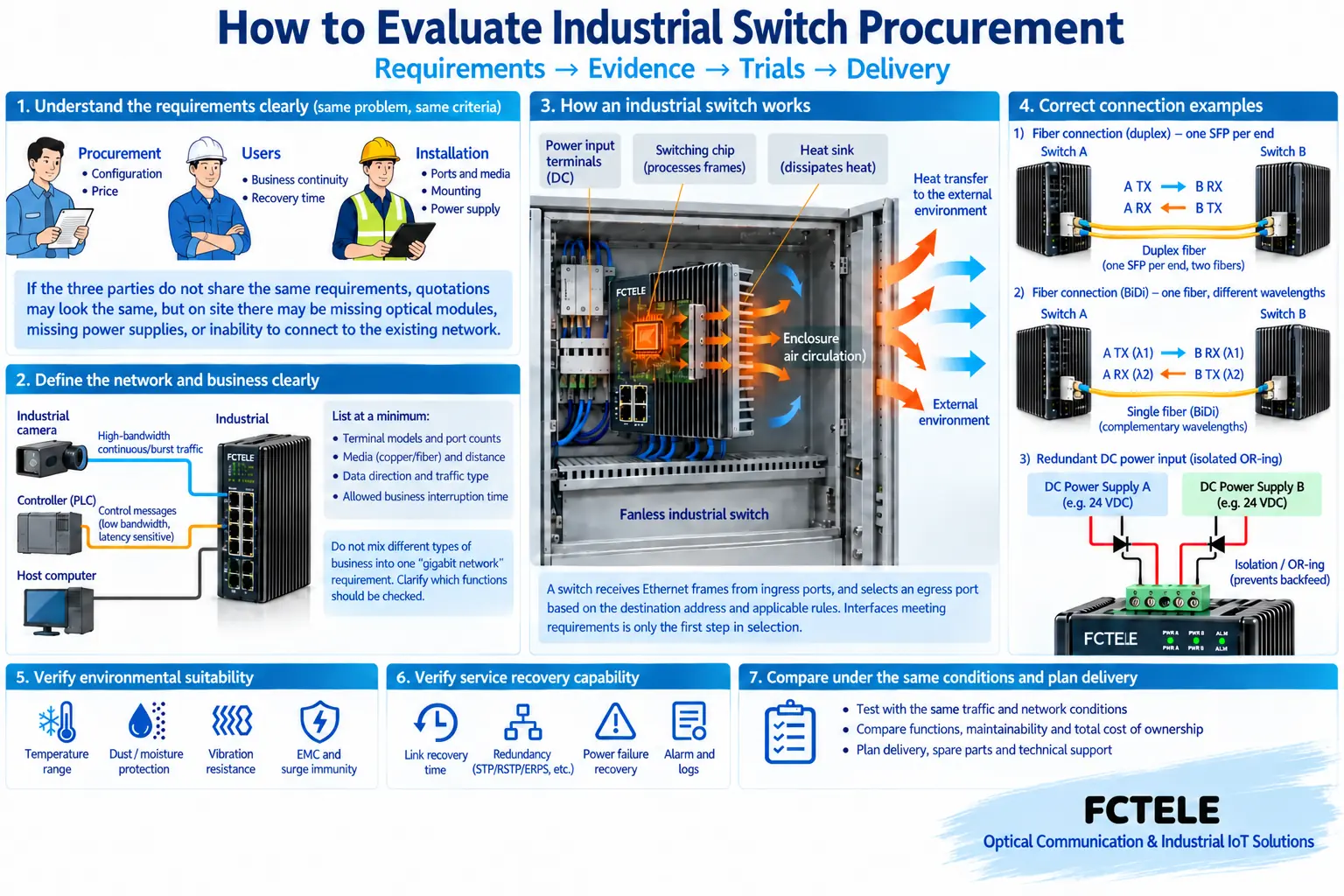
Procurement staff care about configuration and price, users care about business continuity, and installation staff care about ports, mounting, and power. If the three parties do not share the same requirements, quotations may look the same, but on site there may be missing optical modules, missing power supplies, or inability to connect to the existing network. First list terminal models, port counts, media, distance, data direction, and allowed business interruption, then discuss which vendor to choose.
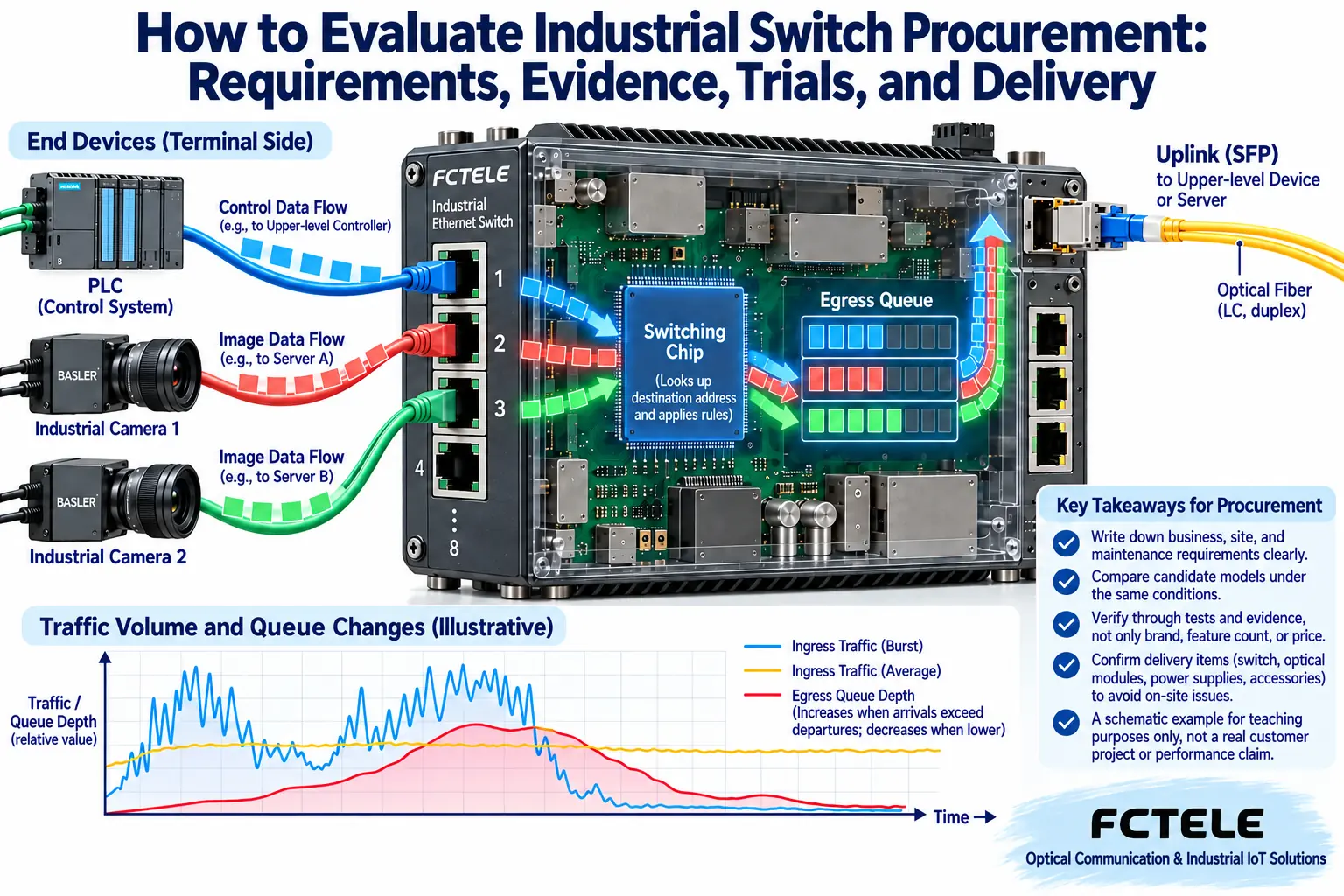
For example, a production line has a controller, an industrial camera, and a host computer. Control messages may not take much bandwidth, but they may be sensitive to latency and recovery; the camera’s continuous and burst traffic may make the aggregation uplink busy. Mixing the two types of business into one “gigabit network” requirement cannot explain which functions should be checked. The hypothetical case only helps organize thinking and cannot be treated as an existing customer project or product performance evidence.
Interfaces meeting requirements is only the first step in selection
A switch receives Ethernet frames from ingress ports, and selects an egress port based on the destination address and applicable rules. A frame can be understood as a piece of data with an address, but it should not be treated as a complete application-layer message. When multiple ingress ports send to the same egress port, frames that the egress port cannot send in time may enter a queue for temporary storage; queue capacity is limited, and if the egress capacity is continuously exceeded, frames may be dropped. Fast chip processing cannot turn one gigabit egress port into twice the rate.
Therefore, the requirements table must not only count ports but also draw traffic flows. Calculate the load to servers, recorders, and other areas separately, distinguishing continuous rate, bursts, and protocol overhead. Switching capacity, packet forwarding rate, and egress rate are different metrics, and the largest number among them cannot be taken as a guarantee for the entire business. To understand the calculations, you can read Capacity and packet forwarding rate explanation.
A feature name must correspond to a practical use
VLAN divides a Layer 2 network into different logical scopes to help organize business, but it is not a complete firewall. QoS arranges traffic handling priorities but cannot increase the physical egress bandwidth. Port mirroring is used to copy specified traffic to an observation port and is not the same as link aggregation; link aggregation also cannot guarantee that a single connection will use all member bandwidth. First explain the phenomenon to be solved, then check the features and limitations.
When multicast is needed, confirm that the terminals actually send multicast and how queries, membership maintenance, and forwarding work together in the network. When crossing subnets is needed, check routing and access policies, and do not mistake a Layer 2 device that can set a management address for a Layer 3 switch. Ordinary unmanaged devices can serve clear basic connections; complex management requirements demand corresponding model capabilities, rather than assuming that because “industrial” is in the name, all protocols are automatically supported.
Judge reliability from installation conditions and test scope
First record the temperature inside the cabinet, heat sources, ventilation, condensation risk, vibration, dust, and power source. A fanless design reduces one maintenance component, but heat still must be transferred from components through the enclosure to the environment. Operating temperature, storage temperature, enclosure protection, and electromagnetic immunity answer different questions; one passing item cannot replace another. Optical modules and power supplies should also be within the scope of checking, not just the switch itself.
Ask the supplier for documentation corresponding to the specific model, version, and configuration. Reports should show the sample, ports, test conditions, and criteria, not just a picture of a certification mark. Actual installation may change heat dissipation and protection conditions, and the project party also bears responsibility for cabinet, grounding, and cabling design. When hazardous electrical work and immunity testing are involved, it should be handled by qualified personnel; temporary high-voltage wiring must not be used to verify promotional numbers.
Redundancy cannot be judged by a single recovery time
Backup links, dual power supplies, and backup servers cover different failures. If two power feeds come from the same failure-prone source, a common risk remains; if the backup fiber follows the same route as the primary, both may be damaged at the same time. Ring connections require an applicable mechanism to control forwarding and must not be closed arbitrarily. The supplier should explain the supported protocols, conditions for working with existing equipment, and configuration requirements.
During acceptance, first define the start and end points of recovery. Port LED recovery, network forwarding again, and the application receiving valid data may not happen at the same time. According to the approved plan, simulate a specific failure on an isolated test network or during a maintenance window, and record port events, packets, application reconnection, and stability after recovery. A single result covers only that condition and cannot be extended to claim zero packet loss for all topologies, loads, and failures.
Quotation comparison should fix configuration and responsibility boundaries
Give candidate suppliers the same requirements and ask them to answer item by item whether it is included as standard, requires an option, is not supported, or is still to be confirmed. List equipment quantities, optical module pairing, power supplies, mounting parts, firmware, commissioning, transportation, and service. Fixed optical ports versus pluggable interfaces, a single unit versus a complete set, and with or without accessories cannot be directly ranked by total price alone.
At the same time, check delivery lead time, spare parts, warranty, repair process, and technical support scope. Whether configuration can be exported, how replacement equipment is restored, and how discontinued models are migrated are more verifiable than an abstract “good service.” Specific costs and validity periods should come from a written quotation. The old article’s company size, founding time, or rankings are not technical suitability evidence for the current project.
Turn product information into questions that can be asked
The managed Layer 3 switch described on Feichang Technology’s Chinese product page 3422 lists VLAN, port statistics, system logs, configuration import and export, and multiple ring network protocols, which can be used to check management, observation, and backup requirements. These capabilities serve only as an information entry point for the corresponding product; they do not prove that all Feichang Technology models are the same, nor do they mean the model is suitable for every small control cabinet.
If a public page shows inconsistent parameter units or configuration descriptions, ask the supplier for written clarification, and do not pick a larger number and rewrite it as a conclusion. The confirmed model, hardware version, modules, and firmware should be written into the order and acceptance records. The manufacturer provides capability descriptions, the installer implements cabling and installation, and the user confirms business criteria; the responsibilities of the three should correspond.
The evaluation result should explain why the choice was made
First set must-meet conditions, then compare the maintenance cost, expansion, and service of those that comply. If a must-meet condition is not satisfied, do not make up for it with scores from other items. Record which document or test each piece of evidence comes from and what remains to be confirmed; scoring helps discussion and does not package artificial weights as a scientific ranking.
After the trial is completed, keep the topology, port table, configuration, versions, and business test records. Re-evaluate after adding terminals, changing optical modules, or changing site installation. A procurement decision formed this way can be reviewed by maintenance personnel and can also distinguish capacity, connection, configuration, and environmental problems in later failures, avoiding having only a model and price without traceable technical basis.
References: the above public details of Feichang Technology products; for performance comparison methods, refer to RFC 2544. RFC is a testing method reference, not equipment certification. The two principle diagrams are generic illustrations, not actual products or measurements.
Translated from the Chinese technical article. Source first published: 2020-03-09. Source last revised: 2026-10-13T18:52:49+08:00. Read the Chinese source
